TailVille
1. Overview
On a winter dawn on the Cheorwon plain, just south of Korea's Demilitarized Zone, tall white birds with black necks and scarlet crowns stand on one leg in an unfrozen stream. As the sun rises they lift off with bugling calls and glide towards snow-covered rice fields. These are red-crowned cranes, the emblem of winter along the DMZ.
Standing about 1.5 metres tall and weighing up to around 10 kilograms, the red-crowned crane is one of the heaviest cranes in the world. Its plumage is snowy white, with black on the neck and the inner flight feathers, and a patch of bare red skin on the crown, which gives the species its English name and its old Chinese name, the cinnabar-crowned crane.
The mainland population breeds in wetlands of the Russian Far East and north-east China and winters on the Korean Peninsula and the east coast of China. A separate population lives year-round in eastern Hokkaido, Japan. Korea is a vital wintering ground, especially the Cheorwon, Yeoncheon and Paju areas near the DMZ and the tidal flats of Ganghwa Island.
Across East Asia the crane has long symbolised longevity, nobility and faithful marriage. It adorns paintings, poems, dances and official robes, and it appears on Korea's 500-won coin. Yet only a few thousand remain. The IUCN lists the species as Vulnerable, and in Korea it is a Natural Monument and a Class I endangered species.
2. Name and classification
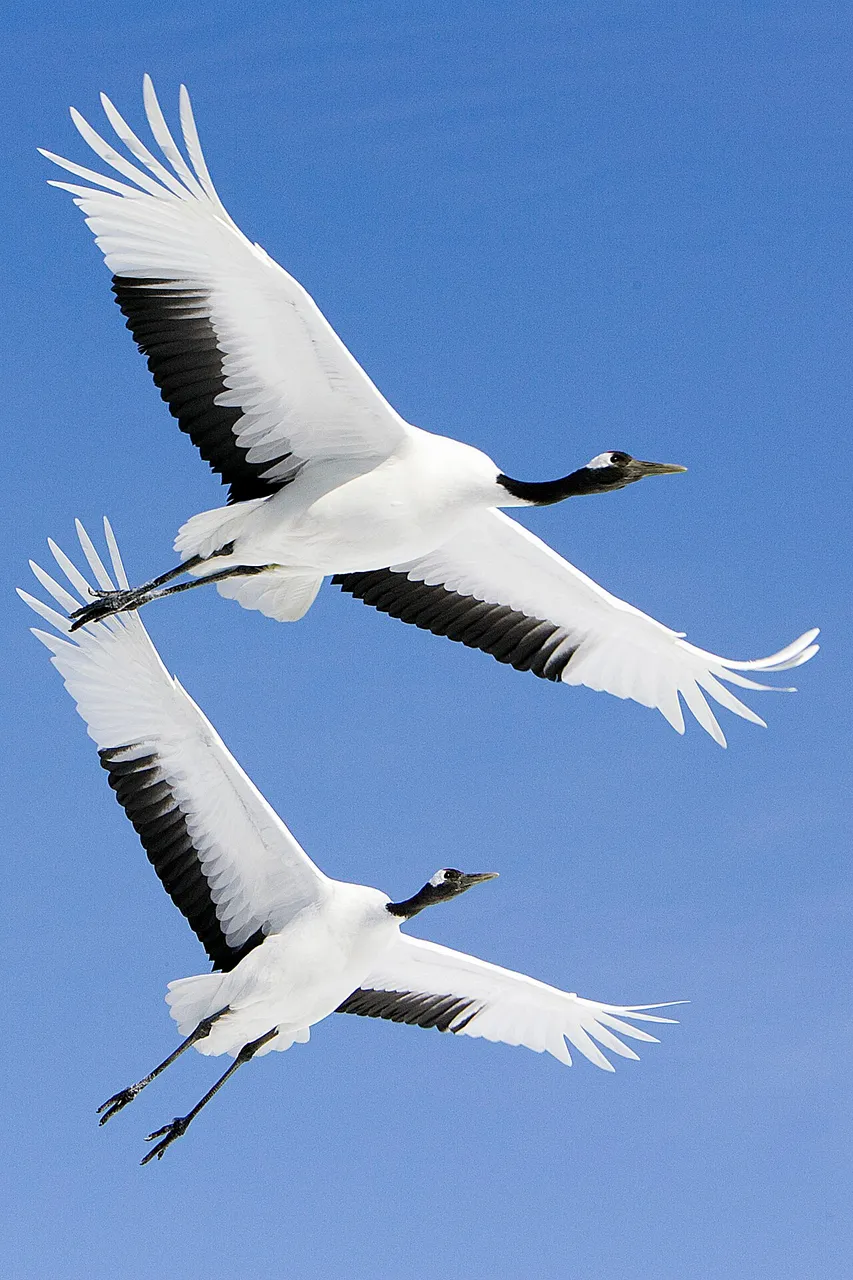
Spaceaero2 · CC BY-SA 3.0
The scientific name is Grus japonensis: Grus is Latin for crane, and japonensis means of Japan, because nineteenth-century Western naturalists first described it from Japanese specimens, though most of the population lives on the mainland. Older English names include Japanese crane and Manchurian crane.
The Korean name, durumi, is widely thought to imitate the bird's rolling, far-carrying call. The Sino-Korean word hak refers to the same bird, and almost every crane in old Korean art is this species. People often call any large white bird a hak, but egrets, herons and storks belong to completely different families. A handy field rule: herons and egrets fly with their necks folded in an S, while cranes and storks fly with necks outstretched.
No subspecies are recognised, though genetic studies show differences between the mainland and Hokkaido populations, which have long been largely isolated.
Several crane species visit Korea:
| Species | Scientific name | Status in Korea |
|---|---|---|
| Red-crowned crane | Grus japonensis | Winters at Cheorwon, Yeoncheon, Paju, Ganghwa |
| White-naped crane | Antigone vipio | Winters at Cheorwon, the Han estuary, Junam; grey with red eye-patch |
| Hooded crane | Grus monacha | Winters or passes through at Suncheon Bay, Cheonsu Bay; dark grey |
| Siberian crane | Leucogeranus leucogeranus | Very rare vagrant |
| Common crane | Grus grus | Scarce winter visitor |
3. Evolution
Cranes are an ancient family. Crane-like fossils have been reported from Eocene deposits tens of millions of years old, and forms close to modern Grus appear by the Miocene. Cranes belong to the order Gruiformes alongside rails, coots and their relatives.
There are fifteen living crane species. The red-crowned crane sits in the genus Grus with the common crane, hooded crane, black-necked crane and whooping crane. Genetic studies show it is especially close to the whooping crane of North America; both are white with red crown skin. Their common ancestors probably moved between Asia and North America across the Bering land bridge, though estimates of when they diverged vary.
The crane's adaptation to the wetlands of East Asia was likely shaped by ice-age cycles, with breeding grounds pushed south during glacial periods and expanding north again as the climate warmed.
4. Range and habitat
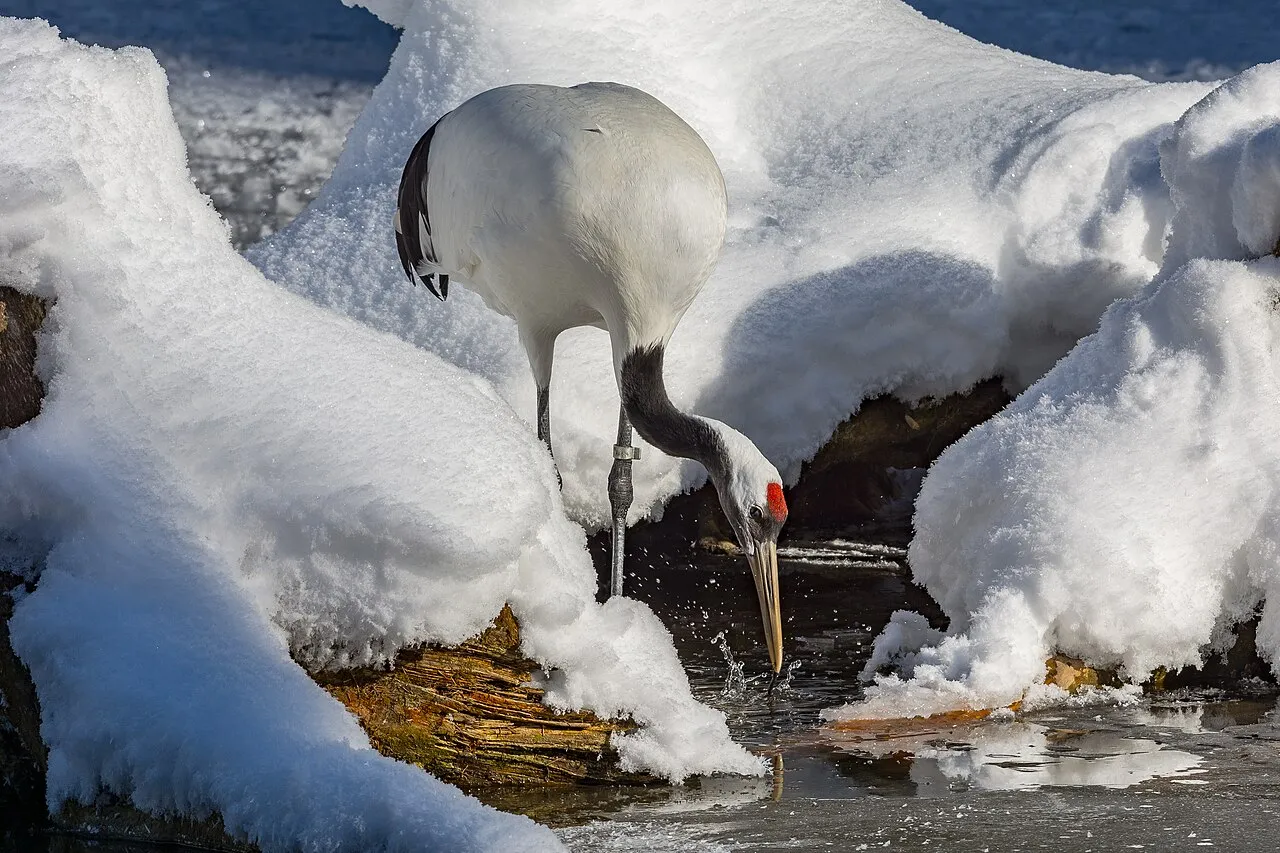
Isiwal · CC BY-SA 4.0
The red-crowned crane has two populations.
The mainland population breeds in the vast wetlands of the Amur and Ussuri basins in the Russian Far East, Heilongjiang and Jilin in north-east China, eastern Inner Mongolia and eastern Mongolia. China's Zhalong wetland is a famous breeding site. In autumn these birds migrate south to winter along Korea's DMZ and west coast and in coastal wetlands such as Yancheng in Jiangsu, China.
The Hokkaido population lives year-round in and around the Kushiro Marsh in eastern Hokkaido, surviving the winter with the help of artificial feeding and unfrozen rivers.
Breeding habitat is extensive, shallow wetland with tall reeds and sedges, where nests can be hidden and disturbance is low. In winter, harvested rice fields, estuarine mudflats and unfrozen streams are essential. At night cranes roost standing in shallow water, where foxes and other predators cannot easily approach.
In Korea, the Cheorwon plain is the single most important wintering site. The DMZ and the civilian control zone keep disturbance low, and the plain combines broad rice fields with spring-fed streams that stay ice-free even in deep winter. Cranes also winter along the Imjin River in Yeoncheon, the Imjin and Han estuary near Paju, and on Ganghwa Island and its tidal flats. Historical records show they once wintered more widely, including in wetlands and coastal areas of what is now North Korea.
5. Body
The red-crowned crane is among the largest and heaviest cranes. Males are slightly bigger than females, but the sexes look alike.
| Measure | Value |
|---|---|
| Height | about 150–158 cm |
| Length | about 140 cm |
| Wingspan | about 2.2–2.5 m |
| Weight | about 7–10 kg, large males over 10 kg |
| Bill length | about 15–17 cm |
The body is pure white. The face and neck are black, with a white band running from behind the eye down the nape. When the bird stands with wings folded, black plumes droop over its rump, giving the impression of a black tail. These are actually the tertial feathers of the inner wing; in flight, the black forms a band along the trailing edge.
The red crown is bare skin, not feathers, and it swells and brightens when the bird is excited or agitated. Juveniles have a brown-feathered crown and brownish mottling on the body. The long legs are dark grey, and the toes are long but barely webbed.
5.1. A built-in trumpet
The secret of the crane's far-carrying voice lies inside its chest. Its trachea is extremely long and coils into the keel of the breastbone, reaching about a metre and a half in adults. Like the tubing of a brass instrument, this resonates to produce loud, low calls that carry for kilometres. In juveniles the coil is not yet fully developed, so their calls are high and thin.
6. Behaviour and ecology
Cranes are active by day, and winter routines are remarkably regular. At dawn they wake at their roost in a stream or shallow river, preen, and with sunrise fly in family groups to nearby rice fields. They spend the day gleaning fallen grain, roots and small animals, then return to the roost at dusk.
The basic unit of crane society is the family: a pair and their one or two young of the year travel and feed together. On the wintering grounds families gather into larger flocks but still stick together, and at Cheorwon it is common to see a brownish juvenile walking between its two parents.
In the breeding season pairs defend large territories, sometimes several square kilometres depending on the wetland.
Mainland birds are migratory. They begin arriving in Korea around October, numbers build through November, and they depart for the breeding grounds between late February and early March. On migration they climb on thermals and travel in lines or V-formations, calling to keep in touch. Satellite tracking has followed cranes from Korean wintering sites to breeding grounds in north-east China and Russia hundreds to over a thousand kilometres away.
7. Diet and feeding
Red-crowned cranes are omnivores, and their diet changes markedly with the seasons.
In spring and summer on the breeding grounds they take mainly animal food:
- Small fish such as loaches and crucian carp
- Frogs and tadpoles
- Crabs, shrimp and freshwater snails
- Aquatic insects and larvae
- Voles, and occasionally eggs or chicks of other birds
In winter, plant food dominates:
- Waste rice left in harvested paddies
- Corn, soybeans and other grain
- Roots, tubers and shoots
- Fish, worms and shellfish in shallow rivers and tidal flats
Cranes probe and dig with their long bills and stalk slowly through shallows, striking fast at fish and frogs. At Cheorwon in winter they pick through stubble for fallen grain; on Ganghwa's mudflats they dig among the saltmarsh plants.
Modern combine harvesters chop straw finely, and much straw is now baled for cattle feed, so less grain remains in the fields. In Cheorwon and elsewhere, farmers, local governments and conservation groups now leave straw and grain in the paddies and provide supplementary food through the winter.
8. Reproduction and life cycle
Red-crowned cranes usually pair for life, which is why they became East Asian symbols of marital fidelity. Dancing and duetting help form and maintain the bond.
On arrival at the breeding grounds in spring, a pair builds a nest deep in a reedbed: a broad, flat platform of reeds and dry grasses that can exceed a metre across, surrounded by water that deters foxes and raccoon dogs.
The usual clutch is two eggs, incubated by both parents for about 29 to 34 days. Within a day or two of hatching, the chicks leave the nest and follow their parents, who feed them. Often only one chick survives, because the older sibling attacks the younger or food runs short, so most families seen in winter have a single youngster.
| Stage | Timing | Notes |
|---|---|---|
| Egg | about 29–34 days | Reed nest, shared incubation |
| Chick | 1–2 days after hatching | Brown down, leaves nest with parents |
| Juvenile | about 3 months | First flight at around 95 days |
| First migration | Autumn | Flies south with parents |
| Independence | Following spring | Separates from parents on return north |
| Immature | 1–3 years | Flocks with other young birds |
| First breeding | Usually 3–4 years or later | Pairs and claims a territory |
Young cranes migrate with their parents in their first autumn, learning routes, wintering sites and feeding areas. The following spring, as the parents prepare to breed again, the young are sent on their way.
Cranes are long-lived: wild birds are known to exceed 30 years, and captive individuals have lived considerably longer. That longevity helps explain the East Asian image of the crane as a bird that lives a thousand years, though of course none does.
9. Intelligence, communication, special abilities
Red-crowned cranes are famous dancers. They bow, leap into the air with wings half open, toss sticks and grass with their bills and spin in circles. Dancing peaks in the breeding season but happens all year; even in midwinter at Cheorwon, pairs can be seen leaping face to face. Beyond courtship, dancing is thought to strengthen pair bonds, release tension and help young birds learn social skills, and it can be contagious, spreading through a flock.
The unison call is another signature. A pair stands side by side, heads thrown back, and performs a precisely coordinated duet: the male lifts his wings and gives long, low calls while the female answers with shorter, higher notes, typically two for each of his. The duet reaffirms the pair bond and advertises territory, and on a still day it carries for kilometres.
Cranes have excellent memories, returning along the same routes to the same wintering grounds, feeding fields and roosts year after year. They also read human behaviour well: farm machinery and passing cars barely bother them, but a person stepping out of a vehicle quickly puts them on alert.
10. Predators and survival
Adult cranes, being large with a formidable bill and feet, have few predators. On the breeding grounds, however, eggs and chicks are vulnerable to foxes, raccoon dogs, wolves, crows and large raptors. A nest surrounded by water is well protected, but in droughts, when marshes dry, losses climb sharply. Parents confront intruders with spread wings and loud calls, or feign injury to draw them away.
In winter, roosting in shallow water is a key defence against foxes and feral dogs. If the water freezes, predators can walk out across the ice, so unfrozen streams are vital; this is why Cheorwon's cranes gather at particular spring-fed shallows.
Today the gravest threats are human-related: collisions with power lines and pylons, poisoning by pesticides and baits, diseases such as avian influenza, and above all the loss of wetlands on both breeding and wintering grounds. With their large bodies and long wings, cranes find it hard to avoid wires, and power-line strikes are a significant cause of death around wintering sites.
11. Relationship with humans
Cranes have held a special place in East Asian culture for millennia. In China, Korea and Japan the crane was the mount of immortals, a bird that lived a thousand years, and an emblem of the scholar's lofty spirit.
In Joseon-dynasty Korea, cranes were embroidered on the rank badges worn on the chest and back of civil officials' robes: senior officials wore a pair of cranes, junior ones a single crane, while military officials wore tigers. The crane is also one of the ten symbols of longevity, the sipjangsaeng, painted on screens and ceramics and embroidered on textiles. One of the most celebrated Goryeo celadons, a maebyeong vase inlaid with cranes and clouds, shows cranes flying among clouds.
Crane dances survive too. Busan's Dongnae Crane Dance, said to have been created by scholars imitating cranes at play, is a designated intangible cultural heritage of Busan, and Korean court dance includes a crane dance performed in costume.
The modern era brought hardship. Hunting and wetland reclamation in the first half of the twentieth century caused steep declines across the peninsula and the mainland, and the Korean War and rapid industrialisation destroyed many more wetlands. Paradoxically, the DMZ and civilian control zone left by the war became a refuge, and the Cheorwon plain grew into one of the world's most important crane wintering grounds.
Today Cheorwon farmers leave straw in the fields, local authorities flood paddies to create roosts, and supplementary feeding continues through the winter. Birdwatching programmes and visitor facilities support eco-tourism. Protecting the crane has become a story that ties together farming, tourism and conservation along the inter-Korean border.
12. Conservation
The red-crowned crane was long listed as Endangered by the IUCN; a 2021 reassessment moved it to Vulnerable, reflecting in particular the strong recovery of the Hokkaido population. It remains one of the world's rarest cranes.
The global population is usually estimated at roughly 3,000 to 4,000 birds, though figures vary with survey methods and years. The Hokkaido population fell to a few dozen birds in the 1920s but, thanks to winter feeding and wetland protection, now numbers well over a thousand. The mainland population, by contrast, is thought to be declining or stagnant as breeding wetlands disappear. Winter counts on the Korean Peninsula are typically somewhere around 1,000 to 2,000 birds, with a large share at Cheorwon, though counts differ between surveys.
Main threats:
- Drainage and conversion of breeding wetlands in north-east China and Russia, dams, drought and fire
- Development of wintering areas, loss of rice fields and farming changes that leave less waste grain
- Collisions with power lines and pylons
- Disease, including avian influenza, made riskier by dense winter concentrations
- Poisoning and poaching
- Potential effects of development plans in the inter-Korean border region
In Korea the species is a Natural Monument and a Class I endangered species under the Wildlife Protection and Management Act, and parts of the Cheorwon plain and other areas are protected as crane wintering sites. Internationally it is on CITES Appendix I. Korea, China, Russia, Japan and Mongolia cooperate on surveys, satellite tracking and flyway conservation through the East Asian-Australasian Flyway Partnership. Migratory birds cross borders, and no single country can save them alone.
13. In zoos and recovery programmes
Red-crowned cranes are kept in zoos worldwide, and as an endangered species they are managed through coordinated breeding programmes that track bloodlines. Captive birds support research and education, and their dances and duets are popular with visitors.
Still, a bird that strides across vast marshes and migrates thousands of kilometres cannot express its full behaviour in a small enclosure. Pinioning to prevent flight is controversial on welfare grounds, and cranes can become aggressive towards keepers in the breeding season.
In Korea, rescuing and rehabilitating injured wild cranes is as important as captive breeding. Birds hurt by power lines or poisoning have been treated at wildlife rescue centres, fitted with tracking devices and released, and some have been followed all the way to their breeding grounds. A crane can never be a private pet, and capturing or keeping one without a permit is a criminal offence.
14. In culture
Cranes are woven into East Asian art and everyday life. Korea's 500-won coin has carried a flying crane since it was first issued in 1982, so most Koreans handle one several times a day. Numerous local governments and organisations have also adopted the crane as their emblem.
In Korean painting, cranes are often paired with pine trees, both symbols of longevity. Real red-crowned cranes never perch in trees, yet painted cranes frequently sit in pines, perhaps through confusion with tree-nesting storks, or simply for the sake of symbolism.
In Japan the crane, tsuru, is a symbol of long life and good fortune. Folding a thousand paper cranes is said to grant a wish, and the story of Sadako Sasaki, a girl who developed leukaemia after the Hiroshima bombing and folded cranes in hospital, made the paper crane a worldwide symbol of peace. Folding paper cranes as gifts was once hugely popular in Korea too. Japan Airlines' famous logo shows a crane within a red circle.
In China the crane is the steed of Taoist immortals and an emblem of longevity, and in the Ming and Qing dynasties it marked the highest rank of civil official. Martial-arts films and novels feature crane-style stances.
Korean idioms include hak-su-go-dae, waiting with one's neck stretched out like a crane's, meaning to wait eagerly, and gun-gye-il-hak, one crane among a flock of chickens, for someone who stands out from the crowd.
15. Trivia
- Red-crowned cranes never perch in trees; their feet are not built to grip branches, so the classic crane-in-a-pine painting is artistic licence.
- Sleeping on one leg is thought to conserve body heat, and cranes switch legs from time to time.
- Some of Cheorwon's roosts are fed by groundwater that keeps them ice-free, and on cold mornings cranes wake amid rising mist.
- Red-crowned and white-naped cranes often winter side by side at Cheorwon; the white-naped is grey with a red patch around the eye.
- Hokkaido's cranes were thought extinct until a small group was rediscovered in the Kushiro Marsh in the 1920s; local winter feeding helped them rebound.
- With wingspans over two metres, a flock of cranes taking off seems to fill the sky with white.
- If a crane raises its head and stares, it has already noticed you. Stop, stay quiet and back away.
Wild animals are not pets. Catching, trading or keeping them is illegal in most places. If you find an injured wild animal, call your local wildlife rescue centre.
FAQ
Is 두루미 the same bird as 학?
Yes. 학 is the Sino-Korean word for the same bird, and the 'cranes' in old paintings are red-crowned cranes. Egrets and storks, often mistaken for them, are unrelated.
When and where can I see them in Korea?
Roughly late October to early March, mainly on the Cheorwon plain, with smaller groups along the Imjin River and Ganghwa tidal flats. Watch quietly from a distance or from a car so the birds are not flushed.
Why do they gather near the DMZ?
Restricted access means little disturbance, while the rice fields provide fallen grain and spring-fed streams stay unfrozen for night roosts. Farmers and local governments also leave straw and grain for them.
Photo credits
Photos are freely licensed images from Wikimedia Commons. Authors and licenses are listed below.
- Grus japonensis -Hokkaido, Japan -several-8 (1).jpg — Alastair Rae from London, United Kingdom · CC BY-SA 2.0
- Grus japonensis in flight at Akan International Crane Center.jpg — Spaceaero2 · CC BY-SA 3.0
- Grünau Manschurenkranich Grus japonensis-0835.jpg — Isiwal · CC BY-SA 4.0