TailVille
1. Overview
A horse-like head, an upright body, a tail that can grip, and males that become pregnant: seahorses hardly seem like fish at all. Yet they are bony fish that breathe through gills and swim with fins, and their closest relatives are pipefishes and seadragons.
'Seahorse' refers to the roughly 40-plus species of the genus Hippocampus. They range from pygmy seahorses smaller than a fingernail to species more than 30 centimetres tall, and they live in shallow tropical and temperate seas worldwide, clinging to seagrass, corals, mangrove roots and seaweed. Several species occur in Korean waters.
Seahorses are famously poor swimmers. They creep forward by fluttering a small dorsal fin and spend most of their time anchored by the tail. What they lack in speed they make up for in other skills: they can change colour to match their surroundings, move each eye independently and snap up prey with one of the fastest feeding strikes in the animal kingdom.
Today seahorses face heavy pressure from the traditional medicine trade, collection for aquariums and curios, bycatch in shrimp trawls and the loss of seagrass beds and reefs. The entire genus is listed on CITES Appendix II. Because this article covers the whole genus, its status is shown as 'Not Evaluated' (NE): the IUCN assesses individual species, not genera. Species-level categories are discussed under Conservation.
2. Name and classification
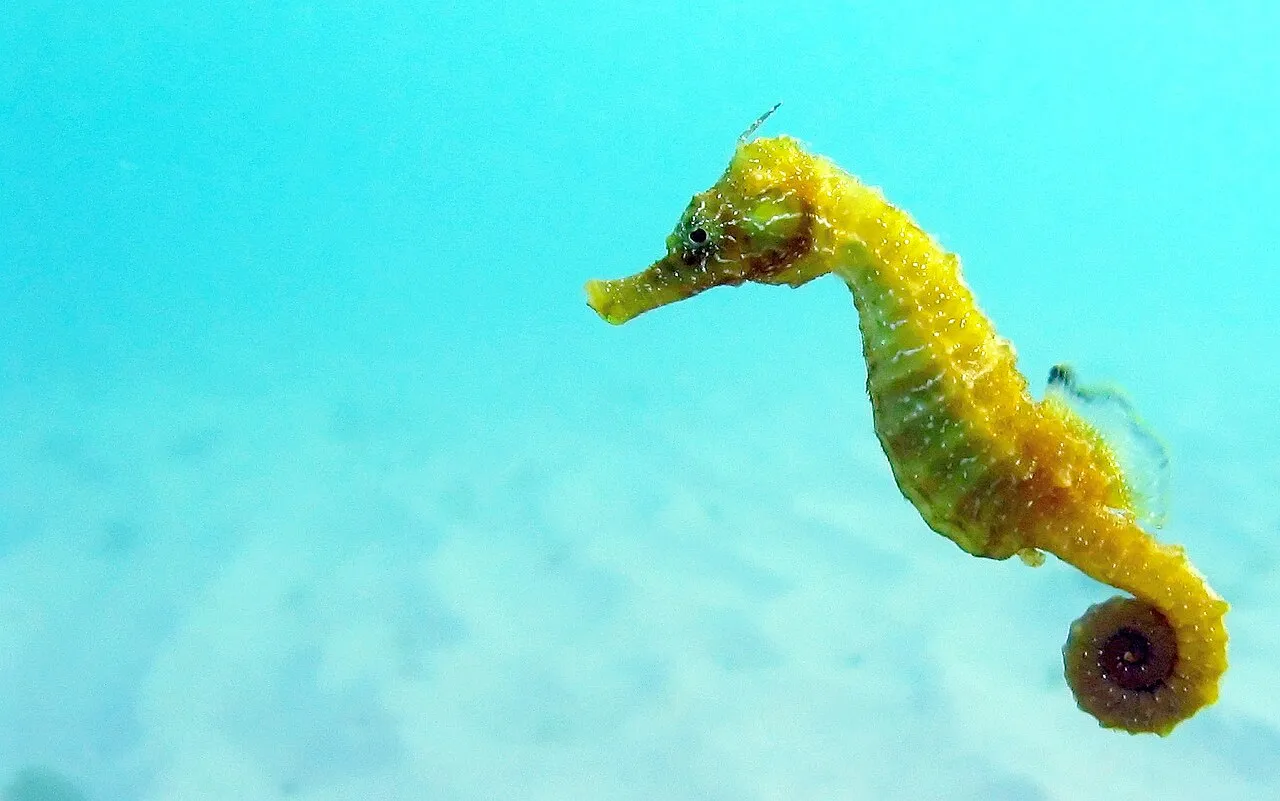
Florin DUMITRESCU · CC BY-SA 3.0
The genus name Hippocampus combines the Greek hippos, 'horse', and kampos, 'sea monster'. It comes from the hippocampus of Greek mythology, a creature with the front of a horse and the tail of a fish that pulled the chariot of the sea god Poseidon. The hippocampus in the human brain, a structure central to memory, was named for its resemblance to the fish.
In Korean, Chinese and Japanese, the seahorse is written with characters meaning 'sea horse'. Japanese also has the charming name tatsu-no-otoshigo, roughly 'the dragon's secret child'.
Seahorses belong to the family Syngnathidae, which also includes pipefishes, seadragons and pygmy pipehorses. All share a tube-shaped snout, a body encased in bony plates and male parental care.
The number of species is debated. Seahorses vary greatly in shape and colour depending on their environment, which has led taxonomists both to split single species and to lump distinct ones. Estimates of around 40 to 50 species are common, and new pygmy species are still being discovered.
| Species | Size | Notes |
|---|---|---|
| Pygmy seahorse (H. bargibanti) | About 2 cm | Lives on sea fans, with knobs mimicking its host |
| Denise's pygmy seahorse (H. denise) | About 1.5 to 2 cm | Among the smallest seahorses |
| Big-belly seahorse (H. abdominalis) | Up to about 35 cm | Australia and New Zealand; one of the largest |
| Thorny seahorse (H. histrix) | About 15 cm | Covered in spines |
| Spotted or yellow seahorse (H. kuda complex) | About 15 to 17 cm | Widespread Indo-Pacific; heavily traded |
| Dwarf seahorse (H. zosterae) | About 2.5 cm | Gulf of Mexico; often cited as the slowest fish |
| Korean seahorse (H. haema) | Around 10 cm | Korea and Japan; described as new in 2017 |
The seahorse living in Korean waters was long assigned to another species until a 2017 study described animals from Korea and Japan as new, naming them Hippocampus haema after the Korean word haema. Several other seahorse species have been recorded around Korea, though identifications differ between studies.
3. Evolution
Seahorses split from a pipefish-like ancestor. Molecular studies place the divergence of the seahorse lineage at roughly 25 million years ago, during the Oligocene. Their closest living relatives are the pygmy pipehorses, whose half-tilted bodies look like a living snapshot of the transition from pipefish to seahorse.
One leading explanation for the upright posture links it to the spread of seagrass meadows in warm, shallow seas around that time. A fish standing vertically among seagrass blades, anchored by its tail, blends in superbly. Studies also suggest the upright body improves the seahorse's ability to swing its head rapidly toward prey.
Seahorse fossils are rare. Among the oldest known are specimens from Slovenia dating to about 13 million years ago, which already look much like modern seahorses. Older fossils of pipehorse-like fish suggest the upright body evolved gradually.
A seahorse genome published in 2016 revealed several surprises: seahorses have lost some genes associated with tooth formation, and have lost a gene involved in pelvic fin development, consistent with their lack of pelvic fins. Families of genes linked to development of the male brood pouch appear to have expanded.
4. Range and habitat
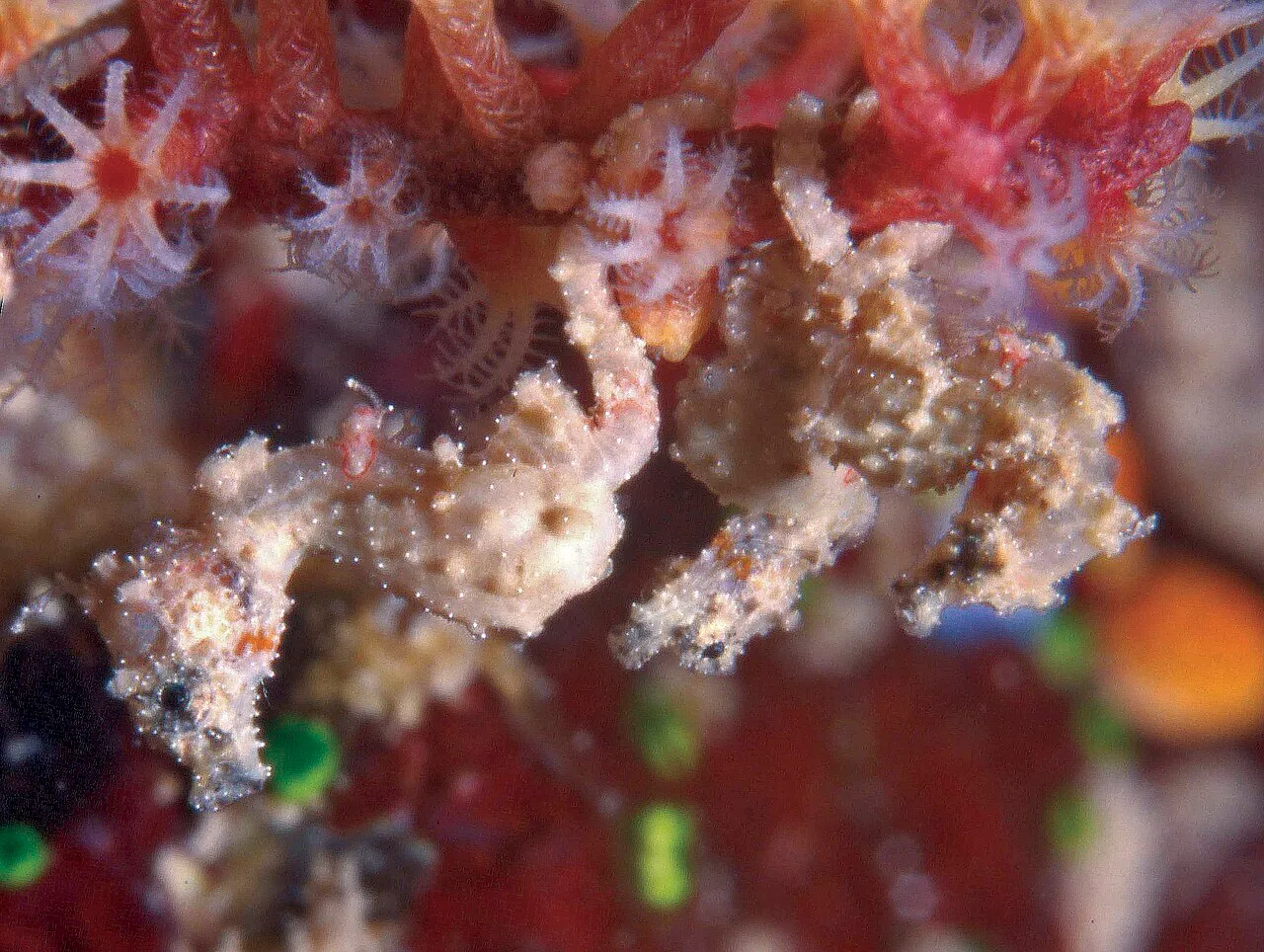
John Sear · CC BY 3.0
Seahorses live in shallow seas around the world, roughly between 50 degrees north and 50 degrees south. Diversity peaks in the Indo-West Pacific, including Indonesia, the Philippines and northern Australia. The Atlantic has fewer species, but seahorses do occur along the coasts of Britain and Europe.
Most live in coastal water about 1 to 30 metres deep, in habitats such as:
- Seagrass meadows, where many species grip eelgrass blades with their tails. The Korean seahorse is often found in eelgrass beds.
- Coral reefs and sea fans; a pygmy seahorse may spend its entire adult life on a single sea fan colony.
- Mangrove roots and estuaries, for species tolerant of changing salinity.
- Kelp and seaweed beds on rocky temperate coasts.
- Artificial structures such as pier pilings, nets and ropes.
Seahorses have tiny home ranges. Many stay within a few square metres to a few hundred square metres and may cling to the same holdfast for days, so destroyed habitat is hard to replace. On the other hand, they can be carried long distances clinging to drifting seaweed after storms, and this 'rafting' is thought to explain how seahorses spread across oceans.
In Korea seahorses are found in eelgrass beds and seaweed forests along the south coast, around Jeju and in the southern East Sea, habitats that are shrinking because of land reclamation and seagrass loss.
5. Body
Instead of scales, a seahorse is armoured with bony plates beneath the skin, arranged in a series of rings. The armour makes it hard for predators to swallow, but it also prevents the body from flexing the way most swimming fish do.
| Feature | Details |
|---|---|
| Head | Set at nearly a right angle to the body, topped by a crown-like coronet |
| Snout | Long, toothless tube that works like a drinking straw |
| Eyes | Move independently, looking in two directions at once |
| Fins | One dorsal fin for propulsion, pectoral fins for steering; no pelvic or tail fin |
| Tail | Prehensile, able to grasp objects |
| Brood pouch | On the male's belly |
The tail has attracted special interest. Most animal tails are round in cross-section, but a seahorse's is nearly square. Research published around 2015 found that this square architecture resists twisting, interlocks rather than breaking when crushed and improves grip, ideas engineers have explored for robotic arms and protective gear.
Seahorses are masters of colour change, adjusting pigment cells to match seagrass or coral, and some species grow skin filaments that mimic algae. Colour also shifts during courtship and under stress. The shape of the coronet varies between individuals and can be used, like a fingerprint, for identification.
Seahorses have no stomach. Food passes through the gut quickly, so they need to eat almost constantly to absorb enough nutrients. Males are distinguished by the brood pouch, and in some species the sexes also differ in colour or snout length.
6. Behaviour and ecology
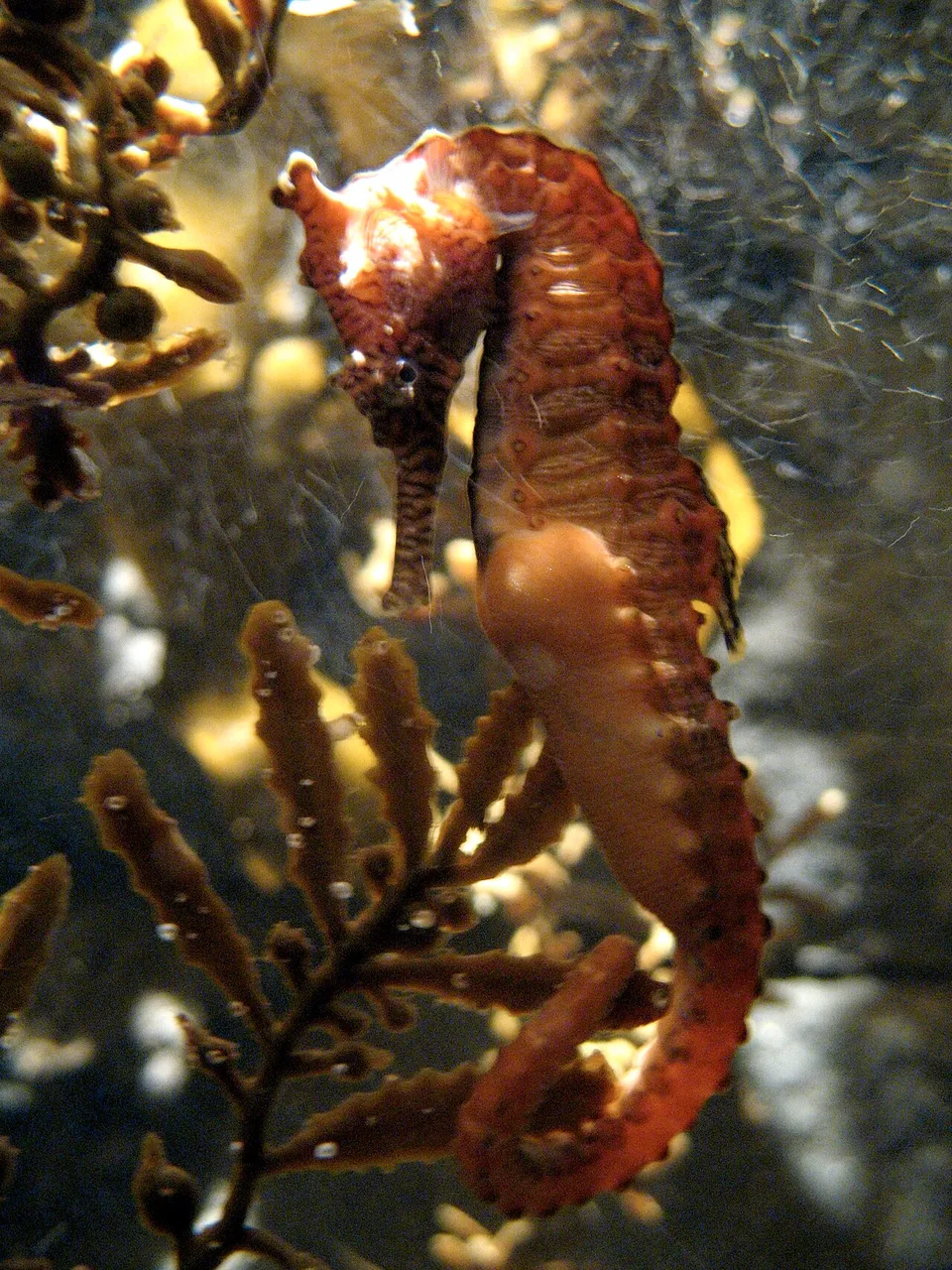
Denise Chan (denn) from Hong Kong, China · CC BY-SA 2.0
Seahorses are among the slowest swimmers of all fish. Holding themselves upright, they fan the dorsal fin around 30 to 70 times a second and steer with small pectoral fins behind the head. The dwarf seahorse of the Gulf of Mexico is often cited as the slowest fish, managing only about 1.5 metres per hour. Seahorses therefore avoid strong currents and spend most of their time anchored by the tail, waiting in ambush.
They adjust buoyancy with a swim bladder, changing the amount of gas to rise or sink slowly. Swim bladder problems leave a seahorse unable to control its position, which can be fatal.
Many species are active by day and rest at night with the tail wrapped around a holdfast. In some species, paired males and females keep separate home ranges: the male stays within a patch of a square metre or so, while the female roams more widely.
The most endearing behaviour is the morning greeting. In some monogamous species, partners meet each morning for a few minutes, brightening their colours, circling each other and sometimes linking tails, before going their separate ways for the day. Researchers think the ritual reinforces the pair bond and keeps the partners' reproductive cycles in sync.
7. Diet and feeding
Seahorses are carnivorous ambush predators. They eat small live animals: copepods, amphipods, mysid shrimp, small shrimp, crustacean larvae and tiny fish fry. With no stomach and rapid digestion, they must feed many times a day; young seahorses have been observed eating thousands of plankton daily.
Their technique is called pivot feeding. When prey drifts close to the snout, the seahorse rotates its head upward in a sudden flick, bringing the snout tip to the prey while rapidly expanding the inside of the snout to suck in water and food. The strike is over in about a thousandth of a second, so to the human eye the prey simply vanishes. Elastic energy stored in tendons and muscles of the head, released like a spring, powers this speed.
Head shape helps seahorses sneak up on prey. A study published around 2013 found that the seahorse's head is shaped to create very little disturbance in front of it as it moves, so even copepods, which are highly sensitive to water movement, often fail to notice the approach. The strategy is slow and stealthy followed by explosively fast.
Independent eye movement lets a seahorse track prey with one eye while scanning for danger with the other. Because they hunt mainly by sight, murky water lowers their success.
8. Reproduction and life cycle
Seahorses are famous as the animals in which males become pregnant. Other syngnathids also have male parental care, but seahorses carry it furthest, brooding their young inside a fully enclosed pouch.
The process typically goes like this. A pair courts for several days, circling, changing colour and linking tails, sometimes in displays lasting hours. When ready, the two rise together through the water and the female inserts her ovipositor into the opening of the male's pouch, transferring her eggs. The male fertilises them inside.
The pouch is far more than a bag; it functions somewhat like a mammalian uterus. Its wall is richly supplied with blood vessels that deliver oxygen and remove waste, and the male gradually adjusts the fluid inside from body-like conditions toward the salinity of the surrounding sea, preparing the young for birth. Studies suggest he may also supply some nutrients such as fats and calcium, along with immune-related substances.
| Trait | Typical range |
|---|---|
| Pregnancy | About 2 to 4 weeks, depending on species and temperature |
| Brood size | Small species 5 to a few dozen; large species hundreds to over 1,000 |
| Size at birth | About 5 to 15 mm |
| Age at maturity | A few months to about a year |
| Lifespan in the wild | About 1 year for small species, roughly 3 to 5 for large ones |
At birth, the male flexes his body back and forth and contracts his pouch muscles, expelling the young in bursts that can continue for hours. The newborns are miniature seahorses, fully independent from the moment they emerge. In many species the male accepts a new clutch soon after giving birth, so he may be pregnant almost continuously through the breeding season.
Despite large broods, survival is very low; by some estimates only a few of every thousand young reach adulthood.
Why males carry the young is debated. One popular explanation is that it lets the female start producing the next batch of eggs right away, speeding up reproduction for the pair.
9. Special abilities
Small and slow they may be, but seahorses have several special talents:
- Independent eyes: like chameleons, they move each eye separately for a wide field of view.
- Camouflage: colour change and skin filaments let them disappear into their surroundings. Pygmy seahorses match the colour and knobbly texture of their host sea fans so perfectly that the first known specimens were reportedly discovered only after a sea fan was brought into a laboratory.
- Ultra-fast feeding: one of the quickest prey-capture strikes known in animals.
- Gripping tail: a square-sectioned tail that holds on tightly.
- Sound production: seahorses make clicking sounds by rubbing a ridge of the skull against the coronet. Clicks accompany feeding, courtship and stress, and some species also produce low growling sounds.
Research on seahorse cognition is limited, but recognising a partner and meeting daily in the same place for a greeting suggest an ability to identify and remember individuals. Seahorses also learn the layout of their small territories and return to favourite holdfasts.
10. Predators and survival
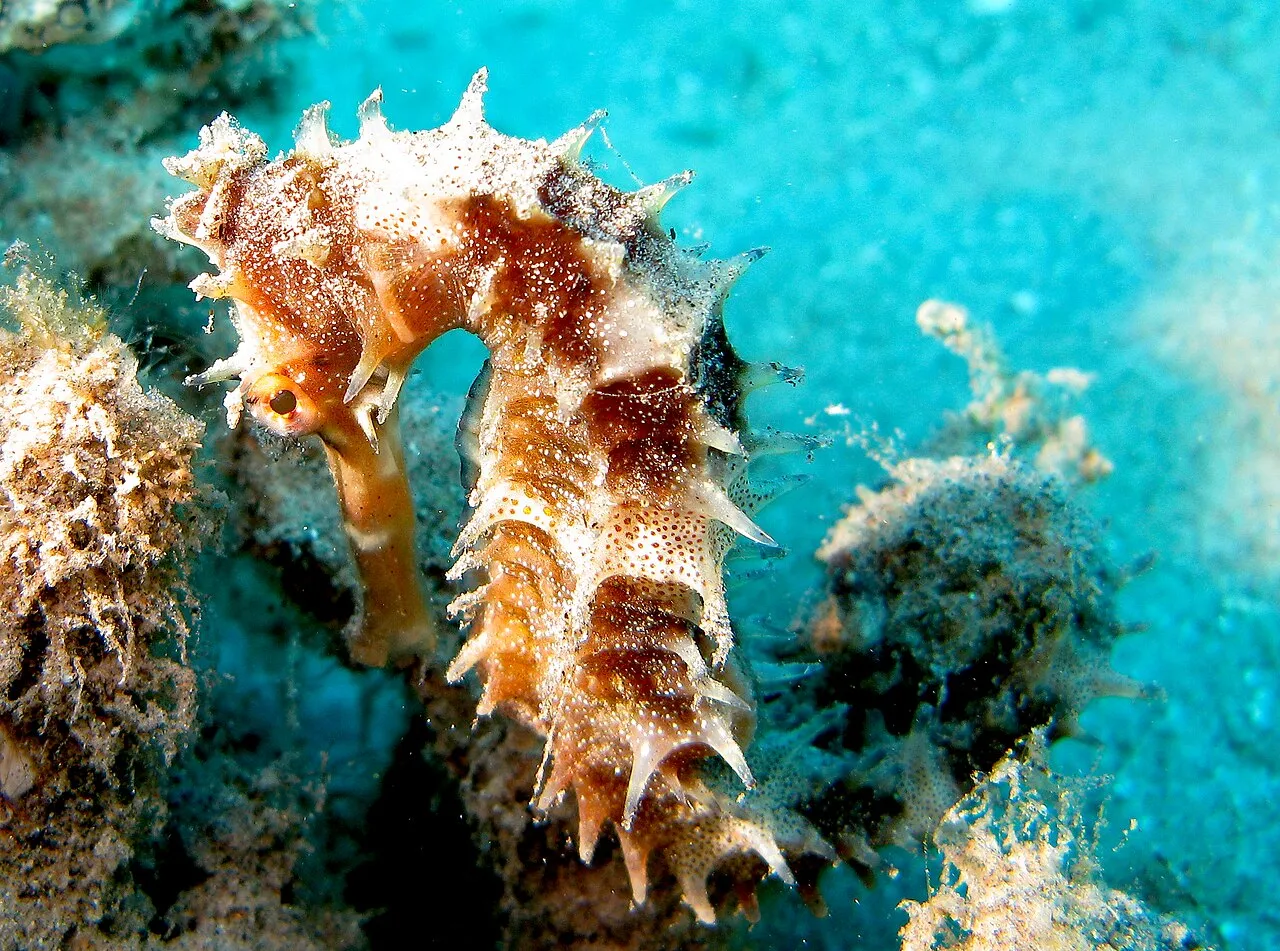
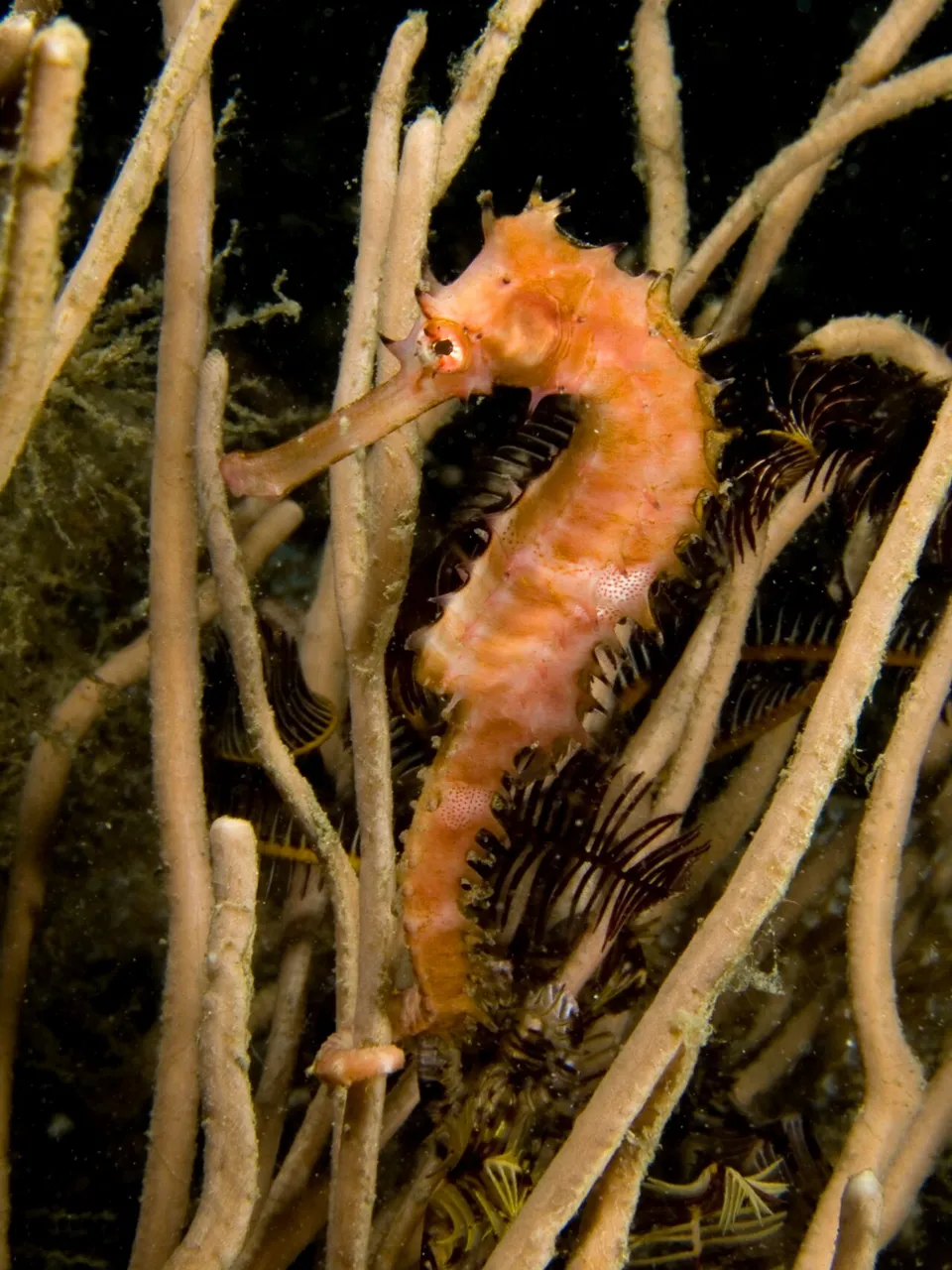
prilfish · CC BY 2.0
Adult seahorses are protected by their bony armour and camouflage, and comparatively few predators target them. Crabs, larger fish such as tuna, dorado and scorpionfish, rays, seabirds and turtles all eat them on occasion. Some researchers suggest seahorses are bony, low-reward prey that predators rarely seek out; they do turn up in the stomachs of large fish, but not often.
Newborns are another story. Only a few millimetres long, they drift like plankton for a time and are eaten by countless fish and jellies. Most die within their first weeks.
Habitat change is a bigger threat. Slow-moving animals with tiny home ranges cannot simply move when seagrass meadows vanish or reefs are damaged. After storms, seahorses are sometimes found washed up on beaches tangled in seaweed. Warming seas that shrink seagrass and reefs pose a long-term danger.
11. Relationship with humans
Seahorses have been used as medicine for centuries. In East Asian traditional medicine, dried seahorses are used as tonics and remedies for various complaints, and they remain one of the most heavily traded medicinal animals. Estimates of international trade run into the tens of millions of seahorses a year, mostly dried. Scientific evidence for their medicinal benefits is lacking.
Many dried seahorses are not targeted at all but come up as bycatch in shrimp trawls. Bottom trawling damages not only seahorses but the seagrass and seabed habitats they depend on, and the fact that bycaught seahorses can be sold keeps the trade going.
Live seahorses are traded for aquariums. Their unusual looks make them popular, but they are hard to keep: they need frequent live or carefully prepared food and are sensitive to water quality. Wild-caught seahorses often refuse artificial food and die. Captive-bred seahorses are increasingly available, but wild-caught animals are still traded, and dried seahorses are sold as souvenirs and key rings.
International trade requires CITES permits, and some countries ban collection or sale altogether. If you see a seahorse while diving or snorkelling, look but do not touch or handle it; seahorses are easily stressed.
Seahorses have also become cultural shorthand for the idea of fathers giving birth, and they often appear in conversations about parenting and gender roles.
12. Conservation
As noted above, the IUCN assesses species, not genera, so there is no single Red List category for 'seahorses'. That is why this article's profile shows NE. Species-level assessments vary widely:
- Many species are listed as Data Deficient; seahorses are small, cryptic and hard to identify, so population data are scarce.
- Several are Vulnerable, reportedly including heavily traded Indo-Pacific species such as the spotted seahorse complex and the thorny seahorse.
- A few are Endangered, such as the Knysna seahorse (H. capensis), confined to a few estuaries in South Africa, and White's seahorse (H. whitei) of eastern Australia.
- Some are Least Concern.
Categories change with reassessment, so check the current Red List for any particular species.
The whole genus was added to CITES Appendix II in 2002, with controls taking effect in 2004, the first time a commercially important group of marine fish was listed in its entirety. Exporting countries must determine that trade will not harm wild populations, and a minimum size of about 10 centimetres was recommended for traded animals. Illegal trade and smuggling remain widespread, raising doubts about how effective the controls are.
Main threats include:
- Catching for traditional medicine and curios
- Bycatch in shrimp trawls and other fisheries
- Collection for aquariums
- Destruction of seagrass, reefs and mangroves, and coastal development
- Pollution and climate change
Conservation work includes marine protected areas, seagrass restoration, trawl-free zones, citizen-science monitoring and improved captive breeding. In the United Kingdom, both native seahorse species are protected by law, and habitat projects are under way in many countries.
13. In aquariums
Seahorses are popular in public aquariums, and some facilities run dedicated galleries of seahorses and seadragons. Aquariums study seahorse reproduction, improve captive-breeding techniques and raise awareness, and some take part in breeding programmes aimed at restoring wild populations.
Keeping seahorses is demanding. They need live or frozen mysid shrimp several times a day, gentle water flow and plenty of structures to hold on to. Housed with fast-swimming fish they lose out at feeding time, and they are prone to bacterial infections and swim bladder disorders, so public aquariums usually give them dedicated tanks.
The ethical debate centres on the home aquarium trade. Wild-caught seahorses often fail to adapt and die, and collection can contribute to declines. Anyone set on keeping seahorses should choose captive-bred animals and acquire the knowledge and equipment first. Buying one on impulse because it looks exotic serves neither the animal nor the owner.
14. In culture
Seahorses take their name from the hippocampus of Greek and Roman myth, and have stirred imaginations since antiquity. Ancient Mediterranean mosaics, coins and fountain sculptures often show sea gods riding chariots drawn by horse-fish creatures; the Trevi Fountain in Rome features hippocampi.
In East Asia seahorses were linked to dragons, as the Japanese name 'the dragon's secret child' suggests, and their image as medicine was strong. Because the males give birth, seahorses were sometimes used as charms for safe childbirth and fertility.
In modern culture the seahorse is a symbol of the devoted father. It appears on Father's Day cards and parenting campaigns, and picture books such as Eric Carle's Mister Seahorse celebrate fathers who care for their young. In undersea animated films, seahorses often serve as messengers or mounts.
The brain's memory centre bears the seahorse's name too: a 16th-century Italian anatomist is credited with naming the hippocampus for its seahorse-like shape.
15. Trivia
- Seahorses have no tail fin; instead the tail works like a hand.
- The snout has no teeth, so prey is swallowed whole.
- Seahorses are essentially the only fish that swim upright.
- The Korean seahorse, Hippocampus haema, takes its species name from the Korean word for seahorse, a rare case of a Korean word in a scientific name.
- Pygmy seahorses are so small and so well camouflaged that divers often miss them even when looking straight at them, unless an experienced guide points them out.
- A pregnant male's belly swells visibly, and just before birth the pouch looks ready to burst.
- In some species females are more brightly coloured and take the lead in courtship, an apparent reversal of typical fish sex roles.
- The square tail inspired roboticists to build seahorse-tail-inspired robotic grippers.
Wild animals are not pets. Catching, trading or keeping them is illegal in most places. If you find an injured wild animal, call your local wildlife rescue centre.
FAQ
Why is the IUCN status 'Not Evaluated'?
The IUCN assesses species, not genera, so there is no single rating for all seahorses. Many species are Data Deficient, and several are Vulnerable or Endangered.
Do male seahorses really give birth?
Yes. The female deposits eggs into the male's pouch, and he broods them for about two to four weeks, supplying oxygen and some nutrients, before giving birth to fully formed young.
Are there seahorses in Korea?
Yes, in eelgrass beds and seaweed forests along the south coast and Jeju. The seahorse of Korea and Japan was described in 2017 as Hippocampus haema, named after the Korean word.
Photo credits
Photos are freely licensed images from Wikimedia Commons. Authors and licenses are listed below.
- Hippocampus hippocampus (on Ascophyllum nodosum).jpg — Hans Hillewaert · CC BY-SA 4.0
- Black Sea fauna Seahorse.JPG — Florin DUMITRESCU · CC BY-SA 3.0
- HSatomiaeJohnSear.jpg — John Sear · CC BY 3.0
- Hippocampus elongatus.jpg — Denise Chan (denn) from Hong Kong, China · CC BY-SA 2.0
- Hippocampus hystrix (Spiny seahorse).jpg — Nhobgood Nick Hobgood · CC BY-SA 3.0
- Hippocampus jayakari, Egipto.jpg — prilfish · CC BY 2.0