TailVille
1. Overview
With its impossibly large orange bill, the toco toucan is one of the most recognisable birds on Earth. It is the largest member of the toucan family, about 60 centimetres long, of which the bill accounts for close to 20 centimetres. Black plumage, a white throat, a ring of bright blue skin around the eye and that glowing bill have made it a universal symbol of the tropics, appearing in advertising, cartoons and souvenir shops worldwide.
Surprisingly, the toco is not mainly a rainforest bird. It prefers semi-open landscapes: the cerrado savannas of central Brazil, the vast Pantanal wetland, and gallery forests strung along rivers. That sets it apart from most other toucans, which live in dense forest.
The bill looks heavy and awkward, but it is mostly a light, foam-like structure, and research has shown that it doubles as a radiator, helping the bird shed excess body heat. The toco toucan plays a complex role in its ecosystems: it is an important disperser of seeds, planting the next generation of trees, and also an opportunistic predator of other birds' eggs and chicks.
2. Name and classification
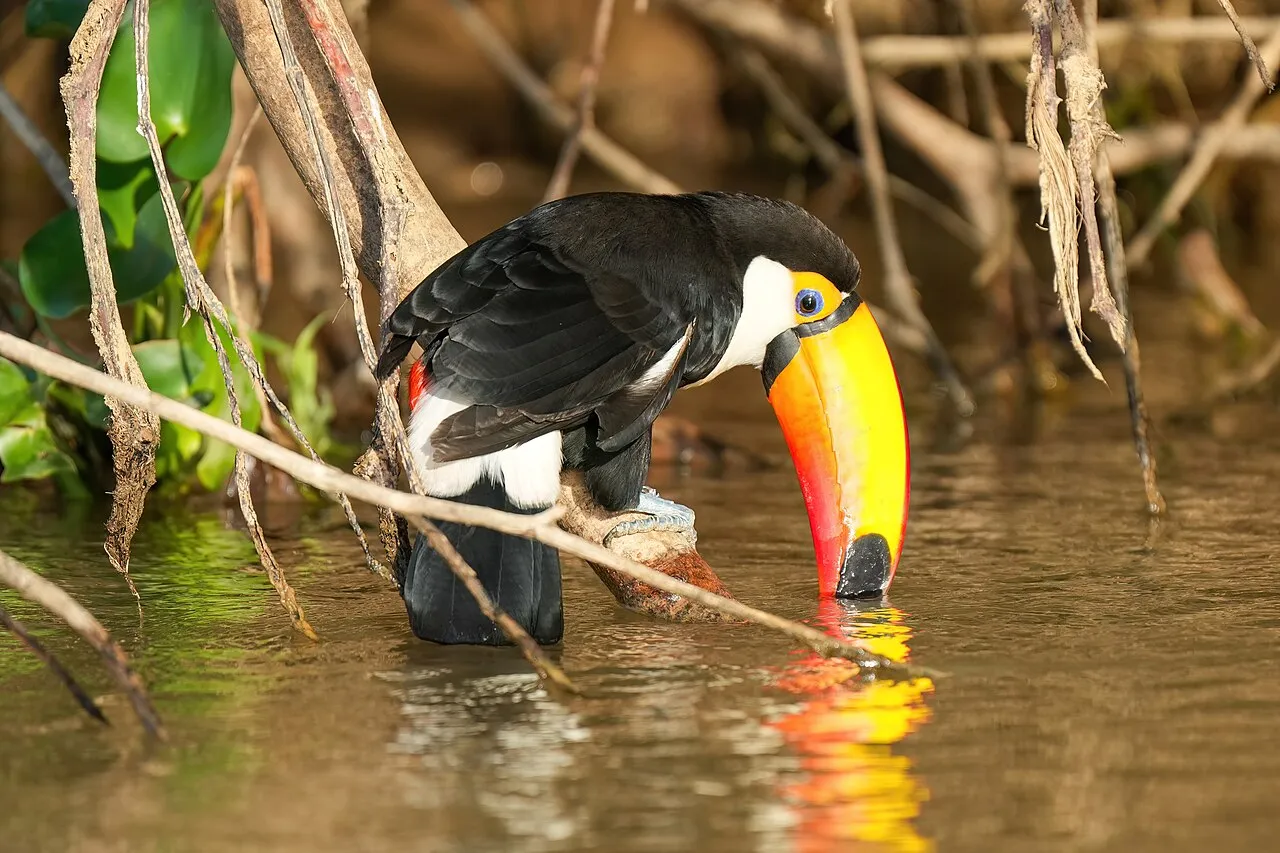
Giles Laurent · CC BY-SA 4.0
The toco toucan, Ramphastos toco, belongs to the toucan family Ramphastidae within the order Piciformes. Its order-mates include woodpeckers, barbets and honeyguides, so despite appearances toucans are distant cousins of woodpeckers. Like them, they have zygodactyl feet, with two toes pointing forward and two back.
The word 'toucan' comes from the Tupi language of Brazil, and the species name toco is also thought to have Tupi or Guarani roots, although sources differ on its precise meaning. Ramphastos comes from the Greek for beak.
Two subspecies are usually recognised: Ramphastos toco toco of the Guianas and the lower Amazon, and R. t. albogularis of central and southern Brazil, Bolivia, Paraguay and northern Argentina. They differ slightly in size and in the tone of the throat patch.
2.1. The toucan family
The toucan family contains around forty species, all in the American tropics from southern Mexico to northern Argentina. They fall into several groups: the large toucans of the genus Ramphastos, the slim, social aracaris, the small green toucanets and the mountain-toucans of the Andes.
| Group | Example | Notes |
|---|---|---|
| Large toucans | Toco toucan, keel-billed toucan | 40–65 cm, the biggest bills |
| Aracaris | Collared aracari | Slender, social, several roost in one cavity |
| Toucanets | Emerald toucanet | Small and green, montane forests |
| Mountain-toucans | Grey-breasted mountain-toucan | Andean cloud forest |
Toucans were once grouped with barbets; today they are usually treated as a separate family most closely related to the New World barbets.
3. Evolution
Toucans are thought to share a common ancestor with the New World barbets, splitting from them tens of millions of years ago and then diversifying across South America. Toucan fossils are extremely rare, so the timing relies mostly on molecular studies.
The large Ramphastos toucans appear to have diverged into several lineages during the Miocene and Pliocene. Rivers such as the Amazon and its major tributaries, together with the rising Andes, separated populations and produced similar but distinct species in different regions. Large toucans fall into two broad voice groups, the 'croakers' and the 'yelpers'; the toco belongs to the group with deep, croaking calls.
Why such an enormous bill? Many explanations have been proposed. Darwin suggested sexual selection, with bright bills attracting mates; others argued for reaching fruit at the tips of thin branches, intimidating other birds, or probing nest holes for eggs and chicks. The more recent discovery of the bill's role in shedding heat has strengthened the view that several advantages together drove its evolution rather than any single cause.
4. Range and habitat
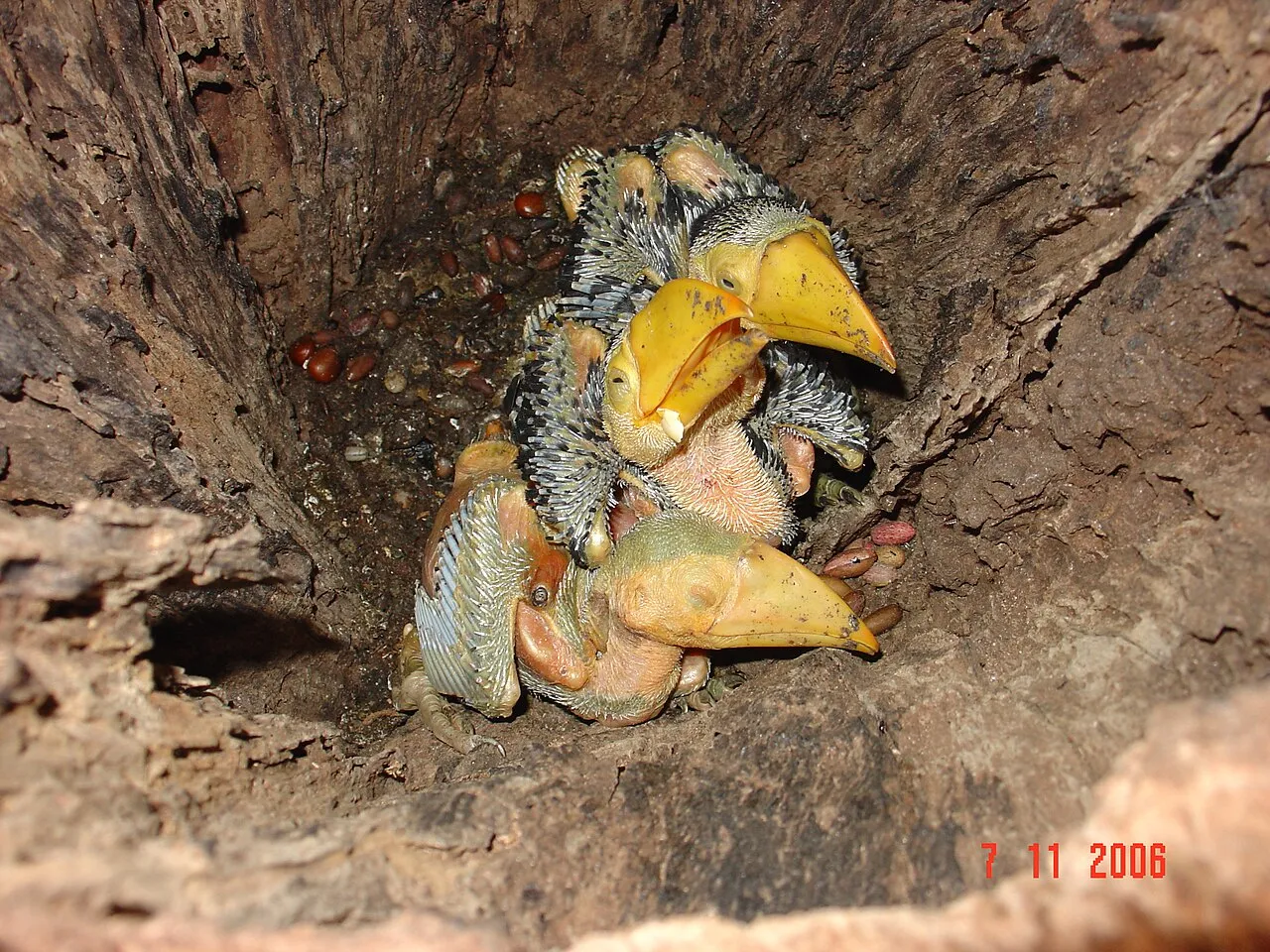
Carlos Eduardo B. Colucci · CC BY-SA 4.0
The toco toucan ranges across central and eastern South America. Brazil is the heart of its range, with populations extending north into the Guianas, west into eastern Bolivia and south-eastern Peru, and south into Paraguay and northern Argentina.
It favours semi-open woodland. The cerrado of central Brazil, a tropical savanna dotted with low, twisted trees, is a core habitat. In the Pantanal it is common in forest islands and riverside woods scattered among seasonally flooded grasslands. In Amazonia it mostly avoids the interior of closed forest, keeping to river edges, river islands and forest margins.
It tolerates human landscapes to a degree and can be seen around farm woodlots, orchards and even parks and gardens in Brazilian towns. It wanders seasonally in search of fruiting trees but does not undertake regular long-distance migrations.
5. Body
| Measurement | Typical value |
|---|---|
| Length | about 55–65 cm |
| Bill | about 16–23 cm, roughly a third of total length |
| Weight | about 500–860 g |
| Wings | short and rounded |
| Feet | zygodactyl, two toes forward and two back |
The plumage is mostly matt black with a white throat and upper breast and bright red undertail feathers. A patch of bare blue skin surrounds each eye, itself ringed with orange skin, and the iris is dark brown.
The bill is orange blended with yellow and red, with a large black spot at the tip and a black band at the base. Its edges are serrated, helping the bird grip and tear fruit. Structurally it is a thin shell of keratin over a foam of fine bony struts, which makes it remarkably light for its size; engineers have studied it as a model for strong, lightweight materials.
The tongue is long and narrow with a frayed, feather-like tip. The short wings make tocos weak long-distance fliers; they travel with a few strong flaps followed by a glide, producing an undulating flight path.
The sexes look alike, although males tend to be slightly larger with longer bills. Young birds have shorter, duller bills that lengthen and brighten with age.
6. Behaviour and ecology
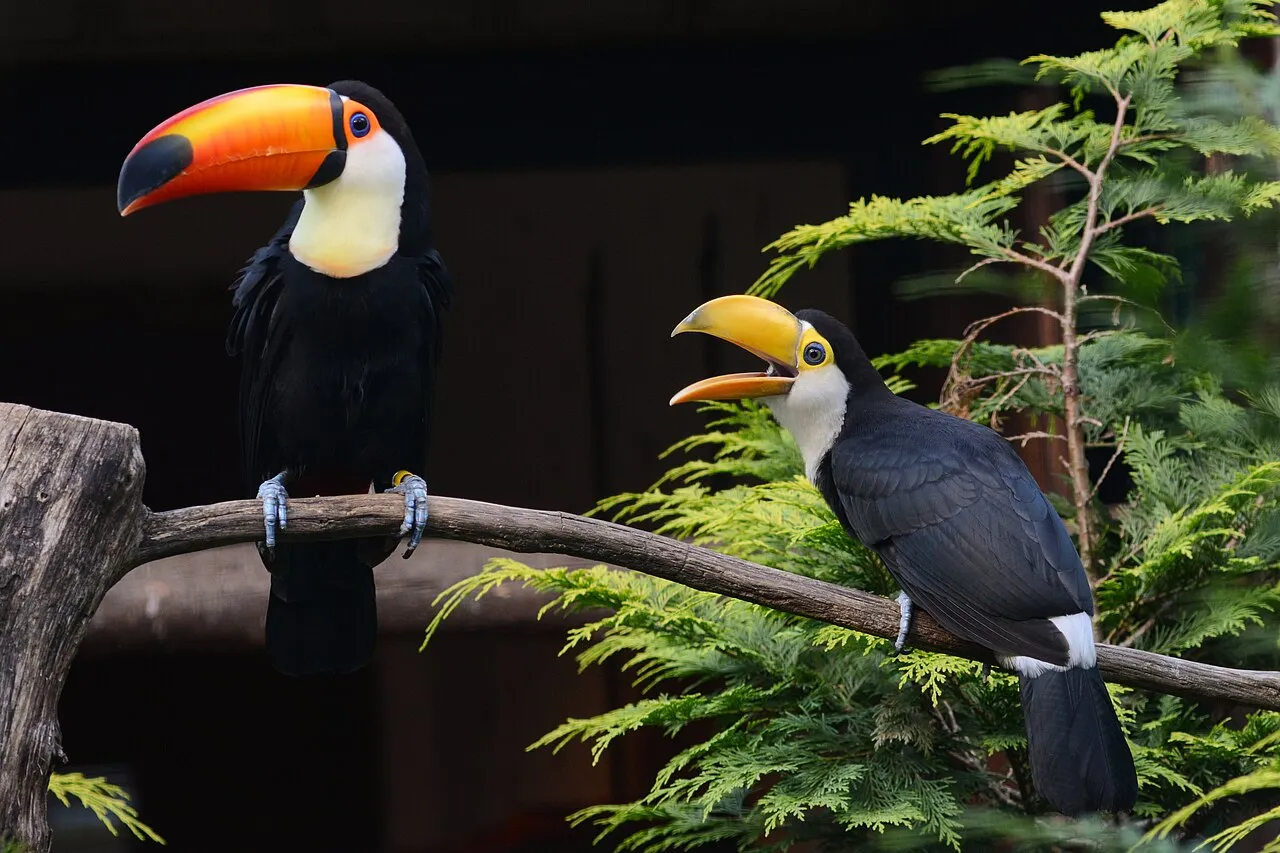
Toco toucans usually live in pairs or small family groups. Several groups may gather at a heavily fruiting tree, but they do not form large flocks. They are active by day, moving through treetops and along forest edges in search of food.
At night they roost in tree cavities or on branches in a distinctive posture: the head is turned back so the huge bill rests along the back, and the tail is folded up and forward, turning the bird into a compact feathered ball. This reduces heat loss through the bill and helps conserve warmth.
Toucans also use their bills socially. Pairs and group members have been seen fencing gently with their bills and tossing fruit to one another, behaviour thought to reinforce bonds or settle dominance.
The bill is a key thermoregulatory organ. When it is hot, the bird increases blood flow to the bill and dumps heat into the air; when it cools, blood flow is reduced to keep warmth in. Thermal cameras show the bill glowing brightly on warm days.
7. Diet and feeding
Toco toucans are primarily fruit-eaters, taking figs, palm fruits and the fruits of many tropical trees, and also flowers and nectar. The long bill lets them reach fruit at the tips of branches too thin to bear their weight.
Their feeding technique is distinctive. A toco seizes a fruit with the bill tip, then flicks its head back, tossing the morsel into the throat. Because the tongue cannot easily move food along such a long bill, this toss is the most efficient way to swallow. Larger fruits are held under a foot and broken into pieces.
Tocos are not strict vegetarians. They eat insects, spiders, small lizards and frogs, and in the breeding season they frequently raid other birds' nests for eggs and chicks. The long bill is ideal for probing nest cavities and hanging nests, which is why small birds often mob a toucan noisily when it appears.
8. Reproduction and life cycle
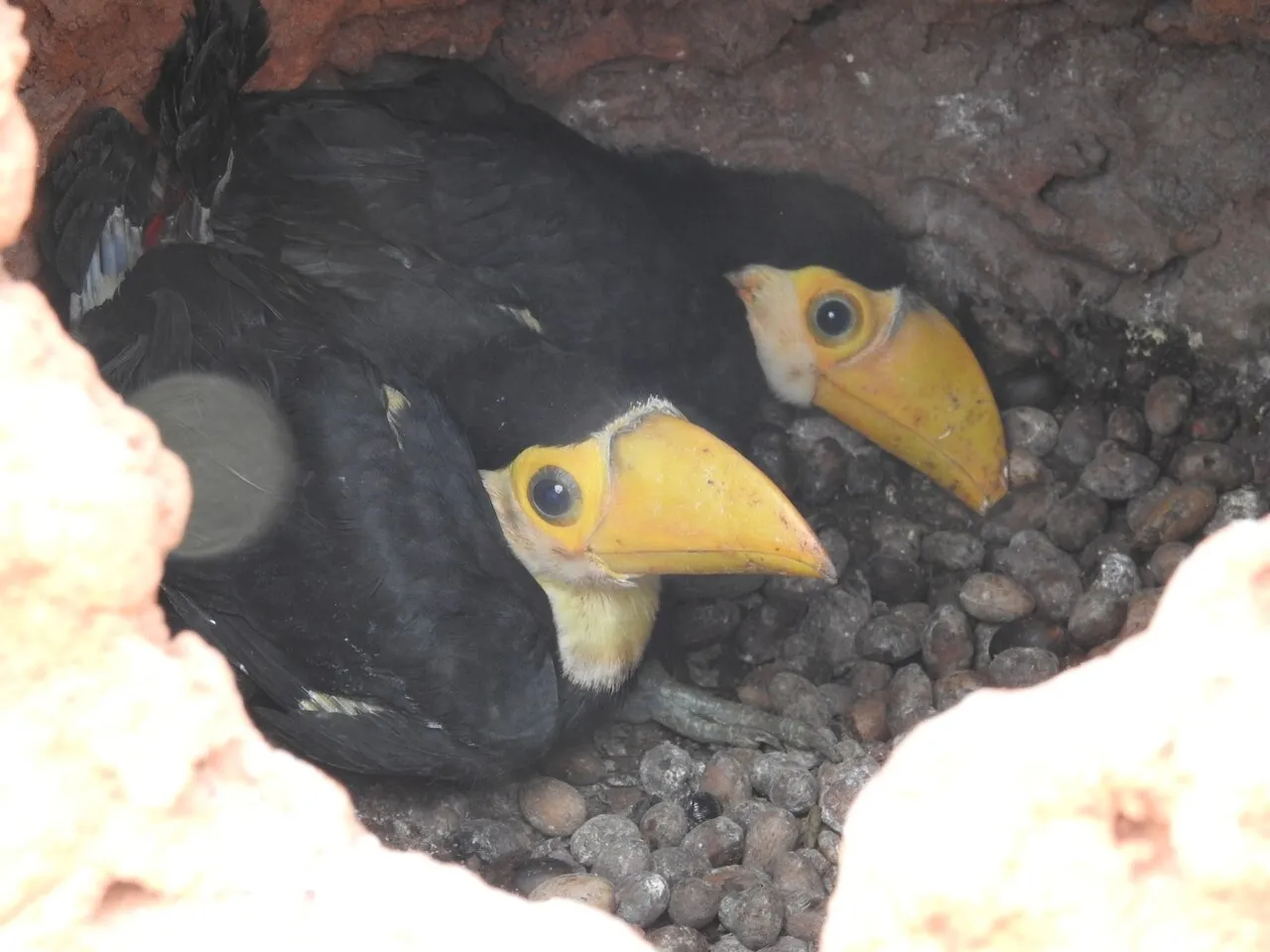
Josi Guimarães · CC BY 4.0
Toco toucans cannot excavate holes in sound wood. Instead they use cavities in rotting trees, old woodpecker holes, termite mounds or holes in earth banks, enlarging them as needed and often reusing the same site year after year.
Breeding timing varies with region but generally falls in the southern spring and early summer. The female lays two to four white eggs, and both parents share incubation. Chicks hatch naked and blind and have callused heel pads that help them sit on the cavity floor. Their bills start short and plain and lengthen quickly as they grow.
| Stage | Duration | Notes |
|---|---|---|
| Clutch | 2–4 eggs | laid on the floor of a cavity or termite mound |
| Incubation | about 17–18 days | shared by both parents |
| Nestlings | about 6–7 weeks | fed fruit and small animals |
| After fledging | several weeks | young follow parents and learn to forage |
| Maturity | around 2–3 years | adult bill colour and size reached |
Lifespan in the wild is poorly known. Captive birds have lived around twenty years, and wild lifespans are often estimated at somewhat less, perhaps fifteen to twenty years.
9. Intelligence, communication and special abilities
The toco's voice is far less glamorous than its looks: a deep, rasping croak repeated over and over, sometimes likened to a frog, along with bill-clattering. These sounds help group members keep in touch and advertise territory.
Its heat-regulating bill is its most celebrated ability. A 2009 study using infrared thermography found that the bill, although a small fraction of the body's surface, could account for a large share of total heat loss, up to around half under some conditions. The principle resembles an elephant cooling itself with its ears, but few animals have such a large radiator relative to body size.
Toucans are curious and playful. In captivity they enjoy toys and games of toss-and-catch and appear to recognise familiar people. However, they have not been studied with the kind of formal cognitive experiments carried out on parrots and crows, so their intelligence is harder to measure.
10. Predators and survival
Adult toco toucans are taken by eagles and large hawks, by cats such as jaguars and ocelots, and by large tree-climbing snakes. Eggs and chicks are vulnerable to snakes, monkeys, tayras and other predators.
When threatened, a toco opens its bill and croaks aggressively, and group members may join forces to drive predators away. Some researchers suggest the bold bill makes the bird look more formidable than it is. Nesting inside cavities also protects the young.
Today, though, people are the main threat. Conversion of the cerrado and Amazon edge to soybean fields and pasture is removing the old trees needed for nesting, and illegal capture for the pet trade is a problem in some areas.
11. Relationship with humans
Indigenous peoples of South America have long hunted toucans for meat and used their colourful feathers and bills in ornaments and ceremonial headdresses. For some groups the toucan was associated with the spirit world or served as a clan emblem.
Europeans learned of toucans in the sixteenth century. In explorers' accounts and illustrations, the giant bill became a symbol of the New World's marvels, and stuffed specimens and paintings were prized by European collectors. Live birds were later shipped to menageries and private collections.
In Brazil and neighbouring countries, tocos are sometimes resented for raiding orchards, but they are also beloved visitors to city parks and farms and a flagship for ecotourism in the Pantanal and cerrado.
Far from their range, toucans have become familiar through zoos, advertising and breakfast-cereal mascots.
11.1. Seed planter and egg thief
Research in the Pantanal revealed a striking example of the toco's double role. The endangered hyacinth macaw nests mainly in cavities of the manduvi tree, and the toco toucan turned out to be the main disperser of that tree's seeds. At the same time, tocos were among the chief predators of macaw eggs.
In other words, toucans plant the trees that will house future macaws while eating today's macaw eggs, a neat illustration that ecological relationships rarely divide cleanly into helpful and harmful.
12. Conservation
The toco toucan is listed as Least Concern by the IUCN because of its wide range and tolerance of open and modified habitats. Its population is nonetheless thought to be declining due to habitat loss and capture, and no reliable total population estimate exists.
The main threat is large-scale agricultural expansion in the cerrado and the southern Amazon. The cerrado receives less attention than the rainforest, yet a large share of its original area has already been converted to cropland and pasture, and the loss of big old trees means fewer nesting cavities. In the Pantanal, severe wildfires in recent years have burned vast areas of habitat.
The species is listed on CITES Appendix II, so international trade requires export permits. Most range countries also prohibit capturing and selling wild birds, yet illegal trade persists. Travellers can help by never buying live toucans or souvenirs made from toucan feathers or bills.
13. In zoos
Thanks to their striking looks, toco toucans are popular in zoos and bird parks around the world, and they adapt reasonably well to captivity, with regular breeding successes.
They are not easy to keep, though. Toucans are prone to iron storage disease (haemochromatosis), accumulating excess iron in the liver if their diet is too iron-rich, so zoos feed carefully formulated low-iron pellets and selected fruits. They also need large flights, nest cavities and shelter from heat and cold.
Some people keep toucans as pets, but this is not advisable: they need big aviaries and specialised diets, live for decades, and the trade sometimes includes wild-caught birds. Debate continues over zoos as well, between those who emphasise their role in conservation education and research and critics who point to welfare problems in facilities with too little flight space.
14. Toco toucans in culture
- In the 1930s an Irish stout brand began advertising with a toucan balancing glasses of beer on its bill, and the bird became a long-running symbol of the brand.
- An American fruit-flavoured breakfast cereal has used a toucan mascot since the 1960s, famous for following its nose to the cereal.
- The animated Rio films, set in Rio de Janeiro, feature a toucan as one of the hero macaw's friends.
- In Brazil the toucan is the emblem of a political party, whose members are nicknamed 'tucanos'.
- The toco's silhouette decorates countless T-shirts, summer adverts, cocktail picks and emoji as shorthand for 'tropical'.
- Indigenous stories in several regions explain how the toucan got its colourful bill.
15. Trivia
- Despite appearances, toucans are not front-heavy; the light bill causes little trouble with balance.
- The bill grows and wears continuously but heals poorly when broken; in Central America, a toucan with a damaged bill made headlines after receiving a 3D-printed prosthetic.
- Watching a toucan toss fruit into its throat is a bit like watching someone flip peanuts into their mouth.
- In flight the toco stretches its bill forward, and birders joke that it looks like a flying banana.
- Bill brightness may vary with age and condition, and some researchers suggest it serves as a signal in mate choice.
Wild animals are not pets. Catching, trading or keeping them is illegal in most places. If you find an injured wild animal, call your local wildlife rescue centre.
FAQ
Isn't such a big bill heavy?
No. It is a thin keratin shell over a foam of fine bony struts, so it is remarkably light and causes little trouble with balance.
Do toco toucans live in rainforest?
Unlike most toucans it prefers semi-open landscapes such as cerrado, the Pantanal and riverside forest; in Amazonia it keeps to rivers and forest edges.
Can toucans be kept as pets?
It is not advisable: they need large aviaries and low-iron diets, live for decades, and illegal wild-caught birds enter the trade. International trade is regulated under CITES.
Photo credits
Photos are freely licensed images from Wikimedia Commons. Authors and licenses are listed below.
- 006 Toco toucan in Encontro das Águas State Park Photo by Giles Laurent.jpg — Giles Laurent · CC BY-SA 4.0
- 138 Toco toucan drinking in Encontro das Águas State Park Photo by Giles Laurent.jpg — Giles Laurent · CC BY-SA 4.0
- Ninho de Tucanos 2.jpg — Carlos Eduardo B. Colucci · CC BY-SA 4.0
- Ramphastos toco (Riesentukan - Toco Toucan) - Weltvogelpark Walsrode 2013-06.jpg — Olaf Oliviero Riemer · CC BY-SA 3.0
- Ramphastos toco 247873928.jpg — Josi Guimarães · CC BY 4.0