TailVille
At a glance
Rough ranges for supplies, food and electricity in Korea (USD is approximate). Purchase or adoption fees are not included.
Patient adults who want a calm, low-maintenance animal and are ready for a very long commitment.
People uncomfortable handling frozen rodents, or whose living situation is likely to change often in the coming years.
1. Overview
The ball python is a python from the savannas and forest edges of West and Central Africa. When alarmed it tucks its head into the middle of its coils and rolls itself into a tight ball, which is where the name comes from. In Britain and much of Europe it is better known as the royal python.
It is one of the smallest pythons, with adult females typically 120 to 150 cm long and males 90 to 120 cm, and its gentle nature has made it one of the most widely kept pet snakes in the world. It is non-venomous, rarely aggressive, eats only every week or few weeks and needs only minutes of daily care. Breeders have also produced thousands of color and pattern morphs, so many that collecting and breeding them is a hobby in its own right.
It is, however, a very long-lived animal, routinely reaching 20 to 30 years and sometimes more, and its habit of refusing food for weeks or months alarms many new owners. It is also listed under CITES, which in some countries, including Korea, brings paperwork and reporting obligations. If you understand and prepare for all of that, a ball python can be a calm, quiet companion for decades.
2. Name and classification
2.1. Scientific name and meaning
The scientific name is Python regius, given by the British naturalist George Shaw in 1802. Regius is Latin for royal or kingly, which is the root of the name royal python. There is a popular story that African royalty, or even Cleopatra, wore these snakes as living bracelets, but it has no solid historical support and is best treated as legend.
North American keepers mostly say ball python, while royal python is standard in the UK. Korean keepers use a transliteration of ball python and often shorten it further in casual conversation.
2.2. Family and relatives
Ball pythons belong to the genus Python in the family Pythonidae. The genus also includes giants such as the Burmese python (P. bivittatus), the African rock python (P. sebae) and the Indian python (P. molurus), and the ball python is one of the smallest members. Its stocky build is shared with the blood and short-tailed pythons, P. brongersmai and P. curtus.
| Rank | Group |
|---|---|
| Order | Squamata |
| Family | Pythonidae |
| Genus | Python |
| Species | P. regius |
Pythons are often confused with boas, which look similar, but pythons lay eggs while most boas give birth to live young. Both families are non-venomous constrictors that subdue prey by squeezing.
3. History
Ball pythons range from Senegal along the West African coast through Ghana, Togo, Benin and Nigeria, and on into Central Africa as far as Cameroon, the Central African Republic, South Sudan and Uganda. They live in grassland, savanna, farmland and forest edges, and are common around cultivated land where rodents are plentiful.
In the late twentieth century, ball pythons were among the most heavily exported wild animals in Africa. Through the 1970s, 1980s and 1990s, huge numbers of wild-caught adults and ranched babies, hatched from eggs laid by gravid females collected in the wild, were shipped to the United States and Europe. Many of those imports carried parasites and refused food, and the species earned a reputation as a difficult feeder.
The morph boom that began in the United States in the 1990s changed everything. The first captive-bred albino ball pythons, produced in the early 1990s, caused a sensation, and piebald, pastel, spider and many other morphs followed. Early rare morphs sold for staggering sums, sometimes tens of thousands of dollars, but as breeding spread, most have come down to everyday prices.
The species reached Korea through reptile shops in the 2000s, and domestic breeding expanded greatly after the 2010s. Because it is CITES-listed, import and transfer require documentation, so it calls for more regulatory awareness than most pet reptiles. Ranched animals are still exported from some West African countries, and their impact on wild populations and on animal welfare remains under discussion.
4. Body
WingedWolfPsion · CC BY-SA 3.0
4.1. Size and build
Hatchlings measure about 25 to 43 cm and weigh 60 to 100 grams. Growth rates vary a lot with food and temperature, but males usually reach adult size over two to three years and females over three to five. Adult females are clearly larger, around 120 to 150 cm and 1.5 to 2.5 kg, while males are about 90 to 120 cm and 1 to 1.5 kg. Animals over 180 cm are rare.
The body is thick and muscular, and the head is a distinctly wider triangle than the neck. The tail is short and tapers abruptly. In cross-section, a healthy adult's body looks like a rounded loaf. A spine that stands out as a ridge means the snake is thin, while folds of flesh along the sides or skin stretching apart between scales suggest obesity.
4.2. Heat pits and senses
Rows of small pits line the scales of the upper and lower lips. These are heat-sensing labial pits that detect infrared radiation, letting the snake pinpoint the location and size of warm-blooded prey even in a pitch-dark burrow. It is the reason thawed prey works best when warmed to around body temperature.
Eyesight is modest and tuned mostly to movement and contrast, but the sense of smell is excellent: the forked tongue gathers scent particles from the air and delivers them to the vomeronasal organ. Snakes have no external ears, yet they sense vibrations through the ground and low-frequency sounds. Heavy footsteps near the enclosure or tapping on the glass easily cause stress.
4.3. Scales and shedding
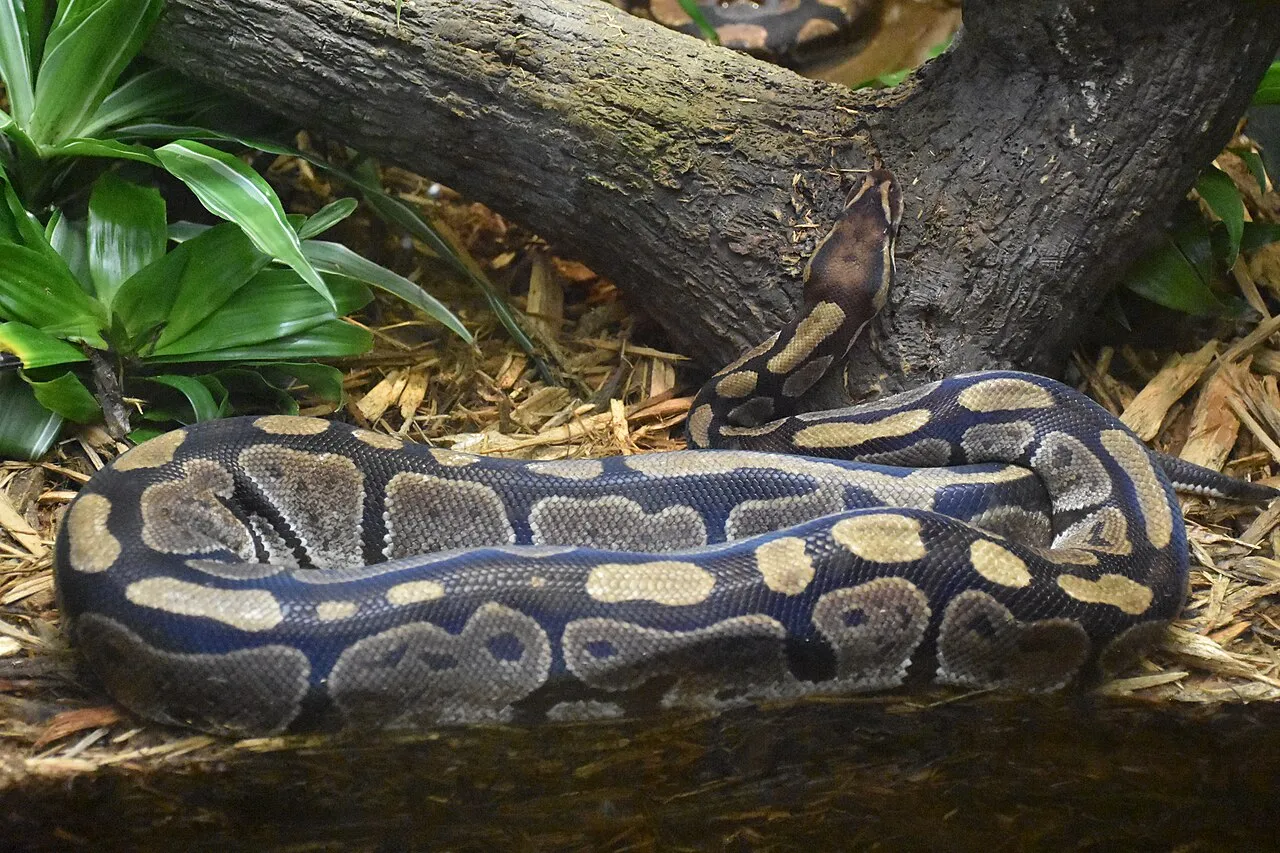
The scales are smooth and glossy, and a single row of broad belly scales helps with movement. Wild-type ball pythons are black or dark brown with rounded tan blotches and a white or cream belly.
Snakes shed their entire skin in one piece, turning it inside out. As a shed approaches, the colors dull and the clear scales covering the eyes, called spectacles, turn milky blue, a period keepers call being in blue. Vision is blurred during this time, the snake is often defensive and it may refuse food. A few days later the eyes clear, and the shed follows within two to five days. Adults shed roughly every four to eight weeks and young snakes more often. A shed that comes off in one clean piece tells you humidity was about right.
4.4. Spurs and sexing
Pythons and boas still carry traces of the hind limbs their ancestors lost: small claw-like spurs on either side of the vent. Males usually have larger, longer spurs, which they use to stroke the female during courtship, while females' spurs are often small or barely visible. Variation between individuals is wide, so spurs alone are not a reliable guide.
Accurate sexing is done either by probing, gently inserting a lubricated metal probe behind the vent and measuring its depth, or by popping, carefully everting the hemipenes of a young snake. Both can cause injury if done badly, so leave them to an experienced breeder or vet, and when you buy a snake, ask how its sex was determined.
5. Morphs and colors
The ball python is probably the pet reptile with the most morphs of all. Hundreds of single-gene morphs are known, and once designer combinations are counted the number of named animals runs into the thousands. Inheritance falls into recessive, co-dominant (incomplete dominant) and dominant types, and co-dominant morphs often have a distinct super form when an animal carries two copies.
| Morph | Inheritance | What it looks like |
|---|---|---|
| Normal (wild type) | - | Black with tan blotches |
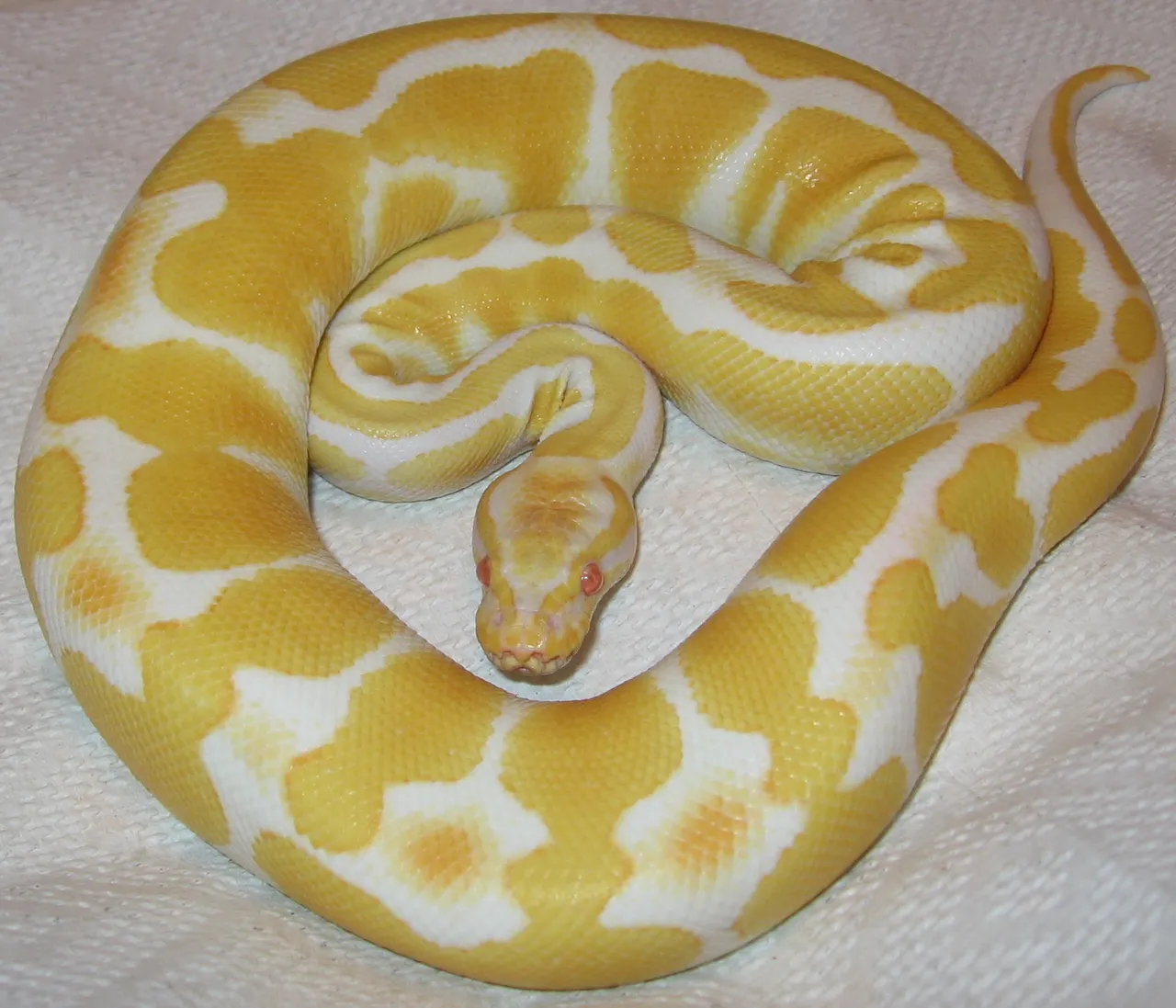
| Albino | Recessive | No black pigment: white and yellow with red eyes |
| Piebald | Recessive | Patches of pure white skin |
| Clown | Recessive | Dorsal stripe and simplified head pattern |
| Axanthic | Recessive | No yellow pigment, giving gray and black tones |
| Pastel | Co-dominant | Brighter yellow and light eye area; super pastel is brighter still |
| Mojave | Co-dominant | Distinctive pattern; the super form is a blue-eyed leucistic |
| Lesser | Co-dominant | Light brown tones; the super form is a blue-eyed leucistic |
| Banana | Co-dominant | Yellow and lavender with small dark freckles that appear with age |
| Cinnamon and black pastel | Co-dominant | Darker colors; spinal and head issues reported in the super forms |
| Spider | Dominant | Fine web-like pattern; linked to wobble syndrome |
| Champagne | Dominant | Pattern largely erased; neurological signs reported |
| Fire | Co-dominant | Lightened color; the super form is a black-eyed leucistic |
Blue-eyed leucistics (BEL) are pure white snakes with blue eyes produced by combining related genes such as mojave, lesser, butter and russo. The banana gene is known for an unusual sex-linked effect: babies inheriting it from a so-called male maker father are mostly male, while female maker lines produce mostly females.
Health should come first when choosing a morph. Nearly all spiders are reported to show some degree of wobble, a neurological condition causing head tremors and poor coordination, and similar problems have been reported in champagne, woma and several other morphs. Super cinnamon and super black pastel animals have been linked to kinked spines, and desert ghost has been associated with reduced fertility in females. Some reptile expos and organizations abroad have discouraged breeding spiders for these reasons. For a first snake, a normal, pastel, mojave, lesser or piebald with no known health issues is the comfortable choice.
6. Behaviour
MusikAnimal · CC BY-SA 4.0
6.1. Life in the wild
Wild ball pythons are mainly active from dusk into the night. By day they hide in tight spaces such as rodent burrows, termite mounds and root hollows, and after dark they hunt rats, shrews and small birds. Young snakes sometimes climb into shrubs after birds, while adults spend most of their time on the ground. During the West African dry season they cut back sharply on activity and feeding, and the autumn and winter fasts seen in captivity are thought to stem from this.
6.2. At home
In captivity a ball python spends most of the day coiled inside a hide. In the evening it emerges to cruise slowly around the enclosure, drink from the water bowl and explore along the walls. It prefers snug hides that its body touches on all sides; a hide that is too roomy can actually make it feel exposed.
Most tolerate handling well. Support the whole body with your hands and arms, avoid grabbing the head or swooping down from above, and the snake will usually glide slowly across your hands, tongue-flicking. Leave a new snake alone for one to two weeks and wait until it has eaten two or three times before starting short sessions. Skip handling for 48 hours after a meal and while the snake is in blue.
6.3. Reading the signals
- Slow, long tongue flicks: calm exploration.
- Rolling into a ball with the head hidden: fear. Do not try to unroll it; set it down.
- Neck drawn back into an S-shape: a defensive pose that can precede a strike. Withdraw your hand slowly.
- Hissing: a warning, heard most often around sheds.
- Constant cruising and pushing at the walls: hunger, wrong temperatures or a male searching for mates in breeding season.
- Soaking in the water bowl for long periods: the enclosure may be too hot or dry, or mites may be present.
- Staying only at the warm end or only at the cool end: the gradient may be off.
- Holding the head up with the mouth open: a possible sign of respiratory infection that needs close watching.
6.4. Fasting
The ball python's best-known habit is fasting. Adult males in particular often refuse food for several weeks to three or four months during the autumn and winter breeding season, and females may stop eating before or after laying or with seasonal changes. In a healthy adult that is not losing much weight, this is considered normal.
When a fast starts, first check that temperatures and humidity are right, that hides are adequate, that the snake is not about to shed and that nothing around the enclosure is causing stress. Then offer the usual meal every one to two weeks and remove it straight away if refused. Weigh the snake monthly; if it loses more than 10 percent of its normal weight, looks noticeably thin or shows other symptoms, talk to a vet. A youngster that goes a long time without eating is at greater risk than an adult, so find the cause quickly.
7. Life stages
Ball pythons grow slowly and live long. Power-feeding a young snake to grow it fast can lead to obesity and health problems, so let it grow at a natural pace.
| Stage | Age | Approx. weight | Feeding interval | Notes |
|---|---|---|---|---|
| Hatchling | 0-6 months | 60-300 g | 5-7 days | Starts eating after the first shed; nervous and loves to hide |
| Juvenile | 6 months-2 years | 300-900 g | 7-10 days | Rapid growth, temperament settles |
| Subadult | 2-3 years | 900 g-1.5 kg | 10-14 days | Males reach breeding size |
| Adult | 3 years and up | Males 1-1.5 kg, females 1.5-2.5 kg | 14-21 days | Seasonal fasting common |
| Senior | 20 years and up | Varies | Longer still | Less active, muscle loss |
Captive lifespan is commonly 20 to 30 years, and there are records of individuals living beyond 40. A ball python bought by a teenager may still be alive when that person is middle-aged, so factor that into your life plans. With age, snakes eat less often and smaller meals, and muscle loss can make the spine show slightly. Tumors, kidney disease and joint problems have been reported in older snakes, so an annual checkup with a vet who treats snakes is a good habit.
8. Housing
TylerMascola · CC0
8.1. Enclosure
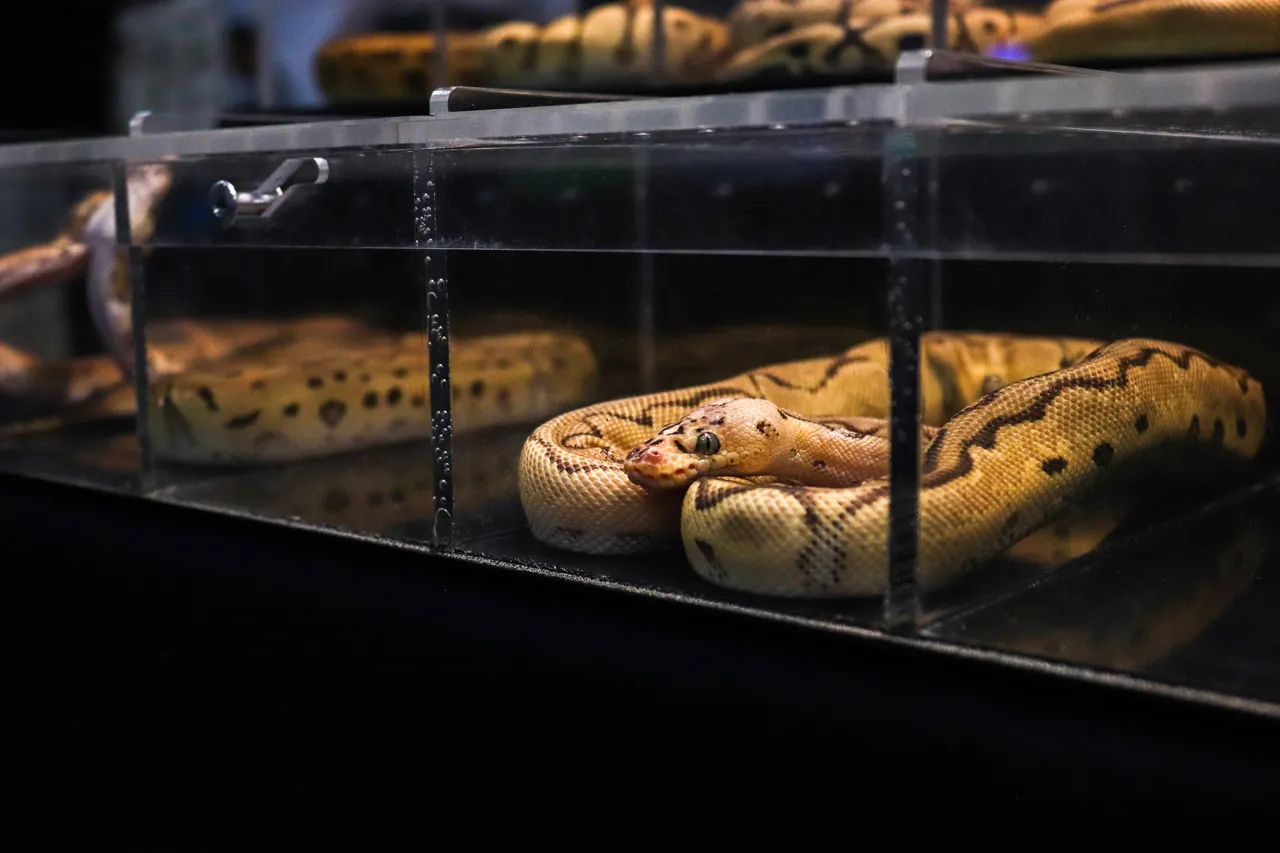
It used to be common to keep ball pythons for life in small plastic tubs in rack systems, on the grounds that they like tight spaces. Current welfare thinking favors giving adults a properly sized enclosure. For an adult female, think of 120 x 60 x 45 cm as a minimum and 120 x 60 x 60 cm or more as better; for males, at least 90 x 45 x 45 cm. Satisfy the love of tight spaces with snug hides, not with a small enclosure.
Front-opening PVC or wooden enclosures hold heat and humidity well, while glass tanks are easier to see into but lose humidity faster; if you use glass, cover part of the mesh top. Ball pythons are skilled at pushing lids open with their heads, so a locking enclosure is essential.
8.2. Temperature and humidity
| Item | Target |
|---|---|
| Warm-side floor | 31-33 °C |
| Warm-side air | 29-31 °C |
| Cool side | 26-28 °C |
| Night minimum | Above 24 °C |
| Humidity | 55-70 percent |
| Before a shed | 70-75 percent |
Combine heat mats, radiant heat panels, heat lamps or ceramic heaters to suit the enclosure. Whatever you use, run it through a thermostat with the probe placed where the snake actually lies. Snakes sometimes stay on an overheated surface instead of moving away and get burned, so lamps and ceramic heaters must always have guards.
Maintain humidity with moisture-holding substrates such as coconut chips, cypress mulch or coco fiber, plus a large water bowl. Dampening only the lower layer of substrate works well. A constantly soggy floor causes scale rot and other skin problems, so keep the surface dry. Indoor air becomes very dry when central heating runs in winter, so check the hygrometer often.
8.3. Hides, lighting and equipment
Place one hide on the warm side and one on the cool side, each snug enough that the coiled snake touches the walls. Ball pythons prefer dark hides with a single entrance. Fill the rest of the space with cork, branches and artificial plants; a snake that does not feel exposed will come out and explore more often.
UVB is not essential, but a growing number of keepers report that low-level UVB of about 2 to 6 percent, with plenty of shade, benefits activity and health. If you use lights, run them about 12 hours a day for a clear day-night cycle.
- Lockable enclosure
- Heat source (mat, radiant panel, ceramic heater) and thermostat
- Guards for heat sources
- Two digital thermometer-hygrometers and an infrared thermometer
- Two snug hides
- A large, heavy water bowl big enough to soak in
- Moisture-holding substrate
- Freezer space for frozen rodents and long feeding tongs
- A scale that reads above 1 kg and a logbook
9. Diet
9.1. Prey type and size
Ball pythons are carnivores that swallow rodents whole. At home, frozen and thawed mice or rats are the safest and most hygienic option. The prey should be about as wide as, or slightly wider than, the thickest part of the snake's body, which works out to roughly 10 percent of the snake's weight. One appropriately sized meal is easier to digest than several small ones.
Rats are more nutrient-dense than mice of the same weight and are popular for adults, though snakes raised on mice sometimes refuse to switch. Ask the seller what the snake has been eating and keep to it at first.
9.2. How and how often
Thaw frozen prey slowly in the refrigerator or in a sealed bag in lukewarm water, then warm the outside to around 38 °C with warm water so it feels like a living animal to the heat pits. Offer it with long tongs and wiggle it slightly to trigger a strike. Offering food by hand teaches the snake to associate hands with meals and invites bites.
| Age or size | Interval | Example prey |
|---|---|---|
| Hatchling (up to 300 g) | 5-7 days | Fuzzy or hopper mice, or rat pups |
| Juvenile (300-900 g) | 7-10 days | Adult mice, weaned rats |
| Subadult (900 g-1.5 kg) | 10-14 days | Small rats |
| Adult male | 14-21 days | Small to medium rats |
| Adult female | 10-14 days | Medium rats |
If the snake refuses, remove the prey right away rather than leaving it overnight, and never refreeze thawed prey. Live prey is discouraged because a rodent can badly injure a snake that misses its strike. If you must use live food, never leave it unattended and remove it if it is not eaten within a few minutes.
9.3. Things to avoid
- Leaving live rodents unsupervised in the enclosure: they can seriously injure the snake.
- Prey much wider than the body: causes regurgitation and digestive trouble.
- Thawing in a microwave: parts may cook or burst.
- Refrozen or spoiled prey: risk of bacterial infection.
- Handling right after a meal: can trigger regurgitation; wait 48 hours.
- Wild-caught rodents: parasites and rodent poison.
- Feeding two snakes in the same enclosure: both may seize the same prey, with dangerous results.
10. Health
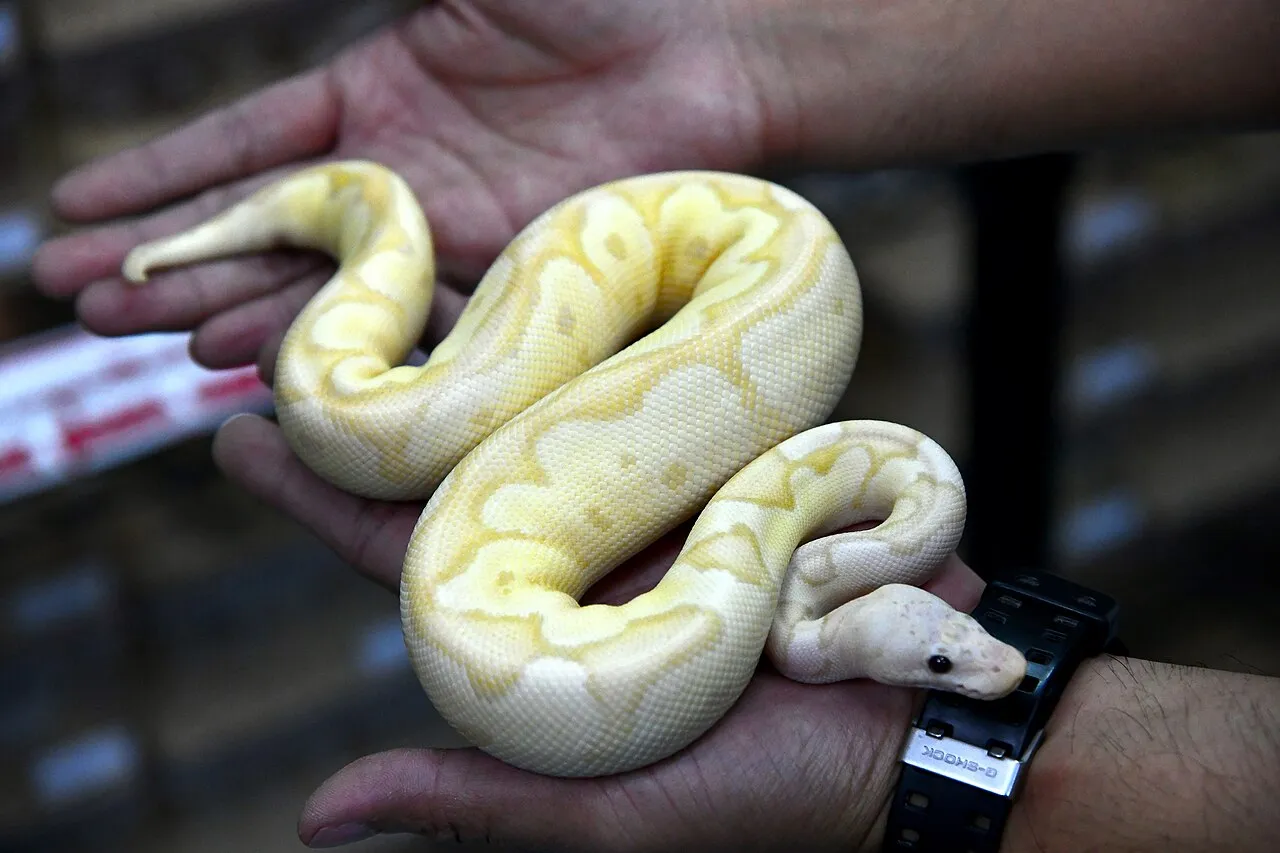
Tris T7 · CC BY-SA 4.0
Ball pythons are robust, but prolonged incorrect temperature or humidity and poor hygiene lead to a range of diseases. Snakes rarely show obvious symptoms early, so keeping a record of weight and shed quality is one of the best tools for catching problems in time.
| Condition | Main causes | Signs | Prevention |
|---|---|---|---|
| Respiratory infection | Low temperatures, excess moisture, poor ventilation | Open-mouth breathing, mucus, wheezing, holding the head up | Correct gradient, airflow |
| Mites | Brought in on new animals or equipment | Tiny black dots around the eyes and chin, long soaks in the water bowl | Quarantine, disinfect equipment |
| Scale rot | Wet substrate, dirty conditions | Red or brown belly scales, blisters | Keep the substrate surface dry |
| Mouth rot | Injury, weak immunity | Swelling, cheesy discharge | Hygiene, proper heat |
| Stuck shed | Low humidity | Retained eye caps or tail tip, patchy shed | Humidity at 70-75 percent before sheds |
| Burns | Unregulated heat, unguarded lamps | Discolored scales, blisters, wounds | Thermostats, guards |
| Regurgitation | Oversized prey, low heat, handling after meals | Undigested meal brought back up | Right prey size, rest after feeding |
| Inclusion body disease (IBD) | Virus, linked to arenaviruses | Head tremors, stargazing, inability to right itself | Quarantine, reputable source |
| Obesity | Overfeeding | Folds along the sides, low activity | Longer feeding intervals |
If eye caps remain after a shed, do not pick at them. Raise humidity or soak the snake in lukewarm water for 15 to 20 minutes and wait for the next shed; if they persist, let a vet remove them. IBD is a fatal, contagious viral disease of boas and pythons with no cure, which is why every new snake should be quarantined in a separate room for at least 60 to 90 days.
See a vet who treats snakes if you notice open-mouth breathing or mucus, weight loss of more than 10 percent, discolored scales or blisters, head tremors or difficulty turning over, repeated regurgitation, or a lump under the skin. Wobble in spider and similar morphs can be hard to distinguish from disease, so know what you are buying, and seek advice if symptoms worsen.
11. Breeding
Males are usually bred from about 18 months and 700 grams to 1 kg, and females from around three years and at least 1.5 kg. Breeding a female that is too young or light can leave her badly depleted after laying.
The breeding season generally runs from autumn into winter, and a cooling period with nights a few degrees cooler is widely believed to stimulate breeding behavior. Introduced to a female, the male courts her by stroking her body with his spurs, and copulation can last from hours to nearly a day. A gravid female develops a swelling in the lower third of her body and often lies upside down on the warm side. She lays about 25 to 30 days after her pre-lay shed.
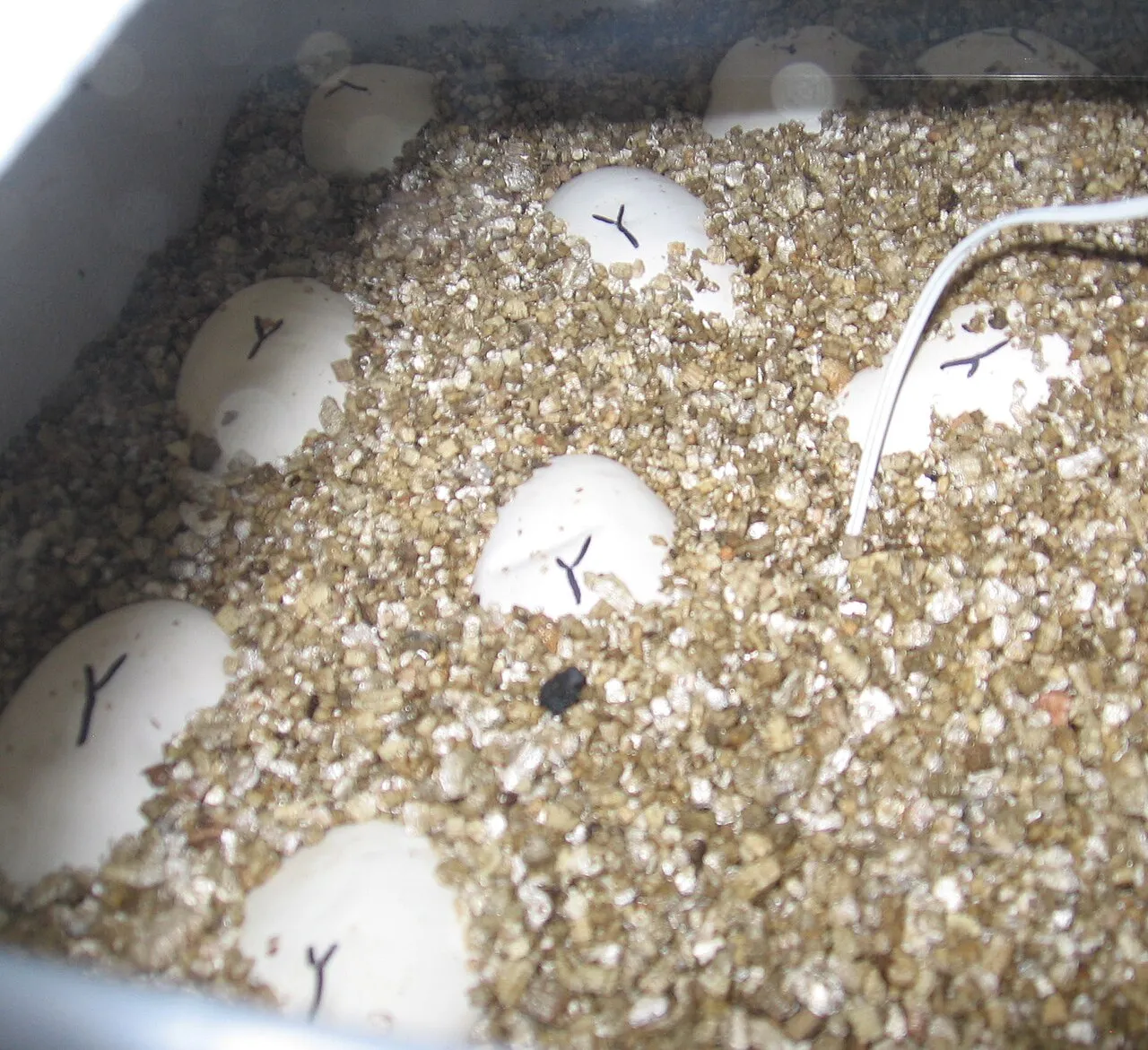
Clutches typically contain 4 to 10 eggs, about six on average. As in the wild, the mother coils around her eggs and can shiver to raise their temperature slightly. Most breeders remove the eggs and incubate them at 31 to 32 °C with humidity above 90 percent, and they hatch in about 55 to 60 days. Sex is not determined by temperature in ball pythons. After slitting the shell and poking out their heads, hatchlings often stay inside the egg for a day or two to absorb the last of the yolk.
Many people start breeding for the fun of combining morphs, but a single clutch produces several babies, each of which may live 20 years or more. Each needs its own tub and food, and coaxing a reluctant hatchling to take its first meal can take weeks. Because the species is CITES-listed, captive breeding may also have to be reported or certified; in Korea, check the requirements with a regional environmental office before you start, and elsewhere with your national wildlife authority. Breeding morphs with known health problems, such as spider, deserves careful thought.
12. Costs
For a ball python, the enclosure and heating are the main setup costs, and running costs are mostly frozen rodents and electricity. Because it eats infrequently, the monthly bill is fairly low. Rough Korean price ranges follow, in won.
| Item | Typical cost (KRW) | Notes |
|---|---|---|
| Enclosure | 200,000-500,000 | 120 x 60 cm PVC or glass |
| Heating, thermostat, guards | 80,000-200,000 | Radiant panel, ceramic heater, etc. |
| Thermometers and IR thermometer | 20,000-50,000 | - |
| Hides, water bowl, decor | 40,000-80,000 | A heavy bowl is best |
| Substrate | 20,000-40,000 | Coconut chips or mulch |
| Scale and tongs | 20,000-40,000 | - |
| First vet check | 30,000-80,000 | With fecal test |
| Initial total (excluding the snake) | About 400,000-900,000 | - |
| Monthly frozen prey | 10,000-30,000 | Depends on size and interval |
| Monthly substrate and supplies | 10,000-20,000 | - |
| Monthly electricity | 10,000-20,000 | Depends on season |
| Monthly total | About 30,000-70,000 | - |
Normal ball pythons are inexpensive, while popular morph combinations range from several hundred thousand won to well into the millions. A basic exam with tests costs tens of thousands of won; X-rays, endoscopy or surgery can cost several hundred thousand or more. Sellers are responsible for the CITES-related paperwork, so avoid suspiciously cheap animals that come without documents.
13. Before you get one
- Can you commit to 20 or 30 years, perhaps more? Add 30 to your current age and picture your life at that point.
- Will you keep frozen mice or rats in the household freezer and thaw them, and does everyone you live with agree?
- Can you wait out fasts lasting weeks or months without panicking?
- Is there an exotic vet nearby who treats snakes?
- Does your lease or building policy allow snakes?
- Are you prepared to handle CITES paperwork and any reporting your country requires?
Choose a seller who can give you the hatch date, parent information, a full feeding record showing what and how often the snake has eaten, and how its sex was determined. Above all, make sure you receive documents proving legal import or captive breeding. A healthy ball python flicks its tongue actively and feels strong and firmly muscled in your hands. Check that the nostrils and mouth are clean, breathing is silent, belly scales are clear, and there are no mites around the eyes or under the chin. For a beginner, a snake with at least three or four consecutive frozen-thawed meals on record is ideal. When choosing a morph, find out whether it is one associated with neurological problems, such as spider or champagne.
14. Laws
The ball python is listed in CITES Appendix II, which covers species not currently threatened with extinction but that could become so without trade controls. International trade requires export permits from the country of origin, and many countries add their own import rules on top.
In Korea, CITES-listed species are managed as internationally endangered species under the Wildlife Protection and Management Act. In practice this can mean an import permit when bringing animals in from abroad, a report or certificate for animals bred in captivity domestically, a transfer report whenever an animal changes hands, and registration of keeping facilities above a certain scale. The specific thresholds, deadlines and penalties change as the law is amended, so confirm the current requirements with a regional environmental office before and after you acquire a snake. Korea is also phasing in licensing for wildlife sellers and importers and a system specifying which species may be imported and sold, so make sure your seller holds the necessary licenses and provides proper paperwork. Keep those documents for as long as the snake lives.
Outside Korea, rules vary widely. Some countries and states require a permit for any snake, some restrict certain species, and some have no specific rules. Check the regulations where you live. Ball pythons cannot survive cold winters outdoors, and releasing one is never acceptable, both legally and for the animal's welfare. If you can no longer keep yours, rehome it through the proper transfer process.
15. In culture
In parts of West Africa, pythons have long been regarded as sacred. The town of Ouidah in Benin is known for its Temple of Pythons, where dozens of ball pythons live and visitors can drape one around their shoulders. Some communities in southeastern Nigeria are also reported to hold traditions against harming pythons. Such beliefs may have allowed ball pythons to live relatively safely close to people in those areas.
In Western film and television, the ball python is the stock image of a snake kept at home. The big snake draped over a movie villain is often a docile ball python, chosen because it is easy to handle and stays calm on set, and the species frequently appears in music videos and photo shoots where someone wears a snake around their neck.
Online, the tightly balled-up snake, photos of ball pythons wearing tiny hats and faces that look comically surprised have all become memes. So many morphs are named after food, from banana and cinnamon to lemon and ice cream, that the species is sometimes joked about as the snake with the most delicious names. Around the world it is often introduced as the gateway species that helps people get over a fear of snakes.
16. Trivia
- When swallowing, the two halves of the lower jaw move independently and the ligaments stretch, letting a ball python engulf prey far wider than its head. The jaw does not actually dislocate.
- Studies on pythons have found that the heart and digestive organs temporarily grow and ramp up activity after a large meal.
- Shivering to warm a clutch is a python trait, and ball python mothers coil around and guard their eggs.
- The spurs are remnants of hind limbs, and an X-ray reveals traces of a pelvis as well.
- In the early days of the morph market, a single rare ball python could reportedly sell for about the price of a house.
- The left lung is greatly reduced and the right lung does most of the work, part of how a long, slender animal packs its organs.
- Balling up protects the head and other vital parts from predators.
- A shed skin preserves every scale, even the eye caps, and usually measures a little longer than the snake itself because the skin stretches as it comes off.
Health notes are general information. If something seems wrong, contact a vet who treats this species.
FAQ
My ball python hasn't eaten in months. Should I worry?
Adults commonly skip two to four months in autumn and winter. Weigh monthly and see a vet if it loses more than about 10 % of its body weight or shows dehydration or breathing signs. Double-checking temperatures and hides often gets it eating again.
Is a ball python okay in a home with kids?
Its calm nature makes it a good family animal to watch, but adults should handle feeding and supervise every session. Teach children never to drape it around their neck, and to wash hands afterward.
Why does my python shed in pieces?
Low humidity is the usual culprit. Raise it to 70–80 % once the eyes turn cloudy, and loosen leftover skin by placing the snake in a tub with a damp towel for 20–30 minutes. Leave retained eye caps to a vet.
Further reading
- 🗳️ Can reptiles make genuinely good pets?
- 🗳️ Do snakes make sense as pets to you?
- ❄️ Winter Care: Keeping Pets Warm and Heaters Safe
- 🦎 Finding an Exotic Pet Vet and Planning Checkups
Photo credits
Photos are freely licensed images from Wikimedia Commons. Authors and licenses are listed below.
- Ball python lucy.JPG — HCA (talk) · CC BY-SA 3.0
- Albino ball python.png — WingedWolfPsion · CC BY-SA 3.0
- Ball Python Eggs Incubating.jpg — WingedWolfPsion · CC BY-SA 3.0
- Ball python (Python regius), Bronx Zoo.jpg — MusikAnimal · CC BY-SA 4.0
- Killer bee ball python snake.png — TylerMascola · CC0
- D85 3418 Ball Python by Trisorn Triboon.jpg — Tris T7 · CC BY-SA 4.0