TailVille
At a glance
Rough ranges for supplies, food and electricity in Korea (USD is approximate). Purchase or adoption fees are not included.
Busy people who would enjoy designing a planted display enclosure, and keepers who prefer not to rely on live insects.
Homes that can't keep summer temperatures below 28 °C, or anyone hoping for a lizard that will sit still on their lap.
1. Overview
The crested gecko is a tree-dwelling gecko found only on New Caledonia, an island territory in the southwest Pacific. A fringe of soft spiny scales runs from above each eye down the neck and back, looking a lot like eyelashes, which is why it is also nicknamed the eyelash gecko. Adults reach about 18 to 22 cm including the tail and weigh 35 to 55 grams.
Its story is unusually dramatic: scientists believed it was extinct until it was rediscovered in 1994. In the three decades since, it has become one of the most popular pet reptiles in the world, and the reasons are easy to see. It thrives at temperatures close to an ordinary room, it can live a full healthy life on a powdered complete diet without any live insects, it has a gentle temperament, and it comes in a huge range of colors and patterns.
There are trade-offs. It handles heat poorly, and temperatures above about 28 °C for any length of time are dangerous. It needs a tall enclosure and an evening misting routine, and its habit of leaping off a hand without warning means small children should not handle it unsupervised. With a lifespan of 15 to 20 years, it also calls for long-term planning.
2. Name and classification
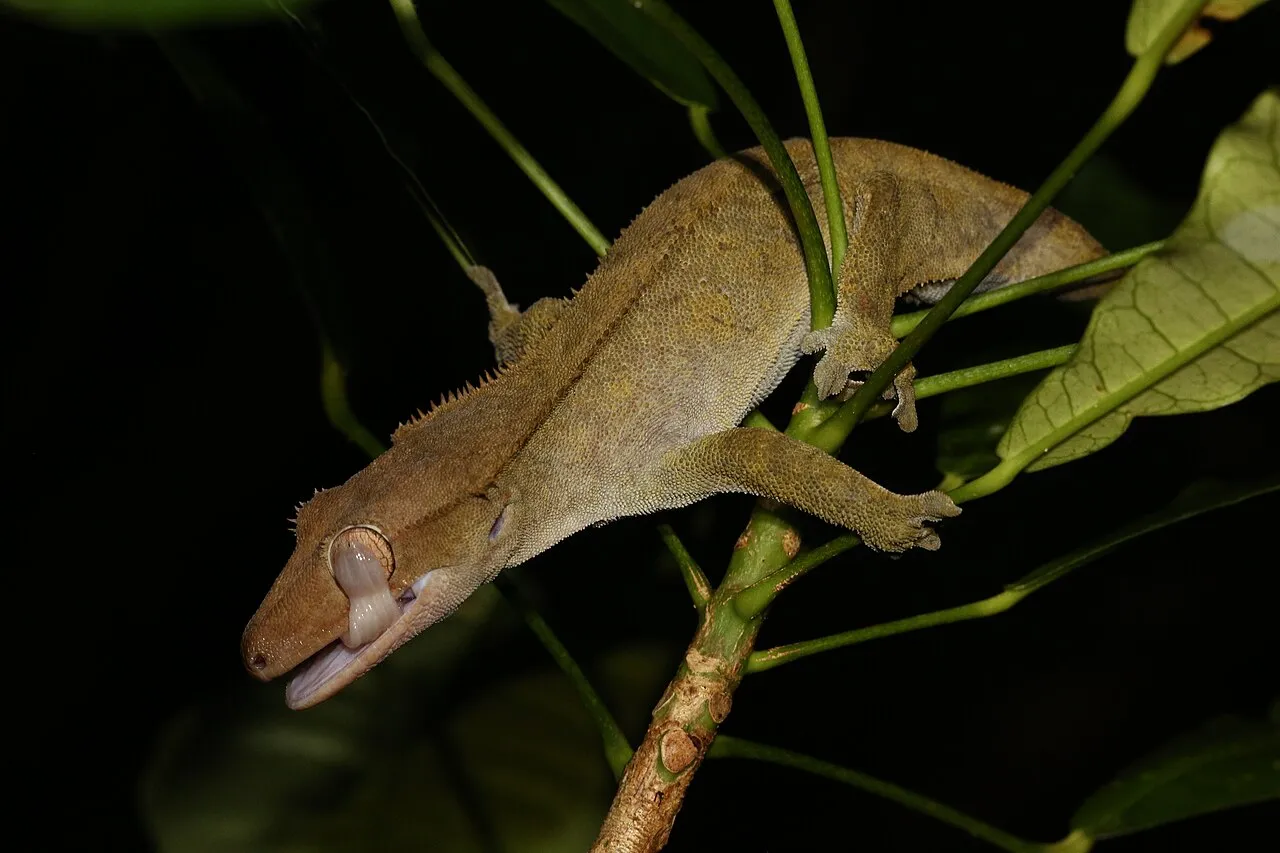
Lennart Hudel · CC BY 4.0
2.1. Scientific name and meaning
Its current scientific name is Correlophus ciliatus. The French zoologist Alphonse Guichenot described it in 1866, and for most of its history in the hobby it was known as Rhacodactylus ciliatus. A genetic review of New Caledonian geckos around 2012 moved it into the genus Correlophus, so older care books and some sellers still use the former name.
The species name ciliatus is Latin for having eyelashes, referring to the spiny crests above the eyes, so it means the same thing as the English nickname. In English the animal is often shortened to crestie, and Korean keepers likewise use a clipped form of its name.
2.2. Family and relatives
Crested geckos belong to the family Diplodactylidae, a group centered on Australia, New Zealand and New Caledonia and quite separate from the Gekkonidae, the family of common house geckos.
New Caledonia is home to several other remarkable large geckos, and a few are kept as pets.
| Species | Scientific name | Notes |
|---|---|---|
| Gargoyle gecko | Rhacodactylus auriculatus | Horn-like head bumps, can regrow its tail, sometimes nippy |
| Mossy prehensile-tailed gecko | Mniarogekko chahoua | Lichen-like camouflage, laid-back |
| New Caledonian giant gecko | Rhacodactylus leachianus | Among the largest geckos alive, over 30 cm |
| Sarasin's gecko | Correlophus sarasinorum | Closest relative of the crested gecko, no crests |
Their care is broadly similar, so many keepers move on to one of them after a crested gecko. Temperament, size and price differ considerably, though, so research each one separately.
3. History
After it was described from specimens in the nineteenth century, the crested gecko went almost entirely unseen for more than a hundred years. With no living animals on record, many scientists assumed it had died out, and a handful of museum specimens were all that remained.
That changed in 1994, when a research team working on the Isle of Pines, off the southern tip of New Caledonia's main island, found living geckos. Populations on the southern part of the main island were confirmed afterward, and a small number of animals collected around that time reached breeders in the United States and Europe. New Caledonia strictly prohibits exporting its endemic wildlife, so virtually every crested gecko in captivity today descends from those early founders.
Once breeders realized how easily the species reproduced and how forgiving its needs were, it spread rapidly through the American hobby in the 2000s. The development of powdered complete diets was the real turning point, because it removed the need for live insects. The species reached Korean keepers in earnest during the 2010s, and alongside the leopard gecko it became one of the two classic starter reptiles there.
Wild populations face pressure from habitat loss and from invasive little fire ants, which harm many small native animals. It is common in living rooms, but in its homeland it remains a species that needs protection.
4. Body
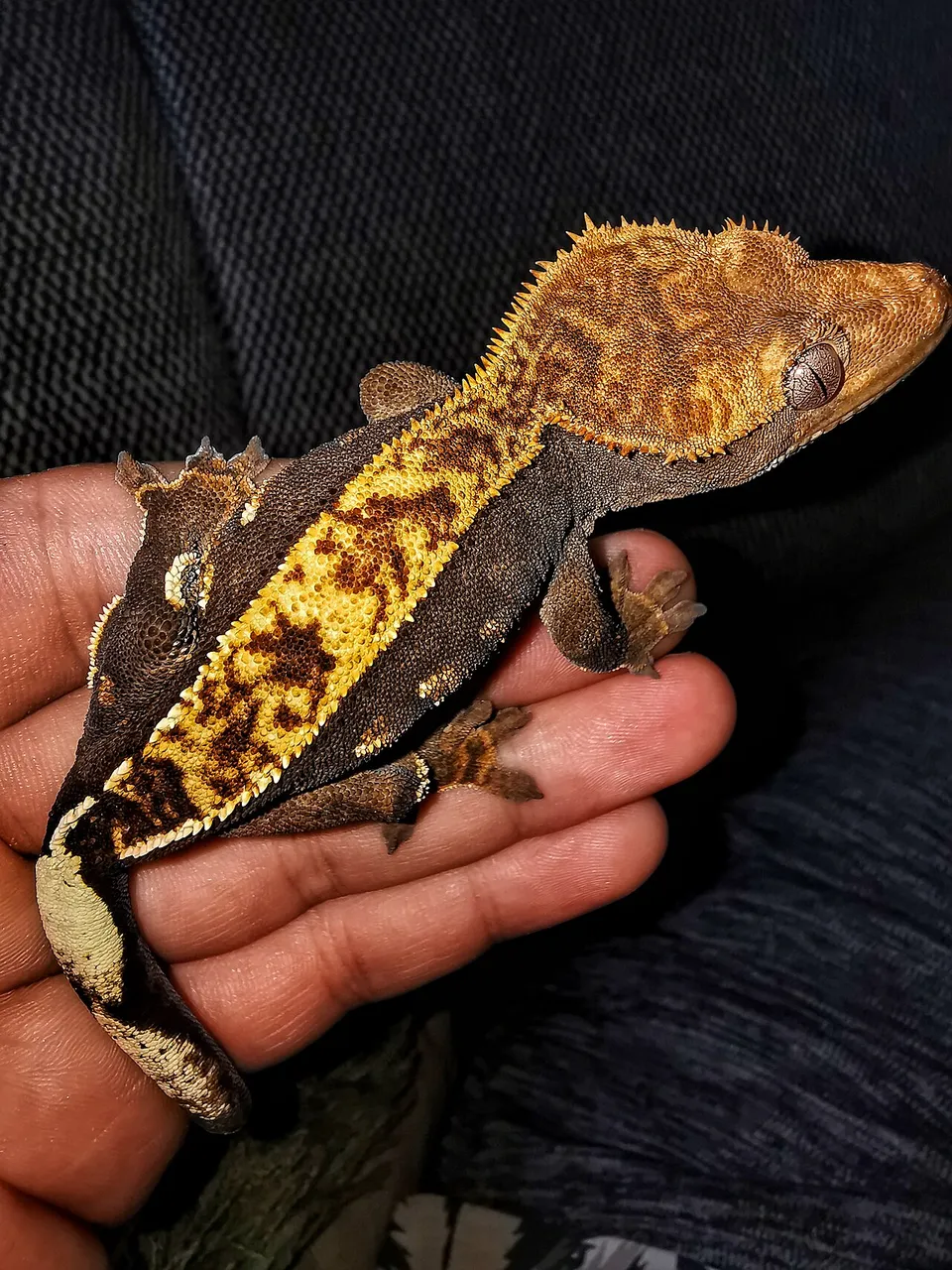
DigitalLem0n · CC BY-SA 4.0
4.1. Size and build
A hatchling weighs about 1.5 to 2 grams and measures 7 to 8 cm in total. Adult size comes at 18 to 24 months, typically 18 to 22 cm and 35 to 55 grams; an adult over 60 grams may be overweight. The head is large and roughly triangular, and the body is slightly flattened from side to side, which helps with balance on branches.
The underside of the tail tip carries small pad-like scales that help it grip twigs. The tail can be dropped when the gecko feels threatened, but unlike a leopard gecko's, it never grows back. Many adult cresties therefore live tailless, a look affectionately called frogbutt in the hobby. Tailless adults are reported to be common in the wild too, and losing the tail does not cause lasting health problems.
4.2. Toes and skin
The toe tips are broad and flat, and underneath they carry countless microscopic hair-like structures called setae. These cling to surfaces through molecular attraction, letting the gecko walk upside down on glass or smooth leaves. Retained shed or grime on the toe pads reduces that grip, so if a gecko keeps slipping off the glass, check its feet.
The skin is soft and finely granular, with a velvety feel. Two rows of crests run from above the eyes toward the tail, with more crests around the back of the head. Growing geckos shed every two to three weeks and adults every four to six weeks, and they usually eat the shed skin.
4.3. Eyes and color change
Crested geckos have no eyelids. A clear scale, called the spectacle, protects each eye, and the gecko wipes it clean by licking it with its tongue. The pupils are vertical and, in bright light, narrow into a wavy line that looks like a string of beads.
Their color shifts during the day. At night, when active, many become darker and more vivid, which keepers call fired up; resting during the day they pale out, called fired down. The difference can be striking enough that judging a morph from a single photo is unreliable, so when buying, ask to see the gecko in both states.
4.4. Sexing
Sexing usually becomes possible at 15 to 20 grams, around four to six months of age. Males develop a clear bulge at the base of the tail behind the vent, where the hemipenes sit, plus a V-shaped row of preanal pores in front of the vent. With a jeweler's loupe the pores can sometimes be seen in younger animals. Females lack both. When in doubt, waiting a few months and checking again is the most reliable approach.
5. Morphs and colors
Most crested gecko colors and patterns are polygenic, meaning many genes act together. Unlike leopard geckos, outcomes cannot be predicted with simple genetic charts, and most breeding is line breeding, where parents with similar traits tend to produce similar offspring. Base colors include yellow, orange, red, olive, brown and gray, and a pattern type layered on top gives each animal its name.
| Morph | Type | What it looks like |
|---|---|---|
| Patternless | Pattern | Solid single color |
| Bicolor | Pattern | Back and sides in different shades |
| Tiger | Pattern | Vertical bands along the sides |
| Brindle | Pattern | Broken, mottled version of tiger striping |
| Flame | Pattern | Light dorsal stripe contrasting with darker sides |
| Harlequin | Pattern | Like flame, with light color spreading onto the sides and legs |
| Extreme harlequin | Pattern | Light pattern covering most of the body |
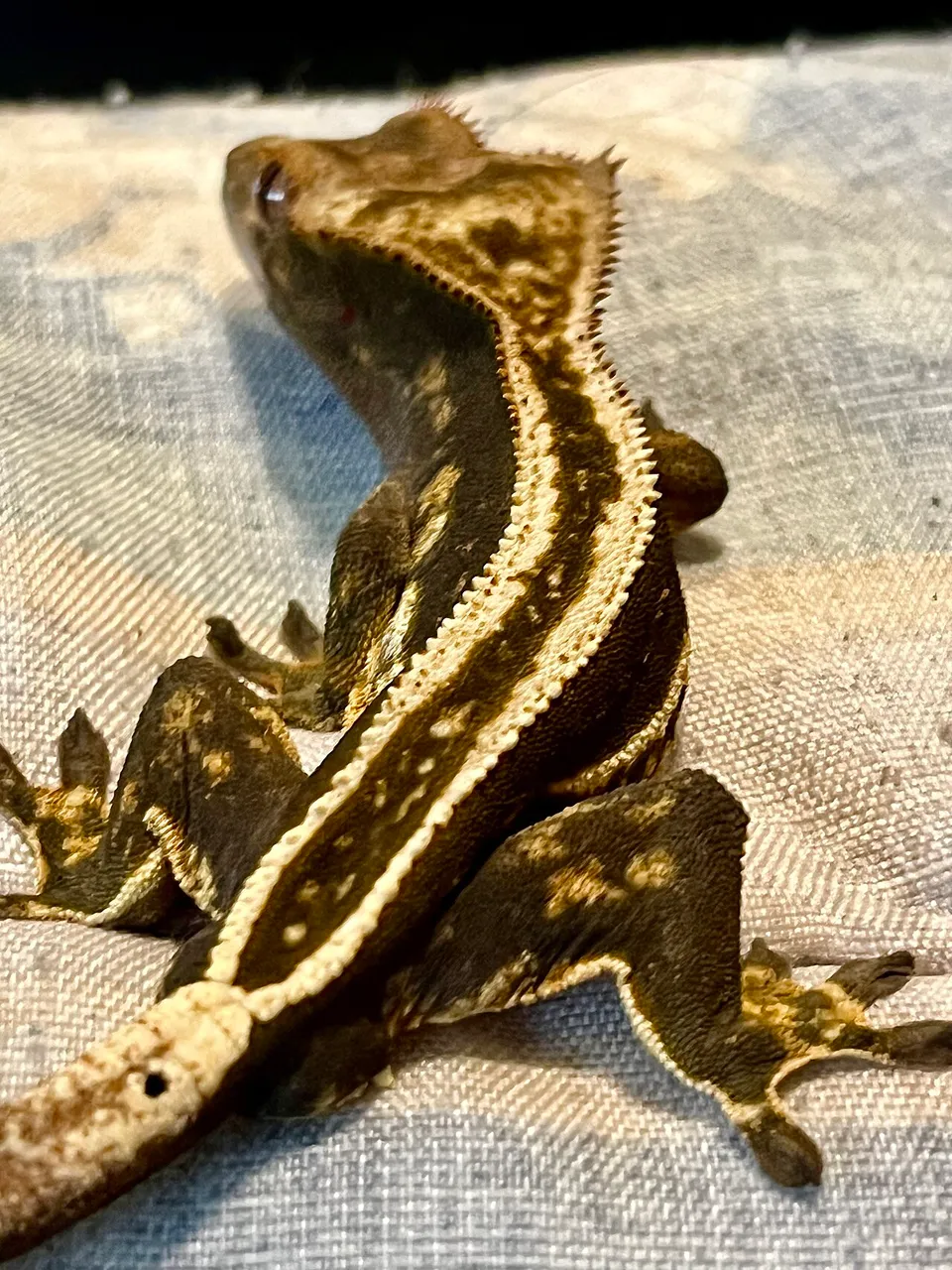
| Pinstripe | Pattern | Rows of raised cream scales lining both dorsal crests |
| Dalmatian | Pattern | Black or red spots; heavily spotted animals are called super dalmatians |
| Lilly white | Single gene (incomplete dominant) | Extensive white; the super form is reported to be non-viable |
| Cappuccino | Single gene (incomplete dominant) | Dark base with a connected dorsal pattern; health concerns in the super form |
| Axanthic | Recessive | No yellow or red pigment, giving gray and black tones |
Terms such as partial pinstripe describe a broken stripe, and many other labels are informal names used by individual breeders or communities. Two sellers may use the same word slightly differently.
Pairing two lilly whites should, on paper, produce a quarter super lilly whites, and these have been reported to die in the egg or shortly after hatching, so responsible breeders never put two lilly whites together. The super form of cappuccino, nicknamed frappuccino, has been linked to deformities of the nostrils and jaw and remains controversial. Newer genetic morphs have little long-term data behind them, so for a first gecko a long-established pattern morph is the comfortable choice.
6. Behaviour
6.1. Life in the wild
In the wild, crested geckos live in the shrub layer and lower canopy of humid forests. They rest during the day among leaves or under loose bark and become active after sunset, hunting insects and eating ripe fruit, nectar and pollen. New Caledonia's climate is mild, and forest temperatures stay moderate even in summer, which helps explain why the species copes so badly with heat. They spend little time on the ground and often jump from branch to branch.
6.2. At home
During the day a crested gecko usually sleeps motionless behind leaves high in the enclosure or inside a cork tube. When the lights go out it becomes surprisingly active, climbing the walls and leaping between branches. People who only see it in daylight often assume it does nothing but sleep.
Most tolerate handling well, and the most comfortable method is hand walking, letting the gecko step from one hand to the other rather than gripping it. Squeezing causes stress and can make it drop its tail. Cresties often jump without warning, so handle them while sitting close to the floor and keep sessions to 10 or 15 minutes. Leave a new arrival alone for about two weeks and confirm it is eating before you start.
6.3. Reading the signals
- Slow tail waving or curling: tension or awareness of another animal.
- Wide-open mouth with squeaks or barks: a defensive reaction to fright.
- Wiggling the hips and crouching: getting ready to jump; have a hand ready.
- Licking its eyes: normal cleaning.
- Sudden darkening: activity, excitement or sometimes stress.
- Lying on the floor during the day: the enclosure may be too warm or the gecko may be unwell.
- A male chirping and chasing another gecko: territorial or courtship behavior; males must be separated.
7. Life stages
Crested geckos grow a little more slowly than leopard geckos. Weighing them regularly during the first year makes it much easier to judge whether feeding and health are on track.
| Stage | Age | Approx. weight | Notes |
|---|---|---|---|
| Hatchling | 0-3 months | 1.5-5 g | Starts eating after the first shed; small enclosures help it find food |
| Juvenile | 3-12 months | 5-25 g | Rapid growth, colors and pattern settle, sexable from 4-6 months |
| Subadult | 12-18 months | 25-35 g | Growth slows; still too young to breed |
| Adult | 18 months-10 years | 35-55 g | Stable weight; females can be considered for breeding above 35-40 g |
| Senior | 10 years and up | Varies | Less active, loses muscle so the hips may show |
Typical captive lifespan is given as 15 to 20 years. Because the species has only been widely kept for about three decades, long-term data are still accumulating, though reports of geckos approaching 20 years are increasingly common. With age, appetite drops, shed sticks to the toes more often and climbing strength fades. For seniors, place branches closer together to reduce falls and put the food dish along their usual route so it is easy to reach.
8. Housing
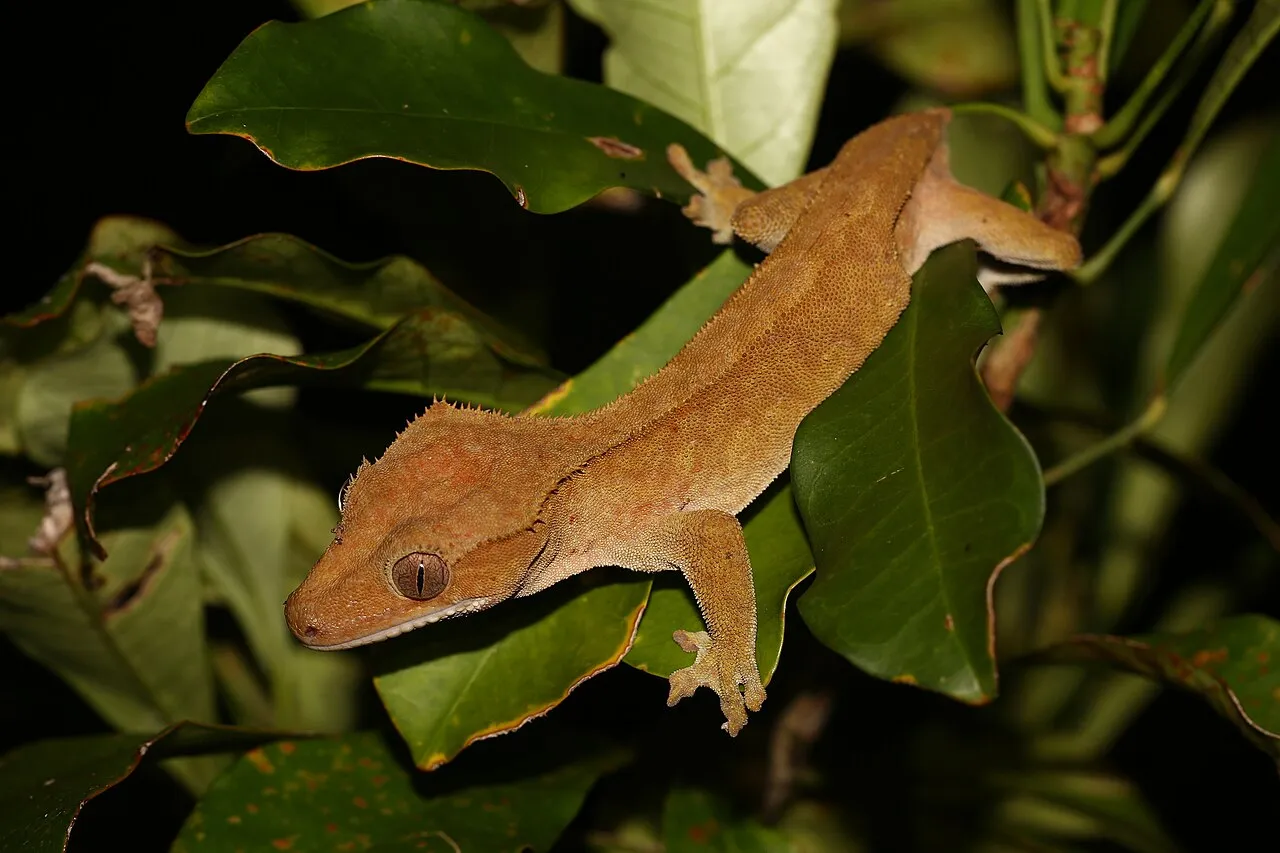
Lennart Hudel · CC BY 4.0
8.1. Enclosure
Crested geckos live vertically, so height matters more than floor space. One adult needs a tall enclosure of at least 45 x 45 x 60 cm (width x depth x height), and around 60 x 45 x 90 cm lets you see a much richer range of behavior. Hatchlings can struggle to find food in a big space, so many keepers start them in a small enclosure of about 30 x 30 x 45 cm and move them up at roughly 15 grams.
Fill the interior with cork tubes, bamboo, vines and artificial or live plants to create several hiding spots up high. Hardy, low-toxicity plants such as pothos, snake plants and philodendrons are popular; rinse off soil and leaves first to remove any pesticide residue. Include horizontal branches so the gecko does not spend all its time clinging to the glass, which matters for tail health.
8.2. Temperature and humidity
Crested geckos like conditions close to a typical indoor room, so for much of the year they need no strong heat source. Summer heat and winter cold are where you need a plan.
| Item | Target |
|---|---|
| Daytime | 22-26 °C |
| Night | 18-22 °C |
| Danger zone | Extended periods above 28 °C or below 15 °C |
| Humidity just after misting | 70-80 percent |
| Humidity during the day | 50-60 percent |
Even a few hours above 28 °C can weaken or kill a crested gecko. In a hot summer climate, air conditioning is effectively required, and it must stay on while you are away. If the room falls below about 18 °C in winter, add a gentle heat mat on a side wall or a low-wattage lamp, always on a thermostat.
The humidity rhythm matters: mist every evening so humidity spikes, then let the enclosure dry out by the following afternoon. Constant dampness breeds mold, skin disease and respiratory infections, while an enclosure that stays too dry causes stuck shed. Cover part of the mesh top to hold moisture but leave enough open for airflow.
8.3. Lighting and substrate
Because complete diets contain vitamin D3, crested geckos can stay healthy without UVB. Many keepers report better activity and appetite when they add a low-output UVB source of around 2 to 5 percent with plenty of shade, however. A 12-hour light cycle on a timer gives a clear day and night. If overhead lights run warm, watch temperatures closely in summer.
For substrate, coconut fiber or topsoil mixed with moss holds humidity well, and bioactive setups with springtails and isopods as cleanup crews are popular. For hatchlings and animals in quarantine, use paper towel so you can easily monitor droppings and food.
- Tall enclosure of at least 45 x 45 x 60 cm with a lock
- Cork tubes, branches, vines and plants
- Two digital thermometer-hygrometers, one high and one low
- Spray bottle or automatic mister
- Food dishes and a ledge or holder to mount them high
- A gentle heat mat and thermostat for winter
- Optional: low UVB and timer, bioactive materials
- Scale accurate to 0.1 gram
9. Diet
9.1. Complete diet
The single biggest reason crested geckos are easy to keep is the powdered complete diet. These products combine fruit powder, insect protein, calcium and vitamins in balanced proportions. Mix roughly one part powder with two parts water to the consistency of ketchup or yogurt. They are formulated to meet nearly all of the gecko's needs, which is why you can skip live insects altogether.
- Hatchlings: fresh food every evening
- Juveniles: every other day
- Adults: about three times a week
Throw out mixed food after 24 to 48 hours and wash the dish; left longer, it grows mold and attracts fruit flies. Rotating two or three flavors or brands reduces fussiness and spreads nutritional risk. Mount the dish at mid-height or higher rather than on the floor, because cresties look for food up in the branches.
9.2. Insects and treats
A complete diet is enough on its own, but offering a few calcium-dusted crickets or dubia roaches about once a week satisfies hunting instinct and adds protein for growing animals. Choose insects smaller than the gap between the gecko's eyes; for hatchlings, crickets one or two weeks old are about right.
Treat fruit as an occasional small extra. A little mashed ripe banana, mango, papaya or fig is fine now and then, but a fruit-based diet is low in calcium and relatively high in phosphorus and leads to metabolic bone disease. Human baby food as a staple is discouraged for the same reason.
9.3. Foods to avoid
- Citrus fruits such as oranges and lemons: too acidic for the digestive tract.
- Avocado: contains compounds considered toxic to many pets.
- Fruit-only or baby-food-only diets: the leading cause of metabolic bone disease.
- Wild-caught insects and fireflies: pesticides, parasites and toxins.
- Water sweetened with sugar or honey: leads to obesity and mouth problems.
- Mixed diet older than two days: mold and bacteria.
10. Health
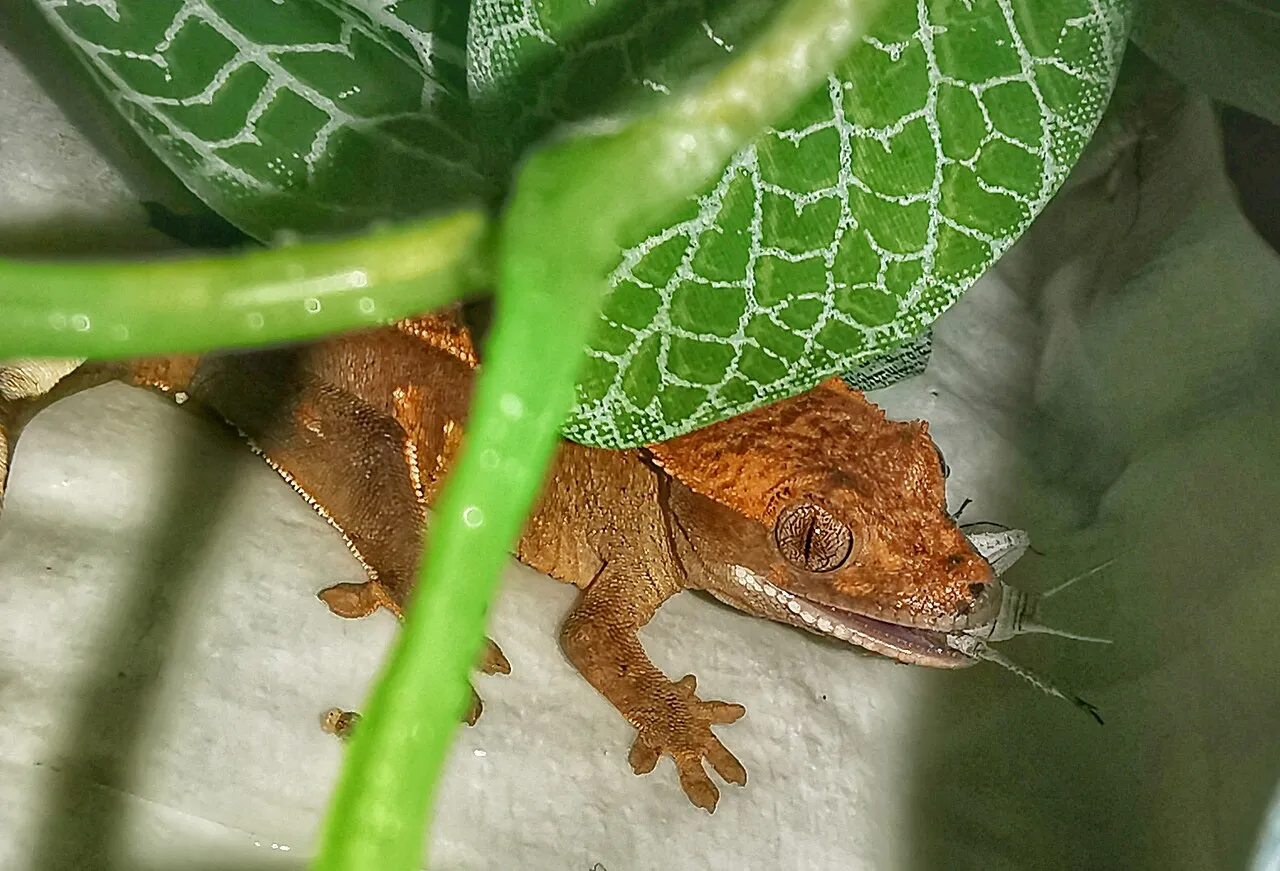
DigitalLem0n · CC BY-SA 4.0
Most health problems in crested geckos come from getting temperature, humidity or diet wrong. In climates with hot, humid summers and dry winters, the risks shift with the seasons.
| Condition | Main causes | Signs | Prevention |
|---|---|---|---|
| Metabolic bone disease | Fruit or baby-food diets, low calcium | Soft or bent jaw, curved spine, trembling legs | Complete diet as the staple |
| Floppy tail syndrome | Long hours hanging head-down on glass | Tail flops sideways or over the back; possible pelvic changes | Plenty of horizontal branches |
| Heat stress | Temperatures above 28 °C | Gaping, lying on the floor, lethargy | Air conditioning, constant monitoring |
| Stuck shed | Low humidity | Skin left on toes or tail tip, toes lost | Evening misting, humidity checks |
| Mouth rot (stomatitis) | Injury, dirty conditions | Swelling, red spots, cheesy discharge | Hygiene, early vet care |
| Respiratory infection | Constantly wet, stuffy or cold enclosure | Nasal discharge, gaping, wheezing | Wet-dry cycle, ventilation |
| Egg binding and calcium depletion (females) | Back-to-back clutches, low calcium | Swollen belly, refusing food, weakness | Calcium supplements, separating from males |
Floppy tail syndrome is specific to crested geckos and their relatives, and some vets believe advanced cases can affect the pelvis. If the tail starts hanging sideways, add more horizontal branches and broad leaves, and talk to a vet if it is severe.
To remove skin stuck on the toes, mist the enclosure again or place the gecko in a container with 1 to 2 cm of lukewarm water for about ten minutes, then ease the skin off with a damp cotton swab. See an exotic vet experienced with lizards if the gecko refuses food for over two weeks while losing weight, if the jaw or legs change shape, if the mouth swells or shows pus, if breathing is noisy or the mouth stays open, or if it does not recover after overheating. If you suspect heat stress, move the enclosure somewhere cool immediately, mist to raise humidity and call a vet.
11. Breeding
Crested geckos breed with very little encouragement. A male and female kept together will usually mate on their own, and the female will then lay two eggs every 30 to 45 days throughout the season. Ten to twenty eggs a year is common, and because females store sperm, they can keep laying fertile eggs for months after being separated from the male. Breeding is easy; protecting the female's health is the real challenge.
Females should weigh at least 35 to 40 grams and be over 18 months old before breeding. Continuous laying can drain calcium and lead to metabolic bone disease or egg binding, so many breeders give a two- or three-month winter rest at slightly cooler temperatures of 18 to 20 °C, with the male removed. Keepers sometimes gauge calcium reserves by checking the endolymphatic sacs, small white pouches visible in the roof of the mouth.
Provide a laying box filled with damp coconut fiber or moss. When you find eggs, move them to an incubation medium without turning them over. Crested gecko eggs hatch in roughly 60 to 120 days at room-like temperatures of 22 to 26 °C; cooler temperatures take longer, and above about 27 °C the risk of deformities and losses rises. The prevailing view is that incubation temperature does not determine sex in this species.
Hatchlings begin feeding two to four days after their first shed. Siblings housed together may bite one another's toes and tails, so raising them individually in small tubs is safer. A single pair can produce more than a dozen babies a year, so do not house males and females together unless you have homes lined up. If you plan to sell offspring, check licensing requirements first.
12. Costs
Because crested geckos do not require strong heat or UVB, setup costs are lower than for most lizards. Running air conditioning through summer can add to the power bill, though. Approximate Korean prices are listed below.
| Item | Typical cost (KRW) | Notes |
|---|---|---|
| Tall enclosure | 80,000-200,000 | 45 x 45 x 60 cm |
| Branches, plants, hides | 30,000-80,000 | More for live plants |
| Thermometers and scale | 20,000-40,000 | Two thermometers recommended |
| Sprayer or automatic mister | 10,000-100,000 | Automatic is optional |
| Winter heat mat and thermostat | 40,000-80,000 | For cold homes |
| Substrate and bioactive supplies | 10,000-50,000 | Including cleanup crew |
| First vet check | 30,000-80,000 | With fecal test |
| Initial total (excluding the gecko) | About 200,000-450,000 | - |
| Monthly diet, insects, supplements | 10,000-30,000 | One tub of powder lasts one to two months |
| Monthly substrate and consumables | 5,000-10,000 | - |
| Monthly total | About 20,000-40,000 | Summer cooling extra |
Geckos with ordinary patterns are inexpensive, while extreme harlequins, lilly whites, high-quality pinstripes and rare color combinations can cost several hundred thousand won or more. A basic vet exam with tests usually costs tens of thousands of won, and X-rays or hospitalization can push the bill well beyond that.
13. Before you get one
- Can you keep your home around 26 °C, and reliably below 28 °C, all summer? If you have no air conditioning, think again.
- Can you mist every evening, and is there someone who can do it when you are away for several days?
- Are you ready for a 15- to 20-year commitment?
- Can you stay calm with an animal that leaps from your hand without warning? If you have young children, will an adult always supervise handling?
- Are you prepared for the fact that a dropped tail never grows back?
- Is there an exotic vet nearby who treats lizards?
When choosing a gecko, ask for the hatch date, current weight and the brand of diet it is eating. Continuing the same food makes the move much easier. A healthy animal has clear eyes, hips that do not jut out, and a straight, firm jawline. A kinked tail, a soft-looking jaw or missing toe tips can point to poor husbandry in the past. Because New Caledonia does not allow wild exports, every legitimately traded crested gecko should be captive-bred, and sellers who share breeder and hatch records are the most trustworthy. For beginners, a juvenile over 10 grams with a confirmed appetite is the easiest start.
14. Laws
To the best of current knowledge, the crested gecko is not listed under CITES, so in most countries it is traded as an ordinary pet reptile. New Caledonia's endemic geckos are, however, the subject of ongoing international conservation discussion, and their listing status could change. Check the current CITES appendices and your national authority's guidance at the time you buy. Since New Caledonia bans the export of wild animals, any seller advertising wild-caught crested geckos should raise suspicion rather than interest.
In Korea, amendments to the wildlife act are phasing in licensing for businesses that sell or import wild animals and a system that specifies which species may be imported and sold. Confirm current details with the Ministry of Environment or a regional environmental office. Reptiles are not covered by the mandatory registration that applies to dogs. Other countries and states have their own rules, from no permits at all to licensing for any exotic pet, so look up the regulations where you live.
Never release a crested gecko outdoors. It cannot survive cold winters, it struggles in summer heat, and most released animals die slowly. If you can no longer care for it, contact the original breeder, a reptile club or a rescue group to find a new keeper.
15. In culture
Because it was given up for extinct and then found alive, the crested gecko appears regularly in documentaries and science writing as a classic rediscovery story. A species biologists had written off quietly surviving in the forest is often held up as a hopeful example in conservation biology.
Online, the favorite images are the gecko licking its huge eye with a long tongue, clinging to glass with its pale belly on display, and the round tailless rump that gave rise to the frogbutt nickname, now practically a catchphrase among keepers. Social media accounts dedicated to individual cresties are common in many countries, and the species is a staple of plush toys, keychains and stickers.
In the Kanak culture of New Caledonia, geckos are said to be linked with ancestors and the spirit world. Sources rarely make clear whether such traditions refer to particular species, so it is best not to tie them specifically to the crested gecko.
16. Trivia
- Gecko toe pads, including the crested gecko's, interest engineers trying to design materials that stick and release without glue.
- The pad-like scales under the tail tip let it hook its tail over a twig for extra support.
- It is a strong jumper, leaping several times its own body length between branches.
- Adult males develop such prominent hemipenal bulges that new owners sometimes mistake them for tumors.
- Nearly the entire captive population traces back to a few animals collected in the mid-1990s, yet dedicated breeding has produced an astonishing variety of colors since.
- Some individuals make sudden short barking sounds at night, usually when startled or wary of another gecko.
- Complete powdered diets transformed the care of other fruit-eating geckos as well, not only crested geckos.
- In a bioactive enclosure, springtails and isopods break down droppings and leftover food, turning the tank into a small forest ecosystem you can watch.
Health notes are general information. If something seems wrong, contact a vet who treats this species.
FAQ
My crested gecko dropped its tail. Is it okay?
It won't grow back, but tailless adults live long, healthy lives. Keep the enclosure extra clean on paper towel for a few days, and see a vet if the stump swells or oozes.
Does a crested gecko need a heater?
Usually not, if your home stays above about 22 °C. If winter nights dip below 18 °C, add a low-wattage heater on a thermostat; cooling in summer is the bigger concern.
Do crested geckos like being handled?
They tolerate it more than enjoy it. Five to ten minutes of hand-walking is fine once settled, but leave a new gecko alone for its first two weeks and during sheds.
Further reading
- 🗳️ Crested geckos: is powdered diet alone enough?
- ❄️ Winter Care: Keeping Pets Warm and Heaters Safe
- 🏢 Choosing a Pet When You Live Alone or Work Full Time
Photo credits
Photos are freely licensed images from Wikimedia Commons. Authors and licenses are listed below.
- Crested gecko - 1.jpg — Lennart Hudel · CC BY 4.0
- Correlophus ciliatus 33604770.jpg — Lennart Hudel · CC BY 4.0
- Crested gecko juvenile.jpg — DigitalLem0n · CC BY-SA 4.0
- Super Empty Back Crested Gecko.jpg — Vsnary · CC0
- Correlophus ciliatus 33606417.jpg — Lennart Hudel · CC BY 4.0
- Baby crested gecko.jpg — DigitalLem0n · CC BY-SA 4.0