TailVille
At a glance
Rough ranges for supplies, food and electricity in Korea (USD is approximate). Purchase or adoption fees are not included.
People who would rather listen than handle, including those who work long days away from home.
Those wanting a cuddly bird, or homes where smoking indoors or scented products are routine.
1. Overview
The canary is a songbird created by more than five centuries of domestication of a wild finch from the Atlantic islands of the Canaries, Madeira and the Azores. The wild ancestor wears modest greenish-yellow plumage, but long selective breeding has produced brilliant yellows, reds and whites, birds with crests, frills and unusual postures, and breeds with long, elaborate songs. Depending on breed, canaries measure roughly 11 to 20 cm and weigh 15 to 30 grams.
A canary is not a parrot-style cuddler. Most dislike being handled and are content and composed on their own. The pleasure lies instead in the male's bright, rolling song from spring into summer and in watching the bird flit back and forth in a roomy cage. With only a few minutes of care needed each day, canaries are a good fit for busy households.
They are also so sensitive to air quality that they were once used as living gas detectors in coal mines. This article covers the canary's name and classification, domestication, breeds, anatomy, behaviour, housing, diet, health, breeding, costs, legal status and its many appearances in culture and idiom.
2. Name and classification
NEWSchr · CC BY-SA 4.0
2.1. Scientific name and etymology
The wild canary is Serinus canaria, described by Linnaeus in 1758. Pet canaries are its domesticated form, sometimes written Serinus canaria domestica or Serinus canaria forma domestica. The genus name comes from an old word for the closely related European serin.
There is a neat twist in the name: the bird is named after the islands, and the islands are named after dogs. The Latin name of the Canary Islands means 'islands of dogs', reportedly because a Roman account described large dogs living there. So etymologically, 'canary' has more to do with dogs than birds.
In Chinese and Japanese the bird is also written with characters meaning 'golden-thread sparrow', but in Korea the borrowed word kanaria is standard.
2.2. Taxonomy and relatives
Canaries belong to the finch family, Fringillidae, close to the group that includes siskins, greenfinches and goldfinches. They are only distantly related to parrots or to estrildid finches such as the Java sparrow.
In captivity they can hybridise with close relatives. In Britain and elsewhere in Europe there is a long tradition of breeding and exhibiting 'mules', hybrids between canaries and goldfinches or other native finches. Red canaries, too, began with crosses to the South American red siskin.
3. History
3.1. From the islands to Europe
After Spain conquered the Canary Islands in the fifteenth century, sailors and monks began taking these small, sweet-voiced birds to mainland Europe. By the sixteenth century Spain is said to have controlled the trade and sold canaries at high prices, supposedly offering only males to keep others from breeding them. A popular legend says canaries reached Italy when birds escaped a shipwreck and settled on an island, though how much of that is true is uncertain.
Breeding spread through Germany, Austria, the Netherlands and Britain in the seventeenth and eighteenth centuries. Miners and craftsmen in Germany's Harz Mountains selected birds for a soft, low, rolling song, creating the Harz Roller, which was exported across Europe. Meanwhile breeders in Britain, Belgium and France developed type breeds valued for shape and posture rather than song.
In the early twentieth century German breeders crossed canaries with the red siskin of South America to introduce red colouring, laying the foundations of today's red-factor canaries. Canary breeding has since developed along three branches, song, colour and type, each with its own breeds and shows.
3.2. Canaries in the mines
The canary's most famous job was as a gas alarm in coal mines. Small birds breathe rapidly relative to their size and absorb airborne toxins efficiently, so when carbon monoxide or other gases built up, a canary showed distress before the miners did. Miners carried canaries underground in small cages and evacuated if the bird wobbled or collapsed.
In Britain the practice continued into the late twentieth century, ending in the 1980s when electronic detectors were adopted. Special cages fitted with an oxygen supply were sometimes used to revive the birds. Today 'a canary in the coal mine' is a common idiom for an early warning of bigger danger.
3.3. Canaries in Korea
No reliable record shows when canaries first came to Korea. They became known in the modern era as the Western songbird, and bird markets have long sold them alongside budgies, Java sparrows and society finches. A cage hung by a shop window or in a home, with a yellow canary singing, was once a familiar sight.
As hand-tame parrots have grown in popularity, canary keeping has become a quieter hobby, yet dedicated fanciers still breed song and type canaries. Because they need little hands-on time and do well alone, canaries are drawing renewed interest from office workers and single-person households.
4. Physical characteristics
Moták · CC BY 3.0
4.1. Size and build
Size varies greatly by breed, from the Spanish Raza Española at little more than 11 cm to the British Lancashire at around 20 cm. The canaries most people keep are typically 12 to 14 cm and 15 to 25 grams.
The short conical bill is built for husking seeds, and the feet have three toes forward and one back, ideal for gripping thin twigs. Unlike parrots, canaries don't climb with their beaks; they move by flying from perch to perch, which is why horizontal flight space matters far more to them than height.
4.2. Feathers and how colour works
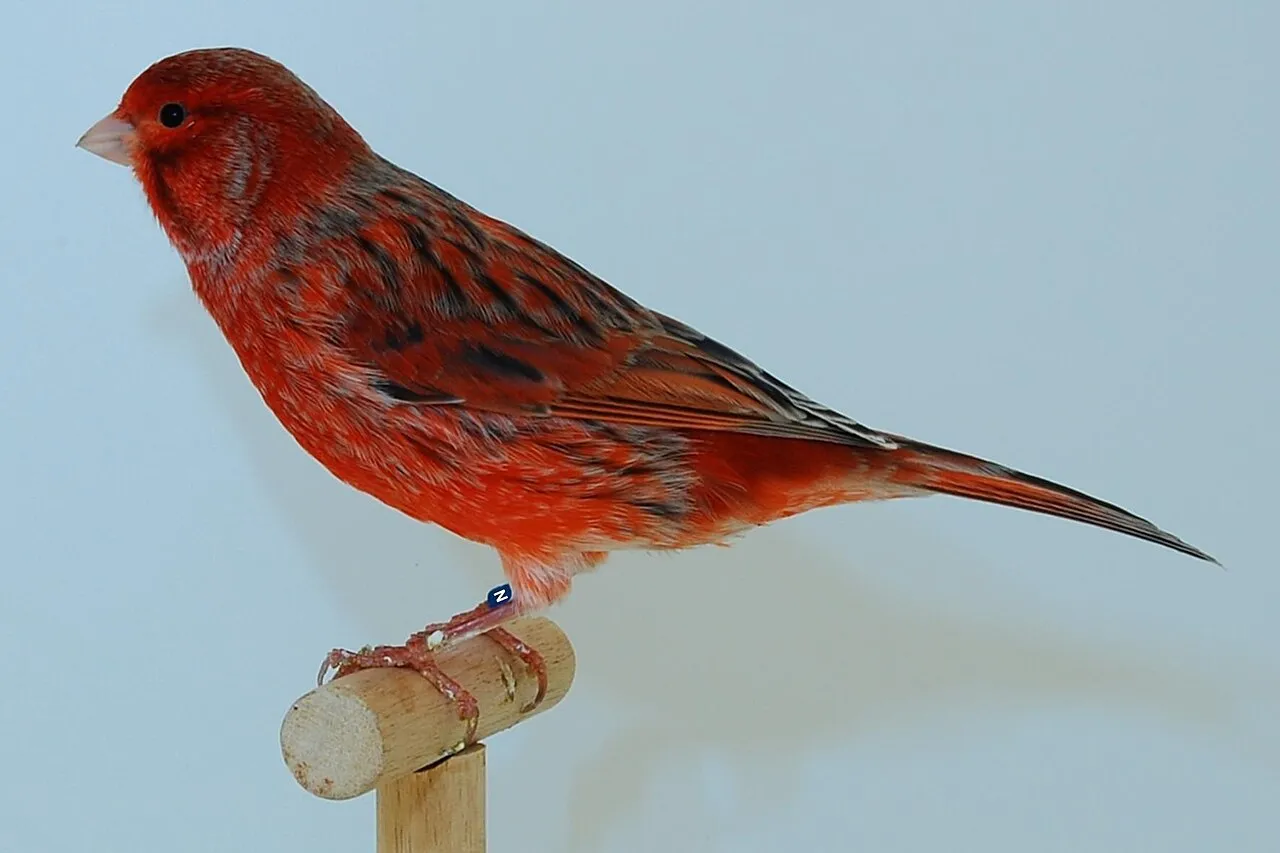
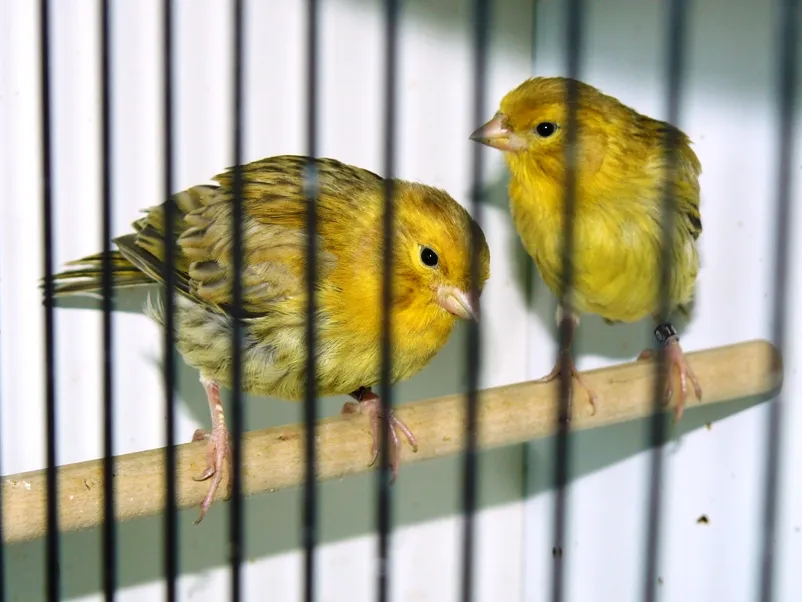
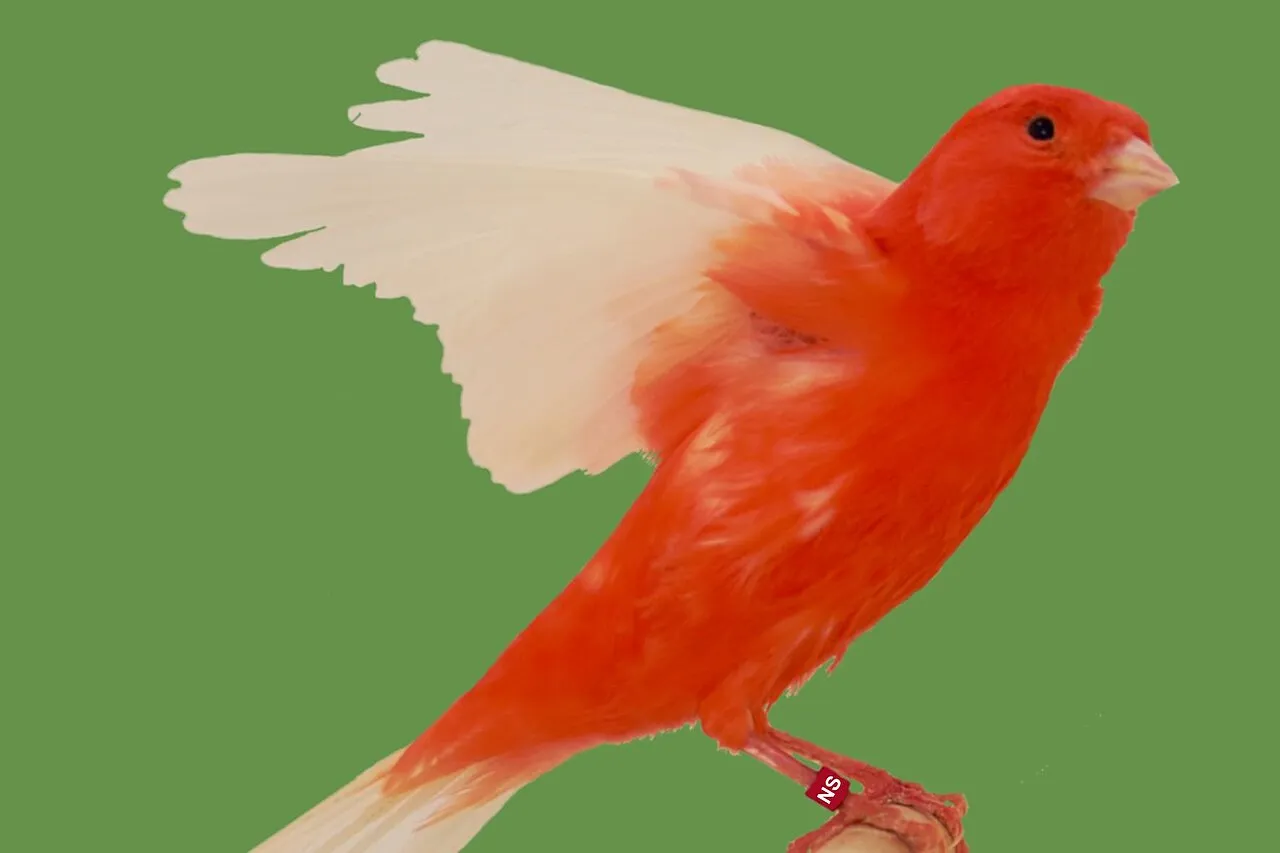
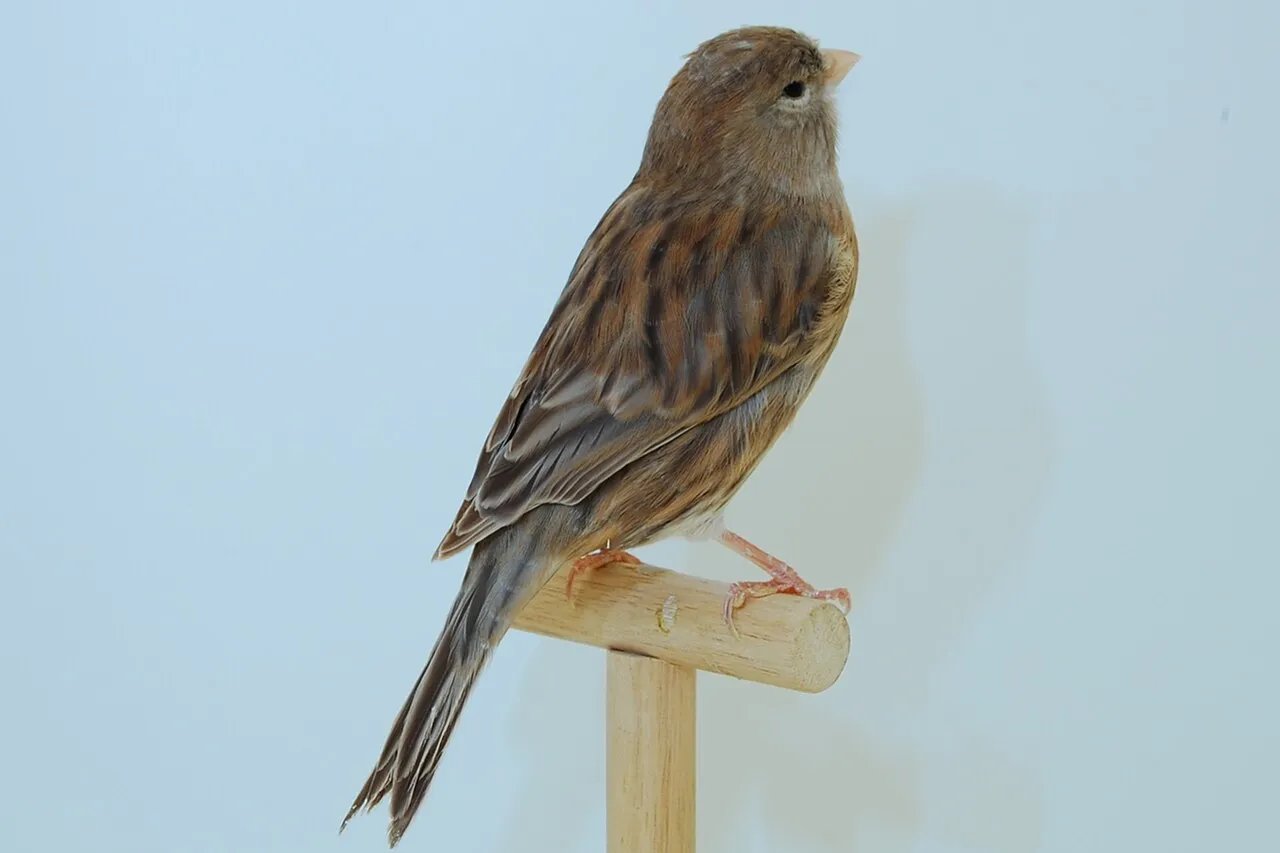
Canary plumage colour comes mainly from two pigment types: fat-soluble lipochromes that give yellow or red, and melanins that give black or brown. Birds with no melanin at all look pure yellow, red or white and are called clear; birds with melanin in patches are variegated; and birds with melanin throughout are selfs. A wild-type green canary is simply yellow lipochrome overlaid with dark melanin.
Red-factor canaries can transfer carotenoid pigments from their food into their feathers, so what they eat during the moult affects how intense their colour becomes. Breeders of red-factor birds often provide colour-enhancing food during the moult for that reason.
4.3. Senses and song organ
Canaries sing with the syrinx, a vocal organ located where the windpipe splits into the two bronchi, quite different from the human larynx. The two sides can work independently, letting the bird produce two sounds almost at once and slip in tiny breaths between notes. That is why a canary's song seems to roll on without a pause for air.
Their colour vision is excellent and is thought to extend into the ultraviolet. Hearing is acute too, and sudden unfamiliar noises easily startle them, so place the cage somewhere free of abrupt sounds.
4.4. Telling males from females
In most breeds males and females look almost identical. The surest guide is song: the bird singing long, complex, repeated phrases is nearly always a male, although some hens chirp or warble a little, which can confuse things.
During breeding season the vent can also be used. A male's vent protrudes like a small cone, while a female's is flatter and rounder. Outside the season the difference is subtle and youngsters are hard to judge. When buying a young bird whose song you haven't heard, accept that its sex may be uncertain, or ask for a DNA test.
5. Breeds
Canary breeds fall into three groups: song canaries bred for their voice, colour canaries bred for plumage colour, and type or posture canaries bred for shape and stance. There are dozens of breeds, and standards differ slightly between organisations.
| Group | Breed | Key features |
|---|---|---|
| Song | Harz Roller (German Roller) | Germany; soft, low rolling song delivered with the beak nearly closed |
| Song | Waterslager (Malinois) | Belgium; notes that sound like bubbling water |
| Song | Timbrado | Spain; bright, metallic, powerful song |
| Song | American Singer | USA; bred for both song and appearance |
| Colour | Red factor | Descended from red siskin crosses; orange to deep red |
| Colour | Yellow, white, mosaic, agate, isabel and more | Countless pigment combinations |
| Type | Gloster | Britain; small, round, with a circular crest (corona) or plain head (consort) |
| Type | Border and Fife | Britain; rounded, balanced shape, the Fife a miniature Border |
| Type | Norwich and Yorkshire | Britain; Norwich stocky, Yorkshire tall and upright |
| Type | Lizard | One of the oldest breeds, with scale-like spangling on the back |
| Type | Frills (Parisian Frill, Padovan, Gibber Italicus and others) | Curled, frilled feathers |
| Type | Belgian Bult, Scotch Fancy | Hunched or arched postures |
| Type | Lancashire | Among the largest breeds |
| Type | Raza Española | Among the smallest |
Pairing two crested Glosters, or two dominant whites, can produce chicks carrying a double dose of the gene that fail to survive, so breeders pair crested with plain-headed birds and dominant whites with other colours. Heavily feathered breeds such as the frills are also more prone to feather cysts.
6. Behaviour
NEWSchr · CC BY-SA 4.0
6.1. Wild canaries
Wild canaries live in a wide range of habitats on the Canaries, Madeira and the Azores, including forest edges, orchards, scrub and gardens. Outside the breeding season they form small flocks feeding on seeds, buds and small fruits, and in spring pairs build cup-shaped nests in trees and bushes. Wild males sing too, though with more varied, freer songs than the formalised performances of song breeds.
Wild birds are streaky greenish-brown above with a yellowish face and breast, quite unlike the bright yellow pet most people picture, and many are surprised to learn they are the same species.
6.2. At home
Canaries spend most of the day flying between perches, husking seeds and preening. They like having people around but tend to find being handled or caught very stressful, so bonding with a canary means sitting nearby, talking to it and letting it sing in peace.
A male's song builds from late winter as days lengthen, peaks from spring into early summer and almost stops during the late-summer moult, resuming gradually in autumn once new feathers are in. Two males in one cage are prone to territorial squabbles, and a male housed with a hen tends to sing less as he focuses on her. That is why people who keep canaries for song usually keep a single male on his own.
Hens are quieter, but in spring they may shred floor paper or crouch in the corner of a dish in search of a nest site.
6.3. Signals to read
- Chest out, throat swelling, pouring out a long song: a healthy, contented male.
- Short 'chip' calls: routine contact sounds.
- Sharp repeated alarm notes while standing tall: startled by a cat, a shadow or an unfamiliar object.
- Fluffed with head tucked into the back: sleeping; if it persists during the day, suspect illness.
- Crouching low with fluttering wings: a breeding-condition hen inviting a mate.
- A song that turns hoarse or includes clicking: may signal respiratory trouble.
- Beak open and wings held away from the body: overheating.
- Falling silent outside the moult: check for stress or illness.
7. Life stages
Canaries typically live 8 to 12 years, and some reach about 15 in good conditions. Some keepers feel that certain type breeds are a little shorter-lived.
| Stage | Age | What happens |
|---|---|---|
| Egg | About 13 to 14 days | Incubated by the hen alone; usually one egg laid each morning |
| Chick | 0 to 2 weeks | Hatches almost naked; eyes open at about a week |
| Fledgling | 2 to 3 weeks | Leaves the nest at around 16 to 21 days |
| Weaning | 3 to 5 weeks | The father keeps feeding until the chick eats alone |
| Juvenile | 5 weeks to 3 months | Partial first moult of body feathers; young males practise song |
| First year | 3 months to 1 year | Flight feathers kept until the next moult; ready to breed the following spring |
| Adult | 1 to 7 years | Song and breeding at their peak |
| Senior | 8 years and up | Sings less, slower moults, more foot and nail problems |
Older canaries sing in shorter bursts, take longer to moult, develop thicker leg scales and faster-growing nails. As grip weakens they spend more time on the floor, so lower the perches and vary their thickness. Seniors are also more sensitive to cold and sudden changes, so avoid moving the cage around.
8. Housing
Mike's Birds from Riverside, CA, US · CC BY-SA 2.0
8.1. Cage and location
Because canaries fly back and forth, choose a long cage of at least 60 cm wide, 30 cm deep and 40 cm high, and if possible a flight cage 80 cm or more in length. Bar spacing of about 1 cm is suitable. Place a perch at each end to leave open flying space in the middle. Canaries need few toys, and clutter can actually get in the way of flight.
Keep the cage in a lived-in room but away from windows with constant direct sun, air-conditioner or heater vents and the kitchen. Eye height and one side against a wall help the bird feel secure. Keep cats and dogs from approaching the cage; a frightened canary can injure itself thrashing about at night.
8.2. Temperature and light cycle
Canaries do well at 18 to 25°C and handle cooler conditions better than many pet birds. Large day-night temperature swings and draughts, however, quickly knock them off condition. In midsummer above 30°C provide shade, ventilation and bath water, and in winter keep the room above about 10°C.
The light cycle is especially important. Song, breeding and moult are all regulated by day length, so evenings under living-room lights confuse a canary's sense of season. The result can be a soft moult, where feathers keep dropping and the moult never properly ends. Aim for roughly 12 to 14 hours of light and 10 to 12 of darkness, covering the cage or moving it to a quiet room after dusk.
8.3. Air quality
As mining history shows, canaries are extremely sensitive to airborne toxins. Indoor smoking and vaping, candles and incense, plug-in fresheners, aerosols, insecticides, paint and glue fumes and smoke from overheated non-stick cookware can all harm them. Cut back on these in the bird's space and ventilate often. If you use an air purifier, keep it far enough away that it doesn't blow directly on the cage.
8.4. Equipment checklist
- A long cage or flight cage with bars about 1 cm apart
- Two or three natural-wood perches of varied thickness
- At least two food and two water dishes, plus a clip-on bath
- Canary seed mix or small finch pellets
- Cuttlebone, crushed oyster shell and mineral grit
- Egg food for the moult and breeding season
- A vegetable clip
- A cage cover for the night
- Fly screens to keep mosquitoes out in summer
- A digital gram scale
- A travel carrier
- Floor paper or sanded cage sheets
9. Diet
9.1. Staple diet and portions
The staple is a canary seed blend built around canary seed with rapeseed, perilla, flax, oats and similar seeds. Budgie mixes are millet-heavy and not ideal, so choose a canary-specific blend. Adding small finch pellets helps balance vitamins and minerals; introduce them gradually to seed-eating birds.
An adult eats about 4 to 6 grams a day, a little over a teaspoon. Blow off husks and top up daily, and change water at least once a day. Keep a cuttlebone, crushed oyster shell and mineral grit available at all times for calcium and minerals.
9.2. Greens and supplements
Give a little nutritious greenery daily, such as bok choy, kale, broccoli, dandelion leaves, chickweed and sprouts; dark leaves beat watery iceberg lettuce. Fruit such as apple or pear in tiny amounts now and then is plenty.
Protein needs rise sharply during moult and breeding. Offer canary egg food or mashed hard-boiled egg three or four times a week in small amounts, and sprouted seed makes another good supplement. Red-factor birds develop deeper colour if given colour food during the moult, but overuse can strain the liver, so stick to the product's dosage.
9.3. Summary and foods to avoid
| Food | How often | Amount |
|---|---|---|
| Seed mix and pellets | Daily | 4 to 6 g a day |
| Leafy greens | Daily | One or two leaves |
| Egg food | Three or four times a week in moult and breeding, about weekly otherwise | Around a small spoonful |
| Cuttlebone and oyster shell | Always available | Free choice |
| Fruit | Occasionally | Tiny amounts |
Keep these away from your canary:
- Avocado
- Chocolate, coffee, energy drinks and alcohol
- Salty or seasoned food and snacks
- Onion and garlic
- Mouldy seed
- Cigarette smoke and vape aerosol
- Insecticides and mosquito sprays
- Overheated non-stick pan fumes, candles and air fresheners
10. Health and disease
NEWSchr · CC BY-SA 4.0
Canaries hide illness well, and their small size means disease progresses quickly. Knowing your bird's song and moult patterns makes it easier to spot when something is wrong. Vets who treat small birds are not common, so find one in advance and quarantine any new bird for at least 30 days. The following is background information only; diagnosis and treatment must come from a vet.
10.1. Common conditions
| Condition | Cause | Main signs | Prevention and response |
|---|---|---|---|
| Air sac mites | Mites in the trachea and air sacs | Hoarse voice, stopping singing, clicking breath, open-beak breathing | Diagnosis and treatment, quarantine newcomers |
| Canary pox | Poxvirus spread by mosquitoes and contact | Wart-like lumps on eyelids and feet; the respiratory form is often fatal | Fly screens, mosquito control, isolate cases |
| Scaly leg mites | Mites under the leg scales | Thick, white, flaking leg scales | Early treatment |
| Feather cysts | Feathers curling under the skin instead of emerging | Yellowish lumps on wings or back | Common in heavily feathered breeds; vet treatment |
| Atoxoplasmosis | Protozoan infection | Swollen belly in youngsters, enlarged liver visible through the skin, sudden death | Hygiene, careful management of adults and young |
| Red mites | Blood-feeding parasites active at night | Restless at night, anaemia, chick deaths | Clean crevices, regular checks |
| Soft moult | Irregular light and temperature | Feathers dropping out of season | Steady light cycle |
| Obesity and fatty liver | Too much fatty seed, little exercise | Yellow fat visible on the belly, sluggish | Balanced diet, roomy cage |
| Egg binding | Low calcium, cold | Tail-pumping, straining, crouching on the floor | Calcium, proper temperature, emergency care |
Be especially alert to canary pox in the mosquito season. If small lumps appear around the eyes, beside the beak or on the feet, separate the bird and see a vet. The respiratory form progresses quickly and is frequently fatal, so prevention matters most.
10.2. When to see a vet
- Sudden silence or a hoarse voice outside the moult
- Pronounced tail movement or clicking with each breath
- Sitting fluffed on the floor or on the food dish
- Loose or discoloured droppings and a soiled vent
- Lumps or scabs on the eyelids, around the beak or on the feet
- Weight loss of 1 to 2 grams or more in a week
- A hen straining without passing an egg
- Constant restlessness and scratching at night
Keep the carrier warm and covered on the way to the clinic, and take along floor paper with recent droppings to help with diagnosis.
11. Breeding
Canary breeding starts in spring as the days lengthen. Breeders gradually extend the lighting from late winter and increase egg food to bring birds into condition, generally pairing healthy birds at least a year old. The hen builds a cup nest in a nest pan from dry grass, coconut fibre or commercial nesting material and usually lays three to five eggs, one each morning.
The hen incubates alone for about 13 to 14 days while the male feeds her. Many breeders swap each egg for a dummy as it is laid and return the real eggs together after the last one, so the chicks hatch at about the same time. Chicks leave the nest at around 16 to 21 days and are fed by their father for another week or two while they learn to eat for themselves.
- Avoid long threads or wool as nesting material; use short fibres that can't tangle around chicks' legs.
- Breeding hens need much more calcium, so provide plenty of cuttlebone and oyster shell.
- Never pair two crested birds or two dominant whites.
- Limit pairs to two or three rounds a year and give them a rest before the moult.
- Think first about whether you can care for every chick, and whether you have space to house young males separately.
If you don't plan to breed, leave out the nest pan and material and don't extend the daylight excessively; both help prevent unwanted laying.
12. Costs
These are rough ranges; prices depend on breed, bloodline, seller, country and clinic.
| Item | Typical range | Notes |
|---|---|---|
| Bird | 25 to 120 dollars | Song breeds and show-quality type canaries can cost more |
| Cage | 40 to 120 dollars | Long cage or flight cage |
| Basic equipment | 25 to 50 dollars | Dishes, bath, perches, cover, carrier |
| First vet visit | 25 to 80 dollars | Faecal test, mite check and more |
| Monthly food and supplements | 8 to 15 dollars | Seed, greens, egg food |
| Monthly supplies | 4 to 8 dollars | Floor paper, grit |
| Annual check-up | 25 to 80 dollars | |
| Emergency care | Tens to several hundred dollars | Respiratory illness, egg binding |
Canaries don't destroy toys and eat very little, so they are among the cheaper pet birds to run. Allow for seasonal needs such as fly screens and winter warmth, and for travel to a clinic that treats small birds.
13. Before you get one
Before getting a canary, consider the following.
- Are you happy with a bird to listen to and watch rather than one that sits on your hand?
- If you want song, can you be confident the bird is male?
- Can you cut back on smoking, candles and sprays at home?
- Can you dim lights or cover the cage after dark to keep a regular light cycle?
- Can you commit for 8 to 12 years or more, with a small-bird vet nearby?
- Can you keep the cage safe from cats and other animals?
Ideally, hear the bird sing before you buy. A healthy canary has sleek, glossy feathers, bright round eyes, quiet breathing and an upright stance on the perch. Avoid birds with white, flaky leg scales, a soiled vent or a fluffed, sleepy look. Males rarely sing during the late-summer and autumn moult, so if you buy then, ask the seller how the bird's sex was determined.
If you plan to keep several canaries, arrange space so males are not housed together, and quarantine newcomers before introductions.
14. Laws and regulations
The canary is a domesticated bird bred in captivity for centuries. It is not listed under CITES and is not a protected species under Korea's wildlife law, so no special permits or paperwork are needed to keep one at home in most countries.
- Animal welfare laws in Korea and elsewhere apply to birds, so cruelty and abandonment can be prosecuted; check current rules where you live.
- Mandatory pet registration, where it exists, generally covers dogs rather than birds.
- During highly pathogenic avian-influenza outbreaks, bird sales, movements and shows may be suspended.
- Taking a canary abroad or importing one involves veterinary certification and the destination country's import rules.
- If you breed and sell canaries regularly, ask your local authority whether a business licence is required.
Releasing a pet canary outdoors can count as abandonment, and a bird raised by people lacks the skills to find food and evade predators.
15. Canaries in culture
The canary has become shorthand for yellow. 'Canary yellow' is a standard colour name in English, and the bird lends its name to many teams in yellow kit. Brazil's national football team is nicknamed Canarinho, 'little canary'; England's Norwich City are The Canaries; and Turkey's Fenerbahçe are the Yellow Canaries.
The most famous cartoon canary is Tweety from Warner Bros.' Looney Tunes, the big-headed yellow bird who always escapes Sylvester the cat. In Japan, a children's song published in 1918 about a canary that has forgotten how to sing became a lasting classic.
The idiom 'canary in the coal mine' is used worldwide, including in Korean news coverage of early signs of economic or environmental trouble. In English slang, to 'sing like a canary' means to inform on one's accomplices to the police.
16. Trivia
- Canaries starred in research showing that adult brains can grow new neurons. In the 1980s the American neuroscientist Fernando Nottebohm and colleagues showed that the song-control regions of male canary brains grow and shrink with the seasons and gain new nerve cells, challenging the then-dominant belief that adult brains could not make new neurons.
- Song-breed fanciers traditionally raise young Harz Roller males within earshot of a fine 'tutor' singer, since canary song is partly innate and partly learned.
- London's Canary Wharf takes its name not from the bird but from a quay used for fruit trade with the Canary Islands.
- Because red canaries take their colour from food eaten during the moult, the same bird can vary in intensity from year to year.
- Mules, hybrids between canaries and goldfinches, are usually infertile but prized for their attractive song and plumage.
- Revival cages once used for mine canaries are now displayed in British museums as a reminder of industrial history.
Health notes are general information. If something seems wrong, contact a vet who treats this species.
FAQ
Do female canaries sing?
Hens chirp and twitter, but the long, complex song is almost always a male's. A few females do sing a little, just not with the same range.
Will a single canary be lonely?
No. Canaries are fairly solitary by temperament, and a lone male often sings more than one housed with a mate.
How do I help a canary through the moult?
The moult usually runs six to eight weeks in late summer. Boost protein with egg food, keep things calm, and avoid moving the cage or changing the light schedule until it's over.
Further reading
Photo credits
Photos are freely licensed images from Wikimedia Commons. Authors and licenses are listed below.
- GelbA.JPG — NEWSchr · CC BY-SA 4.0
- Achat rot schimmel.jpg — NEWSchr · CC BY-SA 4.0
- Achátoví kanáři.JPG — Moták · CC BY 3.0
- Aufgehellt rot weissfluegel intensiv.jpg — NEWSchr · CC BY-SA 4.0
- Bloedel Conservatory Bird (34528525444).jpg — Mike's Birds from Riverside, CA, US · CC BY-SA 2.0
- Braun weiss.jpg — NEWSchr · CC BY-SA 4.0