TailVille
At a glance
Rough ranges for supplies, food and electricity in Korea (USD is approximate). Purchase or adoption fees are not included.
Families wanting a small, low-odour pet that is awake during the day and fun to watch together.
Anyone set on keeping just one animal, or without room for a deep-bedded tank.
1. Overview
The Mongolian gerbil is a small rodent from the dry grasslands of Mongolia and northern China. About the size of a dwarf hamster, it has a long, furry tail with a tuft at the tip and a habit of standing upright on its hind legs to scan for danger, which gives it a faintly kangaroo-like look.
Gerbils have two big selling points as pets: they barely smell, and they are awake on and off throughout the day. Built for the desert, they drink little and pass only small amounts of concentrated urine, so a well-kept enclosure has almost no odour. They sleep in short bouts around the clock, which means far more chances to watch them than with an evening-only hamster.
The catch is that gerbils are intensely social. Keeping one on its own is not recommended; the standard set-up is two of the same sex raised together, in a glass tank filled deep with bedding so they can dig real tunnels. This article covers their history, natural behaviour, housing, diet, introductions, common health problems and the law.
2. Name and classification
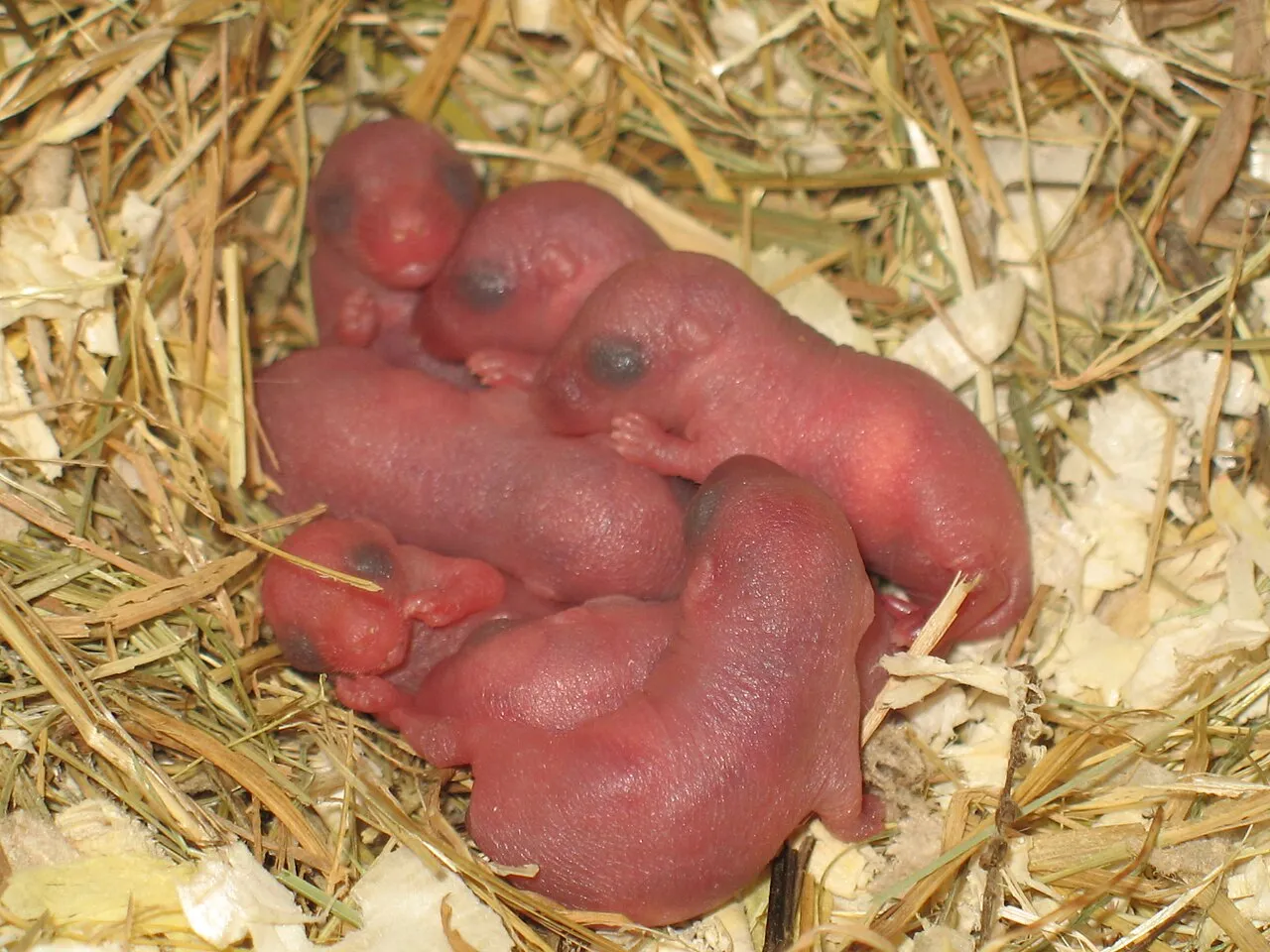
Tedi11 · Public domain
2.1. Scientific name and etymology
The Mongolian gerbil's scientific name is Meriones unguiculatus. Meriones is generally said to come from the name of a warrior in Greek legend, while unguiculatus is Latin for 'with small claws', a nod to the sharp nails it uses for digging. It belongs to the subfamily Gerbillinae within the family Muridae, a group of roughly a hundred species of gerbils and jirds spread across the deserts and steppes of Africa and Asia.
2.2. Common names
In English it is simply the gerbil, or the Mongolian jird. 'Jird' is used for the larger Meriones species, of which the pet gerbil is technically one, while 'gerbil' covers the whole subfamily. In Korean the pet is known by the loanword jeobil and sometimes as moraejwi, literally 'sand rat'.
2.3. Relatives in the pet trade
The Mongolian gerbil is by far the commonest pet species, but enthusiasts abroad also keep fat-tailed gerbils, which store fat in a club-shaped tail, Shaw's jirds and pallid gerbils. Their social needs and care differ, so advice for one species does not automatically apply to another. In everyday use, 'gerbil' means the Mongolian gerbil.
3. History
3.1. From steppe to laboratory to living room
The Mongolian gerbil was described by European naturalists in the nineteenth century. In the first half of the twentieth century Japanese researchers began breeding it for laboratory use, and the widely told story is that a small number were brought to the United States around 1954. Many pet gerbils in America and Europe are said to descend from that founding group. Gentle, odour-free and easy to breed, gerbils became popular pets from the 1960s onward.
3.2. Gerbils in Korea
There is no clear record of when gerbils first appeared as pets in Korea, but they seem to have spread among small-animal enthusiasts later than hamsters, from around the 2000s. They are still less widely sold than hamsters, and prices vary a lot between sellers. Interest is growing among people looking for a low-odour pet that is active during the day.
4. Physical characteristics
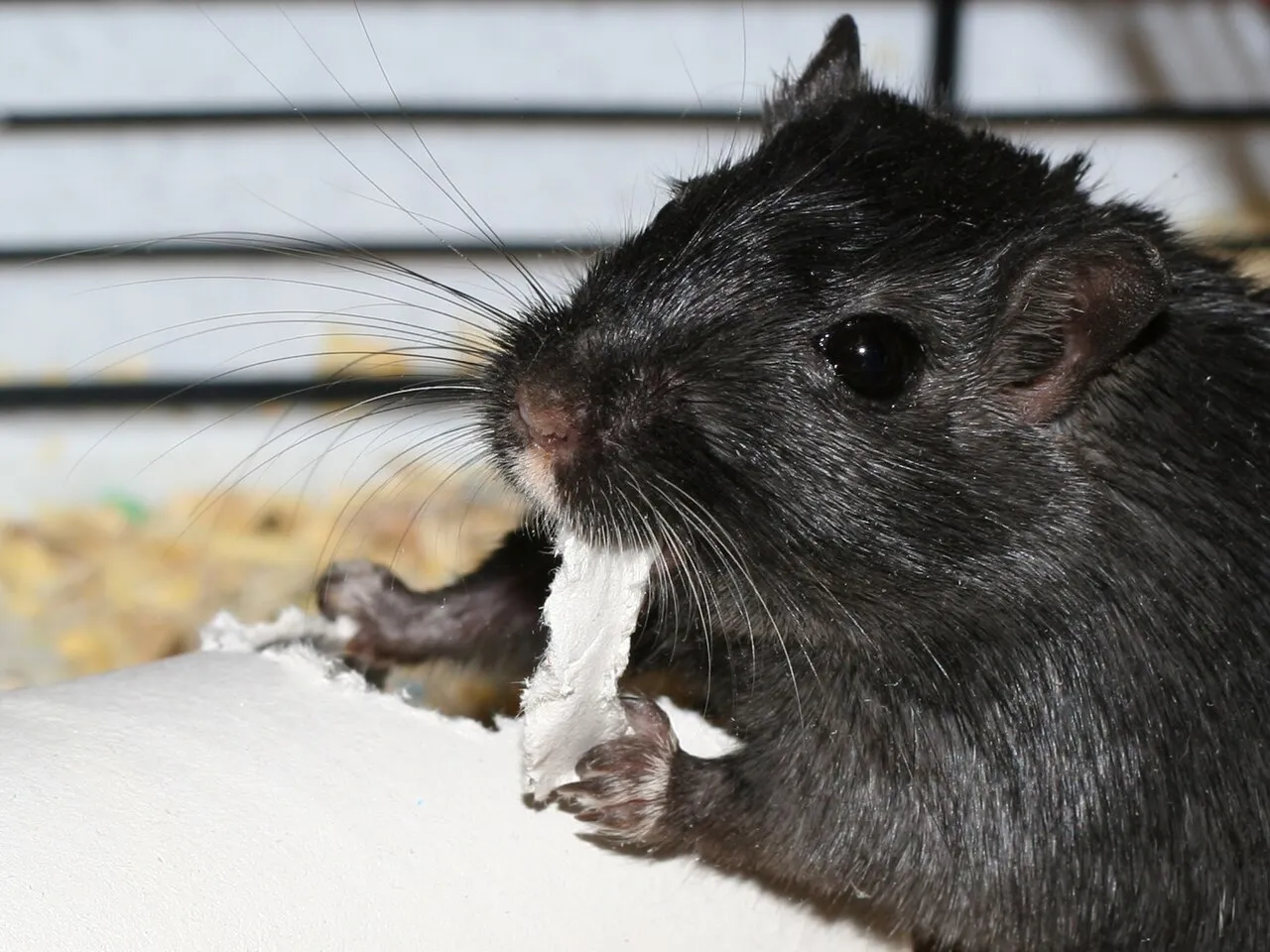
Gophi · CC BY-SA 4.0
4.1. Size and build
| Measure | Typical range | Notes |
|---|---|---|
| Body length | 10–12 cm | Excluding tail |
| Tail | 9–11 cm | Furred, with a terminal tuft |
| Weight | 50–100 g | Males slightly heavier |
| Hind feet | Long and strong | For standing and leaping |
Long hind legs let gerbils stand tall to look around and spring surprisingly high when startled. The short front paws have sharp claws for rapid digging.
4.2. Coat and senses
Wild-type gerbils are 'agouti': sandy brown with dark-tipped hairs on the back and a white belly. The tail is fully furred, but its skin is designed to slip off if a predator grabs it, so never pick a gerbil up by the tail. Large eyes and ears help spot predators across open ground, and gerbils are known for sensitive low-frequency hearing. A scent gland in the middle of the belly is used to mark territory.
4.3. Telling the sexes apart
Adult males have an obvious scrotum, are slightly larger and have a more prominent belly scent gland. In youngsters, the gap between genital opening and anus is longer in males. Mixed pairs breed fast, so double-check the sexes when buying.
5. Colour varieties
Decades of captive breeding have produced many colours. Common ones include:
| Colour | Appearance | Notes |
|---|---|---|
| Golden agouti | Wild type: sandy with dark ticking, white belly | The commonest |
| Black | Solid black, sometimes white toes | |
| White or ivory | White or cream, often red or ruby eyes | Includes albino forms |
| Silver agouti | Greyish with white belly | |
| Slate and lilac | Blue-grey to grey-lilac | |
| Burmese and Siamese | Pale body with darker points | Pointed like a Siamese cat |
| Pied or spotted | White patches or a forehead spot |
Names vary between countries and breeders. Colour has no known effect on temperament, so choose a bright, healthy animal over a rare shade.
6. Behaviour
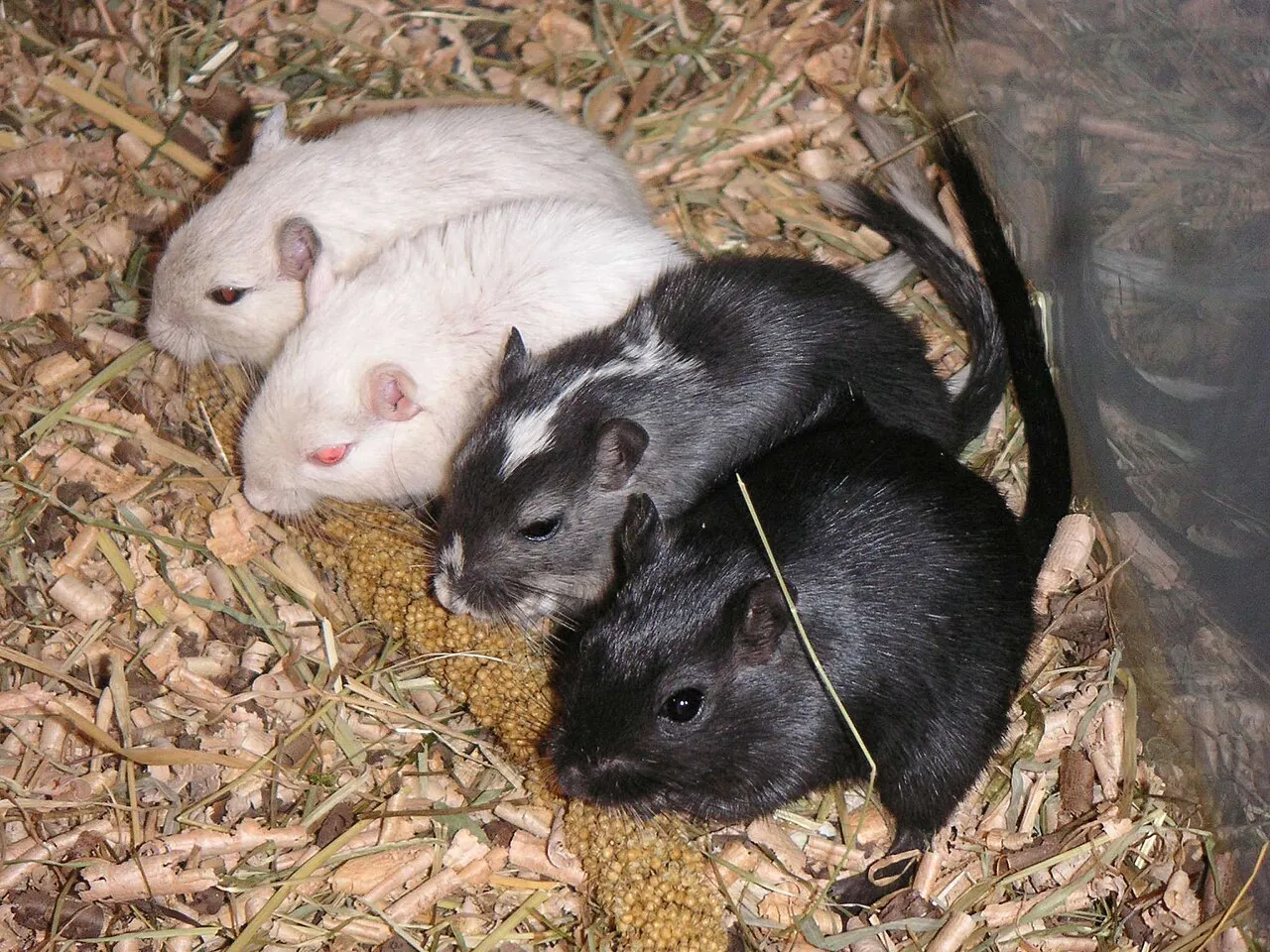
No machine-readable author provided. Mausmac assumed (based on copyright claims). · Public domain
6.1. Life in the wild
Wild gerbils endure a brutal climate, with summer highs near 40°C and winter nights far below freezing. They cope by digging burrows with multiple entrances, nest chambers and food stores, shared by a family group of a breeding pair and several generations of offspring. Group members recognise each other by scent and drive off strangers. Gerbils do not hibernate; they survive winter on seeds stored in autumn.
6.2. Behaviour at home
At home gerbils wake in short bursts throughout the day to dig, shred cardboard and groom one another. Seeing a pair curled up asleep together is one of the joys of keeping them. They are curious: a new object is investigated within minutes, and many will climb onto an offered hand to explore.
Frantic digging in one corner, often called corner-digging, is a classic sign that the bedding is too shallow for real burrows. Giving them enough depth to build tunnels usually reduces it.
6.3. Reading the signals
- Thumping the hind feet: an alarm signal, or excitement during mating
- Standing upright with ears pricked: checking the surroundings
- Grooming each other: a healthy bond
- Leaping and twisting in the air: excitement or play
- Tail drumming: tension or arousal
- Chasing with tail-biting and fur flying: a real fight that may require separation
- High squeaks: young calling their mother, or a startled gerbil
Telling play from fighting matters. Wrestling that ends quickly with mutual grooming is usually fine; one gerbil being chased relentlessly, hiding and getting wounds is not.
6.4. Pairing and group life
The most important decision in gerbil keeping is who your gerbil lives with. The simplest route is two littermates of the same sex. Introducing a new companion to an adult usually involves the split-tank method: divide the tank with a mesh partition so the gerbils can smell but not touch each other, and swap sides every day or two. When they groom through the mesh or sleep side by side against it, the divider can come out.
Pairs that have lived together happily for months can still fall out suddenly, a process keepers call declanning. It is reported to be more common in groups of three or more and in adult males. If one gerbil is being chased constantly or has bite wounds on the tail or rump, separate them immediately, which is why a spare tank and divider are worth having from day one.
A gerbil left on its own after a split may become lonely, so consider introducing a new companion or keeping the two side by side with a divider so they can still share scent.
7. Life stages
| Stage | Age | What happens |
|---|---|---|
| Newborn | 0–2 weeks | Hairless, eyes and ears closed |
| Furring up | about 1–3 weeks | Coat grows, ears open |
| Eyes open | about 2.5–3 weeks | Begins exploring outside the nest |
| Weaning | about 3–4 weeks | Starts eating solid food |
| Ready for a new home | about 6–8 weeks | Fully independent; sex can be confirmed |
| Sexual maturity | about 9–12 weeks | Can breed |
| Adult | about 6 months to 2 years | Most active period |
| Senior | from about 2.5 years | Weight loss, more tumours and ear disease |
Gerbils typically live three to four years, occasionally close to five. Older gerbils lose coat condition, slow down and spend more time resting than digging. Weigh seniors weekly to catch sudden weight loss.
8. Housing
Ducky3.14 at en.wikipedia · CC BY 2.5
8.1. Choosing an enclosure
Gerbils do best in glass tanks rather than wire cages. Burrowing needs 20 cm or more of bedding, which wire cages spill everywhere, and bar-chewing causes sore noses. For a pair, treat 80 × 40 cm of floor as a minimum and go bigger if you can. A tank-topper, a wire section on top of a tank, adds ventilation and climbing space.
Always fit a secure mesh lid. Plastic storage boxes are cheap but gerbils soon chew through them.
8.2. Temperature, humidity and light
Keep the room at 18–24°C with fairly dry air, around 30–50% humidity. Damp conditions cause clumped fur and sore noses. Glass tanks heat up like greenhouses in sunlight, so keep them away from windows and heaters. No special lighting is needed beyond a natural day-night cycle.
8.3. Equipment checklist
- Glass tank or tank-topper, at least 80 × 40 cm for a pair
- Secure mesh lid
- Paper bedding mixed with hay, 20 cm deep or more
- Wooden or ceramic hides and cork tunnels
- Solid wheel, 25 cm or larger
- Sand bath and dust-free chinchilla sand
- Ceramic bowl and water bottle
- Cardboard boxes, tubes and wood chews
- A spare tank and a mesh divider in case of fallouts
- Digital scale
9. Diet
9.1. Staple and extras
Use a gerbil mix or a rodent pellet with seeds as the staple. On a mix alone, gerbils often eat only the sunflower seeds and peanuts, so wait until the bowl is genuinely empty before refilling. Scattering some food through the bedding lets them forage as they would in the wild.
Offer small pieces of carrot, broccoli, cucumber, squash or bok choy a few times a week, but too much watery veg can cause diarrhoea. A mealworm or a little boiled egg once or twice weekly adds protein.
9.2. How much and how often
| Item | Per gerbil | Frequency |
|---|---|---|
| Mix or pellets | about 10 g (one tablespoon) | Daily |
| Vegetables | 1–2 fingernail-sized pieces | 3–4 times a week |
| Fruit | A tiny piece | Once a week at most |
| Sunflower seeds, peanuts | 1–2 | Treats only |
| Mealworms or egg | A little | 1–2 times a week |
| Water | Bottle always available | Fresh daily |
Gerbils drink little, but they still need constant access to water. Check daily that the bottle spout is flowing.
9.3. Foods to avoid
- Chocolate, sweets and snacks
- Onion, garlic, leeks and chives
- Grapes and raisins
- Citrus fruit and rhubarb
- Raw beans and raw potato
- Salty or seasoned human food
- Stale or mouldy food
10. Health and disease
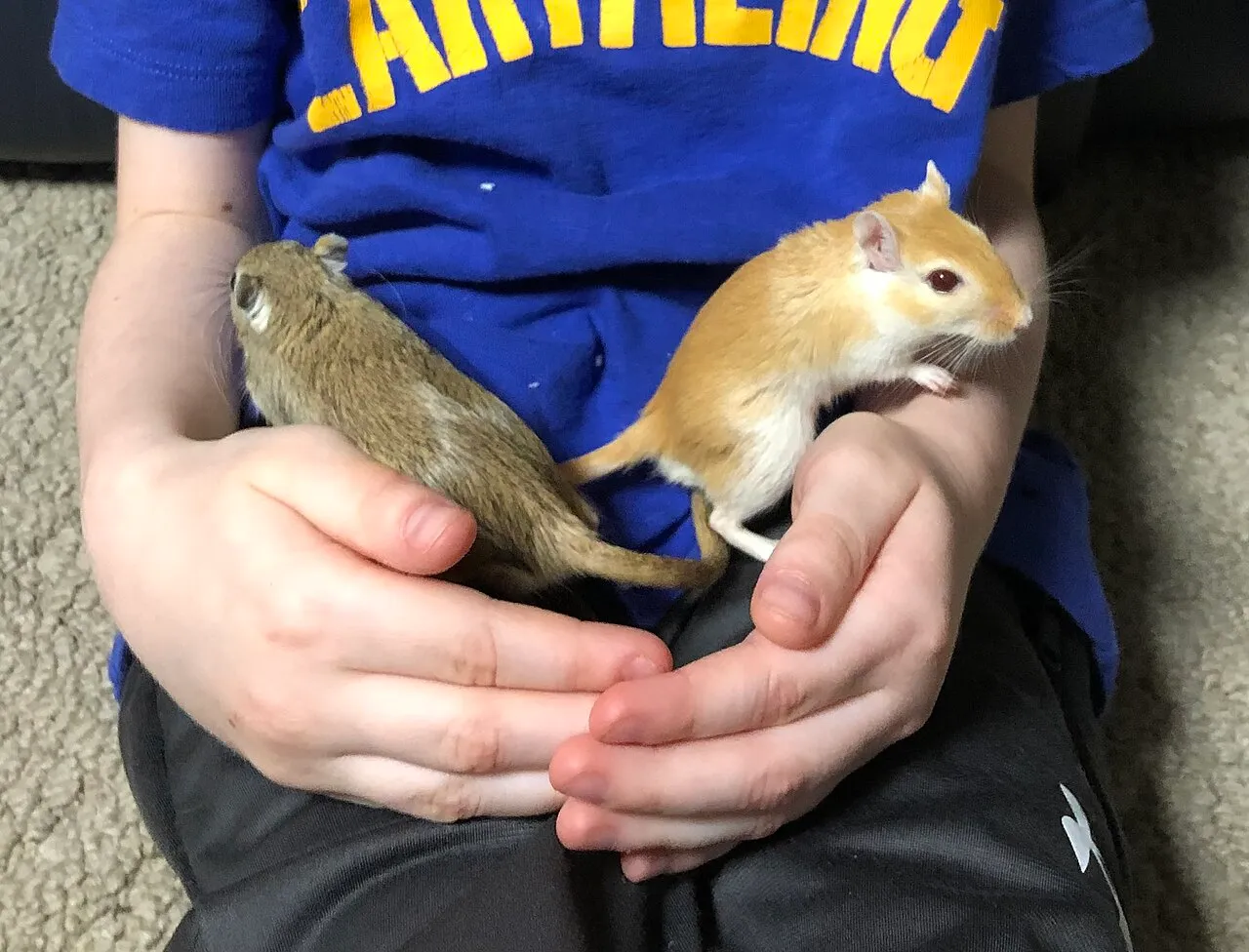
Dianne1009 · CC BY-SA 4.0
10.1. Common conditions
| Condition | Cause | Signs | What to do |
|---|---|---|---|
| Seizures | Genetic tendency, sudden stimuli | Stiffening or twitching, recovery within minutes | Keep quiet; gentle varied handling when young may help |
| Tail degloving | Grabbed by the tail | Skin stripped off, bleeding | Never hold the tail; see a vet |
| Sore nose | Humidity, irritating bedding, bar-chewing, stress | Red, crusty skin and hair loss around the nose | Dry conditions, avoid wire cages |
| Tyzzer's disease | Bacterial infection | Diarrhoea, lethargy, sudden death | Hygiene and fast treatment |
| Scent-gland tumour | Ageing, mostly males | Lump or ulcer on mid-belly | Check regularly, discuss surgery early |
| Ear disease | Ageing | Head tilt, loss of balance, discharge | Vet care |
| Ovarian cysts | Older females | Swollen belly, hair loss | Vet care |
| Overgrown teeth | Too little to gnaw | Unable to eat | Cardboard and wood chews |
Gerbil seizures look alarming but are usually harmless, and many gerbils have fewer as they age. If seizures are prolonged or frequent, talk to your vet.
10.2. When to see a vet
- Not eating or drinking for a day or more
- Diarrhoea or a wet rear
- Head tilt or circling
- Clicking breathing or nasal discharge
- Lumps, wounds or large bald patches
- One gerbil constantly chased and bitten
- Rapid weight loss
Small animals go downhill fast. Find an exotic vet with small-mammal experience in advance.
11. Breeding
Gerbils can breed from about nine to twelve weeks old, with a gestation of roughly 24–26 days and typical litters of four to six. Females can conceive again right after giving birth, so a mixed pair may produce a litter almost every month. Fathers often help care for the young, so a breeding pair forms a family group much as in the wild.
Breeding at home means sexing the pups accurately, separating them by six to eight weeks and finding every one a good home. Some lines carry a strong tendency to seizures, so random breeding is not a good idea. If you are not planning to breed, keep a single-sex pair.
12. Costs
Rough 2026 ranges in Korea for a pair:
| Item | Estimated cost (KRW) | Notes |
|---|---|---|
| Gerbils | 10,000–50,000 each | Depends on colour and seller |
| Glass tank or tank-topper | 70,000–200,000 | By size |
| Wheel, hides, sand bath | 30,000–70,000 | |
| Bedding, hay, sand | 20,000–40,000 | First bulk purchase |
| First vet check | 20,000–50,000 each | Exotic clinic |
| Start-up total (excluding animals) | about 150,000–350,000 | |
| Monthly food and treats | 5,000–10,000 | For two |
| Monthly bedding and cardboard | 10,000–20,000 | |
| Emergency care | tens to hundreds of thousands | Tumour surgery and the like |
Because gerbils produce so little urine, bedding lasts longer than with hamsters, keeping running costs low.
13. Before you get one
- Two or more: plan to bring home a same-sex pair, ideally littermates.
- Check the sexes: sellers sometimes get it wrong, so confirm yourself or with a vet.
- Health: clear eyes, a clean nose, an intact tail and a dry rear.
- Age: around six to eight weeks is ideal; younger gerbils stress easily.
- Space: room for an 80 × 40 cm tank, plus somewhere to store a spare tank in case of a fallout.
- Family: teach children to cup a gerbil in both hands and never to touch the tail.
- Other pets: secure the lid so cats or dogs cannot get in.
- Vet: locate a nearby exotic vet before you need one.
Rescues and small-animal communities sometimes have gerbils needing new homes.
14. Laws and regulations
Gerbils are legal to keep in most countries without a licence. There are notable exceptions: California and Hawaii in the United States prohibit them, on the grounds that escaped gerbils could establish feral colonies and damage crops and native ecosystems. Countries with strict biosecurity, such as Australia and New Zealand, tightly control which rodents may be imported or kept, so rules there can differ from state to state.
In Korea there are no known special restrictions, and gerbils do not need to be registered the way dogs do. Wherever you live, never release a pet gerbil outdoors; it is unlikely to survive and may count as abandonment. Laws change, so check with your local authority if you are unsure, especially before moving abroad with a pet.
15. Gerbils in culture
In the 1960s and 70s gerbils became a classic first pet in the United States and Britain, and the classroom gerbil remains a fixture of children's books and sitcoms as a lesson in responsibility. They also matter to science: gerbils have long been used in research on hearing, epilepsy and stroke.
In Korea they appear in popular culture far less often than hamsters, but videos showing gerbils excavating tunnels against the glass of deep tanks have helped raise their profile on social media.
16. Trivia
- A gerbil may pass only a few drops of urine a day, which is why its enclosure smells so little.
- Foot thumping is thought to warn burrow-mates through vibrations in the ground.
- Group members rub their belly glands on each other and on objects to share a common family scent.
- The tail skin's tendency to slip off is an escape adaptation, but a degloved tail does not grow back.
- Encouraging tunnels against the glass gives a cross-section view of burrow life, which some owners call a gerbil ant farm.
- Gerbils do not hibernate, so their activity stays fairly steady through the seasons.
Health notes are general information. If something seems wrong, contact a vet who treats this species.
FAQ
Do gerbils really not smell?
They produce very little urine, so they smell much less than hamsters or rats. Bedding left far too long or rotting vegetables will still cause odour.
Why does my gerbil thump its back feet?
Foot drumming warns other gerbils of danger and also happens when they are excited. If it keeps up, look for noise or other pets that might be frightening them.
Are gerbils easier than hamsters?
Gerbils are awake by day, smell less and tame faster, but they need a companion and a deep tank. Choose based on your routine and space.
Photo credits
Photos are freely licensed images from Wikimedia Commons. Authors and licenses are listed below.
- Meriones unguiculatus (wild).jpg — Alastair Rae from London, United Kingdom · Public domain
- 2-day-old Mongolian gerbils.jpg — Tedi11 · Public domain
- 2008-02-16 Mongolian gerbil eating toilet paper roll.jpg — Gophi · CC BY-SA 4.0
- 4rennmaeuse.jpg — No machine-readable author provided. Mausmac assumed (based on copyright claims). · Public domain
- Burmese colored gerbil.jpg — Ducky3.14 at en.wikipedia · CC BY 2.5
- Gerbils enjoy human company.jpg — Dianne1009 · CC BY-SA 4.0