TailVille
At a glance
Rough ranges for supplies, food and electricity in Korea (USD is approximate). Purchase or adoption fees are not included.
Families who want children to see metamorphosis first-hand, and anyone after an inexpensive, low-effort first pet.
People bothered by earthy smells or night-time buzzing, or who would find the short adult lifespan hard to accept.
1. Overview
The Japanese rhinoceros beetle is a large scarab of East Asian broadleaf forests, instantly recognisable by the long, forked horn on the male's head. In Korea and Japan it is one of the most widely kept insects of all and a staple of children's summer holidays and school science projects.
Its great appeal is that you can follow an entire life cycle at home. A rice-grain egg becomes a finger-thick white grub, the grub turns into a pupa underground, and finally an armoured adult digs its way to the surface. Watching that transformation is memorable for children and adults alike. The kit is minimal, just a container, fermented hardwood substrate and beetle jelly, and running costs are among the lowest of any pet.
This is not a companion animal in the way a dog or cat is. Adults are nocturnal, scrape at their containers and buzz when they fly, and grub substrate smells earthy. The adult stage lasts only a couple of summer months. But because you can raise the next generation from eggs, a single pair can become a yearly family tradition. This article focuses on Trypoxylus dichotomus, with notes on its exotic relatives.
2. Name and classification
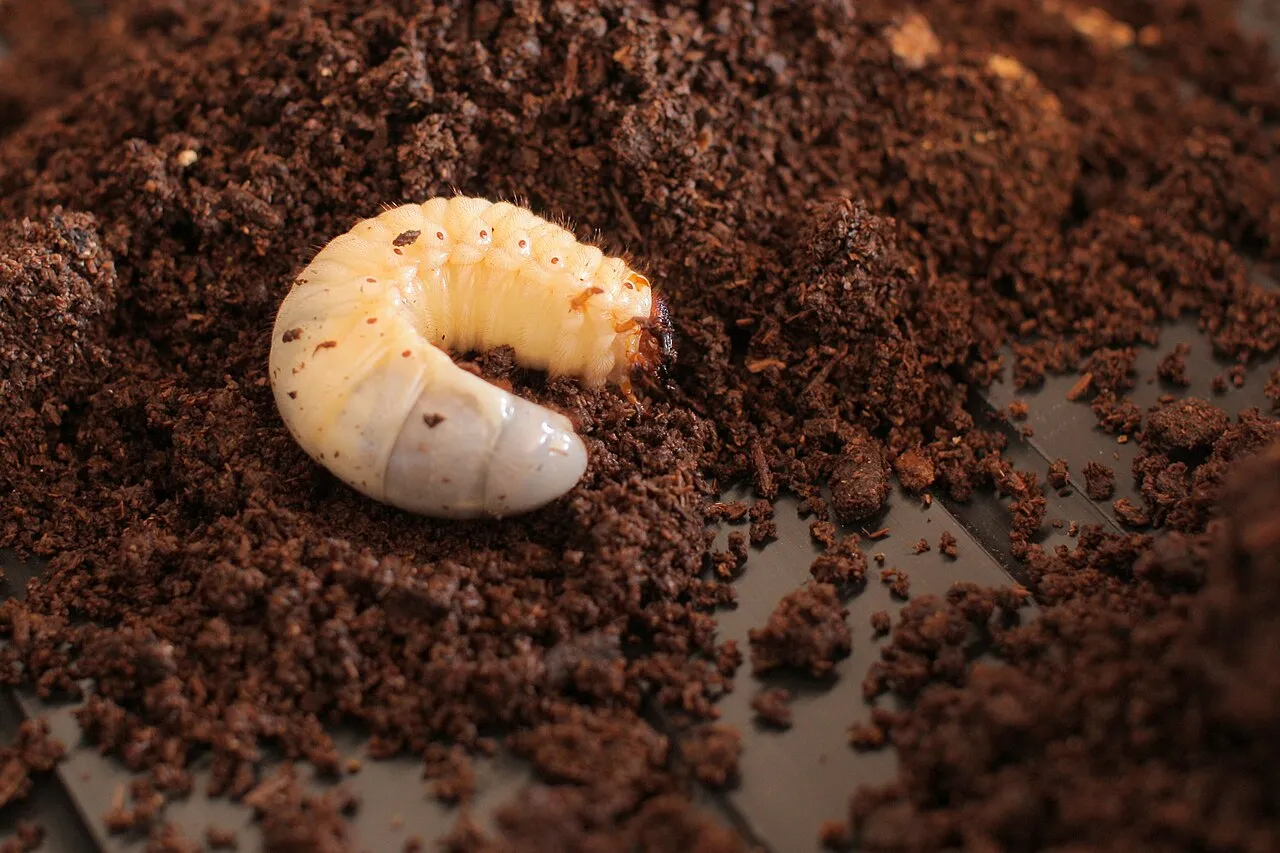
ElHeineken · CC BY 3.0
The scientific name is Trypoxylus dichotomus. For decades it was better known as Allomyrina dichotoma, and older books still use that name. The species name comes from Greek for 'cut in two', referring to the forked tip of the male's horn; the genus name combines Greek words for a bored hole and wood.
In Japanese it is kabutomushi, the 'helmet bug', after the horned helmets of samurai armour. English names include Japanese rhinoceros beetle and Japanese horned beetle. The Korean name is usually explained as 'general's scarab', for its commanding, armoured look.
- Order: Coleoptera, the beetles
- Family: Scarabaeidae, the scarabs
- Subfamily: Dynastinae, the rhinoceros beetles
- Relatives: Hercules beetles (Dynastes), Atlas and Caucasus beetles (Chalcosoma), Neptune beetles and the Siamese rhinoceros beetles (Xylotrupes)
The Dynastinae contain well over a thousand species worldwide. Many are tropical giants, but T. dichotomus is one of the largest found in temperate climates.
3. History
Rhinoceros beetles have been a summer plaything for East Asian children for generations. Japan had a culture of keeping and selling insects as far back as the Edo period, and by the twentieth century beetles sold in department stores and at street stalls were part of the summer scene. Many Korean adults remember catching them around oak sap or compost heaps in the countryside.
The modern boom came in the 2000s. Sega's arcade card game Mushiking: King of the Beetles, released in Japan in 2003, turned rhinoceros and stag beetles into fighting champions, and it became a hit in Korea and elsewhere in Asia too. Specialist insect shops and online stores multiplied, and products such as fermented substrate and beetle jelly became mainstream.
In Korea, a 2010 law supporting the insect industry recognised insect farming as agriculture. The rhinoceros beetle became one of the most farmed species for education and pets, and in the mid-2010s its larvae were also approved as a food ingredient. Today, insect farms supply grubs and adults year-round, and regional insect festivals and nature centres feature them prominently.
4. Body and anatomy
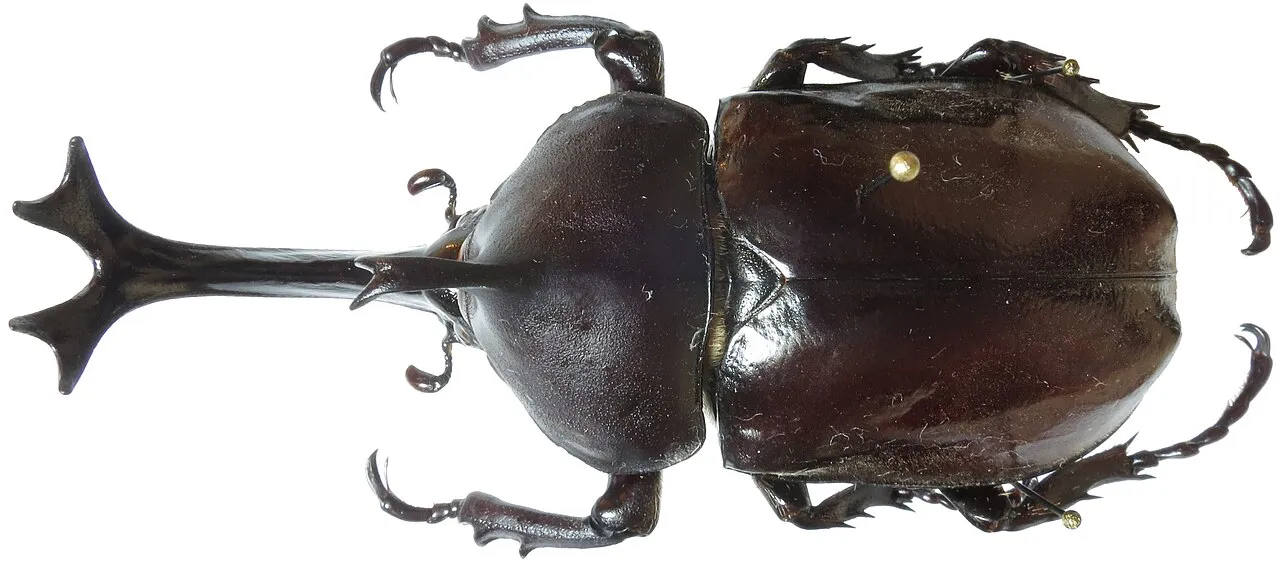
Lsadonkey · CC BY-SA 4.0
4.1. Size and horns
Adult males measure about 4–8 cm including the horn, females about 3.5–5 cm. Colour ranges from dark reddish-brown to almost black, and a fine coat of short hairs gives newly emerged beetles a slightly velvety look. The male's long head horn forks twice at the tip, and a shorter horn projects forward from the thorax. Together they work like pincers for prying and lifting rivals.
Horn size depends heavily on how well the larva fed. Siblings from the same parents can produce both large, long-horned males and small males with stubby horns. Research suggests small males tend to avoid head-on fights and instead sneak access to females. Females have no horn; their sturdy heads and spiny forelegs are built for digging into substrate to lay eggs.
4.2. Structure and senses
Like all beetles, the adult is encased in a hard exoskeleton, with thick wing cases, the elytra, covering the back. To fly, it lifts the elytra and unfolds the delicate hindwings beneath. Being heavy, it flies with loud, deep wingbeats.
Each foot ends in sharp, hooked claws that grip bark tightly, and a beetle that latches onto clothing or skin can be hard to remove. The mouthparts form a brush suited to lapping sap and fruit juice rather than chewing solid food. The antennae end in a small fan of plates that open to catch scents, letting adults home in on fermenting sap from a distance.
The larva is a classic white, C-shaped grub with a hard orange-brown head and strong jaws for chewing rotten wood. Breathing holes, the spiracles, run along each side of the body, which is why waterlogged substrate can suffocate it.
4.3. Sexing
- Adults: males have horns on the head and thorax, females have none. Females also tend to be hairier and less glossy.
- Pupae: the developing horn is obvious on male pupae.
- Third-instar grubs: a small V-shaped mark on the underside near the tail end often indicates a male, although it can be faint and unreliable.
Sexing grubs in advance is useful because males need a longer pupal chamber to accommodate the horn, so their containers should be deeper.
5. Related species in the hobby
In Korea and Japan the native rhinoceros beetle dominates the hobby, but the subfamily includes far larger species, some of which are kept by specialists where the law allows.
| Species | Range | Male size | Notes |
|---|---|---|---|
| Japanese rhinoceros beetle | Korea, Japan, China and beyond | 4–8 cm | Forked head horn |
| Siamese rhinoceros beetles (Xylotrupes) | South and Southeast Asia | 3–7 cm | Pincer-like head and thorax horns |
| Hercules beetle (Dynastes hercules) | Central and South America | Up to 17 cm or more | Among the longest beetles, yellowish elytra |
| Caucasus beetle (Chalcosoma chiron) | Southeast Asia | Up to about 13 cm | Three long horns, aggressive |
| Atlas beetle (Chalcosoma atlas) | Southeast Asia | 6–10 cm | Similar to Caucasus but smaller |
| Neptune beetle (Dynastes neptunus) | South America | Up to about 15 cm | Several short thorax horns |
| Elephant beetles (Megasoma) | The Americas | 7–12 cm | Massive, hairy bodies |
Exotic species often spend one to three years as larvae and can be sensitive to temperature. More importantly, many countries strictly control the import of live non-native beetles, so never buy one without confirming it is legal where you live.
The native species varies a little in size and horn shape across its range, and several island subspecies are recognised in Japan and Taiwan.
6. Behaviour
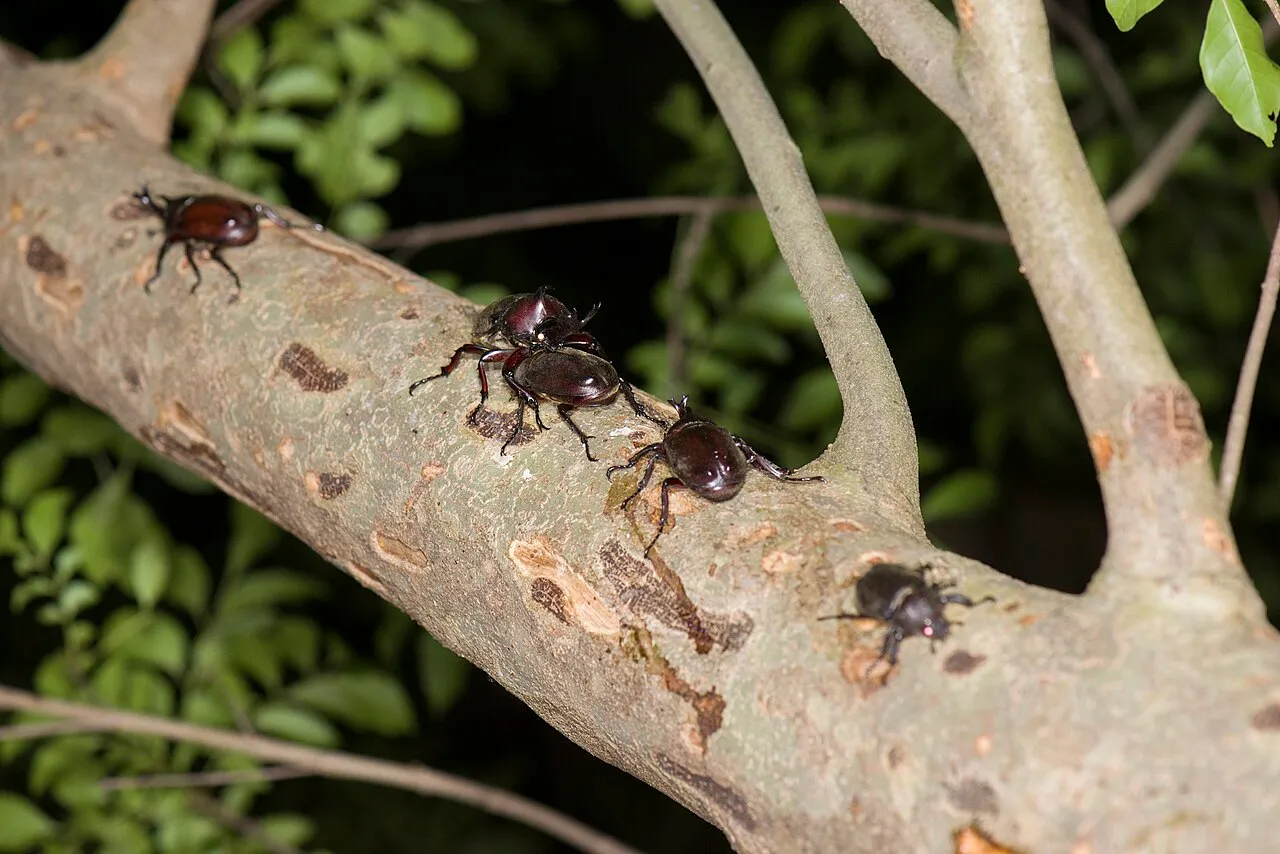
LiCheng Shih · CC BY 2.0
6.1. In the wild
Wild adults are active in high summer, mainly July and August in Korea. By day they hide in leaf litter or soil at the base of trees; after dark they fly to oaks and other trees where sap oozes from wounds in the bark. These sap flows are the forest's night-time restaurants, crowded with rhinoceros beetles, stag beetles, hornets and moths, and competition for the best spot goes on all night.
When two males meet, each tries to slide its horn under the other, lever it up and flip it off the branch. The winner holds the sap site and gains access to females that come to feed. After mating, females burrow into soft, decomposing material such as leaf mould, rotting logs and compost heaps to lay eggs. Large numbers of grubs are often found in old mushroom-growing logs and farm manure piles. Adults are also drawn to lights, which is why they sometimes turn up under streetlamps on summer nights.
6.2. Behaviour at home
Captive adults keep the same schedule: buried by day, out at night to feed and roam. They climb the walls, fall, try to take off and generally make a surprising amount of noise.
- Head buried in a jelly cup for ages: simply eating. They are big eaters and empty jelly fast.
- Stuck on its back, legs flailing: a beetle that cannot right itself tires quickly, so always provide bark or twigs to grab.
- A hissing or squeaking sound when handled: produced by rubbing the abdomen against the wing cases, a defensive signal.
- One male prising another upwards: a dominance contest that, in a cramped container, can break legs or damage wing cases.
- Wandering on the surface by day: the substrate may be too wet or dry, or the beetle may be near the end of its life.
- Slowing down and losing the tips of its legs: normal signs of old age.
7. Life cycle
The rhinoceros beetle undergoes complete metamorphosis through egg, larva, pupa and adult, and in temperate climates it normally completes one generation a year.
| Stage | Season (temperate East Asia) | Duration | Notes |
|---|---|---|---|
| Egg | July–August | About 10–14 days | Around 3 mm, swells and rounds as it develops |
| First instar | August | About 2–3 weeks | Around 1 cm long |
| Second instar | August–September | About 3–5 weeks | Appetite rises sharply |
| Third instar | September to next May | About 8 months | Up to 20–40 g, slows in winter |
| Prepupa | May–June | About 1–2 weeks | Builds a pupal chamber, turns yellowish and wrinkled |
| Pupa | June | About 3 weeks | White at first, darkening to brown |
| Adult | Late June–September | About 1–3 months | Rests in the chamber for a week or two before emerging |
Most of the beetle's life is spent as a grub. Adults have a single summer to mate and lay eggs before dying. In captivity, adults usually live one to three months, a little longer if kept cool. Warm rooms speed up larval growth and bring early emergence; cooler ones slow it.
Signs of old age in adults include eating less, losing the tarsal segments at the ends of the legs so they struggle to grip, and a worn, shiny body as the fine hairs rub off. This is natural and needs no treatment beyond a quiet spot.
8. Housing
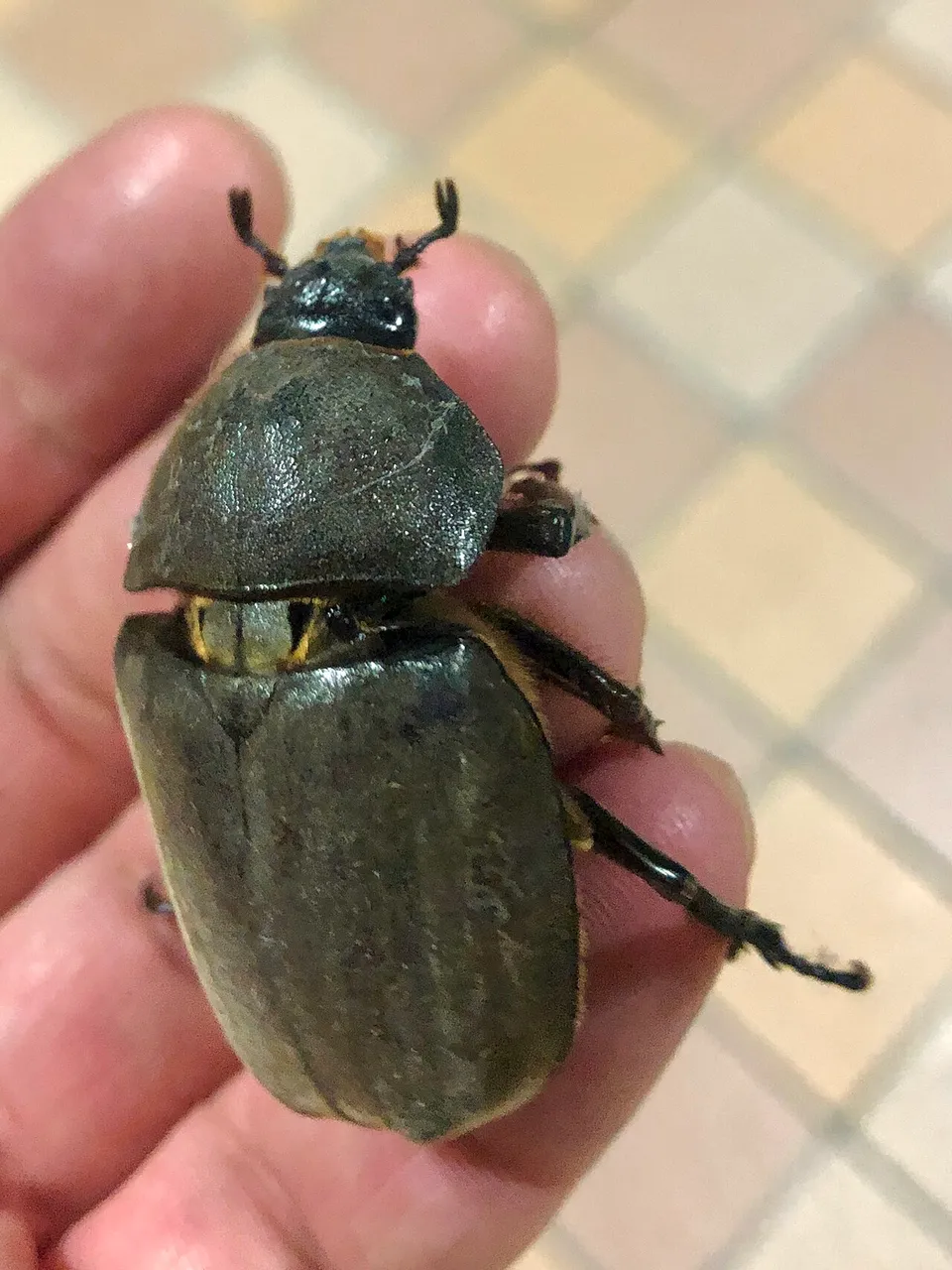
KKPCW · CC BY-SA 4.0
8.1. Raising grubs
For grubs, fermented substrate is both home and food. Use commercially fermented hardwood sawdust, ideally oak, and never pine, cedar, cypress or pet bedding chips. Allow about 2–3 litres per third-instar grub; for several, use a container at least 30 cm long filled 15–20 cm deep. Crowding encourages grubs to bite each other.
After opening a bag of fermented substrate, spread it in a large tub and let it breathe for at least two or three days. Under-fermented substrate keeps generating heat and gas, driving grubs to the surface or killing them. If it feels warm or smells sharply sour, it is not ready. The right moisture is when a squeezed handful holds together and crumbles slightly when you open your hand.
Depth becomes critical in late spring. Rhinoceros beetle grubs build upright, oval pupal chambers, and a male's can be nearly 10 cm long to fit the horn. From this point, stop changing substrate and avoid moving or shaking the container.
8.2. Keeping adults
A pair of adults needs a container of at least 30 × 20 cm; keep extra males separately. Lay 5–10 cm of fermented substrate or beetle mat so they can hide by day, or 15 cm or more if you want eggs. Add plenty of bark and twigs so an upturned beetle can right itself, and a feeding log with holes for jelly cups to stop them being knocked over.
| Factor | Target | Notes |
|---|---|---|
| Temperature | 20–28°C | Sustained heat above 30°C is dangerous |
| Moisture | Substrate slightly damp | Mist when the surface dries |
| Lighting | None needed | Keep out of direct sun |
| Lid | Essential | Adults fly and push out |
Adults are strong enough to shove a loose lid aside, so use a container that latches. A sheet of breathable fabric or newspaper between lid and container keeps out fruit flies and slows drying. Balconies and windowsills can get far hotter than indoor rooms in summer, so choose a cool, shaded spot.
8.3. Shopping list
- Clear larval container at least 20 cm deep
- Adult container with a latching lid
- Fermented hardwood substrate or beetle mat
- Beetle jelly, standard and high-protein
- Feeding log
- Bark, twigs and dry leaves
- Mister
- Breathable fabric or paper to keep out fruit flies
- A spoon or soft gloves for moving grubs
- Floral foam for an artificial pupal chamber, if needed
- Small digital scale to track grub weight, optional
9. Diet
Grubs eat the fermented substrate itself. When the surface and interior fill with small, round brown droppings, the food is running out. Third-instar grubs eat a great deal, so substrate is typically changed about monthly in autumn and every two months in winter. Mixing in about 30% of the old substrate is often recommended to ease the transition. Keepers aiming for big males sometimes use premium substrate enriched with protein and minerals.
Adults lap sap and fruit juice. Commercial beetle jelly is the most convenient and hygienic option. An adult can finish a standard 16–18 g cup in a day, so check every evening and replace empty or dried-out cups. High-protein jelly helps egg-laying females.
- Suitable: beetle jelly, banana, small pieces of peeled apple, ripe peach
- Avoid: watermelon, melon, cucumber and other very watery produce, plain sugar water or neat honey, and spoiled fruit
Watery foods cause diarrhoea and leave the container sticky, attracting mites and fruit flies. Watermelon is the classic picture-book beetle food, but it is one of the worst choices in practice. Remove any fresh fruit within a day.
10. Health
Vets almost never treat insects, so prevention and early detection fall to the keeper. Common problems include:
- Substrate gas and heat: under-fermented or waterlogged substrate drives grubs to the surface, and in bad cases they turn brownish and die. Always air new substrate before use.
- Too wet or too dry: soggy substrate blocks the spiracles; overly dry substrate interferes with moulting and pupal-chamber building.
- Mites: small brown mites on adults are very common. Most are scavengers rather than true parasites, but heavy loads clog joints and spiracles and wear the beetle down. Brush them off with a soft toothbrush and keep substrate and jelly fresh.
- Mould and fruit flies: caused by leftover fruit and jelly.
- Larval disease: dark spots, dull colour and loss of movement can mean bacterial or fungal infection. Isolate the grub and change the substrate.
- Failed emergence: if a pupal chamber collapses or dries out, the adult may emerge with wing cases that do not close or a bent horn. Leaving pupae undisturbed is the best prevention.
- Heat: adults weaken quickly above 30°C, and temperatures approaching 35°C can be fatal.
If you accidentally break open a pupal chamber, pack damp floral foam or substrate firmly, make an upright hollow sized to the pupa with a finger or stick, and gently move the pupa in. Experienced keepers in online communities and specialist shops can often diagnose problems from a photo.
11. Breeding
Rhinoceros beetles are among the easiest insects to breed. Once adults have been out for a week or two and are feeding well, put a male and female together. Mating usually happens at night, with the male riding on the female's back for tens of minutes.
For egg-laying, fill the female's container with at least 15–20 cm of fermented substrate, packing the bottom layers firmly by hand. She burrows deep and lays eggs one at a time, typically several dozen and sometimes close to a hundred. A male left in the container may harass her or disturb laying, so remove him after mating.
Two or three weeks after she starts laying, tiny larvae appear against the sides of a clear container. Tip the substrate gently onto a large tray and use a spoon to transfer eggs and first-instar grubs to fresh substrate. Eggs are easily damaged by fingers, so scoop them with surrounding substrate and place each in a small hollow.
The real issue is numbers. One pair can produce dozens of grubs, quickly multiplying substrate costs and space. Keep only as many as you can raise and line up friends, schools or clubs to take the rest. Releasing extras into woods or parks is discouraged, because captive stock can mix with local wild populations and spread mites or disease.
12. Costs
Few pets cost less. These are rough Korean prices for raising three to five grubs bought in autumn through to adults the following summer.
| Item | Typical cost | Notes |
|---|---|---|
| 3–5 third-instar grubs | 10,000–30,000 won | Varies by season and size |
| A pair of adults, if bought | 10,000–30,000 won | Summer prices |
| Larval container | 5,000–20,000 won | |
| Adult container | 5,000–20,000 won | |
| 10–20 L fermented substrate | 10,000–20,000 won | |
| 50 jelly cups | 5,000–15,000 won | |
| Feeding log and bark | 3,000–10,000 won | |
| Setup total | about 20,000–60,000 won |
| Item | Ongoing | Notes |
|---|---|---|
| Substrate changes for grubs | 10,000–20,000 won every 1–2 months | Scales with numbers |
| Jelly for adults | 3,000–10,000 won a month | Scales with numbers |
| Annual total | about 50,000–150,000 won | More if you breed heavily |
Once breeding produces dozens of grubs, substrate costs can multiply, and premium substrate for big males costs more again. There are effectively no vet bills, which also means you are the one solving any problems.
13. Before you get one
- When will you start? Third-instar grubs bought in autumn let you watch growth through winter and spring and see emergence in early summer. Adults bought in summer are active straight away but stay with you only briefly.
- Are you doing this with children? Explaining in advance that adults live only a short time helps them cope. Keeping an illustrated diary of the life cycle together is a great project.
- Can you live with noise and smell? Adults are loud at night and substrate smells earthy, so a living room or study is better than a bedroom.
- Have you thought about what to do with offspring?
- Do you have cats or dogs? Put containers where they cannot be knocked over.
Healthy grubs are white, plump and firm, and curl into a C when touched. A grub with dark spots, or one that is yellow and wrinkled, may be sick or already preparing to pupate. Healthy adults have all six legs intact, eat well and grip strongly when placed on your hand. Adults sold at the end of summer may already be old, so ask when they emerged.
14. Laws
Within its native range, the Japanese rhinoceros beetle is common, unprotected and sold freely from insect farms, so no licence is needed to keep it there. Elsewhere, the picture is very different.
- Collecting: national parks and nature reserves usually prohibit or restrict insect collecting. Check local rules before collecting wild beetles.
- Imports: many countries, including the United States, Australia and members of the European Union, tightly control the import of live non-native beetles under plant-health and biosecurity laws, because larvae feeding on wood and soil could become pests. Importing without a permit can be a serious offence.
- Exotic species: in East Asia, too, only certain foreign beetle species may be legally imported and sold, and lists change. Buy only from reputable sources and never order live beetles from abroad yourself.
- Release: never release captive beetles. Native-range releases can mix genetically distinct populations and spread mites; non-native releases risk establishing invasive pests.
If you are unsure, ask your national plant protection or agriculture authority.
15. Rhinoceros beetles in culture
In East Asia the rhinoceros beetle is a summer hero. Japanese children often observe one for a holiday homework project, and beetles for sale in supermarkets and department stores are a seasonal sight. Beetle sumo contests, in which two males face off on a log until one is pushed off or retreats, are held in many towns.
- Mushiking: King of the Beetles, Sega's 2003 arcade card game, pitted rhinoceros and stag beetles against each other in rock-paper-scissors battles and spawned an anime series.
- Kamen Rider Kabuto, a 2006 Japanese tokusatsu drama, features a hero modelled on the rhinoceros beetle.
- In Pokémon, Heracross is a bug and fighting type clearly inspired by the Hercules beetle.
- In the Animal Crossing series, horned beetles on summer-night trees are among the most prized catches.
- In northern Thailand, a traditional pastime sets male Siamese rhinoceros beetles fighting on a log, with a female placed nearby to stir their competitive drive.
In Korea, rhinoceros beetles are the star attraction at regional insect festivals and nature centres and a fixture of children's science comics.
16. Trivia
- Rhinoceros beetles are often said to support many times their own body weight. Published multiples vary wildly with how the test is done, so 'astonishingly strong for its size' is the safer summary.
- The horn is rigid exoskeleton with no muscles of its own. The beetle uses it as a lever by raising and lowering its whole head and thorax.
- A study of this species found that male horns are light for their size yet stiff and strong, so even big-horned males can still fly reasonably well.
- Grubs may curl tightly and play dead when handled.
- In winter, grubs lie almost motionless deep in the substrate, then resume heavy feeding as spring warms up.
- During pupation the male's horn is inflated into shape by pressure from body fluids, which is why a cramped or collapsing chamber can leave a permanently bent horn.
- Since the larvae were approved as a food ingredient in Korea in the mid-2010s, some farms have processed them into powders for health-food products.
Health notes are general information. If something seems wrong, contact a vet who treats this species.
FAQ
How can I tell male and female grubs apart?
On third-instar grubs, males often show a small V-shaped mark on the underside near the tail end. If unsure, waiting for adulthood settles it.
Can adults survive the winter?
No, adults normally die by the end of summer. The next generation overwinters as larvae in the substrate.
My grubs keep coming to the surface.
This often means gas from fermentation, wrong moisture or substrate full of droppings. Check it, and replace it with well-aired fresh substrate if needed.
Further reading
- 🗳️ Are rhino or stag beetles good pets for teaching kids?
- 🏢 Choosing a Pet When You Live Alone or Work Full Time
Photo credits
Photos are freely licensed images from Wikimedia Commons. Authors and licenses are listed below.
- Male rhinoceros beetle on concrete - 3.jpg — Kyu3 · CC BY-SA 4.0
- Allomyrina dichotoma L3 Larva.JPG — ElHeineken · CC BY 3.0
- Allomyrina dichotoma Taiwan.jpg — Lsadonkey · CC BY-SA 4.0
- Allomyrina dichotomus (41753465140).jpg — LiCheng Shih · CC BY 2.0
- Female rhinoceros beetle on the hand.jpg — KKPCW · CC BY-SA 4.0