TailVille
1. Overview
The common bottlenose dolphin is the animal most people picture when they hear the word dolphin: a sleek grey body, a short, rounded snout, a curved dorsal fin, and a mouth line that looks permanently amused. The name bottlenose refers to that stubby beak, which reminded early sailors of the neck of an old-fashioned bottle.
It is one of the most widespread marine mammals on Earth, found in warm-temperate and tropical seas around the world, from shallow bays and river mouths to the deep open ocean. Because it lives in so many different settings, local populations have developed strikingly different habits, hunting tricks and social arrangements, to the point that researchers often talk about dolphin cultures.
Bottlenose dolphins are famous for their intelligence. They recognize themselves in mirrors, use individually distinctive signature whistles that work much like names, and in some places use tools or cooperate in elaborate hunting strategies. Those same qualities made them the star of marine park shows for decades, and they now sit at the centre of a lively debate about whether whales and dolphins should be kept in captivity at all.
This article focuses on the common bottlenose dolphin, Tursiops truncatus, but also covers its close relative the Indo-Pacific bottlenose dolphin, which is the species that lives off Jeju Island in Korea and became the subject of a well-known release story.
2. Name and classification
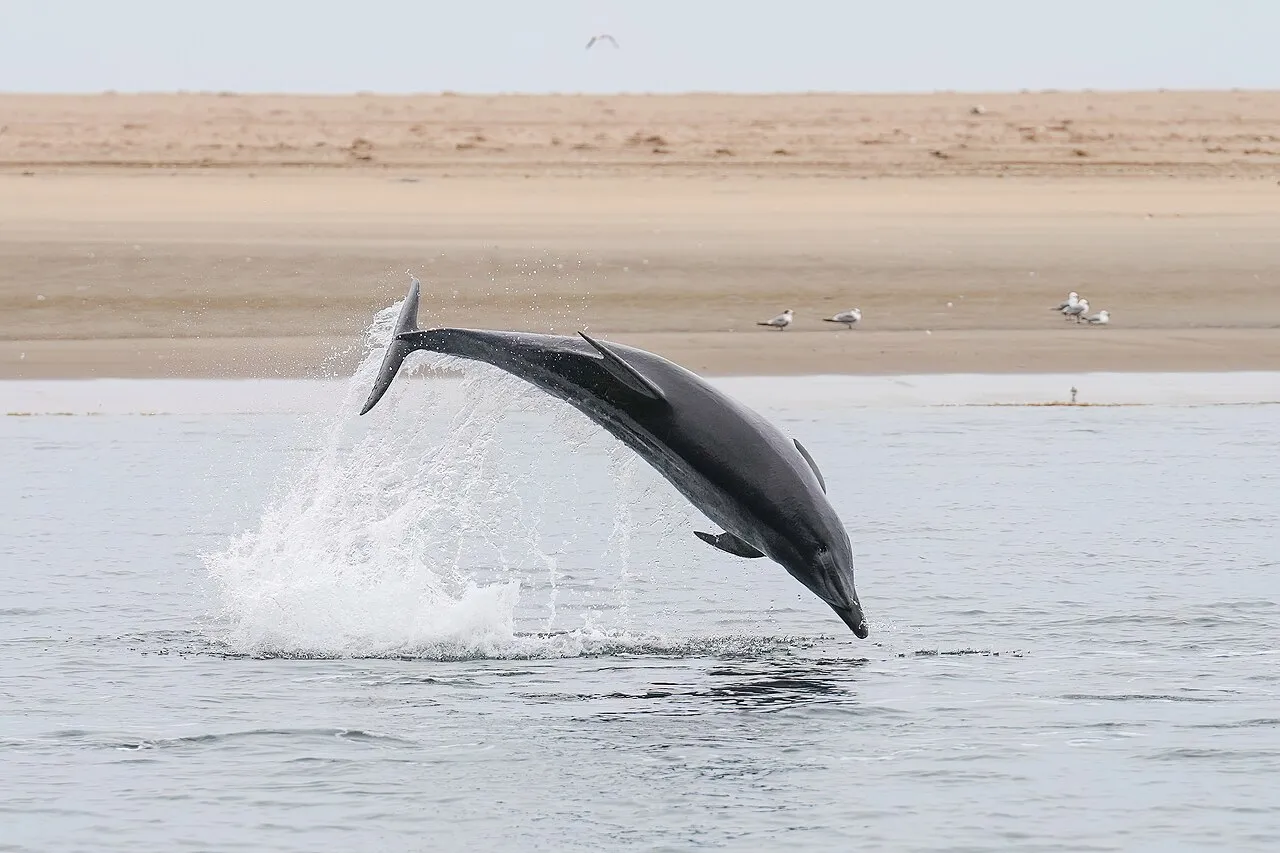
Giles Laurent · CC BY-SA 4.0
The scientific name is Tursiops truncatus. Tursiops combines the Latin tursio, an old word for a dolphin-like sea creature, with the Greek-derived ops, meaning face or appearance, so the genus name roughly means dolphin-faced. The species name truncatus means cut off or blunt; the usual explanation is that the specimen used to describe the species had worn, flattened teeth.
In English it is called the common bottlenose dolphin, or simply the bottlenose dolphin. The Korean name keundolgorae literally means big dolphin, a nod to its size compared with many other dolphin species.
2.1. Species in the genus
For a long time all bottlenose dolphins were lumped into a single species. Genetic and skeletal studies have since split the genus. The Indo-Pacific bottlenose dolphin, Tursiops aduncus, is now firmly recognized as separate: it is smaller, has a longer beak, lives mostly in coastal waters of the Indian Ocean and western Pacific, and adults usually develop dark spots on the belly. The Burrunan dolphin, proposed in 2011 as Tursiops australis for populations in south-eastern Australia, is still debated, and many authorities do not yet treat it as a full species.
2.2. Subspecies and ecotypes
Within the common bottlenose dolphin, the isolated Black Sea population is classed as the subspecies T. t. ponticus, and some researchers recognize a large-bodied eastern Pacific form as well. More important in everyday research is the split between coastal and offshore ecotypes. Offshore animals tend to be larger, darker and better adapted to deep diving, and in many regions the two forms rarely interbreed, so further taxonomic splits may come.
3. Evolution
Whales and dolphins descend from hoofed land mammals that lived around 50 million years ago, and their closest living relatives are hippos. Early forms such as Pakicetus were dog-sized animals that waded at the water's edge; over a few million years their descendants, including Ambulocetus and Rodhocetus, became increasingly aquatic until fully marine giants like Basilosaurus appeared.
About 34 million years ago, the cetacean family tree split into baleen whales, which filter food through plates of keratin, and toothed whales, which rely on teeth and echolocation. Bottlenose dolphins belong to the toothed branch.
The oceanic dolphin family, Delphinidae, is a relatively young group that appeared roughly 10 to 11 million years ago and diversified rapidly. Genetic studies show that Tursiops is tangled up with spotted dolphins and common dolphins in a way that suggests past hybridization between lineages, and hybrids between bottlenose dolphins and other species have occasionally been documented both in the wild and in captivity.
Traces of the land-living past remain inside the body. The hind legs are gone, but small pelvic bones float in the muscle, and each flipper contains finger bones arranged much like a human hand.
4. Range and habitat
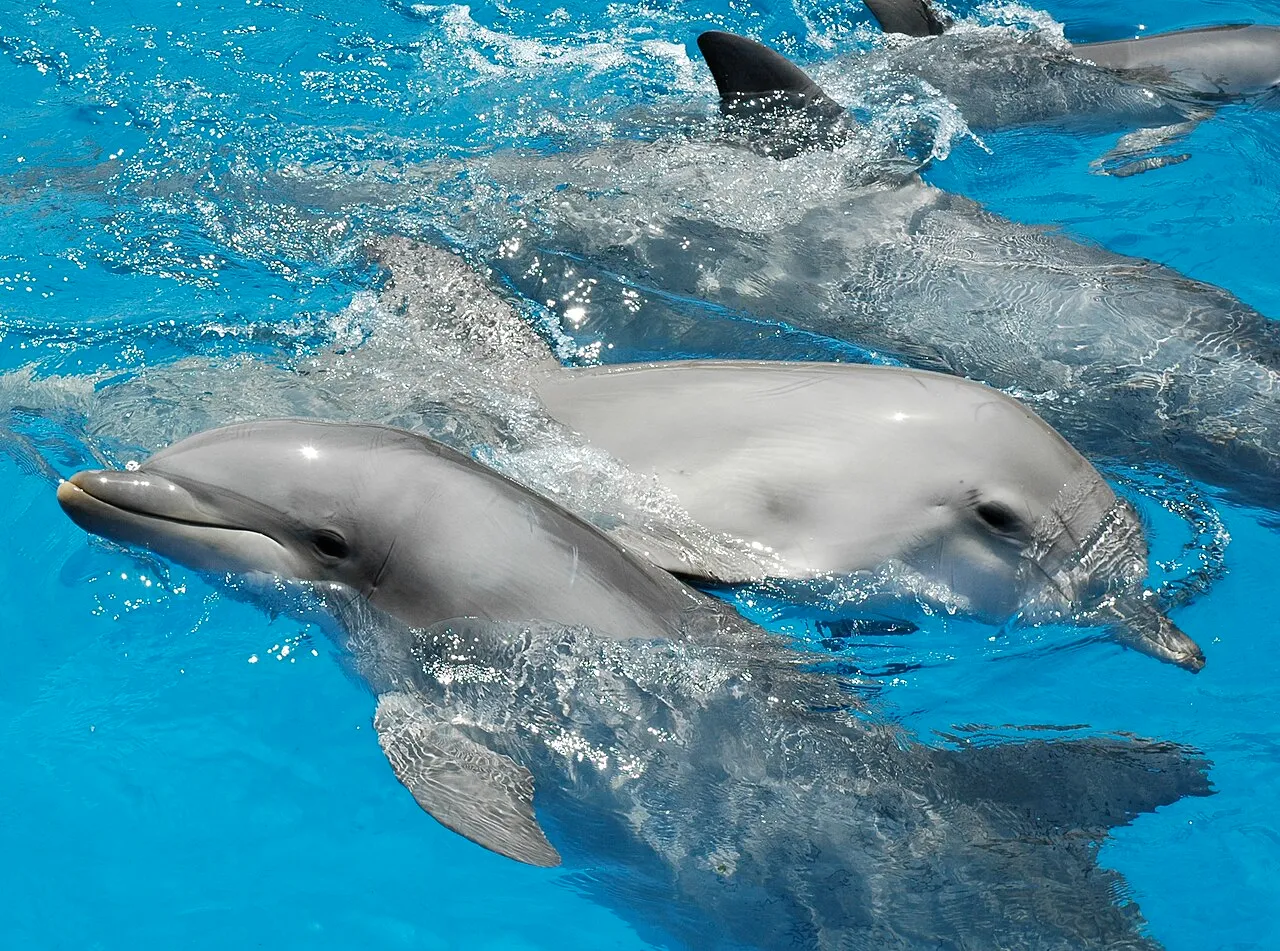
Vince Smith from London, United Kingdom · CC BY 2.0
Common bottlenose dolphins occur in virtually every ocean outside the polar regions: the temperate and tropical Atlantic, Pacific and Indian Oceans, the Mediterranean and Black Seas, the Gulf of Mexico and the Caribbean. They generally favour water between about 10 and 32 degrees Celsius.
Coastal populations live in bays, lagoons, estuaries and harbours, often using the same stretch of coast for decades. One community off western Florida has been followed for more than half a century across several generations, making it the longest-running study of wild dolphins anywhere. Offshore populations range over the continental slope and open ocean and may travel hundreds of kilometres.
In Korean waters the common bottlenose dolphin is only an occasional visitor. The dolphins people usually see near Korea are other species: Indo-Pacific bottlenose dolphins off Jeju, finless porpoises along the west and south coasts, and common or Pacific white-sided dolphins in the East Sea.
5. Physical characteristics
Size varies a lot from place to place. Coastal dolphins in warm water tend to be small, while those in cold water or offshore habitats are considerably larger.
| Feature | Typical value |
|---|---|
| Length | about 1.9 to 4 m, most adults 2.5 to 3.5 m |
| Weight | roughly 150 to 650 kg |
| Newborn | about 0.8 to 1.4 m, 15 to 30 kg |
| Teeth | about 18 to 28 conical teeth in each half of each jaw |
| Burst speed | around 30 km/h, briefly more |
| Diving | usually tens of metres; offshore animals can reach several hundred |
The body is a streamlined torpedo. The colouring is classic countershading: dark grey on the back, paler grey on the flanks and white or pinkish on the belly, so the animal blends into dark water when seen from above and into bright surface light when seen from below. Unlike the Indo-Pacific species, adults rarely develop belly spots.
5.1. Senses and echolocation
Sound is the bottlenose dolphin's master sense. Clicks are produced by structures called phonic lips inside the head, focused by the fatty melon in the forehead and beamed forward. Returning echoes travel through fat in the lower jaw to the inner ear, and the brain builds a detailed picture of distance, size, shape and even internal structure. Dolphins can find fish buried in sand and tell apart objects of identical size made from different materials.
Eyesight is good both underwater and in air, while the sense of smell has largely been lost. Newborns have a few whiskers on the snout that soon fall out; research suggests the pits left behind can detect weak electric fields.
5.2. Breathing and skin
Dolphins breathe through a single blowhole on top of the head. Because breathing is voluntary, they cannot fall completely unconscious; instead they rest one brain hemisphere at a time, often swimming slowly with one eye closed or logging quietly at the surface.
The skin is extremely smooth and its outer layer is replaced far faster than ours, which helps keep it free of barnacles. A thick layer of blubber stores energy and holds in heat. Nicks and notches on the dorsal fin are as individual as fingerprints, and researchers identify animals from photographs of their fins.
6. Behaviour and ecology
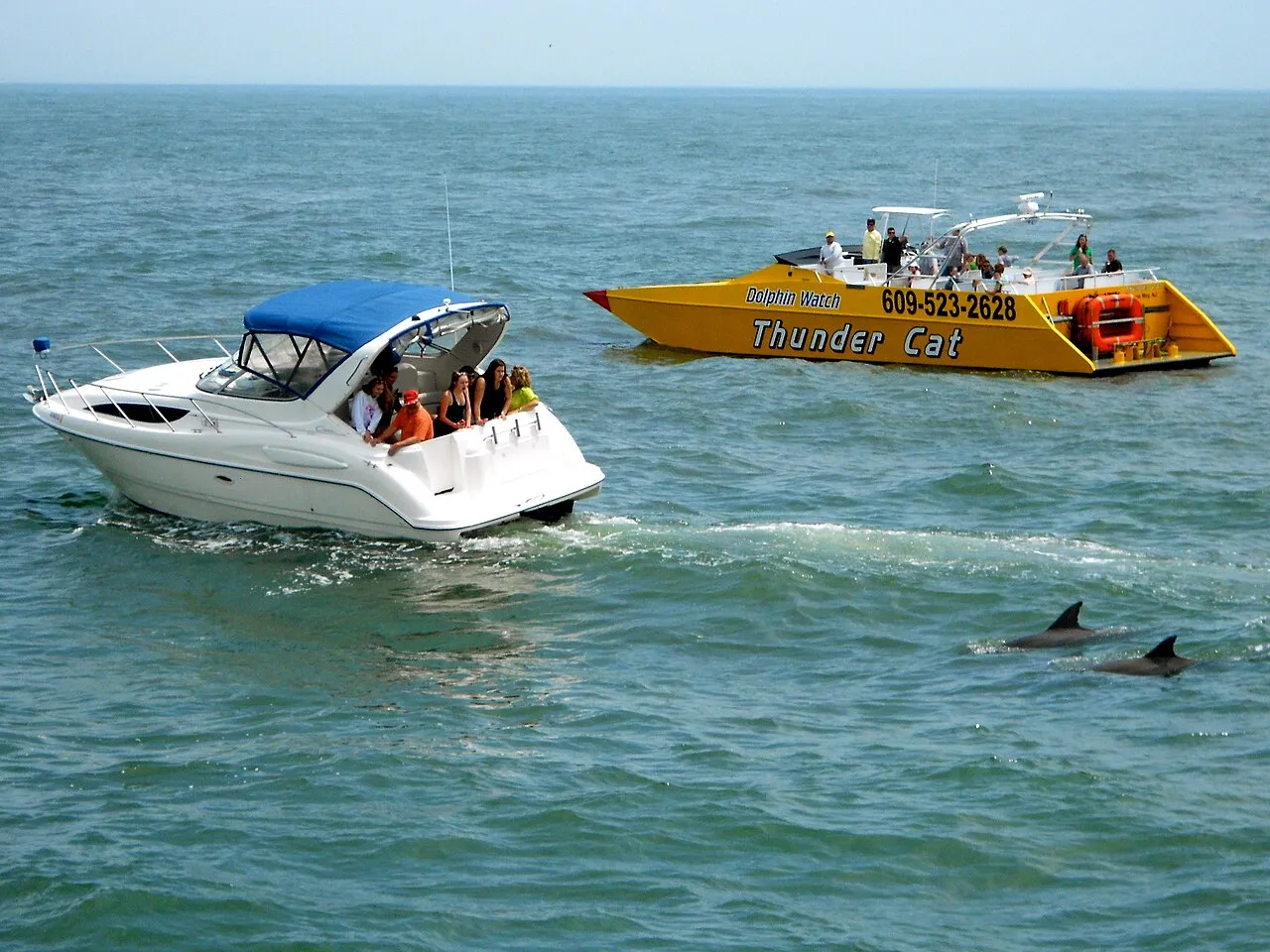
Smallbones · CC0
Bottlenose dolphins live in fission-fusion societies. Groups are not fixed; individuals join and leave over hours or days. Small parties of two to fifteen are typical near the coast, while offshore aggregations can number in the hundreds.
There are still clear patterns. Mothers with calves often travel with other mothers, and many adult males form tight, long-lasting partnerships with one or two other males. In Shark Bay, Western Australia, researchers have described alliances nested within larger alliances, a multi-level structure rarely seen outside humans, though it is worth noting that the Shark Bay dolphins are Indo-Pacific bottlenose dolphins.
A typical day mixes foraging, travelling, resting and socializing. Bottlenose dolphins surf waves, ride the bow waves of boats and play with seaweed or other objects, behaviour that has no obvious practical purpose beyond social bonding and fun.
6.1. Aggression
The friendly image hides a rougher side. Male alliances sometimes herd females aggressively, and many adults are covered in parallel tooth rake scars from fights. In Scotland and parts of the United States, bottlenose dolphins have been seen ramming and killing harbour porpoises, and occasional infanticide has also been reported. These behaviours are a useful reminder that dolphins are wild animals, not cartoon characters.
7. Diet and feeding
Bottlenose dolphins are opportunistic predators. They eat a wide range of fish, including mullet, mackerel and croakers, along with squid, shrimp and crabs. An adult eats roughly 4 to 6 percent of its body weight a day, so a 200 kg dolphin needs about 8 to 12 kg. Prey is swallowed whole; the conical teeth are for gripping, not chewing.
Local hunting techniques vary remarkably:
- Strand feeding: in some salt marshes of the south-eastern United States, groups push a bow wave that drives fish onto mud banks, then lunge partly out of the water to grab them.
- Mud-ring feeding: in shallow Florida waters, one dolphin swims in a circle beating its tail to raise a ring of mud; trapped fish leap out of the plume and into the mouths of waiting dolphins.
- Cooperative fishing with people: in a town in southern Brazil, dolphins have for generations driven mullet toward shore and signalled with a distinctive dive, prompting fishers to cast their nets.
- Fish whacking: dolphins sometimes strike fish with their tail flukes and send them flying through the air.
- Sponging: some Indo-Pacific bottlenose dolphins in Shark Bay wear marine sponges on their beaks as protective gloves while probing the seabed, a skill passed mostly from mothers to daughters.
Because these techniques are learned and transmitted socially, dolphins have become a textbook example in the study of animal culture.
8. Reproduction and life cycle
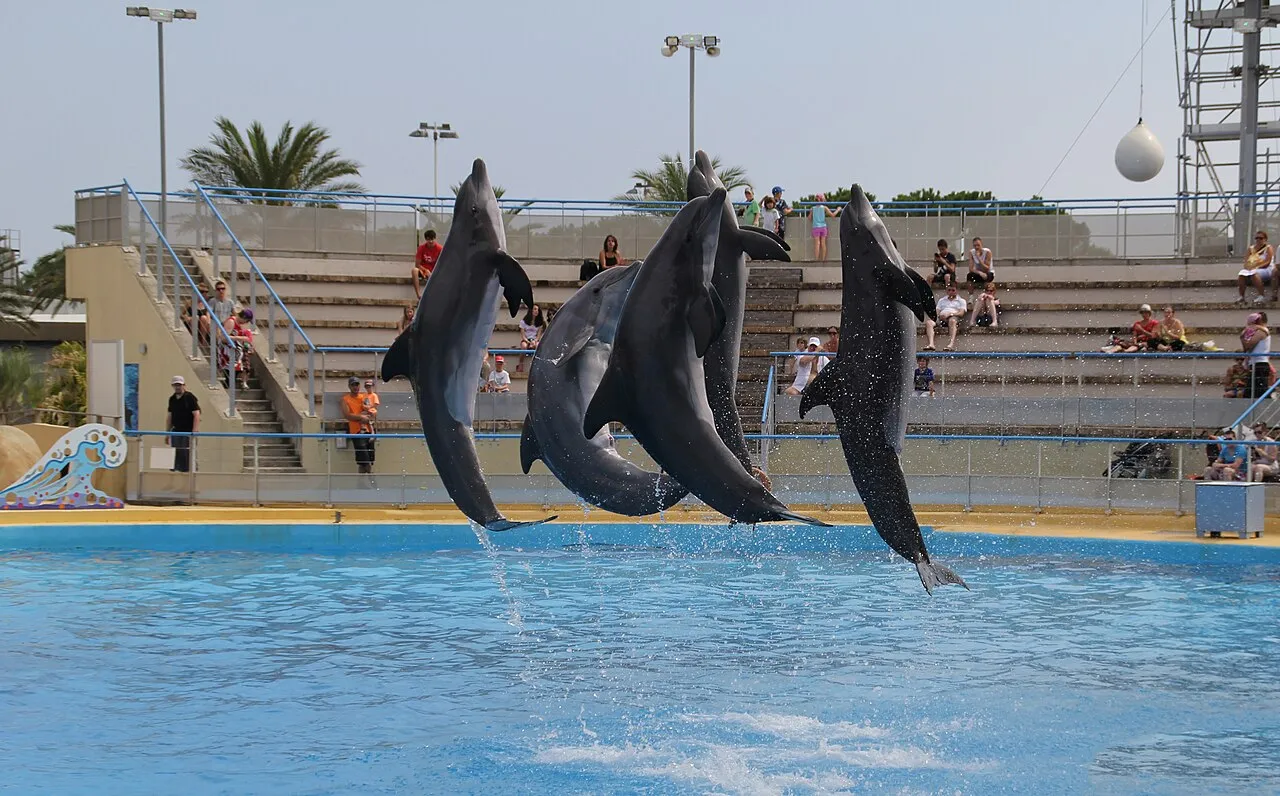
Andreas Ahrens · CC BY 2.0
Breeding can happen year-round, although births often peak in spring and summer depending on the region. Several males may compete for a single female, and pairs do not form lasting bonds.
Gestation lasts about 12 months, and a single calf is born, usually tail first, which is thought to reduce the risk of drowning during birth. The newborn is guided to the surface for its first breath by its mother, sometimes helped by another female.
| Stage | Age | What happens |
|---|---|---|
| Newborn | 0 to 1 month | Fetal folds visible as pale stripes; stays tight against the mother |
| Nursing | 1 month to about 1.5 years | Milk is the main food; first fish tasted after a few months |
| Dependent | 1.5 to 6 years | Weaned but still travels with mother, learning hunting and social skills |
| Juvenile | about 3 to 10 years | Mixes with peer groups and becomes independent |
| Adult | females about 5 to 13, males about 9 to 14 | Begins breeding |
Females typically calve every three to six years, investing heavily in each offspring. Wild bottlenose dolphins commonly live 40 to 50 years; females tend to outlive males, and some have been documented past 60. Age is estimated by counting growth layers in a sectioned tooth, much like tree rings.
9. Intelligence, communication and special abilities
A bottlenose dolphin brain weighs around 1.5 to 1.7 kg, similar to or slightly heavier than a human brain, and its size relative to the body is among the highest of any animal after humans. The cortex is intensely folded.
The best-known ability is the signature whistle. Within the first months of life each calf develops a distinctive whistle contour that it keeps for life. Other dolphins sometimes copy a signature whistle, apparently to call that individual, and one study found that dolphins still responded to the whistles of former companions they had not heard for more than 20 years.
In 2001 researchers reported that bottlenose dolphins inspected marks on their bodies in a mirror, placing them among the few animals that pass mirror self-recognition tests. Captive studies showed that dolphins could interpret sequences of hand signals in which word order changed the meaning, and could invent new behaviours on a signal that meant do something different.
Wild and captive dolphins have also been seen blowing bubble rings to play with. That said, claims that dolphins are smarter than humans go well beyond the evidence. It is more accurate to say their intelligence is shaped for a very different world.
9.1. Diving physiology
When diving, a bottlenose dolphin slows its heart rate and shunts blood toward the brain and heart. Muscles are rich in myoglobin, which stores oxygen, and the lungs are built to collapse under pressure, limiting how much nitrogen dissolves into the blood. Most dives last a few minutes, though breath-holds approaching ten minutes have been recorded.
10. Predators and survival
Adult bottlenose dolphins have few natural predators. Large sharks, especially tiger, bull and great white sharks, are the main threat, and orcas hunt them in some regions. In one Australian study a large share of adult dolphins carried shark bite scars.
Calves are far more vulnerable, and groups tend to keep them in the middle. Dolphins may ram sharks with their beaks to drive them off, and in shark-rich areas they adjust where they rest, avoiding deeper water during risky periods.
Human-caused threats often matter more than natural ones: entanglement in fishing gear, boat strikes, pollution, harmful algal blooms and overfishing of prey all take a toll.
11. Relationship with humans
Dolphins have held a special place in human imagination since antiquity. The ancient Greeks considered killing a dolphin unlucky, and Mediterranean folklore is full of dolphins rescuing drowning sailors. At the same time, people in various parts of the world have long hunted dolphins for meat and oil.
In the twentieth century the bottlenose dolphin became the star of the marine park. A hit American television series in the 1960s helped spread dolphin shows worldwide, and bottlenose dolphins, which adapt relatively well to tanks and learn quickly, became the most commonly captured species. Navies, notably in the United States and Russia, have trained dolphins to detect mines and locate objects underwater.
Today, watching wild dolphins is a major tourism industry. Boats that approach too closely or people who feed dolphins disrupt resting and hunting and can teach animals to beg, which exposes them to boat strikes and injury. Responsible watching means keeping a respectful distance and never chasing animals that choose not to approach.
11.1. Korea and the Jeju dolphins
Any discussion of dolphins in Korea turns to Jeju Island, with one important clarification: the dolphins that live off Jeju are Indo-Pacific bottlenose dolphins, Tursiops aduncus, not common bottlenose dolphins. The two look alike and were once treated as the same species, but the Jeju dolphins are smaller, longer-beaked and develop belly spots with age.
The Jeju population is a small, coastal group of roughly a hundred or so animals that circles the island in shallow water. In the 2000s it emerged that a number of these dolphins had been caught in fixed fishing nets and sold to performance facilities, sparking public controversy. Following a court ruling and pressure from civil society, captive Indo-Pacific bottlenose dolphins were rehabilitated and released back into Jeju waters in several rounds starting in 2013. Some were later seen travelling with wild groups and even raising calves, making the effort an internationally cited example of returning dolphins to the sea. Others were never confirmed after release, a reminder that such projects do not always succeed.
The Indo-Pacific bottlenose dolphin was designated a protected marine species in Korea, banning its capture and trade, and Korean law has since moved toward restricting new captive cetacean holdings and hands-on dolphin experiences. There has even been discussion in Jeju of granting the local dolphins a form of legal personhood.
12. Conservation status
The IUCN Red List classifies the common bottlenose dolphin as Least Concern because it is extremely widespread and the global population is thought to number in the hundreds of thousands. No comprehensive worldwide count exists, however, and estimates vary widely.
The species as a whole is secure, but many local populations are not. The Black Sea subspecies, heavily hunted in the twentieth century and hit by pollution, is assessed as Endangered, and small isolated groups in parts of the Mediterranean, fjords and estuaries number only in the dozens.
Main threats include:
- Bycatch in gillnets, trawls and fixed nets
- Coastal development, dredging and underwater noise
- Persistent pollutants such as PCBs, which accumulate in blubber and weaken immunity and reproduction
- Oil spills; after the 2010 Gulf of Mexico disaster, researchers documented sharp increases in lung disease and reproductive failure among local dolphins
- Direct hunts, including drive hunts that supply meat and live animals for aquariums
International trade is regulated under CITES Appendix II. The Indo-Pacific bottlenose dolphin is listed as Near Threatened by the IUCN and is a protected marine species in Korea.
13. In zoos and aquariums
The bottlenose dolphin is the most commonly kept cetacean in the world, and it breeds fairly readily in captivity, so many dolphins in aquariums today were born there.
Criticism of keeping them has grown steadily. Wild bottlenose dolphins swim tens of kilometres a day, dive deep and navigate complex social lives, which no tank can replicate. Critics point to echoing concrete walls, repetitive show schedules and food-based training as sources of stress, and note stereotypic circling and tooth damage in some captive animals.
Supporters argue that aquariums contribute to research, education and the rescue of stranded animals, and much of what we know about dolphin hearing and physiology did come from captive studies. A middle path now discussed in several countries is to end shows and move remaining animals to seaside sanctuaries, netted-off coves where they can live in natural seawater. Korea has also revised its laws to restrict new cetacean holdings and contact experiences such as riding or touching dolphins.
Private ownership of dolphins is both impractical and illegal almost everywhere. Swim-with-dolphins attractions can also stress animals, so travellers who want to see dolphins are better off choosing responsible wild watching operators.
14. In culture
Greek mythology is full of dolphins. Dionysus turned a crew of pirates into dolphins when they tried to kidnap him, and the poet Arion was said to have been carried to safety on a dolphin's back after his singing charmed it. The constellation Delphinus is tied to such legends, and dolphins appear on ancient Greek coins and mosaics.
In the twentieth century, television and film cemented the image of the clever dolphin who helps people. That image boosted public support for dolphin protection but also fuelled the growth of dolphin shows. In the other direction, a 2009 documentary about dolphin drive hunts in Japan turned the captive dolphin trade into a global controversy.
The Miami Dolphins of American football carry the name, and dolphins are popular mascots for companies and towns, including in Korea. The famous smile is a fixed feature of the jaw, not a sign of happiness, which is worth remembering when that smile is used to sell tickets.
15. Trivia
- Dolphin tail flukes contain no bone. They are made of dense connective tissue and move up and down, unlike the side-to-side tail beat of fish.
- Studies of captive dolphins suggest newborn calves and their mothers sleep very little in the first weeks after birth.
- Dolphin and whale are not formal scientific categories. Dolphin is just a conventional label for smaller toothed whales, which is why the orca, at up to eight metres or more, is technically the largest member of the oceanic dolphin family.
- Footage of dolphins gently mouthing pufferfish has been widely described as dolphins getting high on toxins, but this has never been scientifically demonstrated.
- Dolphins rarely drink seawater; they get most of their water from their food and from metabolizing fat.
- In the United States, feeding or harassing wild dolphins is illegal under the Marine Mammal Protection Act.
- Researchers can collect a dolphin's DNA and hormone data from the blow it exhales, using drones that fly through the spray.
Wild animals are not pets. Catching, trading or keeping them is illegal in most places. If you find an injured wild animal, call your local wildlife rescue centre.
FAQ
Are the dolphins off Jeju common bottlenose dolphins?
No. The Jeju dolphins are Indo-Pacific bottlenose dolphins, a close relative that is smaller, longer-beaked and develops belly spots with age. They were once lumped together but are now recognized as separate species.
Are dolphins really as smart as humans?
Bottlenose dolphins show impressive abilities such as mirror self-recognition, name-like whistles and tool use, but claims that they outsmart humans go beyond the evidence. Their intelligence is shaped for life in the sea.
Can I swim with or feed wild dolphins?
It is best not to. Feeding teaches dolphins to beg, exposing them to boat injuries, and chasing them disrupts resting and hunting. Many countries ban it, so choose operators that keep a respectful distance.
Photo credits
Photos are freely licensed images from Wikimedia Commons. Authors and licenses are listed below.
- Tursiops truncatus 01-cropped.jpg — NASA · Public domain
- 010 Atlantic bottlenose dolphin jumping at Pelican point Photo by Giles Laurent.jpg — Giles Laurent · CC BY-SA 4.0
- Bottlenose Dolphins (1499008891).jpg — Vince Smith from London, United Kingdom · CC BY 2.0
- Cape May dolphin watching.JPG — Smallbones · CC0
- Dauphins antibes.jpg — Andreas Ahrens · CC BY 2.0