TailVille
1. Overview
Chimpanzees share the title of humanity's closest living relative with the bonobo. They live in the forests and woodland savannas of equatorial Africa, form complex communities, make and use tools, and maintain local traditions that researchers describe as culture. Studying them is, in a sense, a way of asking what makes us human.
People often picture chimps as playful monkeys, but they are tailless great apes, not monkeys at all. Their societies run on politics: males form alliances and betray each other in the struggle for rank, and neighbouring communities can fight lethal border wars. Yet chimps also cement friendships through grooming, console injured companions and sometimes adopt orphans.
The chimpanzee is listed as Endangered by the IUCN, and its western subspecies as Critically Endangered. Forest loss, hunting, disease and the illegal pet trade have driven steep declines over recent decades.
2. Name and classification
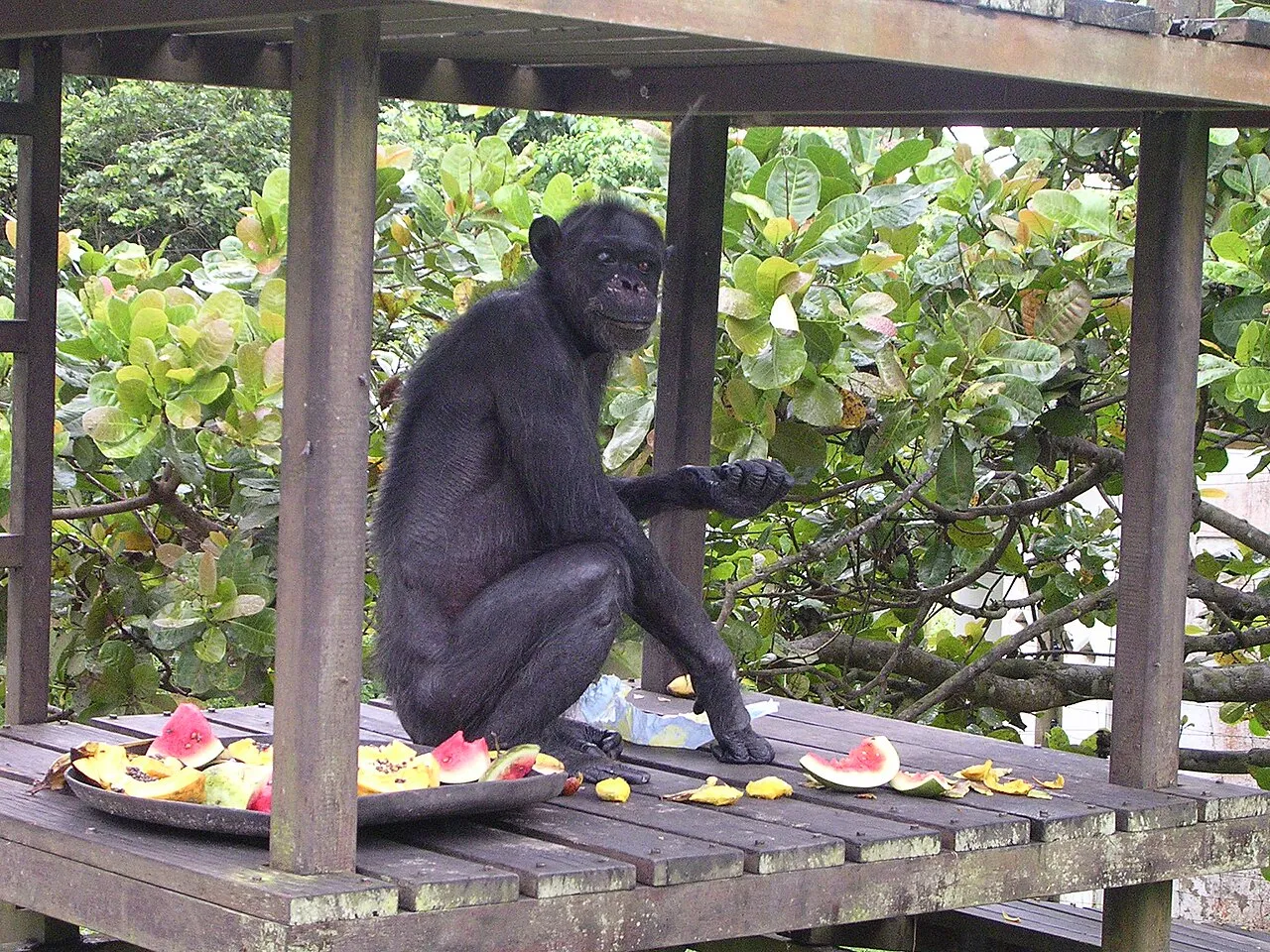
The scientific name is Pan troglodytes. Pan is the Greek god of wild places and shepherds, while troglodytes means cave-dweller, a leftover from early naturalists' confused ideas, since chimps do not live in caves. The common name reached European languages from a word used in central Africa.
Chimpanzees belong to the great ape family Hominidae. Their genus also contains the bonobo (Pan paniscus). Four chimpanzee subspecies are usually recognised.
| Subspecies | Scientific name | Main range |
|---|---|---|
| Western chimpanzee | P. t. verus | Senegal, Guinea, Sierra Leone, Liberia, Côte d'Ivoire and nearby |
| Nigeria–Cameroon chimpanzee | P. t. ellioti | Nigeria and western Cameroon |
| Central chimpanzee | P. t. troglodytes | Southern Cameroon, Gabon, Republic of Congo, Central African Republic |
| Eastern chimpanzee | P. t. schweinfurthii | North-eastern DR Congo, Uganda, Tanzania, Rwanda and nearby |
Bonobos were once called pygmy chimpanzees, but they differ in build, appearance and especially social life and are recognised as a separate species. They live only south of the Congo River, while chimpanzees live north and east of it, so the two never meet in the wild.
3. Evolution
Molecular estimates place the split between the human lineage and the chimpanzee–bonobo lineage around six to seven million years ago, though dates vary with method. Our side of the tree produced a series of upright-walking hominins, while the other branch stayed in the forest and eventually gave rise to today's two Pan species.
Chimpanzees and bonobos diverged roughly one to two million years ago, very likely because the Congo River became an impassable barrier. Chimps cannot swim, so big rivers make firm boundaries.
Chimpanzee fossils are almost non-existent. In 2005 researchers reported fossil chimpanzee teeth roughly half a million years old from Kenya, practically the only secure fossil evidence for the lineage. The find showed that chimps once lived in the same East African landscapes as early humans, not only in deep forest.
Across alignable DNA, humans and chimpanzees match at about 98 to 99 percent. The differences that matter lie largely in when and how strongly genes are switched on, and in larger structural changes in the genome.
4. Range and habitat
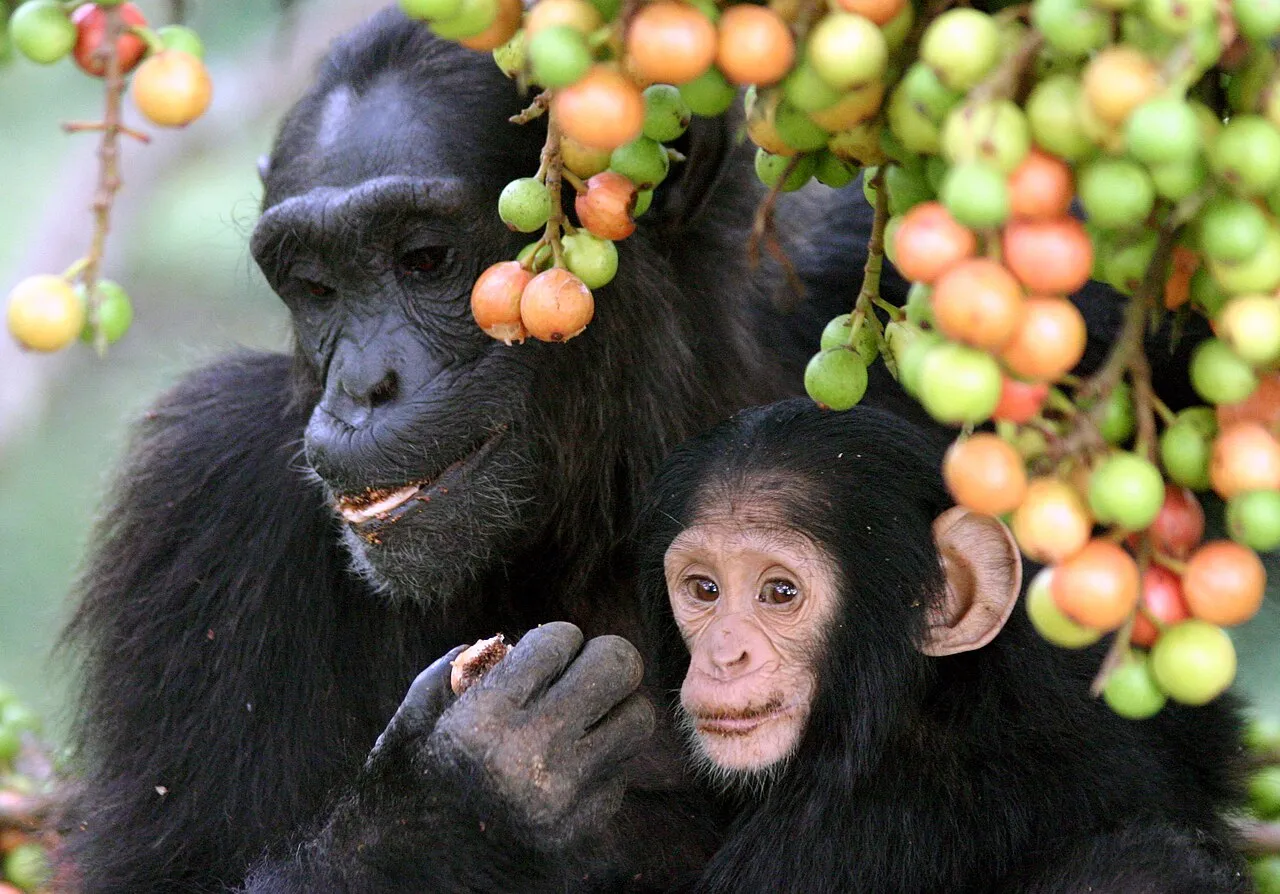
Chimpanzees are found in roughly twenty African countries from Senegal in the west to Tanzania in the east. Their range is far from continuous; human development has broken it into fragments, and in some West African countries they have vanished or nearly so.
They occupy a surprising variety of habitats. Most live in tropical rainforest, but they also inhabit montane forest, riverside gallery forest and open woodland savanna. In hot, dry south-eastern Senegal, chimpanzees have been seen resting in caves and cooling off in pools during the heat of the day. Such savanna chimps give researchers a glimpse of how early humans may have coped as they moved out of the forest.
| Habitat | Character | Effect on chimps |
|---|---|---|
| Lowland rainforest | Fruit available year-round | Relatively small home ranges |
| Montane forest | Cool and wet | Movements follow fruiting seasons |
| Woodland savanna | Long dry season, sparse trees | Very large home ranges; finding water is crucial |
5. Body
Chimpanzees are covered in black or dark brown hair, with bare faces, palms and soles. Youngsters have pinkish faces and a white tail tuft on the rump, which seems to signal youth and earns them tolerance from adults. Faces darken with age, and many adults develop bald foreheads.
| Measure | Males | Females |
|---|---|---|
| Standing height | About 1.2 to 1.7 m | About 1.0 to 1.3 m |
| Weight (wild) | About 40 to 60 kg | About 27 to 50 kg |
The arms are longer than the legs, reaching below the knees when standing. On the ground chimps knuckle-walk like gorillas and sometimes walk upright for short distances; in trees they climb and swing by their arms.
Chimps are often said to be many times stronger than people. Their muscle composition does give them more explosive and pulling power, but a recent study put the advantage at roughly one and a half times rather than five or ten. Even so, no adult human should expect to out-muscle an adult chimp.
Females develop large pink swellings of the genital skin when fertile, a clear signal to males.
6. Behaviour and ecology
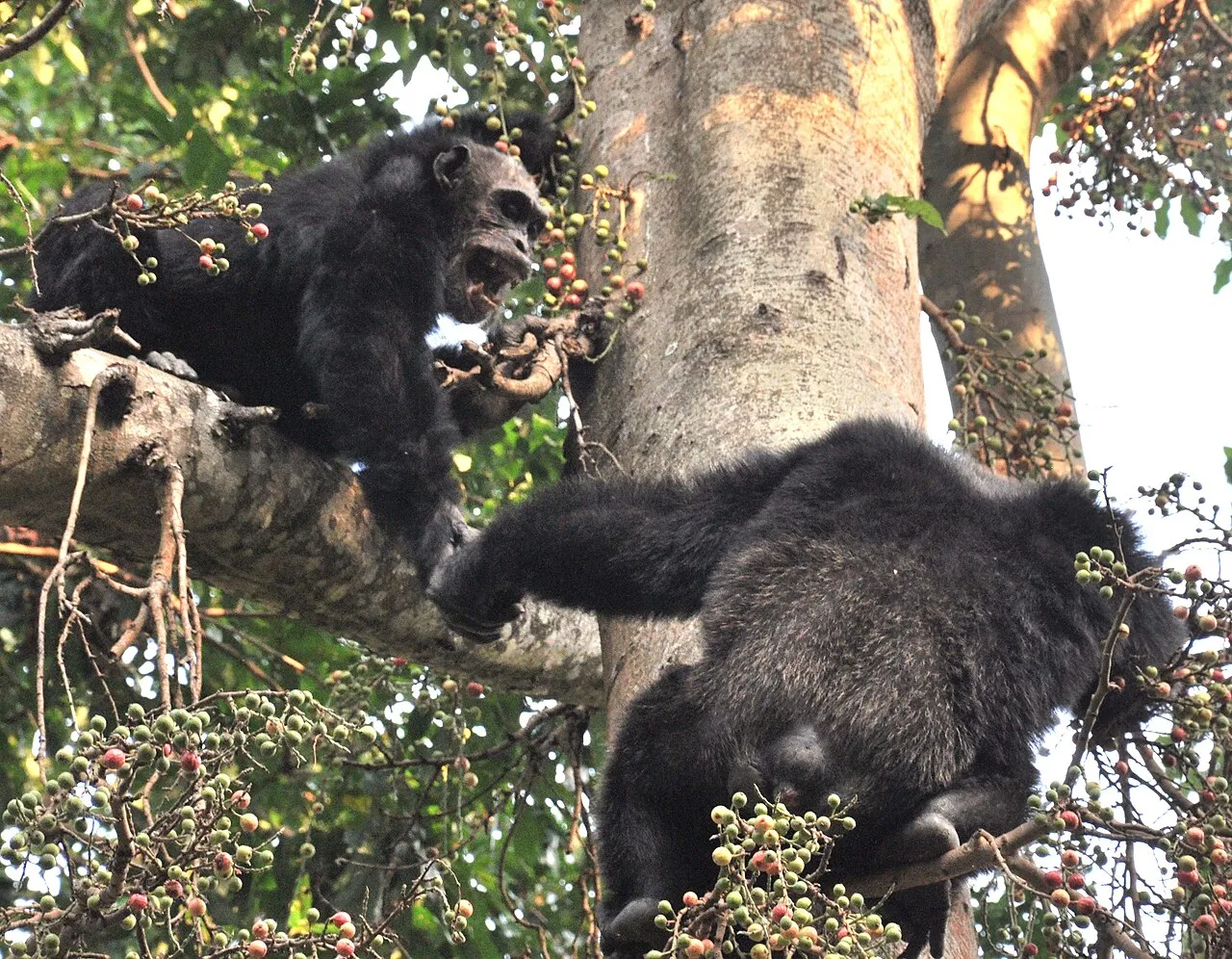
Caelio · CC BY-SA 3.0
Chimpanzees live in communities of a few dozen up to around 150 individuals. The whole community rarely travels together, though. Instead, members split into smaller parties and regroup according to food supply, a pattern called fission–fusion. A tree loaded with fruit may draw a crowd, while lean times see chimps wandering in twos and threes.
Males form the core. They stay in their birth community for life, while females usually transfer to a neighbouring community around adolescence. As a result, the males of a community are often related, and they patrol and defend their territory together.
6.1. Rank and politics
Males have a clear hierarchy topped by an alpha. Reaching the top takes more than brawn: a would-be alpha needs allies, wins support through grooming and sometimes shares meat to stay popular. A strong male without friends rarely lasts, while a smaller but politically skilled male can hold power for years.
Rank contests involve dramatic displays, with hair on end, branches dragged and screams. After fights, chimps often embrace or kiss in what researchers call reconciliation, which helps keep the peace. Bystanders also comfort the loser, a behaviour known as consolation.
Females have their own hierarchy. High-ranking females get the best feeding spots, and their offspring tend to do better.
6.2. Patrols and warfare
Males patrol the edges of their territory in silent groups. If they meet chimps from a neighbouring community, they attack when they have the numbers and retreat when they do not. In the 1970s, at a study site in Tanzania, one community split in two, and over several years one faction killed the males of the other one by one. Dubbed the chimpanzee war, it sparked lasting debate about the roots of group violence.
Long-term studies at many sites have since confirmed repeated lethal attacks between communities. Researchers now generally see this as a natural outcome of competition for territory and mates rather than an artefact of human observation or feeding.
6.3. Daily life
Chimps wake in their tree nests at dawn and set off to forage. They feed mostly in the morning and late afternoon and rest at midday, grooming each other; grooming is about hygiene but even more about maintaining friendships and alliances. Daily travel can reach several kilometres depending on habitat, and every evening each chimp builds a fresh nest high in a tree. One study found they prefer firm tree species that also tend to attract fewer insects.
7. Diet and feeding
Chimpanzees are omnivores, but ripe fruit is the heart of their diet. Figs and other trees that fruit year-round are vital, and when fruit is scarce they eat young leaves, flowers, seeds, bark and pith. They also love honey, insects and birds' eggs.
Their best-known feeding behaviour involves tools:
- Termite fishing: they strip a grass stem or twig, poke it into a termite mound and pull out the insects clinging to it.
- Nut cracking: some West African chimps use stones or heavy wood as hammers and anvils to crack hard nuts, a skill that takes years to master.
- Leaf sponges: chewed leaves soak up water from tree holes.
- Honey dipping: sticks are used to raid bee nests.
Chimps eat meat too. Especially in East Africa, males cooperate to hunt red colobus monkeys, some driving the prey through the canopy while others block escape routes. Meat is shared according to rank, friendship and mating interest, and some researchers see sharing as a political tool. Savanna chimps in Senegal made headlines for sharpening sticks with their teeth and jabbing them into tree hollows to catch bushbabies.
Meat makes up a small share of the overall diet but provides valuable protein and fat. Chimps that appear unwell have been seen chewing bitter pith or swallowing rough leaves whole, which some researchers interpret as self-medication against parasites.
8. Reproduction and life cycle
Chimpanzees breed year-round. Fertile females often mate with several males, which may protect their infants, since no male can be sure he is not the father. High-ranking males try to monopolise females at peak fertility, and sometimes a male and female slip away from the group for days together.
Gestation lasts about eight months. A single infant weighing around 1.5 to 2 kg is the norm, and the bond between mother and offspring is intense and long-lasting.
| Stage | Age | What happens |
|---|---|---|
| Newborn | 0 to 6 months | Clings to mother's belly and suckles |
| Infant | 6 months to 4 years | Rides on mother's back, learns foods; weaned around 4 to 5 |
| Juvenile | 4 to 8 years | Plays a lot, learns tool use, still travels with mother |
| Adolescent | 8 to 13 years | Females begin to show swellings and transfer communities |
| First birth | About 13 to 15 years | Then a birth roughly every 5 to 6 years |
| Male maturity | About 15 to 16 years | Joins adult male rank competition |
| Old age | 35+ | Wild lifespan typically around 40, some beyond 50 |
Young chimps learn from their mothers for years. Hard skills like nut cracking take years of watching and practice, and this long childhood is one of their most human-like traits. Orphans struggle to survive, but older siblings and even unrelated adults have been seen adopting them. Captive chimps have lived past sixty.
9. Intelligence, communication, special abilities
Chimpanzees are among the most studied animals in cognition research. They recognise themselves in mirrors, understand to some degree what others can see and know, and will carry tools in advance for a task later on.
In Japanese studies, some young chimpanzees outperformed adult humans at memorising the positions of numbers flashed briefly on a screen and touching them in order, showing remarkable short-term visual memory.
Chimps have culture. Some communities crack nuts while others with the same nuts nearby do not; grooming postures and the shape of ant-dipping tools vary from group to group. These differences are not explained by environment or genes alone and appear to be learned traditions passed down through generations. A landmark analysis pooling data from many field sites identified dozens of such traditions.
Their vocal repertoire is rich. The loud pant-hoot, used to keep in touch over long distances, is individually distinctive, so chimps can tell who is calling. There are food calls, alarm calls and submissive pant-grunts, plus dozens of gestures, some of which seem to be understood by bonobos as well.
Many studies have taught captive chimps sign language or symbol keyboards. Chimps clearly can combine symbols to make requests, but whether this counts as language in the human sense is still argued over.
10. Predators and survival
Chimps have few natural predators. Leopards are the main one, and lions have occasionally killed chimps in savanna habitats. On spotting a leopard, chimps give alarm calls and may mob it together, screaming and waving branches. Large eagles can threaten infants.
Violence within the species is a significant cause of death too. Long-term studies show that inter-community attacks, rank fights and infanticide account for a noticeable share of mortality.
Disease is a major threat. Because chimps are so close to us genetically, human respiratory viruses spread to them easily, and outbreaks apparently caught from people have killed chimps at research sites. Ebola and anthrax have also devastated some populations.
The biggest danger, though, is human activity: hunting, snares and habitat destruction. Snares set for other animals frequently catch chimps by the hands or feet, leaving permanent disabilities.
11. Relationship with humans
Chimpanzees became known in Europe around the seventeenth century, and the first individuals brought there caused a sensation as apparent people of the forest.
Our understanding was transformed by Jane Goodall's fieldwork in Tanzania, which began in 1960. She watched wild chimps trim grass stems to fish for termites, overturning the belief that only humans made tools, and she revealed their individual personalities, emotions and family bonds. Her project grew into one of the longest-running field studies of any wild animal.
Chimps also endured a long history as research subjects. In 1961 the United States launched a chimpanzee into space before sending a human, and chimps were used in medical research such as hepatitis vaccine development. As ethical objections grew, many countries banned or ended invasive biomedical research on chimpanzees, and retired laboratory chimps were moved to sanctuaries.
In films, advertisements and circuses, chimps were long used as comic performers. Most were taken from their mothers as infants, trained, and then discarded once they grew too strong to handle. Even the famous grinning chimp was misread: a wide, teeth-baring grin in chimps usually signals fear or tension, not happiness.
Chimpanzees are on CITES Appendix I, so international commercial trade is prohibited.
12. Conservation
The chimpanzee is listed as Endangered on the IUCN Red List, and the western chimpanzee was uplisted to Critically Endangered in 2016 after studies documented a steep decline over recent decades.
Total numbers are uncertain, with estimates commonly ranging from about 170,000 to 300,000. Central chimpanzees are the most numerous; Nigeria–Cameroon chimpanzees are the fewest.
Main threats:
- Habitat loss and fragmentation from farming, logging, mining and roads
- Hunting and snaring for bushmeat
- Ebola and human-borne respiratory diseases
- Illegal capture of infants for the pet and entertainment trade
- Conflict with farmers over crop raiding
The pet trade is especially cruel. Catching one infant usually means killing its mother and other adults who try to defend it, so every trafficked baby represents several deaths. Sanctuaries across Africa care for rescued chimps, but returning them to the wild is extremely difficult.
Conservation efforts include protected-area management, ranger patrols, snare removal, community-based ecotourism, disease monitoring and vaccine research. Chimpanzees are on CITES Appendix I.
13. In zoos
Chimpanzees have long been zoo favourites, but they are so intelligent and socially demanding that poor conditions quickly lead to stress behaviours such as hair plucking and repetitive rocking.
Good facilities keep chimps in sizeable groups rather than alone, with climbing structures, nesting material and feeding puzzles that make them think. Artificial termite mounds filled with honey or juice, to be fished out with sticks, are a classic example. Integrating hand-reared chimps into a group is very hard, so it matters that young chimps grow up among their own kind.
The ethics are hotly debated. Campaigners in several countries argue that great apes deserve special legal protections, and some jurisdictions have banned experiments on them. Opinions differ on whether any zoo can truly meet the needs of an animal with such complex social lives and large ranges.
A chimpanzee can never be a pet. An infant may seem as cute as a human baby, but adolescents become powerful and unpredictable, and serious injuries to owners have happened. Above all, chimps need to live among other chimps.
14. In culture
Chimpanzees were among the most frequently seen animals in twentieth-century film and television. A chimp sidekick became a star of the early Tarzan films, and countless comedies and adverts featured chimps acting like people.
A long-running science fiction franchise imagined a world ruled by apes, flipping the relationship between humans and animals to ask questions about prejudice, arrogance and scientific ethics; chimpanzee characters appear in it as wise scientists and revolutionary leaders.
Chimps also star in popular science. Books comparing chimpanzee power struggles to human politics, and memoirs of decades in the field, became international bestsellers and did much to convince the public that animals have emotions and social intelligence.
The word chimp is sometimes used playfully for a mischievous mimic, but growing awareness of field research has encouraged people to see chimpanzees as fellow beings rather than clowns.
15. Trivia
- Chimpanzees cannot swim, which is why zoos sometimes use water moats as barriers, and why drowning accidents occasionally happen.
- Chimps show hand preferences, though populations are not as strongly right-handed as humans.
- The broad, teeth-baring grin usually means fear or nervousness. A genuinely happy chimp shows a relaxed play face with lower teeth visible and makes breathy, panting laughter.
- Pant-hoots differ subtly between communities, leading some researchers to talk about chimp dialects.
- Some chimps perform a so-called rain dance, swaying rhythmically and dragging branches during heavy downpours.
- Archaeologists in West Africa have excavated stone hammers used by chimps to crack nuts thousands of years ago, evidence of a chimpanzee stone age.
- Wild chimps in Guinea have been seen using leaf sponges to drink fermented palm sap, making them a curious case study in animals and alcohol.
Wild animals are not pets. Catching, trading or keeping them is illegal in most places. If you find an injured wild animal, call your local wildlife rescue centre.
FAQ
Is a chimpanzee a monkey?
No. It is a tailless great ape, in the same family as gorillas, orangutans and humans.
How much stronger than a human is a chimp?
Popular claims say several times, but a recent study suggests roughly one and a half times. Still, no person should expect to win a contest of strength.
How do chimpanzees and bonobos differ?
Bonobos live only south of the Congo River, are more slender and have more peaceful, female-centred societies. Chimp society is male-centred and more aggressive.
Photo credits
Photos are freely licensed images from Wikimedia Commons. Authors and licenses are listed below.
- 015 Chimpanzee at Kibale forest National Park Photo by Giles Laurent.jpg — Giles Laurent · CC BY-SA 4.0
- 2006-12-09 Chimpanzee Gregoire D Bruyere.JPG — Delphine Bruyère · CC BY-SA 3.0
- Adult female and infant wild chimpanzees feeding on Ficus sur.jpeg — Alain Houle (Harvard University) · CC BY 4.0
- Adult male chimps in mahale.jpg — Caelio · CC BY-SA 3.0