TailVille
1. Overview
The giraffe (Giraffa camelopardalis) is the tallest animal on Earth. Adult males can stand well over 5 metres to the tops of their heads, with the neck alone approaching 2 metres. That height lets giraffes feed on the upper branches of savanna trees, out of reach of almost every other browser. With its long neck and legs, patchwork coat and stubby horns, the giraffe is one of the first animals children learn to draw.
But a giraffe's body is a marvel of engineering, not just an exercise in length. It needs a powerful heart and very high blood pressure to push blood up to its brain, special vascular adaptations to stop blood rushing to its head when it bends down to drink, and tight, thick skin on its legs that works like compression stockings.
Giraffes were long assumed to be common, but numbers fell sharply over about three decades from the late 1980s, and in 2016 the IUCN moved the species from Least Concern straight to Vulnerable. Conservationists began speaking of a 'silent extinction', a decline that happened largely unnoticed while attention focused on elephants and rhinos.
2. Name and classification
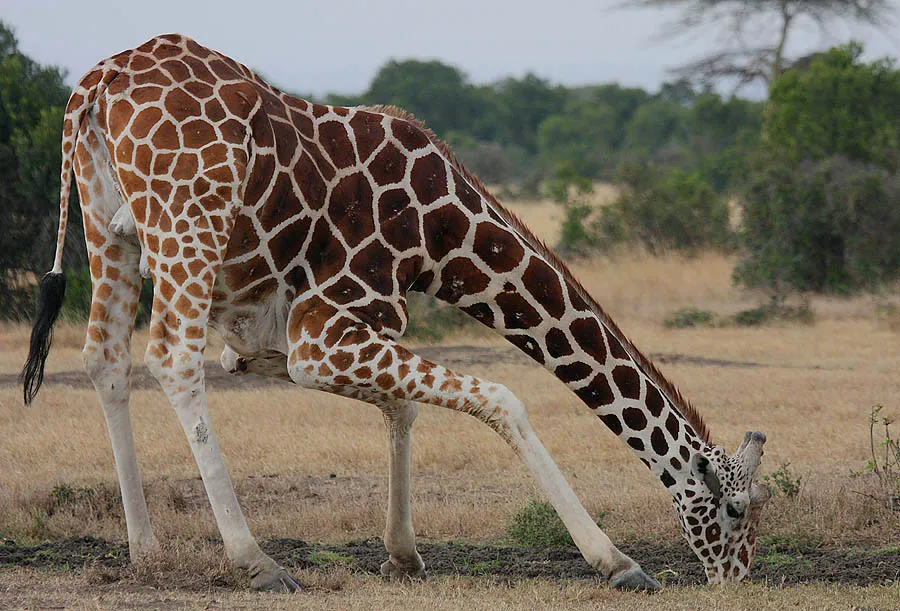
Steve Garvie from Dunfermline, Fife, Scotland · CC BY-SA 2.0
The English word giraffe comes from Arabic zarāfa via Italian and French. The species name camelopardalis is what ancient Greeks and Romans called the animal: a 'camel-leopard', tall like a camel and spotted like a leopard. Some early Europeans genuinely believed it was a hybrid of the two. The faint northern constellation Camelopardalis takes its name from the same word.
In Korean, girin (麒麟) originally named a mythical, auspicious beast of East Asian legend. When Admiral Zheng He's Ming fleet reached the East African coast in the early 15th century, a giraffe from the region of Malindi, in present-day Kenya, was presented to the Chinese emperor. The court hailed the strange creature as the legendary qilin made flesh, and the name stuck in Korea and Japan. In modern Chinese, however, the real animal is usually called 'long-necked deer'.
2.1. One species or four?
Giraffe taxonomy is still hotly debated. Traditionally one species with nine subspecies was recognised, but genetic studies from around 2016 onwards, reinforced by further work in 2021, propose splitting giraffes into four species. The IUCN still assesses them as a single species, and experts remain divided.
| Proposed species | Traditional subspecies included | Main range |
|---|---|---|
| Northern giraffe (G. camelopardalis) | Nubian, Kordofan, West African | West, central and north-east Africa |
| Reticulated giraffe (G. reticulata) | Reticulated | Northern Kenya, Somalia, southern Ethiopia |
| Masai giraffe (G. tippelskirchi) | Masai, Thornicroft's | Southern Kenya, Tanzania, Zambia |
| Southern giraffe (G. giraffa) | Angolan, South African | Southern Africa |
Coat patterns differ noticeably by region. Reticulated giraffes have crisp, narrow white lines forming a neat net; Masai giraffes have jagged, star- or leaf-shaped patches; South African giraffes have rounder, lighter blotches.
The giraffe's only living relative is the okapi of the Democratic Republic of the Congo's rainforests. With a modest neck and zebra-like stripes on its legs it looks rather like a horse, yet the two together make up the entire family Giraffidae.
3. Evolution
The ancestors of the giraffe family appeared in Africa and Eurasia roughly 20 million years ago. Early giraffids were not long-necked at all; they looked more like okapis or deer. Sivatherium, a bulky, short-necked, ox-like giraffid with broad, flattened ossicones, ranged across Africa and southern Asia and may have survived until relatively recent times.
The long-necked giraffe lineage emerged around 7 to 8 million years ago, as forests shrank and savannas spread, favouring tall animals able to reach high foliage. Fossils of the modern genus Giraffa appear in East Africa from roughly one to two million years ago.
The giraffe's neck is a textbook case in evolutionary theory. In the early 19th century Lamarck proposed that giraffes stretched their necks to reach leaves and passed the gains to their offspring. Darwin's theory of natural selection instead held that individuals born with slightly longer necks survived and reproduced better. Today researchers also consider sexual selection, since males fight by swinging their necks and longer, heavier necks may win more bouts, and thermoregulation. A 17-million-year-old giraffid from China, Discokeryx, had a thickened skull and robust neck joints apparently built for head-butting, supporting the idea that combat shaped giraffid heads and necks.
4. Range and habitat
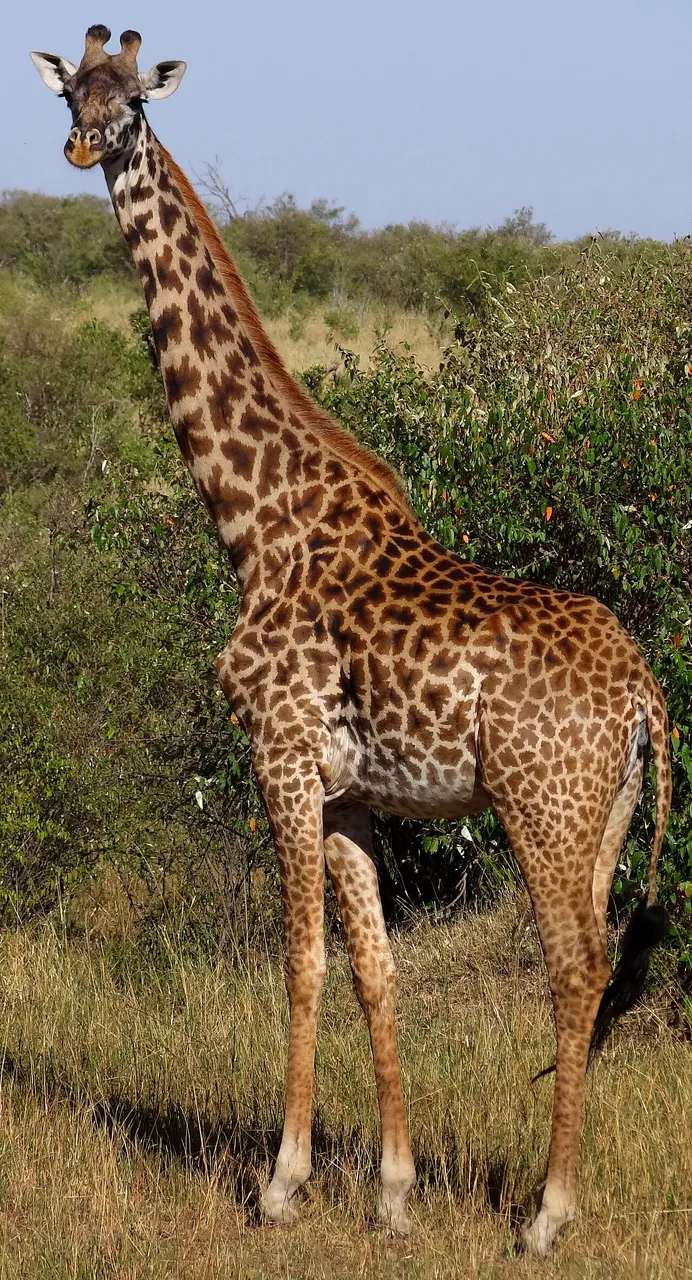
Bjørn Christian Tørrissen · CC BY-SA 3.0
Giraffes live in about two dozen countries in sub-Saharan Africa. The largest numbers are in East Africa (Kenya and Tanzania) and southern Africa (South Africa, Namibia, Botswana, Zimbabwe and Zambia). In West Africa a small population survives in Niger, and scattered groups live in Chad, Uganda, South Sudan, Ethiopia and elsewhere.
Giraffes prefer savanna and open dry woodland dotted with acacias, Commiphora and similar trees. They need browse, but also open sightlines to spot predators, so they avoid dense forest and treeless plains. They can go days without drinking, getting much of their water from leaves and dew, which lets them live in semi-arid areas.
Giraffes once ranged across most of Africa south of the Sahara and parts of North Africa; giraffes are a common subject in Saharan rock art from times when the desert was green. They have since vanished from Senegal, Nigeria, Mali, Eritrea, Guinea and other countries. In southern Africa, restocking of private reserves has spread giraffes into some areas where they did not historically occur.
5. Body
A giraffe's body slopes from high shoulders down to lower hips, with forelegs slightly longer than the hind legs. Males are considerably larger and heavier than females.
| Measurement | Male | Female |
|---|---|---|
| Height to top of head | about 4.5–5.8 m | about 3.9–4.5 m |
| Shoulder height | about 3–3.5 m | about 2.7–3 m |
| Weight | about 800–1,900 kg | about 550–1,200 kg |
| Neck length | about 1.5–2 m | slightly shorter |
| Leg length | over 1.8 m |
The tallest giraffe on record is generally cited at around 5.9 metres. Even a newborn calf stands about 1.5–2 metres tall, taller than most adult humans.
5.1. Neck and circulation
Remarkably, a giraffe has seven neck vertebrae, the same as humans and mice, but each can be more than 25 cm long. Research suggests the first thoracic vertebra is also unusually mobile, adding flexibility. A massive nuchal ligament supports the weight of the head, easing the load on the muscles.
With its head nearly 2 metres above its heart, a giraffe needs enormous pressure to supply its brain. Its heart weighs around 11 kg and has very thick walls, and its blood pressure is two to three times a human's, among the highest of any mammal. When it lowers its head to drink, valves in the neck veins and a dense network of blood vessels at the base of the brain help prevent a dangerous surge of blood.
The legs face the opposite problem: high pressure tends to make blood and fluid pool and cause swelling. Giraffe leg skin is thick and tight, acting like a compression stocking. The principle has interested researchers studying astronaut physiology and medical compression garments.
5.2. Ossicones, tongue and coat
The horns on a giraffe's head are called ossicones. They are neither shed annually like antlers nor sheathed in keratin like cattle horns; instead they form from cartilage that turns to bone and stays covered in skin and hair. Both sexes have them, but females' keep tufts of hair on top, while males' become bald, thick and polished from fighting. Older males also grow a bony lump in the middle of the forehead and deposit extra bone across the skull, so their heads keep getting heavier.
The tongue is 45–50 cm long and prehensile. Its dark blue-black colour is often said to protect it from sunburn during long hours of feeding, though this has not been firmly proven. Tough lips, a leathery tongue and thick saliva let giraffes strip leaves from between acacia thorns.
Every giraffe's coat pattern is unique and stays the same for life, so researchers use photographs to identify individuals. Spot size and shape tend to be inherited from the mother, and one study found that calves with larger, rounder spots had better survival. Networks of blood vessels beneath the patches may also act as heat-shedding windows.
6. Behaviour and ecology
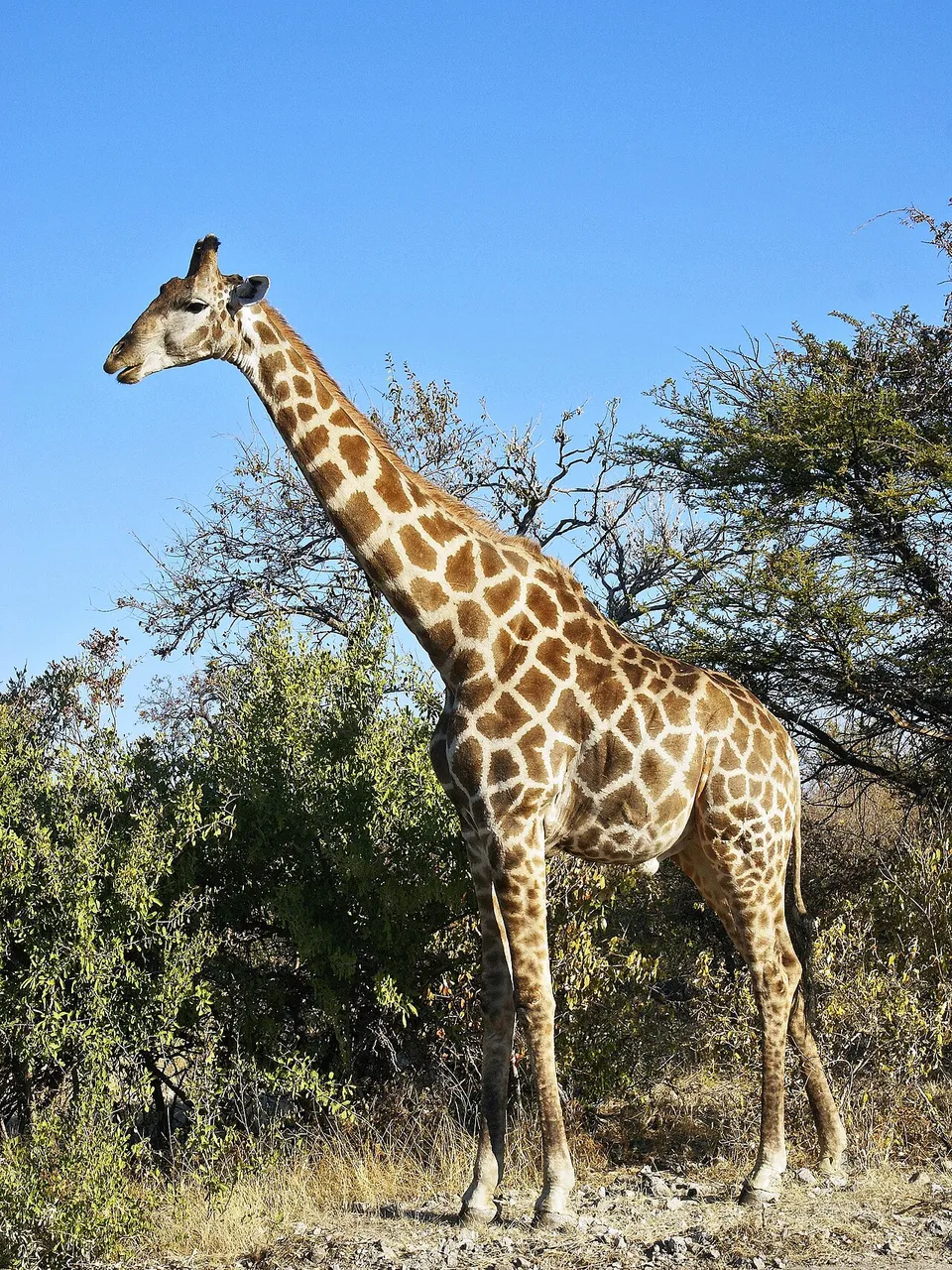
Hans Hillewaert · CC BY-SA 4.0
Giraffes spend much of the day, up to 16–20 hours, feeding, walking and chewing the cud. They sleep remarkably little. Wild giraffes mostly doze standing up; for deep sleep they lie down and curl their necks back to rest their heads on their rumps or hind legs. These deep-sleep bouts last only minutes, and total sleep is thought to amount to just a few hours a day, because getting up from the ground takes time and leaves them vulnerable.
Giraffe society follows a fission–fusion pattern: group membership changes every few hours or days as herds split and merge. Giraffes were once thought to have loose, casual social lives, but recent research shows that females maintain long-term preferred companions and sometimes share calf care, revealing richer relationships than expected.
Males compete for mates through a distinctive form of combat called necking. Two bulls stand side by side and swing their long necks to slam their heads into each other's bodies. Most bouts are tests of strength, but violent fights can knock a rival unconscious or cause serious injury. Giraffes walk with a pace gait, moving both legs on one side together, and can gallop at around 50–60 km/h.
7. Diet and feeding
Giraffes are browsers. Their favourite foods are the leaves and shoots of acacias, along with leaves, flowers and fruit from dozens of other trees and shrubs such as Commiphora and Terminalia. An adult eats around 30–35 kg of food a day. Like cattle, giraffes are ruminants with four-chambered stomachs, and you can watch balls of cud travel up and down the neck as they chew.
Acacias fight back with long thorns and bitter tannins, and some species house ants in swollen thorns that attack browsing animals. Giraffes cope with tough lips and long tongues that strip leaves around the thorns, and by moving from tree to tree before tannin levels rise. Studies also suggest that browsed acacias release airborne chemical signals that prompt neighbouring trees to boost their tannins too.
Males and females tend to feed at different heights. Males often stretch to reach high branches, while females more often feed at body height with their necks bent. This difference has been used in debates about why the neck evolved.
Giraffes sometimes chew bones to obtain calcium and phosphorus, a behaviour called osteophagia, mouthing old bones for long periods. They drink only every few days, and doing so means splaying the forelegs or bending the knees to lower the head, the moment when a giraffe is most vulnerable to predators.
8. Reproduction and life cycle
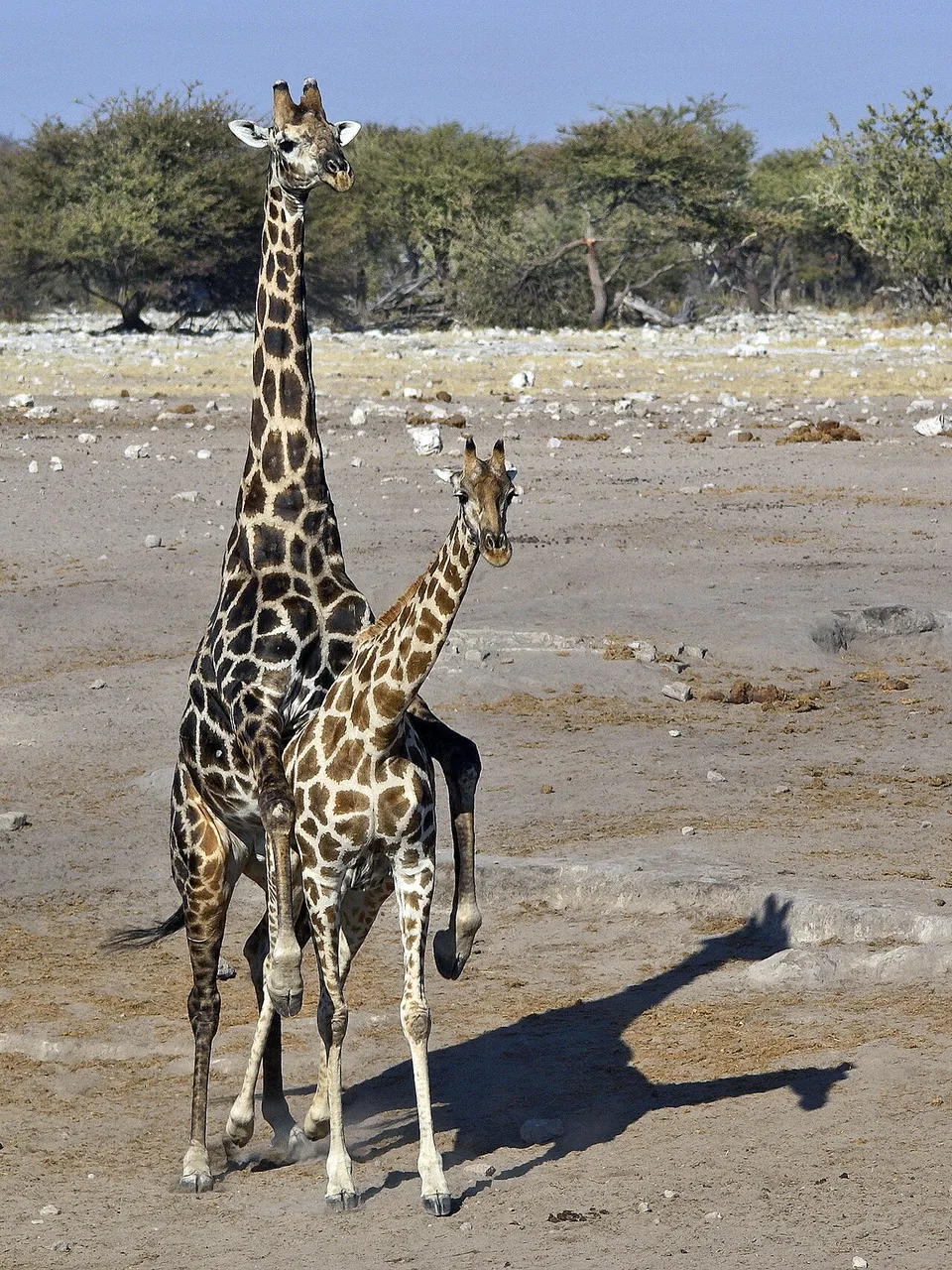
Hans Hillewaert · CC BY-SA 3.0
Giraffes breed year-round, though mating often peaks in the rainy season. A bull checks whether a cow is in oestrus by tasting her urine, catching it in his mouth and then showing the lip-curling flehmen response. Dominant males secure most matings.
Gestation is long, about 15 months (450–460 days). Females give birth standing up, so the calf drops roughly 1.5–2 metres to the ground, a jolt that may help stimulate its first breath. Newborns are about 1.7–2 metres tall and weigh around 50–70 kg, and they stand and walk within an hour. Many females return to the same areas to give birth year after year, known as calving grounds.
| Stage | Age | What happens |
|---|---|---|
| Newborn | 0–1 week | Hidden near cover; mother visits often |
| Crèche | 1 week–several months | Calves group together while mothers take turns guarding |
| Weaning | about 12–16 months | Increasingly feeds on leaves |
| Independence | 1.5–2 years | Young males join bachelor groups; females often stay near mother |
| First breeding | Females 4–5 yrs, males around 7 | Males must rise in rank to mate |
The first year is dangerous. Lions, hyenas, leopards and wild dogs take many calves, and in some areas first-year survival is only around 50%. Wild giraffes typically live 20–25 years, sometimes longer in zoos.
9. Intelligence, communication and special abilities
Giraffes were long thought to be silent, but they snort, grunt, moan and call to their calves, and a sharp snort warns others of danger. Around 2015, researchers recording giraffes at European zoos reported a low-frequency humming at night; what it means remains a mystery.
Vision is the giraffe's strongest sense. Large eyes perched high give a wide field of view and the ability to spot predators kilometres away. Zebras and antelopes sometimes watch where giraffes are looking to detect danger, so giraffes act as lookout towers of the savanna.
Giraffes communicate through gaze and the posture of their ears and necks, and probably through smell as well. Their distinctive odour contains compounds that may repel ticks and other parasites, and because males smell stronger, some suggest it plays a role in attracting females. Studies of giraffe cognition are few, but one experiment found that captive giraffes could make simple probability judgements, choosing the hand more likely to hold a preferred food.
10. Predators and survival
Adult giraffes have few predators thanks to their size and devastating kicks, delivered with both front and hind legs and said to be capable of crushing a lion's skull or breaking its spine. Lions that hunt adult giraffes usually do so in large groups, often when a giraffe is drinking or lying down. In places such as the Serengeti and Kruger National Park, lion prides kill adult giraffes fairly regularly.
Calves are far more vulnerable, falling prey to spotted hyenas, leopards, African wild dogs and crocodiles as well as lions. Mothers stand over their calves and kick fiercely to defend them.
The giraffe's best defence is seeing danger first. Spotting predators early allows it to flee or alert others. Disease is a growing concern too: giraffe skin disease, which produces grey crusty lesions, has been reported in many areas, though its causes and impact are not fully understood. In some regions, electrocution by power lines and vehicle collisions also kill giraffes.
11. Relationship with humans
Giraffes and people go back a long way. Rock art across the Sahara and southern Africa depicts giraffes, and at Dabous in Niger two nearly life-size giraffes are carved into a rock outcrop, estimated to be roughly 7,000 to 9,000 years old. Ancient Egyptians received giraffes as tribute from Nubia and used a giraffe-shaped hieroglyph.
Julius Caesar is said to have brought the first giraffe to Rome, astonishing the crowds, but for centuries afterwards giraffes were rare in Europe. Lorenzo de' Medici famously received one in Florence in 1486, and when the Egyptian ruler sent a giraffe, later nicknamed Zarafa, to King Charles X of France in 1827, Paris went wild with giraffe-patterned fashions. As noted above, a giraffe also reached Ming China in the 15th century.
In Africa giraffes were traditionally hunted for meat, hides and sinew; hides became shields and drums, sinews bowstrings and instrument strings, and tail hairs were prized for ornaments and in some places formed part of bride wealth. Today poaching and bushmeat hunting drive declines in some regions, while giraffe-watching tourism supports local economies elsewhere.
12. Conservation
The IUCN listed the giraffe as Vulnerable in 2016, estimating that numbers had fallen from roughly 150,000–160,000 around 1985 to about 97,000 by 2015, a decline of around 36–40% over three decades. Thanks to conservation gains in some areas and better surveys, the Giraffe Conservation Foundation reported a total of around 117,000 in the early 2020s. The picture varies hugely by subspecies: the Kordofan and Nubian giraffes have been assessed as Critically Endangered and the reticulated and Masai giraffes as Endangered, while the South African and Angolan giraffes are relatively secure.
The main threats are:
- Habitat loss and fragmentation as farms and settlements expand and trees are cut for fuel and charcoal.
- Poaching and bushmeat hunting, especially in areas of conflict and instability.
- Civil war and political insecurity, which have nearly wiped out giraffes in parts of South Sudan, Somalia and the Democratic Republic of the Congo.
- Drought, climate change and competition with livestock.
There are success stories. Niger's West African giraffes fell to around 50 in the mid-1990s, but cooperation between government, villagers and conservation groups has reportedly brought them to more than 600 in the 2020s, living alongside farming communities. In Uganda, Nubian giraffes have been translocated to establish new populations, and community conservancies in Kenya protect reticulated giraffes.
In 2019 giraffes were added to CITES Appendix II for the first time, bringing international trade in giraffe bone, skin and meat under regulation. World Giraffe Day is celebrated on 21 June, the longest day of the year in the Northern Hemisphere, for the animal with the longest neck.
13. In zoos
Giraffes generally adapt and breed well in zoos. Their height demands tall indoor housing, and in cold climates they must spend the winter in heated barns. Hard or slippery floors cause hoof and joint problems, so many facilities use sand or rubber surfaces.
A common stereotypic behaviour in captive giraffes is repetitive licking of walls and fences. In the wild they spend most of the day searching for and processing leaves; in captivity, concentrated feed is eaten quickly and leaves them with little to do. Hanging fresh branches and high feeders with small openings that slow feeding are widely used enrichment.
Visitor feeding encounters are popular but can harm giraffes if food types and amounts are not controlled. In 2014, a European zoo's decision to euthanise a healthy young giraffe deemed genetically surplus, and to dissect it in public, sparked a worldwide debate about how zoos manage their populations.
14. Giraffes in culture
In East Asia the name girin carries the long symbolism of the legendary qilin, a beast with a deer's body, an ox's tail, horse's hooves and a single horn, said to appear when a sage or benevolent ruler arrives. A gifted child is called a girin-a, a 'qilin child'. The Japanese beer brand Kirin and its logo take their name from this mythical creature, and in Joseon Korea the qilin appeared on the rank badges of royalty and high officials.
The real giraffe is a pop-culture favourite too: Geoffrey, the mascot of Toys “R” Us; Melman, the anxious giraffe of Madagascar; and Sophie la girafe, a French teething toy loved by babies around the world for decades. Burning giraffes appear in Salvador Dalí's surrealist paintings.
In 2017 millions of people watched a live stream from a New York zoo awaiting the birth of a calf to a giraffe named April. Tall people everywhere get nicknamed 'giraffe', and the giraffe is the national animal of Tanzania.
15. Trivia
- A giraffe's hoof is about 30 cm across, roughly the size of a dinner plate.
- Giraffes can yawn and cough, but do so rarely enough that observers seldom see it.
- Their long, thick eyelashes protect their eyes from dust and thorns.
- A giraffe can clean its own ears and nostrils with its tongue.
- A group of giraffes is sometimes called a 'tower' when standing and a 'journey' when on the move.
- Lightning is a genuine hazard for the tallest animal on the savanna; giraffes killed by lightning strikes have been reported in South Africa.
- In 2020 researchers described two wild giraffes with skeletal dwarfism, one in Uganda and one in Namibia, the first such cases documented in wild giraffes.
- Despite their height, giraffes have a surprisingly short sleep requirement, and calves sleep more than adults.
Wild animals are not pets. Catching, trading or keeping them is illegal in most places. If you find an injured wild animal, call your local wildlife rescue centre.
FAQ
Do giraffes make any sound?
They are quiet but not mute. Giraffes snort, grunt and call to calves, and recordings suggest they hum at a low pitch at night, though its purpose is unclear.
How many giraffe species are there?
Traditionally one species with nine subspecies, but genetic studies propose four species (northern, reticulated, Masai and southern). The IUCN still assesses it as one species, so sources differ.
Why are giraffes in trouble?
Numbers are estimated to have dropped about 30–40% over three decades from the late 1980s, driven by habitat loss to farming, poaching for bushmeat in conflict zones and fragmentation of their range.
Photo credits
Photos are freely licensed images from Wikimedia Commons. Authors and licenses are listed below.
- Angolan giraffe (Giraffa camelopardalis angolensis) female with young 2 months.jpg — Charles J. Sharp · CC BY-SA 4.0
- Flickr - Rainbirder - Reticulated Giraffe drinking.jpg — Steve Garvie from Dunfermline, Fife, Scotland · CC BY-SA 2.0
- GiraffaCamelopardalisTippelskirchi-Masaai-Mara.JPG — Bjørn Christian Tørrissen · CC BY-SA 3.0
- Giraffa camelopardalis angolensis, flip.jpg — Hans Hillewaert · CC BY-SA 4.0
- Giraffa camelopardalis angolensis (mating).jpg — Hans Hillewaert · CC BY-SA 3.0