TailVille
1. Overview
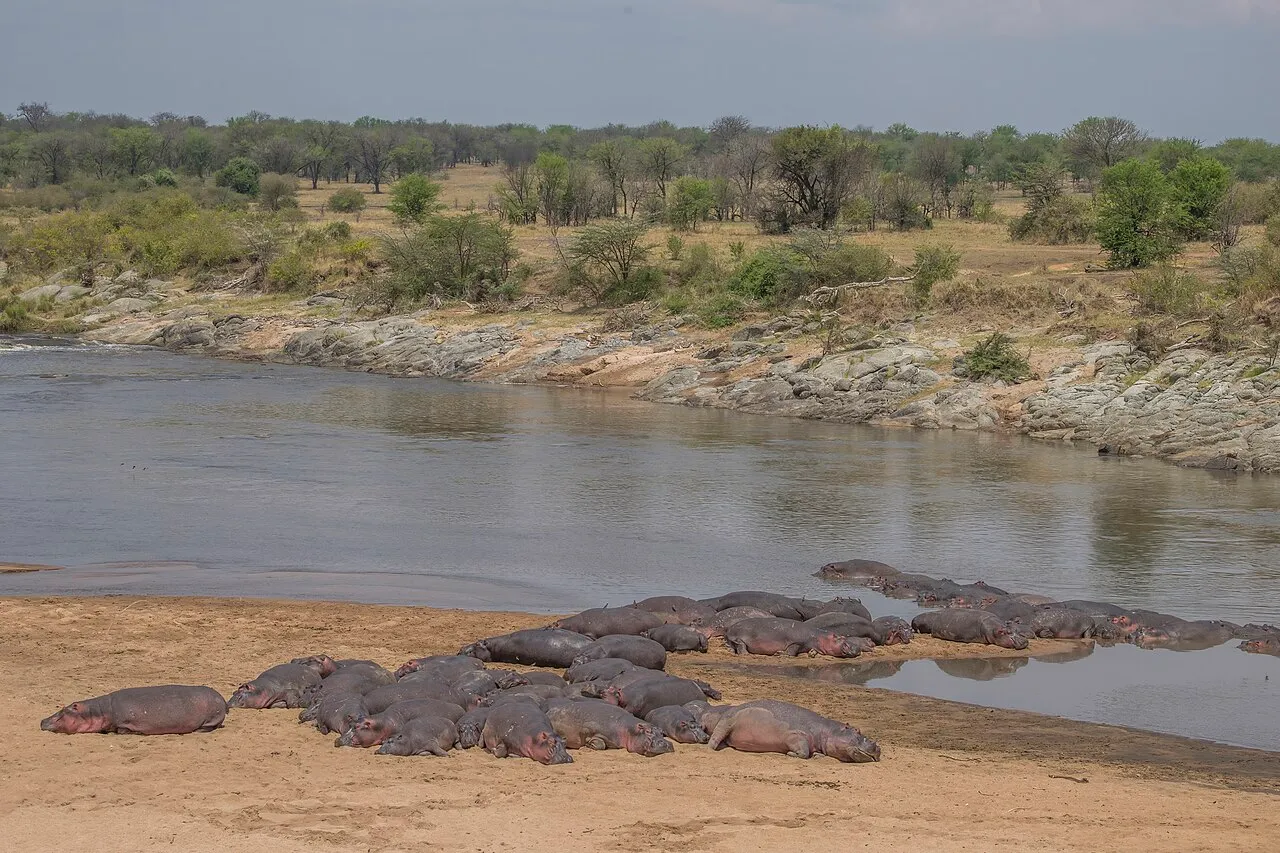
If you see a huge grey shape floating in an African river with only its eyes, ears and nostrils above the surface, it is almost certainly a hippo. The common hippopotamus (Hippopotamus amphibius) ranks with elephants and white rhinos among the heaviest land animals. By day it rests submerged in rivers, lakes and swamps; at dusk it climbs ashore and walks several kilometres to graze through the night.
With its rotund body, tiny ears and huge yawning mouth, the hippo is often portrayed as a jolly, lazy creature. In reality it is intensely territorial and quick-tempered. Hippos capsize boats that enter their stretch of water and attack people who block their path back to the river, earning a reputation as one of Africa's most dangerous large animals.
The hippo is fascinating from an evolutionary point of view too. Despite its pig-like look, genetic studies show that its closest living relatives are whales and dolphins. Hippos are widespread in sub-Saharan Africa, but habitat loss and hunting for meat and ivory have reduced their numbers, and the species is listed as Vulnerable on the IUCN Red List.
2. Name and classification
The name hippopotamus combines ancient Greek hippos (horse) and potamos (river): the 'river horse'. Greeks coined it after seeing the animals in the Nile, though hippos are not remotely related to horses. The species name amphibius is Latin for 'living in both elements', apt for an animal that splits its life between water and land.
The Korean name hama (河馬) uses the characters for river and horse, mirroring the Greek, and the same characters are used in Japanese and Chinese.
2.1. The two living hippos
Only two hippo species survive: the common hippo and the pygmy hippo.
| Species | Range | Weight | Lifestyle | IUCN |
|---|---|---|---|---|
| Common hippo | Sub-Saharan Africa | about 1.3–3.2 t | Social, rivers and lakes | VU |
| Pygmy hippo | West African rainforest, mainly Liberia | about 180–275 kg | Solitary, forest streams and swamps | EN |
The pygmy hippo is roughly a tenth of the common hippo's weight, has proportionally longer legs and spends less time in water. In 2024 a baby pygmy hippo named Moo Deng, born at a zoo in Thailand, became a worldwide social media sensation and introduced millions of people to this rare species.
Hippos belong to the even-toed ungulates along with cattle, deer and pigs, and modern classifications group them with whales in Cetartiodactyla, or an expanded Artiodactyla. Several regional subspecies of the common hippo have been proposed, but the differences are slight and they are not widely accepted.
3. Evolution
The discovery that hippos are the closest living relatives of whales was one of the great surprises of molecular biology from the 1990s onwards. Because of its appearance, the hippo was long assumed to be closely related to pigs. Genetic analysis revealed instead that hippos and whales shared a common ancestor around 50–60 million years ago and are more closely related to each other than to pigs or cattle. The whale line went to sea and became fully aquatic, while the hippo line kept a life split between land and water. Both are nearly hairless, can give birth and nurse underwater, and share features of skin glands and underwater sound communication.
Hippo fossils, however, appear surprisingly late. For tens of millions of years after the split from whales, the hippo lineage is poorly known. The leading explanation is that the anthracotheres, pig-like semi-aquatic animals that spread through Asia, Africa and Europe from around 40 million years ago, were the ancestors or close relatives of hippos. True hippos appear in Africa roughly 20 million years ago.
Fossils of the genus Hippopotamus have been found in Europe and Asia as well as Africa. During warm interglacial periods, hippos wallowed in Britain's Thames and Germany's Rhine. Dwarf hippos evolved on Cyprus, Crete, Malta and Madagascar; those on Madagascar may have survived until only one or two thousand years ago, perhaps disappearing after humans arrived.
4. Range and habitat
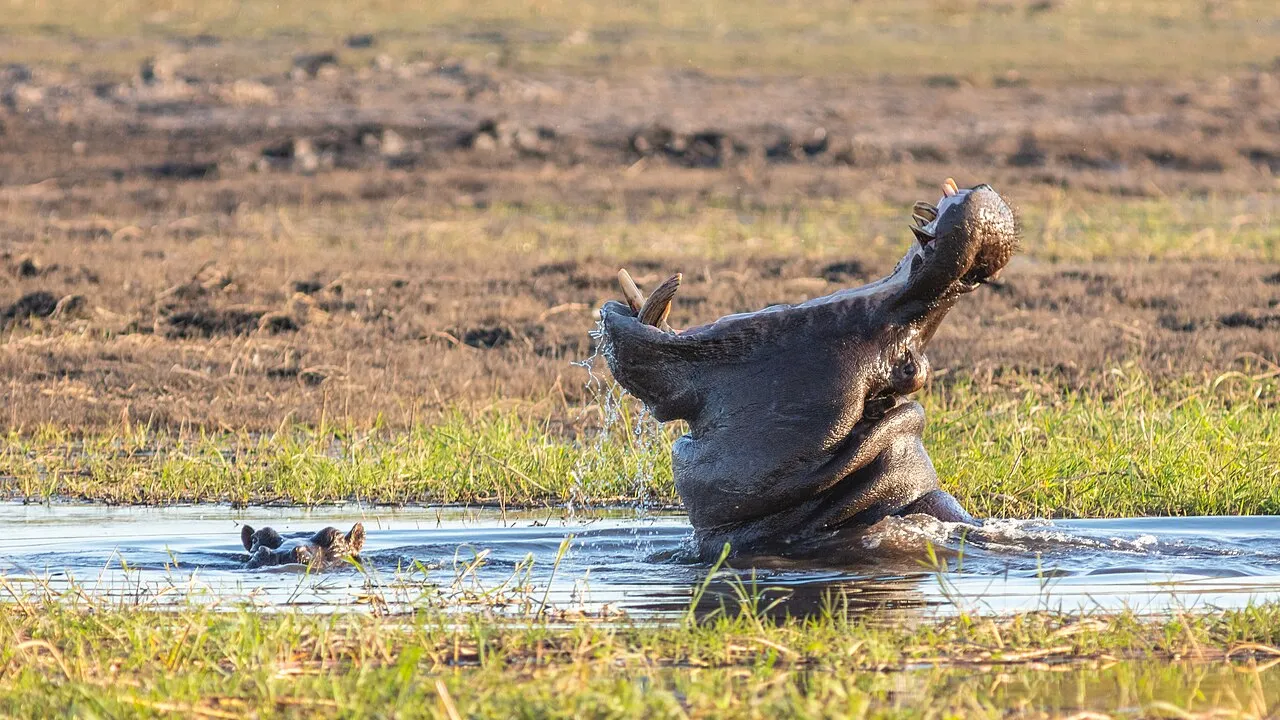
Diego Delso · CC BY-SA 4.0
Hippos live in around 30 countries south of the Sahara. The largest populations are in eastern and southern Africa, with Zambia, Tanzania, Mozambique, Uganda, Kenya, Malawi and Botswana especially important. Zambia's Luangwa River is famous for extraordinary densities, with dozens of hippos per kilometre along some stretches. Hippos also occur in West and Central Africa, but in smaller, scattered populations.
A hippo needs two things: water deep enough to submerge in by day, roughly 1–2 metres, and grazing land within walking distance for the night. They prefer slow-moving rivers, lakes, reservoirs and swamps with gently sloping bottoms. They sometimes enter brackish estuaries, and in the Bijagós Islands of Guinea-Bissau hippos swim through the sea between islands.
In ancient times hippos lived along the lower Nile and in parts of North Africa, which is why hippo hunts are a common scene in Egyptian tomb art. Egypt's hippos were gone by the early 19th century, and hippos have vanished or become very rare in several West African countries. Separately, a feral population descended from imported animals is spreading in Colombia, in South America.
5. Body
Hippos have barrel-shaped bodies, short stout legs and enormous heads. The legs are short but strong enough to carry the bulk, and the four toes on each foot are slightly webbed. The eyes, ears and nostrils sit in a line on top of the head, so a hippo can breathe, see and hear while the rest of it stays underwater. When diving it seals its nostrils and ears shut.
| Measure | Male | Female |
|---|---|---|
| Body length | about 3.3–5 m | about 2.9–4 m |
| Shoulder height | about 1.3–1.6 m | about 1.3–1.5 m |
| Weight | about 1.5–3.2 t (average around 1.5–2 t) | about 1.3–1.5 t |
| Jaw gape | about 150° | |
| Canine length | over 50 cm including the root | smaller than males' |
Males keep growing slowly throughout life, so old bulls are the biggest; individuals over three tonnes have been recorded but are rare. Despite their weight, hippos are startlingly quick over short distances, reportedly reaching around 30 km/h on land, faster than a person can run.
5.1. Skin and 'blood sweat'
A hippo's skin is around 5 cm thick on the body, but it is nearly hairless with a thin outer layer that loses water quickly. Hippos must stay in water or mud during the day to keep from drying out; prolonged sun exposure can crack and burn their skin.
Instead of sweat, special skin glands secrete a thick fluid that is colourless at first but turns red within minutes and then brown. This gave rise to the old belief that hippos sweat blood. In 2004 Japanese researchers reported that the secretion contains a red pigment and an orange pigment that absorb ultraviolet light and inhibit bacterial growth, acting as a natural sunscreen and antiseptic. It may help explain why wounds from fights rarely become infected despite the murky water.
5.2. Jaws and teeth
A hippo can open its jaws to around 150 degrees, a gape that can exceed a metre. Its lower canines grow throughout life, reaching more than 50 cm including the root and occasionally much longer; upper and lower canines grind against each other to stay razor-sharp. The incisors are long and strong as well. Yet these fearsome teeth play almost no role in eating. Hippos crop grass with their thick, tough lips and reserve their teeth for fighting and defence.
What looks like a huge yawn is usually a threat display, showing off the tusks as a warning to keep away. A hippo's bite is among the most powerful of any land animal, strong enough to wreck small boats and kill crocodiles.
6. Behaviour and ecology
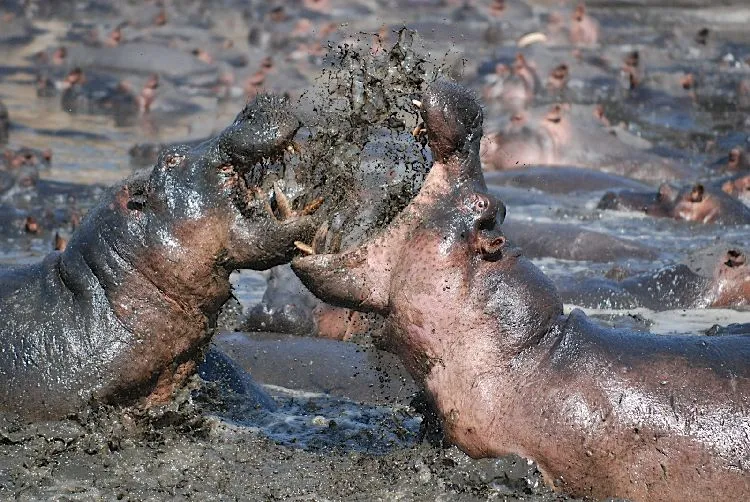
Nilsrinaldi · CC BY 2.0
A hippo's day is sharply divided. Daylight hours are spent resting or sleeping in water. Adults surface to breathe every three to five minutes, a largely automatic process: a sleeping hippo rises, breathes and sinks again without waking. Dives can last five or six minutes.
Hippos look like accomplished swimmers but in fact cannot really swim, and they do not float well. Their heavy bodies and dense bones make them sink, so they walk along the bottom or push off it in bouncing, slow-motion leaps. The water's buoyancy makes them surprisingly light-footed.
At dusk hippos leave the water to graze, usually alone or as mother and calf, walking several kilometres a night and sometimes more than ten. Because they reuse the same routes, they wear deep 'hippo paths' into the ground that can become water channels in the rainy season. They return to the water around dawn.
In the water, hippos gather in groups, usually of about 10–30, though hundreds may crowd into a single pool when water shrinks in the dry season. The core of the group is females and young, and a dominant bull holds a stretch of river or lakeshore as his territory. Territories are defended fiercely in the water, while grazing grounds on land are shared. Territorial bulls mark their patch by spinning their tails like propellers to spray dung in every direction, a behaviour known as dung showering.
7. Diet and feeding
Hippos are almost exclusively grazers. For their size they eat little: around 35–50 kg of grass a night, roughly 1–1.5% of body weight, far less than other herbivores of similar bulk. Spending the day resting in water uses little energy, which is thought to explain their modest appetite.
Hippos crop grass with their broad, muscular lips, about 50 cm wide, rather than their teeth. They favour short grass, and heavily grazed areas become close-cropped 'hippo lawns'. Surprisingly, they eat little aquatic vegetation. Their stomach has several chambers, but they do not chew the cud; grass ferments slowly as it passes through the gut.
Hippos are vital to African river and lake ecosystems. Grazing on land at night and defecating in water by day, they act as nutrient pumps, moving nutrients from land into water. Their dung feeds fish and aquatic insects and boosts river productivity. When too many hippos crowd into shrinking pools, though, dung can build up so much that oxygen levels crash and fish die.
Occasionally hippos have been seen scavenging carcasses or even attacking and eating other animals, and cannibalism of hippo carcasses has been recorded. This may help them obtain nutrients during hard times, but a hippo's digestive system is not built for meat, and such behaviour may cause health problems.
8. Reproduction and life cycle
Hippos mate mostly in the water. A territorial bull has priority access to receptive females within his stretch. Breeding is possible year-round, but in many areas mating peaks in the dry season and births in the wet season, when abundant grass helps nursing mothers.
Gestation lasts about eight months (around 240 days). Near term, the female leaves the group to give birth alone in shallow water or a riverside thicket. Usually a single calf is born, often underwater, weighing about 25–55 kg, and it immediately swims to the surface for its first breath. Calves can suckle underwater, holding their breath and surfacing between drinks, and in deep water they often rest on their mother's back.
| Stage | Age | What happens |
|---|---|---|
| Newborn | 0–2 weeks | Alone with mother, bonding |
| Joining the group | after about 10–14 days | Mother and calf rejoin the pod |
| Nursing | several months to 1 year | Starts nibbling grass after a few weeks |
| Weaning | about 6–12 months | Mostly grass, but stays near mother |
| Sexual maturity | Females about 5–7 yrs, males 7–8 | Males need a territory to breed |
Mothers defend calves fiercely. Calves are targeted by crocodiles, lions and hyenas, and can be attacked by other male hippos, so mothers sometimes keep a little apart from the group. Females typically give birth about every two years. Wild hippos usually live 35–45 years, and zoo hippos have lived past 50.
9. Intelligence, communication and special abilities
Hippos are surprisingly noisy. Their signature call is a booming 'wheeze honk', a series of deep grunts and honks that can exceed 100 decibels and carry more than a kilometre. A 2022 study in Tanzania found that hippos use these calls to tell familiar group members from strangers; when played the calls of unfamiliar hippos, they responded more strongly and were more likely to spray dung aggressively.
Hippos can call above and below water at once. With the head half-submerged, a call travels through both air and water. Underwater they also produce clicks and low rumbles, an aquatic communication style that echoes their kinship with whales, and research suggests their jawbones help conduct underwater sound to the ears.
Body language matters as well: gaping, head-shaking with splashing, dung showering and snorting all express rank and territory. A subordinate hippo lowers its body and releases small amounts of dung in front of a dominant bull to show submission.
Little research exists on hippo intelligence, but zoo hippos respond well to training, learning to open their mouths and present their feet for health checks. In the wild they remember and reuse the same paths and pools for years.
10. Predators and survival
Almost no animal can take on an adult hippo. Thick skin, huge tusks and a ferocious temper mean even lions and crocodiles generally leave adults alone, though large lion prides occasionally bring down hippos on land, especially old or injured ones.
Calves are far more vulnerable to Nile crocodiles, lions and spotted hyenas, and a moment's inattention by the mother can be fatal. Yet hippos and crocodiles mostly coexist peacefully in the same rivers: crocodiles avoid adult hippos, and hippos attack crocodiles mainly when calves are threatened. Hippos have frequently been seen biting and killing crocodiles.
A hippo's most dangerous enemy may be another hippo. Fights between bulls over territory are brutal, with tusks inflicting deep gashes and sometimes killing one combatant; old bulls are covered in scars. Males taking over a territory have also been recorded killing calves.
Drought is another major threat. As water shrinks, hippos crowd into small pools, fights increase and animals weaken from walking ever farther to find grass. Anthrax causes mass die-offs, and outbreaks in Zambia and Uganda have killed hundreds of hippos at once.
11. Relationship with humans
Hippos are regarded as one of the most dangerous large animals to people in Africa. Reliable statistics are lacking, but estimates of several hundred human deaths a year are often cited. Most incidents occur in three situations: when fishermen or boats enter a hippo's territory, when a person stands between a grazing hippo and the water at night, and when someone approaches a mother with a calf. Blocking a startled hippo's route back to the water is especially dangerous.
Hippos also raid crops, entering riverside rice paddies and maize fields at night and eating or trampling them, which causes serious losses for farmers, fuels conflict and sometimes leads to retaliatory killing.
Hippos have long been hunted for meat, hide and teeth. Hippo meat is a valued food in some regions, and the hide was made into whips and shields. Hippo tusks, harder than elephant ivory and less prone to yellowing, were used to make dentures in 18th- and 19th-century Europe and America; some of George Washington's false teeth reportedly included hippo ivory. After the 1989 ban on the elephant ivory trade, hippo teeth became a substitute, raising concerns that the trade was driving poaching.
The strangest hippo story comes from Colombia. In the 1980s drug lord Pablo Escobar built a private zoo on his estate and imported four hippos. After his death in 1993, other animals were relocated, but the hippos were too difficult to move and spread into the Magdalena River basin. With no predators and no droughts, they multiplied to an estimated 100-plus by the 2020s, and studies warned they could reach hundreds or even thousands within decades. In 2022 Colombia declared them an invasive species and announced plans involving sterilisation, relocation abroad and some culling. Concerns about water quality and the safety of fishermen and residents clash with opposition from animal-welfare groups, and the debate continues.
No wild hippos live in Korea, but they are familiar zoo animals, and Koreans commonly compare big eaters or people with wide mouths to hippos.
12. Conservation
The hippo is listed as Vulnerable by the IUCN. Assessments around 2016–2017 estimated roughly 115,000–130,000 hippos. Populations crashed in parts of the Democratic Republic of the Congo during the 1990s and 2000s; in Virunga National Park numbers reportedly fell from about 29,000 in the 1970s to under 1,000 by the mid-2000s, as armed groups and local people hunted hippos for meat and teeth during the conflict. Some areas have since recovered under stronger protection.
The main threats are:
- Habitat loss as riverbanks and lakeshores become farmland and settlements, and as dams and water extraction reduce flows.
- Hunting and poaching for meat and teeth, especially in conflict zones and poorly protected areas.
- Conflict with people over crop damage and attacks, leading to retaliatory killing.
- Drought and climate change drying up pools.
- Illegal trade in hippo teeth as an ivory substitute.
Because hippo habitat follows rivers and lakes in long, narrow strips, it is easily severed or degraded by pollution and water diversion. Conservation measures include managing parks and reserves, anti-poaching patrols, crop-protection fences and compensation schemes. Since hippos live close to people, local cooperation is essential.
The hippo is on CITES Appendix II, which regulates international trade in teeth, skin and meat. At the 2022 CITES conference, several West African countries proposed moving it to Appendix I, but the proposal was not adopted.
13. In zoos
Hippos generally adapt well to zoos, living long lives and breeding readily. Keeping them properly, however, requires a pool large and deep enough for full submersion. Hippos spend most of the day in water and defecate there copiously, so water quality deteriorates fast; powerful filtration systems or frequent water changes are needed, at considerable cost.
In the past many hippos were kept in small, shallow concrete pools, which damaged their skin and led to health problems from inactivity. Modern exhibits increasingly offer large pools, sandy or earthen land areas and underwater viewing windows where visitors can watch hippos gliding along the bottom, a perennial favourite.
Male hippos remain aggressive in captivity and can fight seriously if housed together. Keepers do not share space with them, training them through barriers instead. Occasionally zoos have discovered that a hippo's sex was misidentified for years, because male and female hippos are surprisingly hard to tell apart externally.
14. Hippos in culture
In ancient Egypt the hippo had two faces. Male hippos, which overturned boats and ravaged crops along the Nile, symbolised chaos and were ritually hunted. Female hippos, by contrast, were revered in the form of Taweret, goddess of pregnancy and childbirth, depicted with a hippo's head and body, a lion's limbs and a crocodile's tail, protecting mothers and infants. Blue-glazed faience hippo figurines are common finds in Egyptian tombs; one, nicknamed William, is the unofficial mascot of the Metropolitan Museum of Art in New York. Some scholars interpret the great beast Behemoth in the Book of Job as a hippo.
Modern pop culture usually casts hippos as lovable and comic: the tutu-wearing ballerina hippos of Disney's Fantasia, Gloria in Madagascar and the children's book characters George and Martha. The Moomins of Finnish author Tove Jansson are often said to look like hippos, though they are in fact imaginary trolls. Hungry Hungry Hippos, the marble-gobbling board game, has been a childhood staple in many countries, including Korea.
In 2024 Moo Deng, a baby pygmy hippo at Thailand's Khao Kheow Open Zoo, became a global internet celebrity, inspiring memes, merchandise and even songs. The attention boosted interest in this endangered species, but some visitors splashed water or threw objects at her, prompting the zoo to limit viewing times, a reminder that popular animals deserve respectful observation.
15. Trivia
- The popular internet claim that hippo milk is pink is false; it probably arose from images of the red skin secretion mixed with milk.
- Hippos surface to breathe every few minutes even while asleep underwater.
- Being too dense to float, hippos move by walking or bounding along the bottom.
- A hippo's short, flattened tail is a highly effective dung-spreading paddle.
- Because the canines grow continuously, a hippo whose teeth do not grind against each other properly can suffer from overgrown tusks.
- Hippo paths reshape wetlands, carving new channels and pools; in Botswana's Okavango Delta, hippos play an important role in creating waterways.
- Birds such as oxpeckers pick parasites off hippos, and fish nibble algae and dead skin from their bodies; hippos have even been seen gaping underwater while fish clean their teeth.
Wild animals are not pets. Catching, trading or keeping them is illegal in most places. If you find an injured wild animal, call your local wildlife rescue centre.
FAQ
Do hippos really sweat blood?
Neither blood nor sweat. Skin glands release a thick fluid that turns red and then brown in the air. It appears to absorb sunlight and slow bacterial growth.
Do hippos really kill many people?
Reliable statistics are scarce, but estimates of several hundred human deaths a year are often quoted. Most incidents happen when people block a hippo's path to water or boats pass close to mothers and calves.
Is it true there are wild hippos in Colombia?
Yes. A few hippos imported in the 1980s for Pablo Escobar's private zoo escaped into rivers after his death and grew to more than 100 by the 2020s. Colombia has declared them invasive and pursued sterilisation and relocation.
Photo credits
Photos are freely licensed images from Wikimedia Commons. Authors and licenses are listed below.
- Portrait Hippopotamus in the water.jpg — Muhammad Mahdi Karim · CC BY-SA 4.0
- Common hippos (Hippopotamus amphibius kiboko) Serengeti.jpg — Charles J. Sharp · CC BY-SA 4.0
- Hipopótamos (Hippopotamus amphibius), parque nacional de Chobe, Botsuana, 2018-07-28, DD 79.jpg — Diego Delso · CC BY-SA 4.0
- Hippo fight.jpg — Nilsrinaldi · CC BY 2.0