TailVille
1. Overview
High in the rainforest canopy of Southeast Asia lives a large, shaggy, red-haired ape. The orangutan is Asia's only great ape and the largest mammal that spends most of its life in trees. It rarely comes down to the ground, moving slowly from tree to tree and building a fresh sleeping nest high up every night.
Orangutans live only on Borneo and Sumatra and are now divided into three species: Bornean, Sumatran and Tapanuli. The Tapanuli orangutan was described as a new species only in 2017, and with fewer than a thousand individuals thought to remain, it is the rarest great ape on Earth.
Unlike other apes, orangutans spend much of their time alone. The bond between mother and young is extraordinarily long; a youngster stays with its mother for seven or eight years learning how to survive in the forest. With such slow breeding, and forests disappearing to oil palm plantations, fires and logging, all three species are listed as Critically Endangered.
2. Name and classification
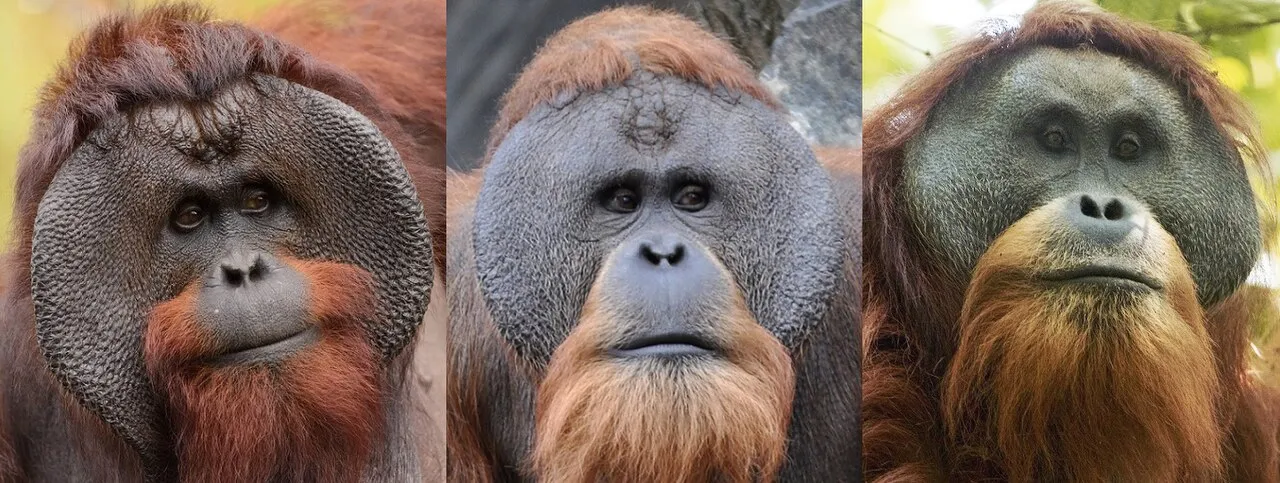
Eric KilbyAiwokTim Laman · CC BY-SA 3.0
The name comes from the Malay words orang, meaning person, and hutan, meaning forest: the person of the forest. It is spelled in several ways in English, including orang-utan. Some historians note that locally the phrase may not originally have referred exclusively to this ape.
Orangutans belong to the great ape family Hominidae, genus Pongo, and form their own subfamily, Ponginae, separate from the African apes.
| Species | Scientific name | Range | Notes |
|---|---|---|---|
| Bornean orangutan | Pongo pygmaeus | Borneo (Indonesia and Malaysia) | Three subspecies |
| Sumatran orangutan | Pongo abelii | Northern Sumatra | Slimmer, paler coat |
| Tapanuli orangutan | Pongo tapanuliensis | Batang Toru forest, northern Sumatra | Described in 2017 |
The Bornean orangutan has three subspecies: P. p. pygmaeus in the north-west, P. p. wurmbii in the centre and south-west, and P. p. morio in the north-east. The north-eastern form tends to be smallest and the central form largest.
The Tapanuli orangutan was long treated as an outlying Sumatran population. Differences in skull and tooth shape, long calls and especially the genome led to its recognition as a separate species, and genetic analyses showed it to be an old, distinctive lineage rather than a recent offshoot of its Sumatran neighbours.
3. Evolution
The orangutan lineage was the first to branch off from the line leading to humans, chimpanzees and gorillas, roughly twelve to sixteen million years ago. Sivapithecus, an ancient ape known from India and Pakistan, had a face strikingly similar to an orangutan's and is regarded as an early relative.
Gigantopithecus, the largest primate known to have lived, was also an orangutan cousin. Known only from huge teeth and jaws found in China and Southeast Asia, it was confirmed as a close relative of orangutans in 2019 through analysis of proteins preserved in its tooth enamel. It died out hundreds of thousands of years ago.
Today's orangutans cling to two islands, but during the Pleistocene they lived across southern China, Vietnam, Laos, Java and other parts of Southeast Asia. Falling and rising sea levels during the Ice Ages repeatedly joined and separated islands and mainland, splitting and mixing populations. Some researchers think early human hunting, along with climate change, helped shrink their range.
Genetic studies suggest the Tapanuli lineage separated from other Sumatran orangutans millions of years ago, while the Bornean–Sumatran split came much later, though published dates vary.
4. Range and habitat
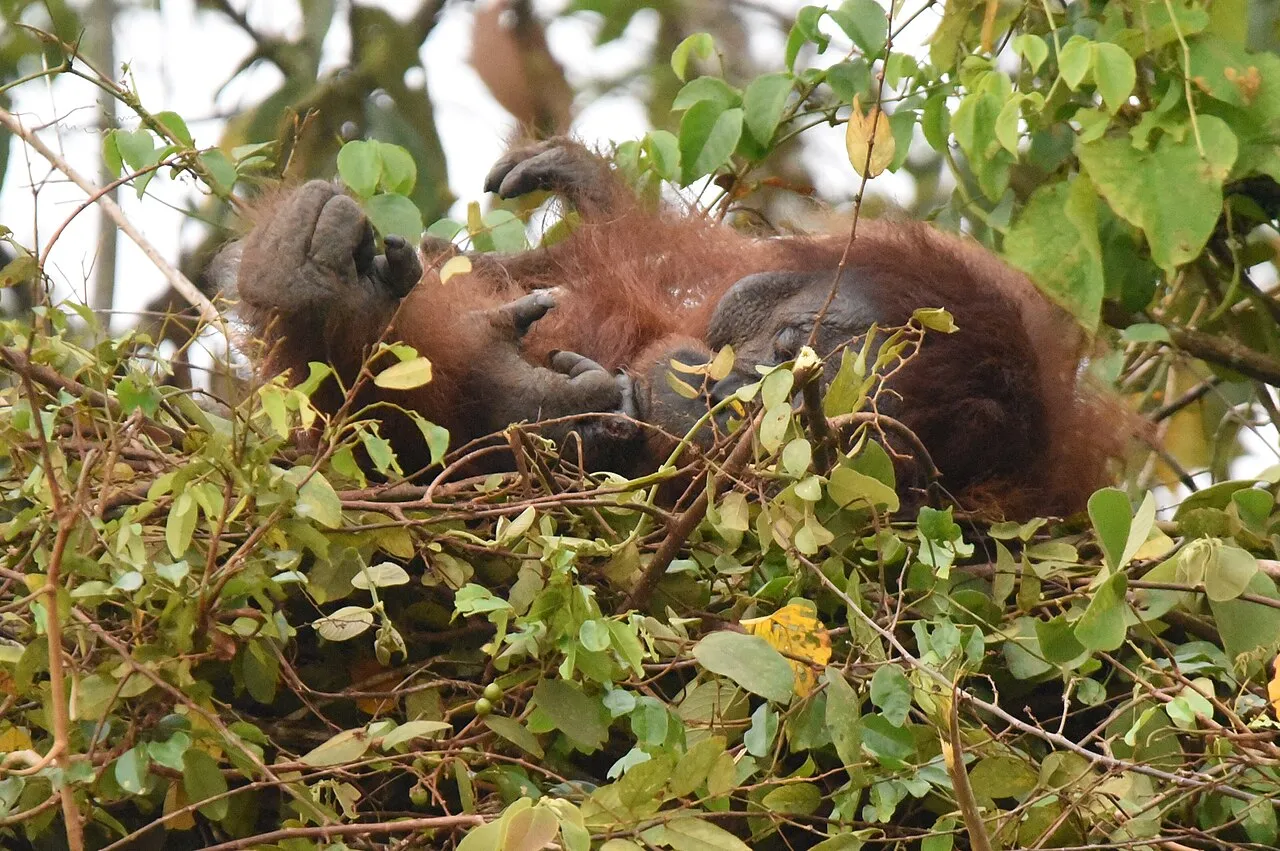
Orangutans live only in the rainforests of Borneo and northern Sumatra. Borneo is shared by Indonesia, Malaysia and Brunei; orangutans occur in Indonesian Kalimantan and the Malaysian states of Sabah and Sarawak. Sumatran orangutans live in the north of the island, especially Aceh and North Sumatra, while Tapanuli orangutans are confined to the Batang Toru forest block in North Sumatra.
They inhabit lowland rainforest, peat swamp forest, and hill and montane forest, reaching the highest densities in fruit-rich lowland and peat swamp forests. Peat swamps form over thousands of years from waterlogged plant debris; they are prime orangutan habitat and store enormous amounts of carbon. Once drained and cleared, they become tinder for devastating fires.
| Species | Range size | Main habitats |
|---|---|---|
| Bornean | Largest | Lowland rainforest, peat swamp, hill forest |
| Sumatran | Intermediate | Lowland to montane rainforest, peat swamp |
| Tapanuli | Very small | Upland forest at relatively high elevations |
Orangutan range has shrunk dramatically in recent decades, and fragmentation by plantations and roads is leaving many remaining populations isolated.
5. Body
Orangutans wear long, coarse, reddish-brown hair. Bornean orangutans tend to be dark maroon-red, while Sumatrans are lighter and more orange, with longer faces and more prominent beards. Tapanuli orangutans are described as having frizzier, cinnamon-coloured hair.
| Measure | Mature males | Females |
|---|---|---|
| Head and body length | About 1.2 to 1.5 m | About 1.0 to 1.2 m |
| Weight (wild) | About 50 to 90 kg, large males more | About 30 to 50 kg |
| Arm span | Can exceed 2 m | Shorter |
Their bodies are built for the canopy. The arms are much longer than the legs, spanning up to about one and a half times body height. Hands and feet are hook-shaped for gripping branches, and the feet can grasp like hands. Exceptionally flexible hip joints let the legs rotate in almost any direction. On the ground, by contrast, they walk rather awkwardly on fists or palms.
5.1. Flanged and unflanged males
Male orangutans have a remarkable feature. Some mature males develop large cheek pads, or flanges, a pendulous throat sac and a much bigger body; these are flanged males. Others of the same age remain unflanged, staying closer to female size.
Unflanged males are fully fertile. They may stay that way for years, sometimes more than a decade, and then transform into flanged males within months when conditions change, for instance when a dominant flanged male nearby disappears. This two-track development, called bimaturism, is extremely unusual among mammals. Flanged males are preferred by females but face more competition and stress, while unflanged males keep a low profile and look for opportunities.
5.2. Senses and face
Like us, orangutans have forward-facing eyes for accurate depth perception, essential for judging gaps between trees, and full colour vision for spotting ripe fruit. Their faces are mostly bare and dark-skinned, and highly expressive, with pouting lips and a range of grimaces.
6. Behaviour and ecology
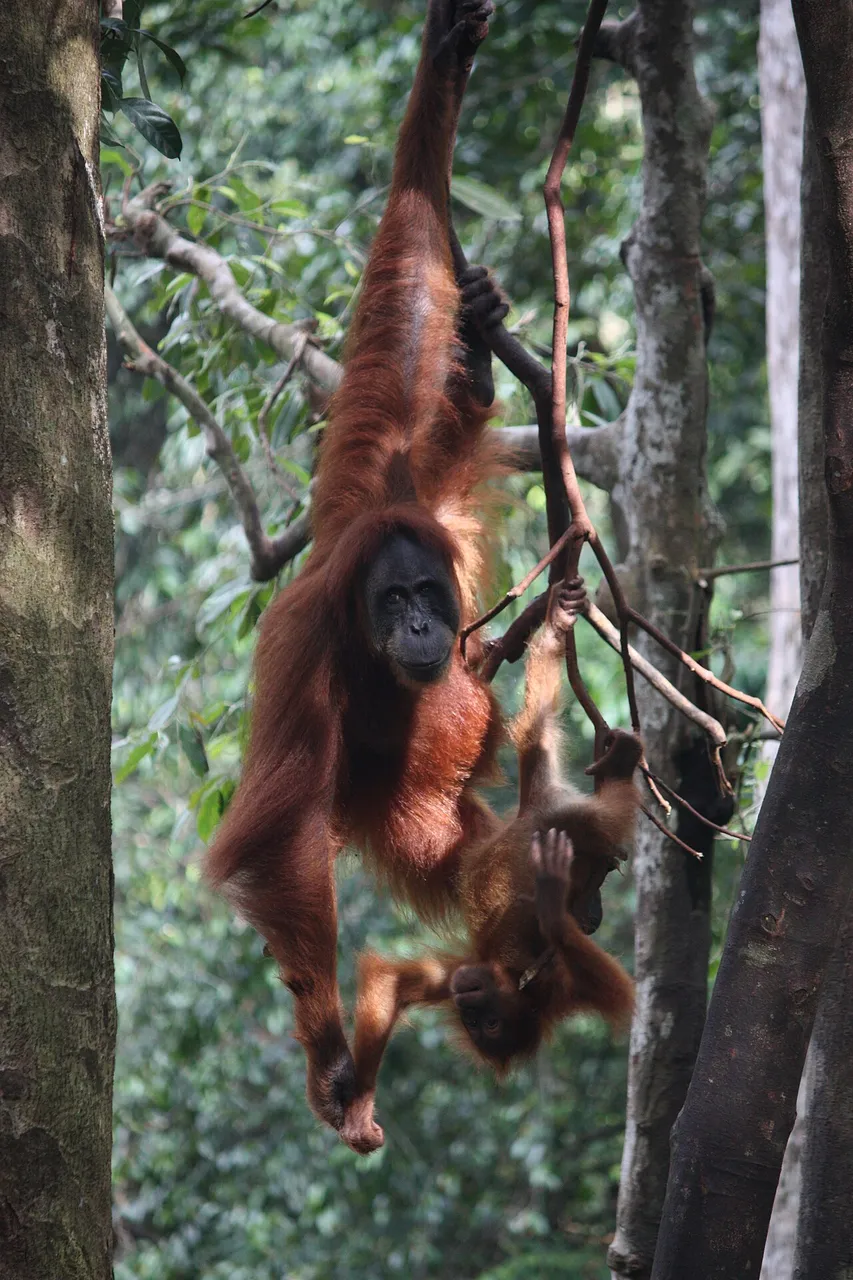
Arian Zwegers · CC BY 2.0
Orangutans are the most arboreal of the great apes. Sumatran orangutans, perhaps because they share their island with tigers, almost never come down to the ground. Bornean orangutans, especially heavy males, walk on the ground more often.
In the canopy they hang from branches by their arms or clamber using all four limbs. When a gap is too wide, they sway a slender tree back and forth with their body weight until it bends close enough to the next one, then step across. It is slow travel, but very economical.
Orangutans are semi-solitary. Adult males usually travel alone, and females move with their dependent young. They are not truly isolated, though: individuals with overlapping ranges know each other and may feed together in a heavily fruiting tree. Sumatran orangutans, living in richer forests, spend more time in company than Bornean ones.
Flanged males produce a booming long call, amplified by the throat sac, that can carry over a kilometre through the forest, telling females where they are and warning rival males to keep away.
Every evening each orangutan builds a new nest in a tree, bending and weaving branches into a platform lined with leaves in just a few minutes. On rainy nights they may add a roof or hold a large leaf over their heads like an umbrella, and they often build a simpler nest for a midday nap. Young orangutans take years to master nest building.
7. Diet and feeding
Fruit is the orangutan's favourite food. In good times it makes up most of the diet, from figs to spiky durians that they open deftly with hands and teeth. When fruit is scarce they switch to young leaves, shoots, inner bark, flowers, honey and insects such as ants and termites. Sumatran orangutans have occasionally been recorded eating small animals like slow lorises.
Orangutans eat hundreds of plant species and remember when and where particular trees will fruit. Southeast Asian rainforests experience mast fruiting, when many trees fruit together every few years. Orangutans gorge during these events and store fat to see them through the lean periods in between.
They also use tools. Some Sumatran orangutans fashion sticks to extract seeds from a fruit whose husk is packed with irritating hairs. Others use twigs to probe tree holes for insects or honey, or hold leaves like gloves when handling spiny fruit. These behaviours vary between populations, which is strong evidence that orangutans, too, have learned cultural traditions.
They get most of their water from food and from rain pooled in tree holes, scooping it up by hand or licking it from wet fur.
8. Reproduction and life cycle
Orangutans breed more slowly than almost any other mammal. Females typically have their first infant at around fifteen, then one every six to nine years, often cited as the longest birth interval of any land mammal. A female may raise only three or four offspring in her whole life.
Females generally prefer flanged males whose long calls they can follow, travelling with them for days and mating. Unflanged males sometimes attempt forced matings.
Gestation is about eight and a half months. A single infant of around 1.5 to 2 kg is born, clinging tightly to its mother's hair and sharing her nest each night.
| Stage | Age | What happens |
|---|---|---|
| Newborn | 0 to 1 year | Clings to mother constantly and suckles |
| Infant | 1 to 4 years | Samples the foods its mother eats and makes short solo climbs |
| Juvenile | 4 to 8 years | Learns nest building and foraging; fully weaned at around 6 to 8 |
| Adolescent | 8 to 12 years | Gradually becomes independent; females often settle near their mother's range |
| First birth | Around 15 years | Then every 6 to 9 years |
| Male maturity | After 15 | Timing of flange development varies greatly |
| Old age | 35 to 45 years | Estimated wild lifespan |
Over that long childhood, a young orangutan learns which of hundreds of plants to eat, where and when they fruit, how to process them, and how to build nests. Orphans rarely survive alone. Captive orangutans have lived beyond fifty, and a few close to sixty.
9. Intelligence, communication, special abilities
Orangutans are highly intelligent and notably deliberate. They recognise themselves in mirrors and tend to study a problem quietly before solving it. In captivity they are infamous escape artists, picking locks and finding weak points in enclosures. Keepers like to say that a chimpanzee will smash a problem while an orangutan will patiently take it apart.
In 2024 researchers reported that a wild male Sumatran orangutan chewed the leaves of a climbing plant known for medicinal properties and applied the paste to a facial wound, which healed within days without infection. It was one of the first systematically documented cases of a wild animal treating a wound with a medicinal plant.
Orangutans communicate with both sounds and gestures. Besides the long call, they make a pursed-lip kiss squeak when disturbed and sometimes hold leaves to their mouths to make it deeper and louder, a kind of acoustic tool. Some captive orangutans have even learned to whistle by imitating people.
Researchers have also observed orangutan mothers waiting several minutes after a predator had passed before giving an alarm call, hinting at an ability to refer to events no longer present, a topic of great interest in the study of language origins.
10. Predators and survival
Orangutans have few natural predators. On Sumatra, tigers can catch individuals that come to the ground, which helps explain why Sumatran orangutans rarely leave the trees. Borneo has no tigers; clouded leopards may take young orangutans, and large pythons or crocodiles pose an occasional risk.
A threatened orangutan breaks off and throws branches, shakes vegetation and gives kiss squeaks. Simply staying high in the canopy is its best defence.
In nature, food shortage is the bigger challenge. Long gaps between fruiting seasons lead to weight loss and poorer health. El Niño droughts are doubly dangerous, reducing fruit and raising the risk of forest fires.
The greatest threat, though, comes from people. As forests disappear, orangutans wander into plantations and villages, where they are often killed as pests.
11. Relationship with humans
The indigenous peoples of Borneo and Sumatra have lived alongside orangutans for millennia. In some areas orangutans were hunted for food; in others, traditions held them to be forest spirits or kin to humans and forbade harming them.
Orangutans became known in Europe around the seventeenth century. In the eighteenth and nineteenth centuries many were captured for exhibition or shot for museum collections, including by famous naturalists working on evolution in Borneo. Shocking by today's standards, it was standard scientific practice then.
From the late twentieth century, long-term field studies, starting in Borneo in the 1970s, revealed that orangutans, though largely solitary, maintain complex social relationships.
Today the biggest issue is oil palm. Palm oil is a cheap, high-yield vegetable oil found in snacks, instant noodles, cosmetics, detergents and biofuels. Soaring demand turned vast areas of Bornean and Sumatran forest into plantations, displacing huge numbers of orangutans. Certification schemes for sustainable palm oil exist, but their effectiveness and credibility remain debated.
Because palm oil is used worldwide, the orangutan's plight is connected to everyday shopping almost everywhere. Orangutans are on CITES Appendix I, so international commercial trade is banned.
12. Conservation
All three orangutan species are listed as Critically Endangered on the IUCN Red List; the Bornean orangutan was uplisted from Endangered in 2016.
| Species | Estimated numbers | Trend |
|---|---|---|
| Bornean | Roughly 55,000 to 100,000 (mid-2010s estimates; figures vary widely) | Decreasing |
| Sumatran | Around 14,000 (mid-2010s estimate) | Decreasing |
| Tapanuli | Fewer than about 800 | Decreasing |
One study estimated that more than 100,000 orangutans were lost on Borneo alone between 1999 and 2015. Declines occurred even where forest remained standing, pointing to hunting and conflict with people as major drivers.
Key threats:
- Forest conversion to oil palm, pulpwood plantations and mines
- Drainage of peat swamps and catastrophic fires, especially in El Niño years
- Killing for food or in retaliation for crop damage
- Capture of infants for the illegal pet trade
- Fragmentation by roads and dams, including a controversial hydroelectric project in Tapanuli orangutan habitat
Conservation work includes protected-area management, forest restoration, rehabilitation centres that return rescued orangutans to the wild, and community programmes to reduce conflict. Rehabilitation is slow: orphaned infants may spend years in forest schools learning to climb and forage before they can be released.
Orangutans are listed on CITES Appendix I.
13. In zoos
Zoos keep both Bornean and Sumatran orangutans. In the past the two were sometimes bred together, producing hybrids, but today they are managed separately.
Because orangutans live high up, good enclosures need tall structures, ropes, hammocks and nesting material. Their intelligence means they bore quickly, so enrichment such as hidden food and puzzle boxes is essential; some zoos have even offered orangutans touchscreen games and drawing apps. Lack of exercise and rich food make captive orangutans prone to obesity, so diet management is important.
Orangutans are largely solitary in the wild, yet zoos often house them in groups. Researchers are still studying whether this causes stress or provides welcome stimulation, and the broader ethics of keeping such human-like apes remain under debate.
Orangutans are never pets. Infants are still sold illegally in Southeast Asia, almost always after their mothers have been killed. Orangutans raised by people miss out on years of forest learning, so even rescued animals find it very hard to return to the wild.
14. In culture
Orangutans hold a curious place in literary history. Edgar Allan Poe's 'The Murders in the Rue Morgue', often called the first modern detective story, reveals an orangutan as the culprit, a sign of how exotic and mysterious the animal seemed to nineteenth-century readers.
Disney's animated Jungle Book features a swinging king of the apes drawn as an orangutan, though orangutans do not live in India and the character does not appear in Kipling's original stories. An orangutan sidekick also starred in popular Hollywood comedies of the late 1970s and early 1980s.
On Borneo and Sumatra, orangutans are regional icons and the stars of ecotourism. Environmental groups frequently use them as the face of campaigns about palm oil, and images of an orangutan confronting a bulldozer have become symbols of rainforest destruction.
19 August is International Orangutan Day, marked by events raising awareness of their conservation.
15. Trivia
- Orangutans share roughly 97 percent of their genome with humans, slightly less than chimps or gorillas, but they are still very close relatives.
- Their arm strength is immense; they can hang by one arm for long periods.
- Photos of orangutans holding big leaves over their heads in the rain are wildlife photographers' favourites.
- A flanged male's long call can last more than a minute.
- Orangutans are less water-shy than some apes and have been seen wading through shallow water, though they are not good swimmers.
- The peat swamp forests they inhabit are huge carbon stores, so protecting orangutans also helps tackle climate change.
- By swallowing seeds and dispersing them far away, orangutans act as forest gardeners; losing them may affect the regeneration of certain trees.
Wild animals are not pets. Catching, trading or keeping them is illegal in most places. If you find an injured wild animal, call your local wildlife rescue centre.
FAQ
How many orangutan species are there?
Three: Bornean, Sumatran and the Tapanuli orangutan, described in 2017. All three are Critically Endangered.
What does palm oil have to do with orangutans?
Vast areas of Bornean and Sumatran forest have been cleared for oil palm plantations, destroying much orangutan habitat.
What is the difference between flanged and unflanged males?
Both can breed. Flanged males are bigger, give long calls and are preferred by females; unflanged males may develop flanges later when conditions change.
Photo credits
Photos are freely licensed images from Wikimedia Commons. Authors and licenses are listed below.
- Orang Utan, Semenggok Forest Reserve, Sarawak, Borneo, Malaysia.JPG — Eleifert · CC BY-SA 3.0
- Bornean, Sumatran & Tapanuli orangs (horizontal).jpg — Eric KilbyAiwokTim Laman · CC BY-SA 3.0
- Bornean Orangutan in nest.jpg — Joeavison1 · CC BY-SA 4.0
- Bukit Lawang, orangutans (6785217748).jpg — Arian Zwegers · CC BY 2.0