TailVille
1. Overview
Jet black with crisp white patches and a dorsal fin that can stand as tall as a person, the orca is one of the most recognizable animals in the sea. Despite the name killer whale, it is actually the largest member of the dolphin family.
Orcas live in every ocean, from polar pack ice to the tropics, making them one of the most widely distributed mammals on the planet after humans. Yet orcas in different places can be strikingly different. Some eat only fish, some hunt seals and other whales, and some specialize in sharks. These groups have their own calls, hunting traditions and even body shapes, and they rarely interbreed, which has led many scientists to argue that orcas should be split into several species.
At the heart of orca society is the grandmother. Mothers and their offspring often stay together for life, and older females, long past breeding age, lead their families using decades of accumulated knowledge. Orcas are one of very few animals known to go through menopause and then live for decades afterward.
Wild orcas are not known to have ever killed a person. Their lives in captivity, however, have become one of the most heated animal welfare debates of the past half century.
2. Name and classification
The scientific name is Orcinus orca. Orcinus has been interpreted as belonging to Orcus, the Roman god of the underworld, though it may simply derive from orca, an old Latin term for a kind of whale. Either way, the name reflects a long reputation as a fearsome sea creature.
Killer whale is thought to come from Spanish sailors who called these animals asesina de ballenas, killer of whales. In translation the order flipped. Many people now prefer orca to avoid the menacing connotation.
The Korean name beomgorae means tiger whale, inspired by its power as a predator and its bold black-and-white markings. The orca is the only living species in its genus; the false killer whale and the pilot whales are fellow dolphins but belong to different genera.
2.1. Ecotypes: one species or several?
The key concept in orca research is the ecotype: a population with its own diet, behaviour and genetic identity, even when it shares waters with other orcas. In the eastern North Pacific, three are well known.
| Ecotype | Main prey | Traits |
|---|---|---|
| Resident | Salmon and other fish | Large family groups, highly vocal, more rounded dorsal fin tips |
| Bigg's (transient) | Seals, sea lions, porpoises, whales | Small groups, quiet while hunting, pointed dorsal fins |
| Offshore | Sharks and other fish | Large groups far from shore; teeth worn down by abrasive shark skin |
In Antarctica researchers describe types A, large B, small B, C and D, which differ in size, eye patch shape and colour. Type C is small and eats fish such as Antarctic toothfish, while type D has a tiny eye patch and a rounded head.
In 2024 a study proposed formally recognizing resident and Bigg's orcas of the eastern North Pacific as separate species. This is not yet universally accepted, but many researchers expect the orca to be divided into several species in the coming years.
3. Evolution
Orcas branched off relatively early within the oceanic dolphin family. Their closest living relatives are debated, but many analyses place them near blunt-headed dolphins such as the Irrawaddy dolphin, false killer whale and pilot whales.
The fossil Orcinus citoniensis, from Italian deposits roughly three to five million years old, was smaller than the modern orca, had more teeth and probably ate fish. Other orca-like fossils have been reported from Argentina and England.
Genetic studies suggest that today's ecotypes diverged within the last few hundred thousand years, which is fast in evolutionary terms. Culture is a leading explanation. Prey specializations and hunting skills are passed down within families; groups with different traditions do not mate with each other, and over time they drift apart genetically. Orcas are often cited as an example of culture driving evolution.
4. Range and habitat
Orcas occur in all oceans and most seas, but they are not evenly spread. They are most abundant in cold, productive waters and along coasts. Well-known areas include British Columbia, Washington State and Alaska, Norway, Iceland, the Southern Ocean, Patagonia in Argentina, South Africa and New Zealand.
Some populations move with their prey. Resident orcas gather near the coast when salmon return to rivers in summer and autumn, and Norwegian orcas follow herring between fjords and open sea. Some Antarctic orcas have been tracked making rapid round trips of thousands of kilometres into subtropical waters, possibly to shed and regrow skin in warmer water without losing too much body heat.
Orcas are occasionally sighted in the East Sea off Korea, and they appear in historical whaling records. Whether any population visits Korean waters regularly is not well known.
5. Physical characteristics
The orca is the largest dolphin, and males are much bigger than females.
| Feature | Males | Females |
|---|---|---|
| Length | about 6 to 8 m, occasionally over 9 m | about 5 to 7 m |
| Weight | about 3.5 to 6 tonnes, sometimes more | about 1.5 to 4 tonnes |
| Dorsal fin | up to about 1.8 m, tall and triangular | about 0.9 m, curved |
| Teeth | 10 to 13 per side in each jaw, up to about 10 cm long | same |
| Top speed | bursts over 45 km/h | same |
Orcas are black on the back and sides, with an oval white eye patch behind each eye, white on the lower jaw and belly, and a grey saddle patch behind the dorsal fin. These markings, along with nicks in the fin, differ between individuals and are used for identification. In newborns the white areas are yellowish or orange and turn white within about a year.
A male's dorsal fin begins shooting upward at adolescence, so fin shape alone reveals whether an animal is an adult male. The paddle-shaped pectoral fins are also huge, up to a fifth of body length in large males.
5.1. Senses
Like other toothed whales, orcas echolocate. Mammal-hunting Bigg's orcas, whose prey can hear them, use clicks and calls sparingly and hunt in near silence. Fish-eating residents, whose salmon prey hear clicks poorly, call freely. Orcas also see well in and out of water and often spyhop, lifting their heads above the surface to look around.
6. Behaviour and ecology
Orca social structure varies by ecotype. In the well-studied resident orcas of the North Pacific, the basic unit is the matriline: a grandmother, her children and her daughters' children, sometimes spanning four generations. Remarkably, both sons and daughters stay with their mother for life. Males mate with females from other groups during brief encounters and then return to their mothers.
Matrilines that travel together form pods, pods sharing a dialect form clans, and clans that associate form communities. Bigg's orcas live in smaller groups, and some offspring eventually disperse, probably because small groups are more efficient for hunting seals.
Orcas spend most of the day travelling and foraging, and the rest resting in tight, slow-moving lines or socializing. Tail slapping, breaching and playing with kelp are common. Southern resident pods sometimes line up facing each other when they meet, in what looks like a greeting ceremony.
6.1. Grandmothers and menopause
Female orcas usually stop breeding in their late thirties or forties but may live for decades longer. Prolonged post-reproductive life is documented in only a handful of species, including humans and several toothed whales.
Long-term studies show that older females lead their groups to feeding grounds, especially in years when salmon are scarce, and share fish with relatives. After a grandmother dies, her grandchildren's risk of death rises noticeably. Orcas have become a key example of the grandmother hypothesis: that helping existing kin survive can be more valuable, genetically, than continuing to reproduce.
7. Diet and feeding
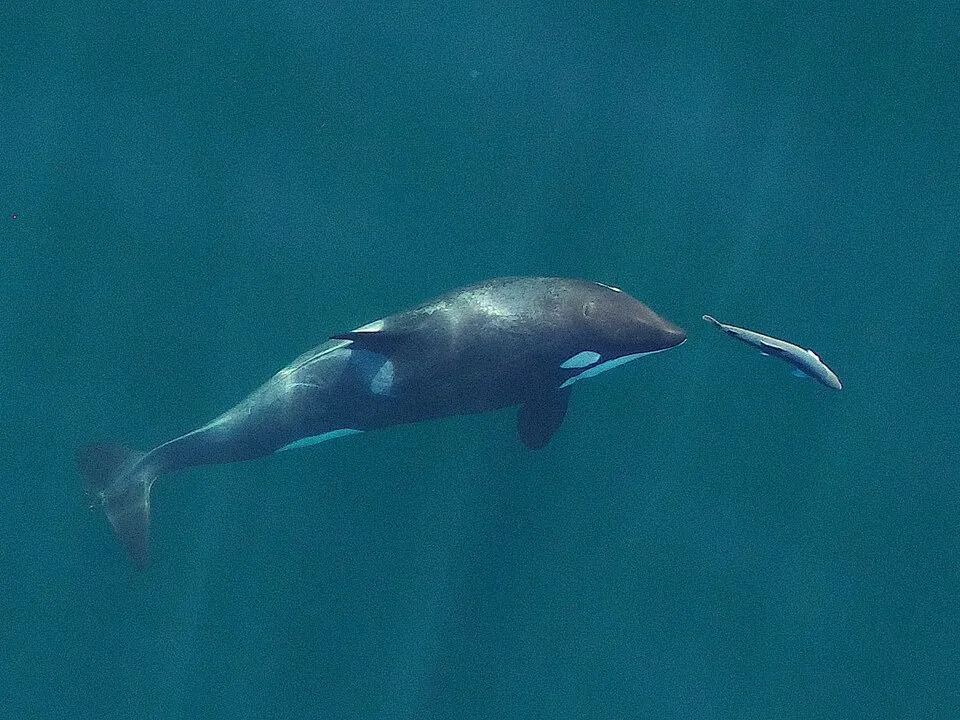
As a species, orcas eat almost everything: fish, squid, seabirds, turtles, seals, sea lions, dolphins, large whales and sharks. Individual populations, though, are extremely picky. Resident orcas in the North Pacific prefer salmon, especially fatty Chinook salmon, while Bigg's orcas in the same waters almost never eat fish.
Each group has its own techniques:
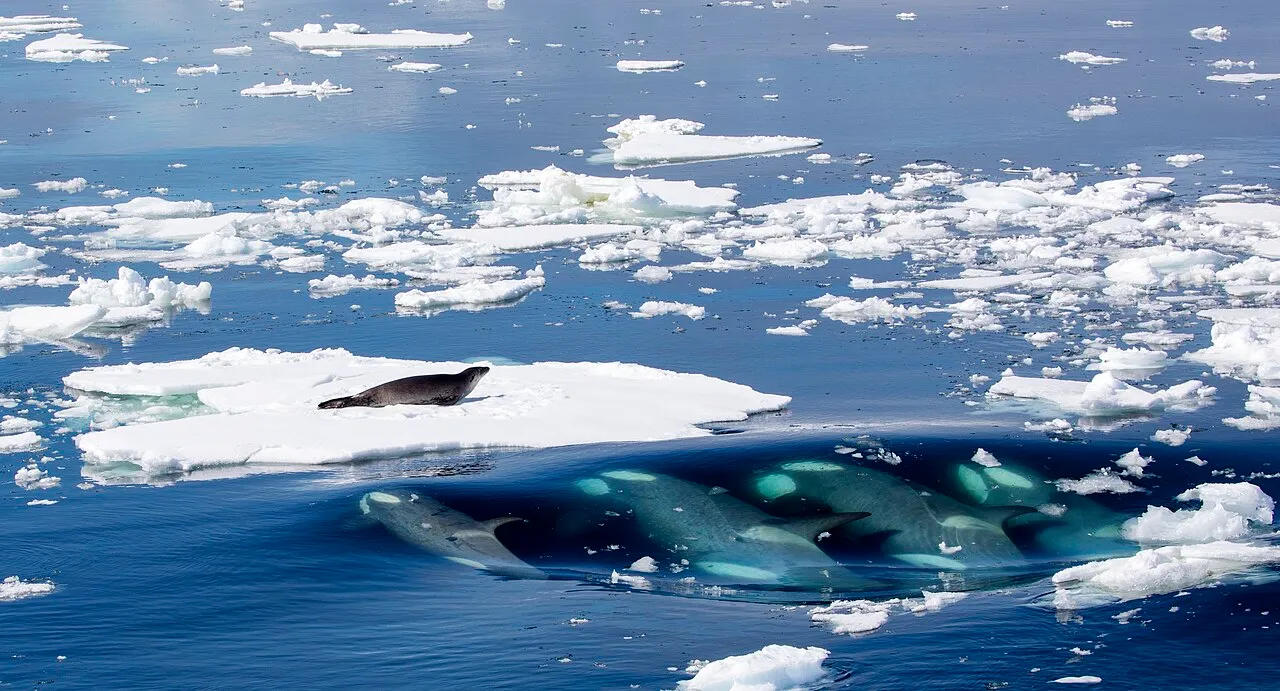
- Wave washing: some Antarctic orcas swim side by side toward an ice floe to create a wave that sweeps resting seals into the water.
- Intentional stranding: orcas in Patagonia and the Crozet Islands rush up beaches to snatch sea lion or elephant seal pups, then wriggle back into the sea. Mothers spend years teaching this risky skill.
- Carousel feeding: Norwegian orcas herd herring into a tight ball, stun fish with tail slaps and pick them off one by one.
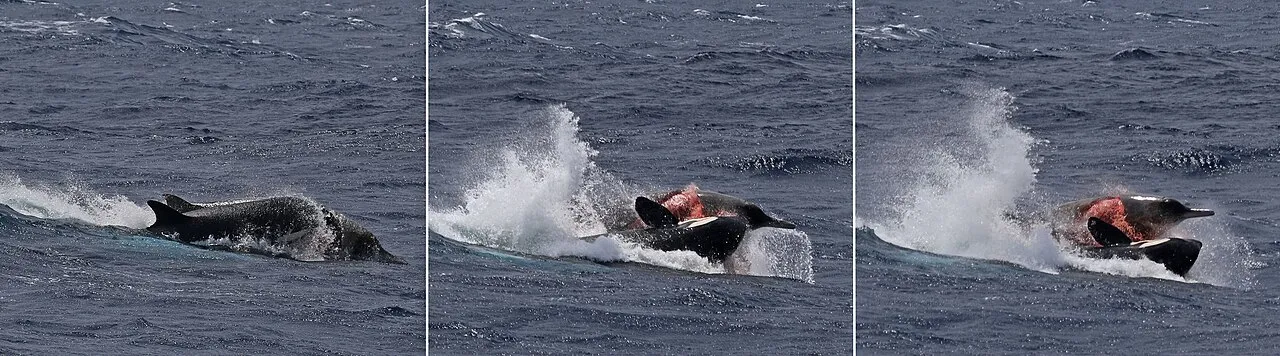
- Hunting large whales: Bigg's orcas separate grey or humpback whale calves from their mothers, and on rare occasions packs have killed adult blue whales.
- Hunting sharks: off South Africa, a few orcas have been recorded killing great white sharks and eating only the nutrient-rich liver. Great whites then abandoned some of those areas for long periods.
Every population, in short, maintains its own specialized hunting culture adapted to local prey.
8. Reproduction and life cycle
Orcas tend to mate with individuals from other family groups, avoiding close relatives, although inbreeding has been documented in very small populations.
Gestation lasts about 15 to 18 months, one of the longest among cetaceans. A single calf is born, about 2 to 2.6 metres long and 120 to 200 kg. Females calve every three to ten years and may raise around four to six calves in a lifetime. Calf mortality is high, and many die in the first year.
| Stage | Age | What happens |
|---|---|---|
| Newborn | 0 to 1 year | Orange-tinted patches; swims at mother's side and nurses |
| Juvenile | 1 to 10 years | Weaned; learns hunting skills and the family dialect |
| Adolescent | 10 to 15 years | Male dorsal fin begins to sprout |
| Adult | females breed from about 10 to 15 | Males reach full size around 20 |
| Elder | females over about 40 | Stops breeding but leads the family |
Lifespan differs sharply between the sexes. Females average around 50 years and some exceed 80; one well-known female was estimated, uncertainly, to be near 100. Males average around 30 years and rarely exceed 50 or 60. Studies have also found that adult sons are far more likely to die in the year after their mother's death, earning them a reputation as mama's boys.
9. Intelligence, communication and special abilities
An orca brain weighs roughly five to seven kilograms, among the heaviest of any animal after the sperm whale's. Some studies suggest brain regions associated with emotion and social processing are especially elaborate.
Orcas communicate with clicks, whistles and pulsed calls. Pulsed calls vary between groups and are called dialects: each family has its own repertoire, and calves learn their mother's calls. Researchers can identify a family from recordings much as a person might guess someone's hometown from their accent.
Orcas are also skilled mimics. Captive orcas have imitated bottlenose dolphins and sea lions and, in one experiment, copied a few human words. In the wild, orcas that spent time with dolphins have been heard mixing dolphin-like sounds into their repertoire.
Odd behaviours sometimes spread like fads. In 1987 a resident orca began carrying a dead salmon on her head; within weeks others copied the habit, and by the next year it had vanished. Since 2020 a small population off the Iberian Peninsula has been pushing and breaking the rudders of sailing boats. Whether this is play or a response to some past bad experience is still unclear.
10. Predators and survival
As apex predators, orcas have essentially no natural enemies. Natural risks come mainly from conflicts with other orcas and injuries from large prey. Bigg's orcas have occasionally been recorded attacking calves of other orca groups, and pilot whales sometimes appear to chase orcas away.
What really determines orca survival is food and people. Sitting at the top of the food chain, orcas accumulate high concentrations of pollutants, and they feel the effects quickly when prey declines.
11. Relationship with humans
Orcas are central to the cultures of Indigenous peoples of the Pacific Northwest. In stories of the Haida, Tlingit, Kwakwaka'wakw and others, they appear as guardians of the sea, as beings who can take human form and as clan crests, carved on totem poles and woven into regalia.
In the town of Eden in south-eastern Australia, a famous partnership between orcas and whalers lasted from the nineteenth into the early twentieth century. The orcas herded baleen whales into the bay and slapped their tails to alert the whalers; in return, the whalers left the whale's tongue and lips for the orcas.
Until the mid-twentieth century orcas were widely seen as pests that competed with fishers and were often shot. From the 1960s they were captured alive for aquariums, and the Southern Resident population lost dozens of animals to captures. Ironically, seeing orcas up close changed public perception from fearsome killer to intelligent, social animal, helping to spark the movement to protect them in the wild.
Orca watching is now a major industry in North America, Norway and elsewhere. Because heavy boat traffic and noise interfere with hunting, some jurisdictions have increased the required approach distance to 400 metres or more.
12. Conservation status
The orca is listed as Data Deficient on the IUCN Red List. Many sources suggest a global population of at least 50,000, but conditions vary so much between ecotypes, and the species may soon be split, that a single global category is hard to justify.
Some populations are in serious trouble. The Southern Resident orcas of the north-eastern Pacific have hovered around 70 to 75 animals in the 2020s and are listed as endangered in both the United States and Canada. The orcas of the Strait of Gibraltar number only a few dozen, and a tiny group off the west coast of Britain has not produced a calf in decades and is expected to disappear.
Main threats include:
- Prey depletion: declining Chinook salmon, caused by dams and habitat loss, is the biggest threat to Southern Residents.
- Pollution: orcas carry some of the highest loads of PCBs of any animal. A 2018 study warned that PCBs could cause more than half of the world's orca populations to decline severely within decades.
- Noise and vessel traffic, which mask echolocation and make hunting harder.
- Oil spills: some Alaskan pods lost many members after the 1989 Exxon Valdez spill and never fully recovered.
- Conflict with fisheries, including orcas taking fish from longlines and being shot or entangled.
The orca is listed in CITES Appendix II. Deliberate whaling has been banned in Korea since 1986, a rule that covers orcas.
13. In zoos and aquariums
Keeping orcas in captivity is the most symbolic issue in the debate over marine mammal welfare. From the 1960s, orca shows became the headline attraction at large marine parks, and at one time dozens lived in tanks around the world.
Critics point to several problems:
- Animals that may travel more than 100 km a day in the wild are confined to small pools.
- Collapsed dorsal fins are very common in captive males but rare in the wild.
- Boredom and stress lead many captive orcas to chew on concrete and steel, wearing down or breaking their teeth.
- Housing orcas from different populations together can lead to aggression and injury.
- Captive orcas have injured and killed trainers on several occasions.
- Many analyses show shorter average lifespans in captivity, though some argue the gap has narrowed, and this remains disputed.
A widely seen 2013 documentary shifted public opinion, and in 2016 a leading American marine park company announced the end of its orca breeding programme. Canada banned keeping and breeding cetaceans by law in 2019, and France introduced a similar ban. Seaside sanctuaries are being discussed for remaining captive orcas, but returning a long-captive orca to the wild is extremely difficult, as shown by the male made famous by a 1990s film, who was released but never fully joined a wild group and died a few years later.
14. In culture
Orcas have two faces in popular culture: menace and friend. In the 1970s, riding the success of shark films, a horror movie cast an orca as a vengeful monster. In contrast, a hit 1993 family film about a boy befriending a captive orca prompted a real campaign to free the whale that starred in it.
Around the North Pacific, orcas are regional icons. The Vancouver Canucks ice hockey team features an orca in its logo, and Washington State named the orca its official marine mammal. In 2018 a Southern Resident mother carried her dead calf for 17 days over more than 1,000 kilometres, a story that moved people worldwide. Scientists debated carefully whether it should be called grief, but it became a symbol of the depth of orca family bonds.
In Japan the word shachi refers both to orcas and to shachihoko, mythical fish-tigers placed on castle roofs as charms against fire. More recently, news of Iberian orcas ramming yachts inspired a wave of internet memes portraying orcas as ocean revolutionaries rising against humanity.
15. Trivia
- Orcas are among the fastest marine mammals, capable of brief bursts approaching 50 km/h.
- The white eye patch is not the eye. The real eye sits below and in front of it, in the black area.
- Some Antarctic orcas look yellowish because of diatoms growing on their skin.
- There is no confirmed case of a wild orca attacking a human as prey. One common explanation is that orcas are culturally conservative eaters that rarely try unfamiliar food.
- Some orca populations share the same waters yet have not interbred for thousands of years.
- An orca is estimated to eat around 2.5 to 4 percent of its body weight each day.
- The name Orca has been borrowed for ships, submarines and software, a sign of how strongly the animal stands for power and intelligence.
Wild animals are not pets. Catching, trading or keeping them is illegal in most places. If you find an injured wild animal, call your local wildlife rescue centre.
FAQ
Is the orca a whale or a dolphin?
It belongs to the oceanic dolphin family, so it is technically the largest dolphin. Whale and dolphin are informal, size-based labels rather than strict scientific categories.
Do orcas attack people?
There is no confirmed case of a wild orca killing a person as prey, although captive orcas have injured and killed trainers. Wild orcas should still be watched from a respectful distance.
Why is the orca listed as Data Deficient?
There are probably tens of thousands of orcas, but ecotypes differ so much, and the species may be split, that a single global category is hard to assign. Some populations, such as the roughly 70 Southern Resident orcas, are in serious danger.
Photo credits
Photos are freely licensed images from Wikimedia Commons. Authors and licenses are listed below.
- Killerwhales jumping.jpg — Robert Pittman · Public domain
- KW attack STBW.jpg — Rebecca Wellard, Project ORCA, (www.projectorca.com.au). · CC BY-SA 4.0
- Killer Whale chasing Chinook.jpg — Oregon State University · CC BY-SA 2.0
- Killer Whales Hunting a Crabeater Seal.jpg — Callan Carpenter · CC BY 4.0