TailVille
1. Overview
The red kangaroo is the largest living marsupial, a creature of Australia's dry inland plains. A big male standing upright can look a tall man in the eye, and powerful hind legs and a thick tail carry it across the landscape in bounds of several metres. It is the animal most people imagine when they hear the word 'kangaroo'.
Marsupials give birth to tiny, undeveloped young and raise them in a pouch. A newborn red kangaroo weighs less than a gram, yet after months in the pouch it becomes as large as its mother, one of nature's more astonishing transformations.
Red kangaroos are superbly adapted to deserts where rain is scarce and unpredictable. Millions live across Australia and the species is listed as Least Concern by the IUCN, but numbers boom and crash with drought, and conflict with farmers and the commercial harvest remain hotly debated.
2. Name and classification
Dellex · CC BY-SA 3.0
The scientific name is Osphranter rufus. For many years it was Macropus rufus, but a genetics-based revision of the kangaroos around 2019 moved it, along with the wallaroos, into Osphranter. Rufus is Latin for 'red'. Macropus, 'big foot', lives on in the word macropod, used for the whole kangaroo family.
The word kangaroo comes from an Aboriginal language of far north Queensland, recorded by a British expedition in 1770; the original word seems to have referred to a grey kangaroo. The popular story that it meant 'I don't understand you' is a myth.
Males are called boomers, females flyers or does, the young joeys, and a group a mob. The family includes kangaroos, wallaroos and wallabies of many sizes, and the red kangaroo is the biggest. Its closest relatives are the eastern and western grey kangaroos and the wallaroos.
3. Evolution
Marsupial ancestors reached Australia long ago by way of South America and Antarctica. Once Australia drifted into isolation, marsupials diversified to fill niches occupied elsewhere by placental mammals, and kangaroos took on the role of grazing herbivores.
The kangaroo family is thought to descend from small, possum-like tree dwellers. Tens of millions of years ago, when Australia was wetter and more forested, small kangaroo relatives foraged on the forest floor. As the continent dried and grasslands spread, large grazing kangaroos evolved that could travel long distances efficiently, developing the hopping gait and grass-grinding teeth seen today.
During the Pleistocene much larger kangaroos lived alongside them. The short-faced giant Procoptodon may have exceeded 200 kg and probably moved differently from modern kangaroos. These megafaunal marsupials vanished roughly 40,000 to 50,000 years ago, most likely through a combination of climate change and the arrival of people.
4. Range and habitat
Bidgee · CC BY-SA 3.0
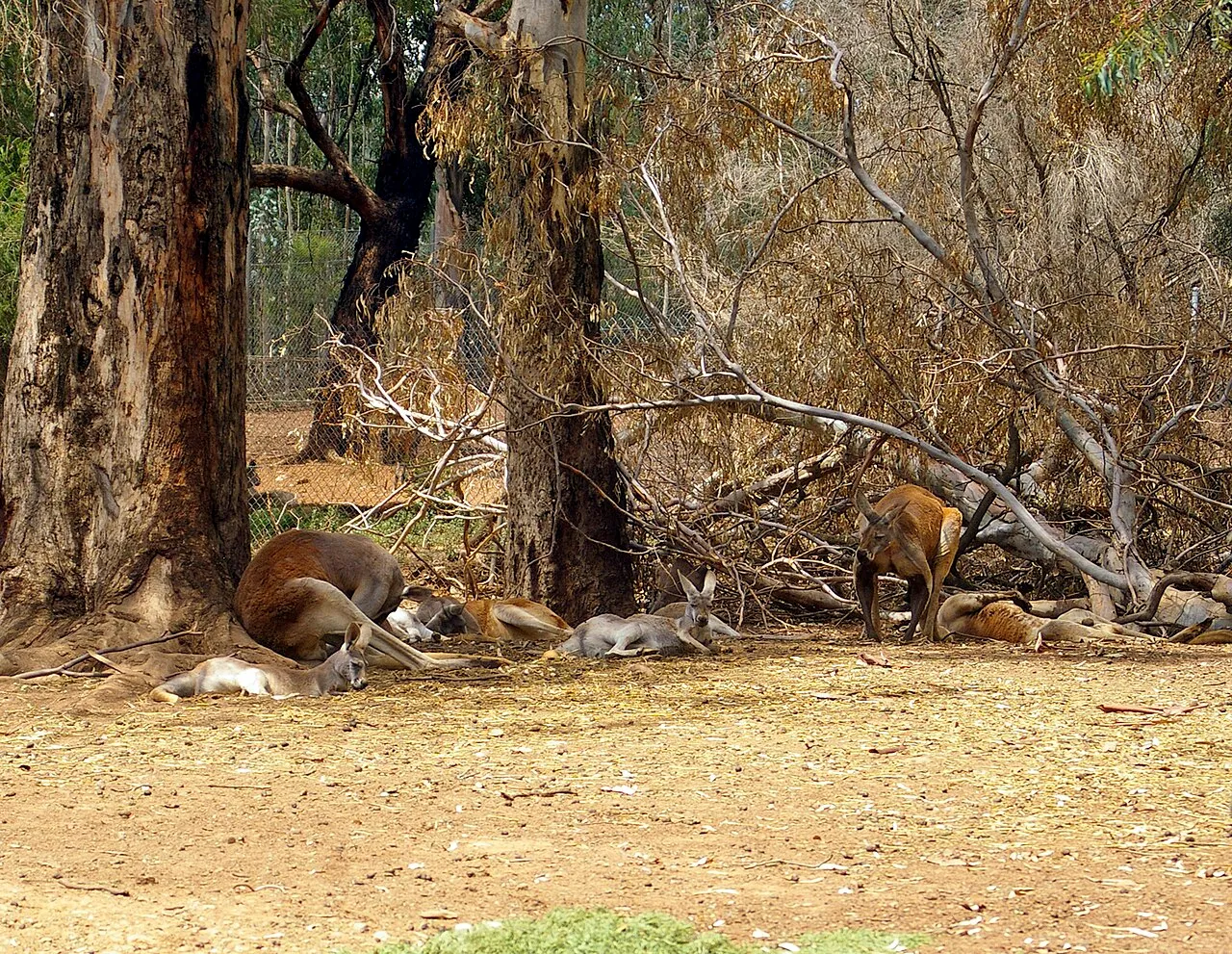
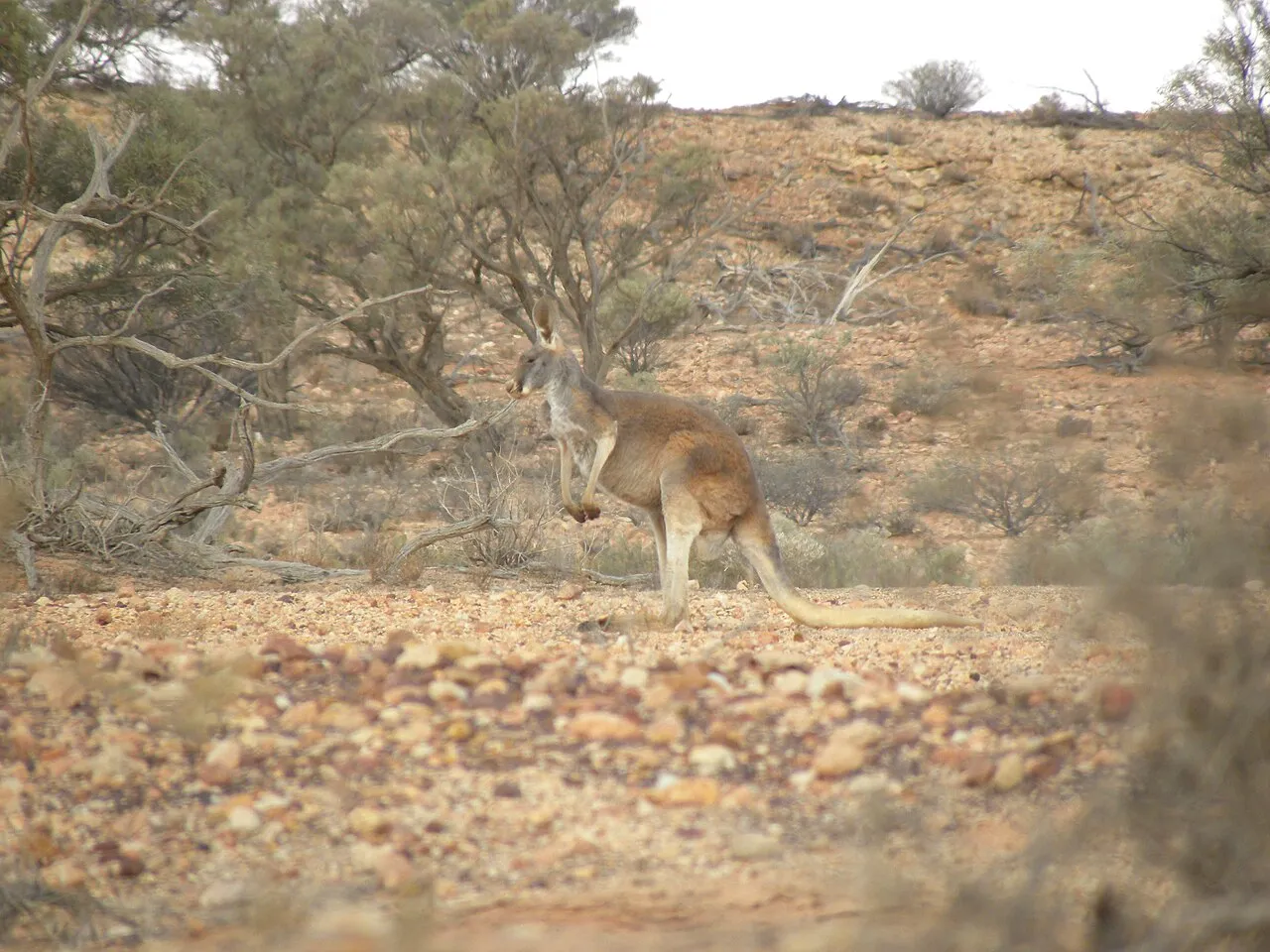
Red kangaroos live only in Australia, across most of the interior away from the wetter coasts. Their core habitat is arid and semi-arid plains and shrubland: desert margins, open grassland with scattered trees, and saltbush plains.
They like having some trees for shade and spend the hottest part of the day resting beneath them. They can go a long time without drinking, but in severe drought they move in search of water.
Since European settlement, the spread of pastoralism has in some ways helped red kangaroos: artificial watering points built for livestock and improved pastures provide extra water and food. Kangaroo numbers also tend to be higher inside the long fences built to keep out dingoes, their main natural predator.
5. Body
Size differs dramatically between the sexes; a mature male is often more than twice as heavy as a female.
| Measure | Male | Female |
|---|---|---|
| Head-body length | about 1.3–1.6 m | about 0.85–1.1 m |
| Tail | about 1.0–1.2 m | about 0.65–0.85 m |
| Standing height | about 1.5–1.8 m | about 1.1 m |
| Weight | about 55–90 kg | about 18–40 kg |
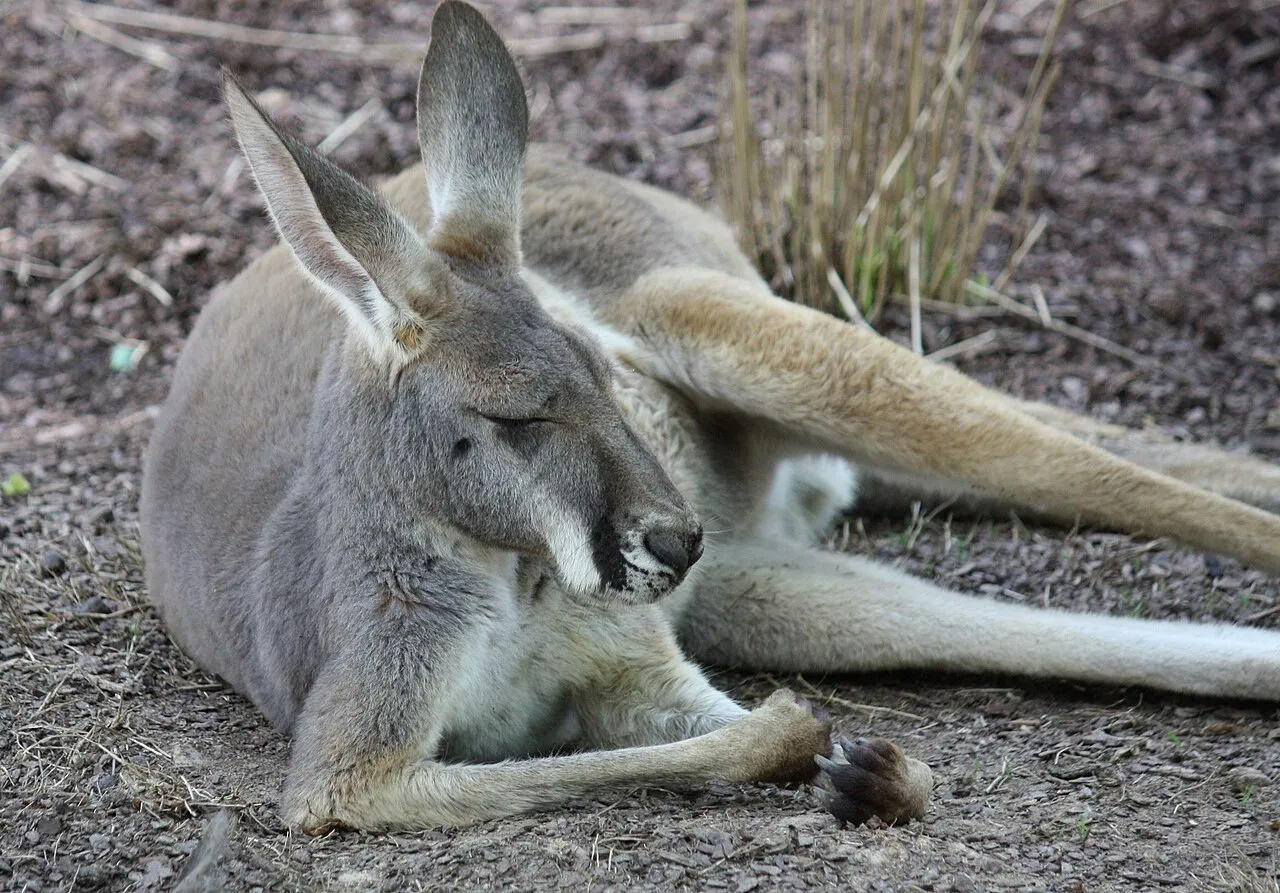
As the name suggests, males are typically rusty red. Females are often blue-grey, hence the nickname 'blue flyer', although some males are greyish and some females reddish depending on region. Black-and-white markings on either side of the muzzle help distinguish the red kangaroo from other species.
The hind legs are long and massively muscled, the forelimbs short and small. The thick, muscular tail acts as a fifth leg when the kangaroo moves slowly and as a counterbalance when it hops. Large ears can swivel independently to pinpoint sounds.
Females have a forward-opening pouch containing four teats. Males develop heavily muscled chests and arms that help in fights with rivals.
6. Behaviour and ecology
Ltshears · CC BY-SA 3.0
Red kangaroos live in groups called mobs, usually of a few to a dozen or so animals, with larger gatherings where food and water are plentiful. Mob membership is loose and changes often, and the largest, strongest male generally monopolises mating with the females.
They rest in the shade through the hottest hours and graze from dusk through the night and early morning. To cool down they lick their forearms, where blood vessels run close to the skin, so evaporating saliva chills the blood. They also scrape shallow hollows to lie on cooler soil.
6.1. Hopping
Hopping is remarkably efficient. Long tendons in the hind legs store and release energy like springs, so once a kangaroo is moving, going faster costs surprisingly little extra energy. Red kangaroos cruise comfortably at around 20–25 km/h and can exceed 50 km/h over short distances. Single bounds approaching 8 metres have been recorded, and they can clear obstacles close to 2 metres high.
Breathing is coupled to the hopping rhythm, reducing the cost of respiration. Because the hind legs move together, kangaroos can barely walk backwards. At low speed they use a peculiar gait, propping themselves on tail and forelimbs while swinging both hind legs forward together.
7. Diet and feeding
Red kangaroos are herbivores that feed mainly on fresh grasses, turning to shrub leaves, forbs and succulents when grass runs short. They prefer soft green growth and move to areas where rain has triggered new grass.
Kangaroos are not true ruminants, but their stomachs are divided into chambers where microbes ferment tough plant material. They occasionally regurgitate and re-chew food, which looks a little like chewing the cud.
They are also water misers. They can survive for long periods on the moisture in their food, and their kidneys produce highly concentrated urine. Outside droughts they rarely need to drink. Research suggesting that kangaroo gut microbes produce less methane than those of cattle has drawn interest from climate scientists.
Their teeth are unusual too. Grass wears teeth down, so kangaroo molars slowly migrate forward throughout life; worn front molars drop out and fresh ones move in from behind.
8. Reproduction and life cycle
dnatheist · CC BY 2.0
Red kangaroo reproduction is one of the marvels of the animal world. Females can breed at any time of year whenever rain brings enough food. Gestation lasts only about 33 days, and the newborn is the size of a jelly bean, weighing less than a gram. Blind and barely formed, it hauls itself through its mother's fur using only its forelimbs and reaches the pouch within minutes, where it latches onto a teat.
| Stage | Age | What happens |
|---|---|---|
| Birth | Day 0 | about 0.8 g; crawls unaided to the pouch |
| Attached | 0 to about 2 months | Stays fixed to the teat |
| First outings | about 6 months | Pokes its head out and makes brief trips |
| Leaves pouch | about 8 months | No longer returns to the pouch |
| Weaned | about 12 months | Grazes while still suckling at foot |
| Maturity | Females 1.5–2 years, males 2–3 years | Males must grow much bigger to win matings |
The key trick is embryonic diapause. A female can mate again soon after giving birth, but the resulting embryo pauses at a tiny stage. Only when the pouch joey leaves, or dies, does the embryo resume development. A mother may therefore support three offspring at once: a dormant embryo, a joey in the pouch and a youngster at foot.
Even more remarkably, she produces two different kinds of milk at the same time from separate teats, each tailored to the needs of a newborn or an older joey. Breeding shuts down in severe drought and restarts quickly after rain, a flexibility that suits the unpredictable desert.
Wild red kangaroos usually live around ten years, with records beyond twenty. Mortality is high among young animals, especially just after they leave the pouch, and droughts kill many juveniles.
9. Intelligence, communication, special abilities
Red kangaroos are fairly quiet animals. Mothers and joeys exchange soft clicking calls, and competing males growl and make coughing sounds. When alarmed, a kangaroo thumps the ground hard with its hind feet, and the thud warns the whole mob.
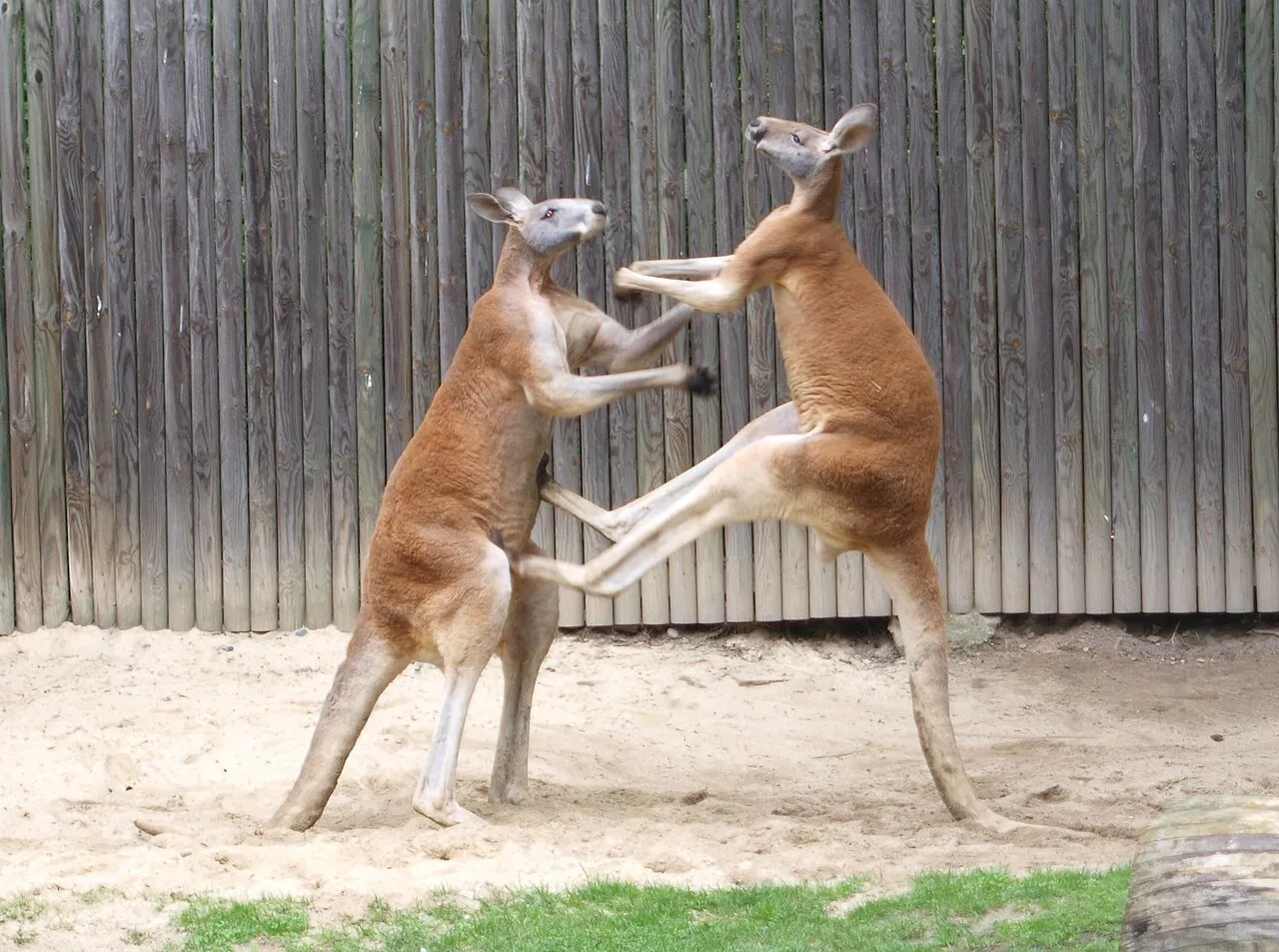
Male fights are famous as 'boxing'. Propped on their tails, rivals grapple, push and strike with their forepaws, and at the decisive moment one may lean back on its tail and kick the other in the belly with its powerful hind feet, whose long claws can inflict serious wounds. Before fighting, males often size each other up with displays, standing as tall as possible, pulling at grass or scratching their chests.
Recent research found that kangaroos faced with an impossible task would look at a nearby person as if asking for help, a behaviour more often associated with domesticated animals.
10. Predators and survival
The main predator of adult red kangaroos is the dingo, which hunts in packs and targets young or weak animals. Wedge-tailed eagles take small joeys and young kangaroos, and introduced red foxes may prey on young joeys. In the past, the thylacine was probably a predator on the mainland as well.
Threatened kangaroos flee at speed. Cornered, some retreat into water and have been known to grab a pursuing dingo with their forepaws and hold it under. A fleeing mother in serious danger may also eject the joey from her pouch, a grim strategy that improves her own chance of survival and future breeding.
The biggest factor in red kangaroo numbers, though, is drought. Multi-year droughts wipe out food and cause populations to crash, and numbers rebound quickly once the rains return.
11. Relationship with humans
Aboriginal Australians have hunted kangaroos for tens of thousands of years, using meat, hide, sinew and bone. Kangaroos feature prominently in Aboriginal stories, ceremonies and rock art.
After European settlement, pastoralists saw kangaroos as competitors for grass needed by sheep and cattle. Today Australia permits a commercial harvest within government-set quotas, producing lean red meat and leather once widely used for football boots. Supporters frame it as population management and sustainable use; opponents raise animal welfare and the fate of joeys. The debate has run for decades.
Road collisions are another major issue. Kangaroos often cross roads at dusk and at night, so warning signs are a familiar sight in rural Australia and many vehicles carry 'roo bars'. Because a joey may survive in the pouch of a mother killed by a car, wildlife groups ask drivers to check the pouch of any dead female they find.
12. Conservation
The IUCN lists the red kangaroo as Least Concern. Numbers swing with rain and drought, but regular surveys in commercial harvest zones have recorded populations ranging from several million to well over ten million in different years. Exact figures vary greatly by year and region.
The species as a whole faces low extinction risk, but there are concerns:
- Climate change making droughts longer and more severe
- Land clearing and fencing restricting movement
- The risk of over-harvesting during population lows
- Roadkill
In Australia kangaroos are protected under state and federal law and cannot be killed or traded without a permit. The commercial harvest operates only under government management plans and quotas, and exports of kangaroo products need separate approval.
13. In zoos
Red kangaroos are popular in zoos worldwide. As animals built to roam, they lack exercise in small enclosures, and panicked kangaroos can injure themselves against walls and fences. Captive kangaroos are also prone to a bacterial infection of the jaw known as lumpy jaw, so stress reduction and hygiene are important.
Some facilities run walk-through exhibits where visitors share space with kangaroos. Too much feeding and touching stresses the animals, and adult males can become aggressive; a kick from a big male can seriously injure a person.
Kangaroos are sometimes kept in petting operations or as pets, but they need space, specialised diets and social groups that households and small facilities cannot provide. Acquiring one because it looks cute too often ends in neglect.
14. In culture
The kangaroo is Australia's emblem. On the national coat of arms a kangaroo and an emu support the shield, and a popular story says they were chosen because neither can easily walk backwards, symbolising a nation always moving forward, although that is more folklore than official explanation. Kangaroos appear on the tail of the national airline, on coins and in the nicknames of national teams; the men's football team is known as the Socceroos.
Aboriginal stories explain how the kangaroo came to look the way it does. In popular culture there is the kangaroo hero of a classic Australian children's TV series, Kanga and Roo in the Winnie-the-Pooh stories, and the cartoon 'boxing kangaroo'.
In Korean, adult children who keep living off their parents are called the 'kangaroo tribe', and the practice of holding a premature baby skin to skin on a parent's chest is known worldwide as 'kangaroo care', both inspired by the pouch.
15. Trivia
- A newborn kangaroo weighs only a tiny fraction of its mother's weight, tens of thousands of times less.
- Leaning on its tail, a kangaroo can briefly support its whole body weight on the tail alone.
- Mothers clean the pouch by licking it out before a birth.
- Red kangaroos can survive long stretches on the moisture in their food, drinking very little.
- A group of kangaroos is a 'mob', the same word English uses for an unruly crowd.
Wild animals are not pets. Catching, trading or keeping them is illegal in most places. If you find an injured wild animal, call your local wildlife rescue centre.
FAQ
How small is a newborn kangaroo?
About the size of a jelly bean and under a gram. Blind, it climbs through its mother's fur to the pouch using only its forelimbs and stays there for about eight months.
Does 'kangaroo' really mean 'I don't know'?
That is a myth. The word was recorded in 1770 from an Aboriginal language of north-east Australia and seems originally to have referred to a grey kangaroo.
Are kangaroos dangerous to people?
They usually avoid people, but a threatened adult male can deliver a seriously injurious kick. Keep your distance and don't feed them.
Photo credits
Photos are freely licensed images from Wikimedia Commons. Authors and licenses are listed below.
- Female Red Kangaroo (Macropus rufus).jpg — Bidgee · CC BY 3.0
- Fighting red kangaroos 1.jpg — Dellex · CC BY-SA 3.0
- Mob of Red Kangaroos (Macropus rufus).jpg — Bidgee · CC BY-SA 3.0
- RedKangaroo1.jpg — Ltshears · CC BY-SA 3.0
- Red Kangaroo.jpg — dnatheist · CC BY 2.0