TailVille
1. Overview
Hanging upside down from a high branch in the rainforest canopy and turning its head with exquisite slowness, the three-toed sloth is the very symbol of slowness. It spends most of the day motionless and, when it does move, rarely covers more than a few metres a minute. This is not laziness but a finely tuned strategy for surviving on a diet of leaves that provide very little energy.
Three-toed sloths are the four species of the genus Bradypus, found in the tropical forests of Central and South America: the brown-throated, pale-throated and maned three-toed sloths, and the pygmy three-toed sloth, which lives on a single small island off Panama.
The word sloth covers two groups: three-toed sloths and two-toed sloths, genus Choloepus. They look and behave alike but are only distantly related. Their lineages split tens of millions of years ago, and each adapted independently to hanging life in the trees, a textbook case of convergent evolution. This article focuses on three-toed sloths while explaining how they differ from their two-toed cousins.
Three-toed sloths grow algae and moths in their fur and descend to the ground about once a week to defecate. Their appealing faces have made them targets for wildlife selfie tourism and illegal trade, even though being handled is highly stressful for them.
2. Name and classification
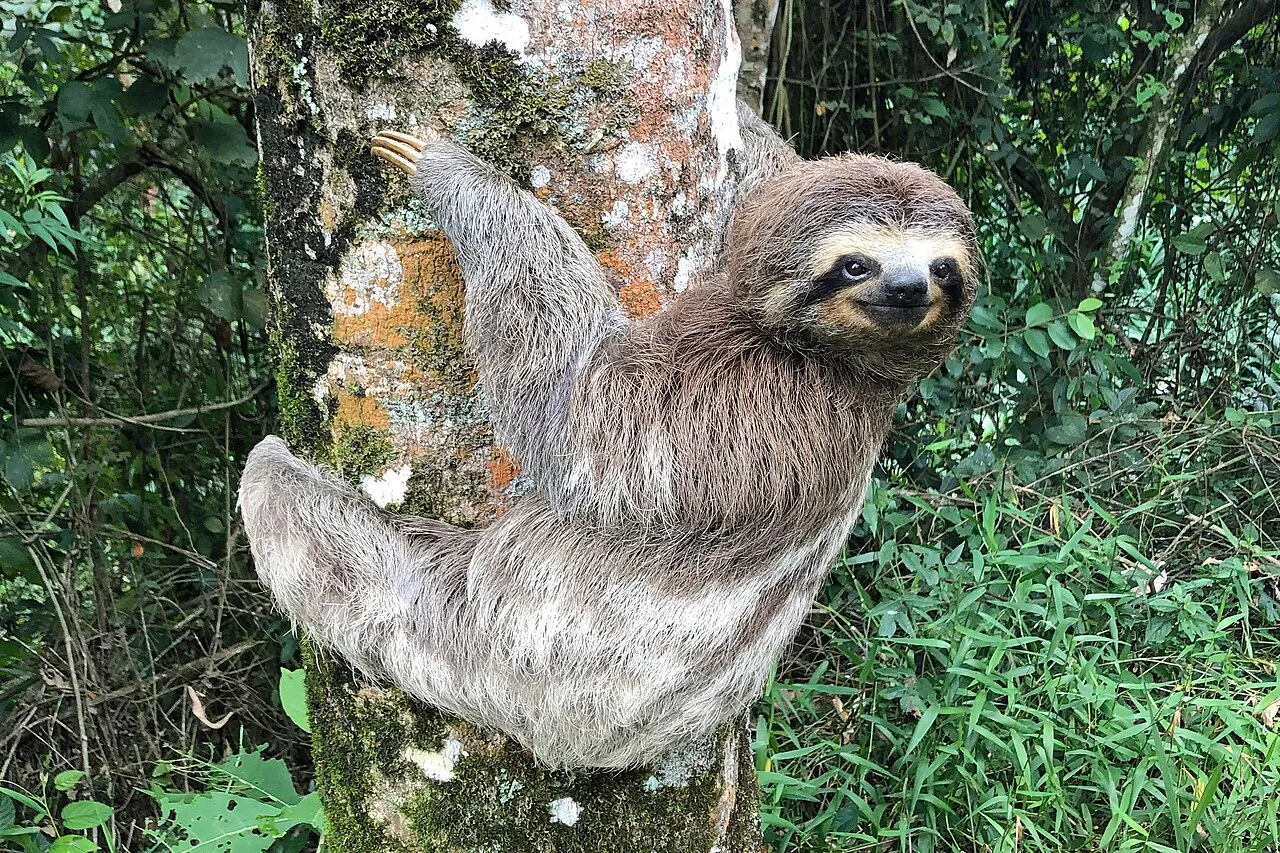
Daniella Maraschiello · CC BY-SA 4.0
Bradypus comes from the Greek for slow and foot. The English word sloth comes from Middle English for laziness and is the same word as the deadly sin. In Spanish and Portuguese, sloths have names meaning lazy one or bear-like creature, and the Korean name namuneulbo means slowpoke of the trees.
The name three-toed refers to the forelimbs. Both three-toed and two-toed sloths have three toes on their hind feet; the difference is only in the front, where three-toed sloths have three fingers and two-toed sloths two. Some specialists therefore prefer three-fingered and two-fingered.
Sloths belong to the superorder Xenarthra, an ancient group of mammals that evolved in South America and also includes armadillos and anteaters. Sloths and anteaters together form the order Pilosa.
2.1. The four species
| Species | Scientific name | Range | IUCN status |
|---|---|---|---|
| Brown-throated three-toed sloth | Bradypus variegatus | Honduras to northern Argentina | Least Concern |
| Pale-throated three-toed sloth | Bradypus tridactylus | north-eastern South America (the Guianas, northern Brazil, parts of Venezuela) | Least Concern |
| Maned three-toed sloth | Bradypus torquatus | Atlantic Forest of south-eastern Brazil | Vulnerable |
| Pygmy three-toed sloth | Bradypus pygmaeus | Isla Escudo de Veraguas, Panama | Critically Endangered |
The brown-throated sloth is the most common and widespread. The pale-throated sloth has a yellowish or pale throat and face. The maned sloth has a mane of long black hair on the neck and is genetically the most divergent, probably the earliest branch. The pygmy sloth was described as a new species in 2001 and is an example of island dwarfism.
2.2. Three-toed versus two-toed
| Feature | Three-toed (Bradypus) | Two-toed (Choloepus) |
|---|---|---|
| Front digits | three | two |
| Weight | about 2.5 to 6 kg | about 4 to 9 kg |
| Face | round, dark eye stripes, permanent smile | longer, more pig-like snout |
| Tail | short stubby tail | almost none |
| Neck vertebrae | 8 or 9, more than the usual mammalian 7 | 5 to 7, varying by species |
| Diet | leaf specialist | broader: leaves, fruit, flowers, some insects |
| Activity | day and night | mainly nocturnal |
| Temperament | generally mild | more likely to bite or slash when threatened |
| In captivity | very hard to keep, rare in zoos | easier; most zoo sloths are two-toed |
Most sloths seen in zoos are two-toed sloths, because three-toed sloths are such picky eaters that they rarely thrive in captivity.
3. Evolution
Today's sloths are small tree-dwellers, but their extended family was once far more diverse and much larger. For tens of millions of years the Americas were home to dozens of genera of ground sloths. Megatherium reached about six metres and several tonnes, as big as an elephant, and probably reared up on its hind legs to browse high branches. Thalassocnus, a marine sloth, waded into the sea to graze on seagrass.
Most ground sloths vanished around 10,000 years ago, at the end of the last ice age, when people spread across the Americas; climate change and human hunting are both implicated. On Caribbean islands, ground sloths survived for thousands of years longer, disappearing only after people arrived.
The two living sloth genera sit on different branches of this family tree. Studies published in 2019, using ancient proteins and DNA from fossil bones, found that two-toed sloths are closely related to a group of ground sloths including Megalonyx, while three-toed sloths belong to a separate lineage, either related to the megatheres or branching off even earlier. The two living genera are thought to have shared a common ancestor around 30 million years ago or more. Each, in other words, evolved its tree-hanging lifestyle independently from ground-living ancestors.
That two lineages arrived separately at the same solution, with upside-down bodies, hook-like claws, slow metabolism and a leafy diet, shows how strongly life in the rainforest canopy shapes the animals that live there.
4. Range and habitat
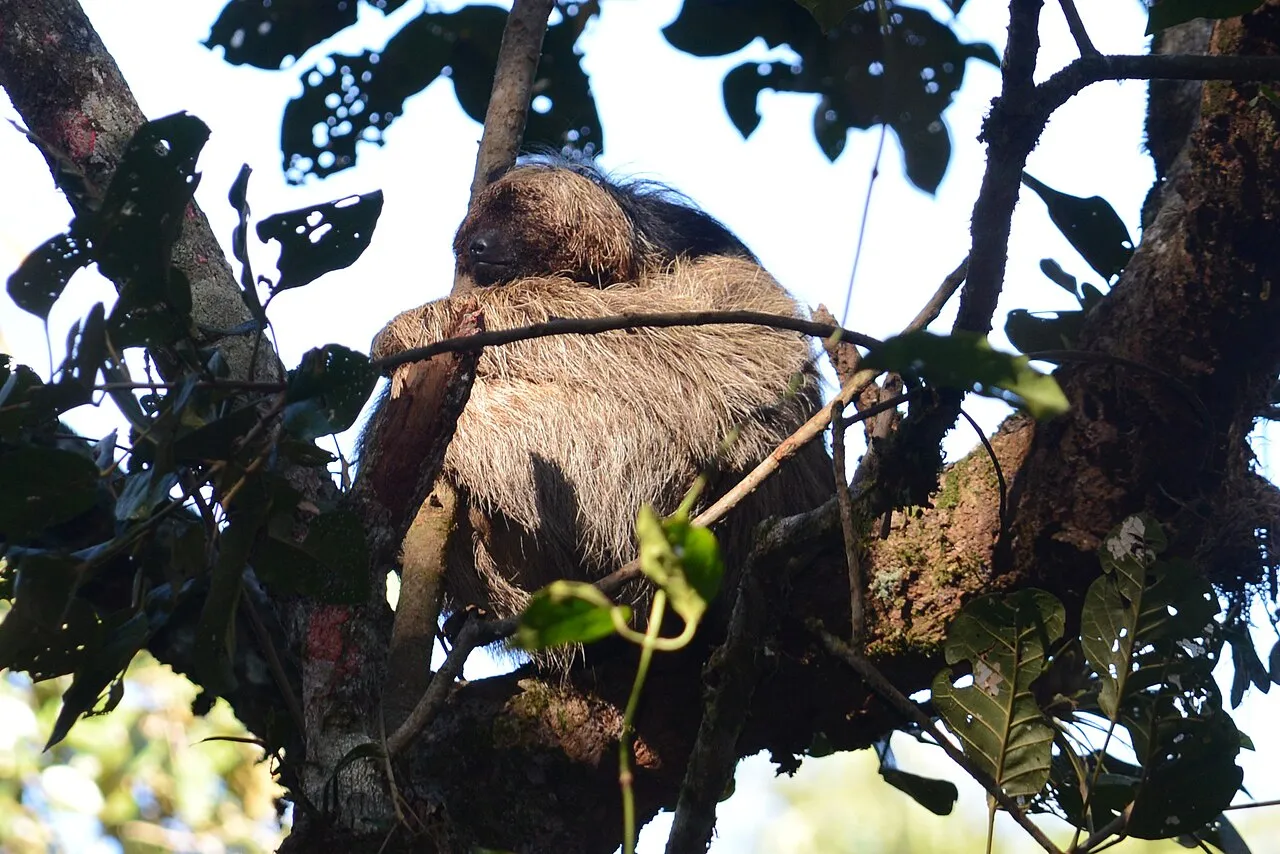
deboas · CC BY 4.0
Three-toed sloths range from Honduras through Central America into South America as far as Brazil, Bolivia and northern Argentina. The brown-throated sloth is the most widespread; the pale-throated sloth lives in the north-eastern Amazon, and the maned sloth is restricted to the Atlantic Forest of coastal south-eastern Brazil.
They mainly inhabit lowland tropical rainforest but also live in humid montane forest, riverside forest, mangroves and shade-grown plantations. They are often seen in Cecropia trees, whose large leaves and open branches make sloths easy to spot. This led to the myth that sloths live only in Cecropia, when in fact they feed on dozens of tree species.
The pygmy sloth's home is extraordinary: Isla Escudo de Veraguas, a Caribbean island off Panama of only about four square kilometres. The island separated from the mainland roughly 9,000 years ago, and its isolated sloths shrank over time. Pygmy sloths are found mainly in red mangroves fringing the island.
5. Physical characteristics
| Feature | Typical value (brown-throated sloth) |
|---|---|
| Head and body | about 42 to 80 cm |
| Tail | about 3 to 9 cm |
| Weight | about 2.2 to 6.3 kg, usually 3.5 to 4.5 kg |
| Pygmy sloth | about 48 to 53 cm, 2.5 to 3.5 kg |
| Body temperature | about 30 to 34 degrees Celsius, varying with surroundings |
| Front claws | about 8 to 10 cm |
| Speed | about 2 to 4 m per minute in trees, slower on the ground |
The face is round and flat, with dark stripes running from the eyes like tear tracks and a mouth that curves into a permanent smile. Adult males have a speculum, a patch of short yellow or orange fur with a dark stripe on the back, which distinguishes them from females. Maned sloth males lack it.
The forelimbs are much longer than the hind limbs, and every digit ends in a long, hooked claw. These claws let sloths hang from branches with almost no muscular effort, so securely that sloths may remain hanging while asleep or even after death. On the ground, however, they cannot support their weight on their legs and must drag themselves along on their bellies.
Sloths carry far less muscle than other mammals of their size, by some estimates around half the usual proportion. Less muscle means lower energy costs and a lighter body that can hang from thinner branches.
5.1. Neck bones and an upside-down body
Almost all mammals, from giraffes to mice to humans, have seven neck vertebrae. Three-toed sloths have eight or nine, one of very few exceptions. This lets them rotate their heads about 270 degrees and reach leaves all around without moving their bodies. Some of the extra vertebrae appear to be modified chest vertebrae.
The internal organs are adapted to life upside down. Heavy organs such as the stomach and liver are anchored to the ribs and pelvis by fibrous tissue, so they do not press on the lungs when the sloth hangs, saving energy on breathing. The fur also grows in the opposite direction to that of most mammals, parting along the belly and flowing toward the back, so rain runs off when the animal hangs upside down.
5.2. An ecosystem in the fur
Three-toed sloth fur has long outer hairs with cracks that soak up water, and green algae grow in these cracks, tinting sloths green in the rainy season and helping camouflage them among leaves.
The fur also hosts fungi, mites, beetles and moths found nowhere else but on sloths. A single sloth may carry dozens of moths, sometimes over a hundred. How these residents interact with their host is described under Diet.
6. Behaviour and ecology
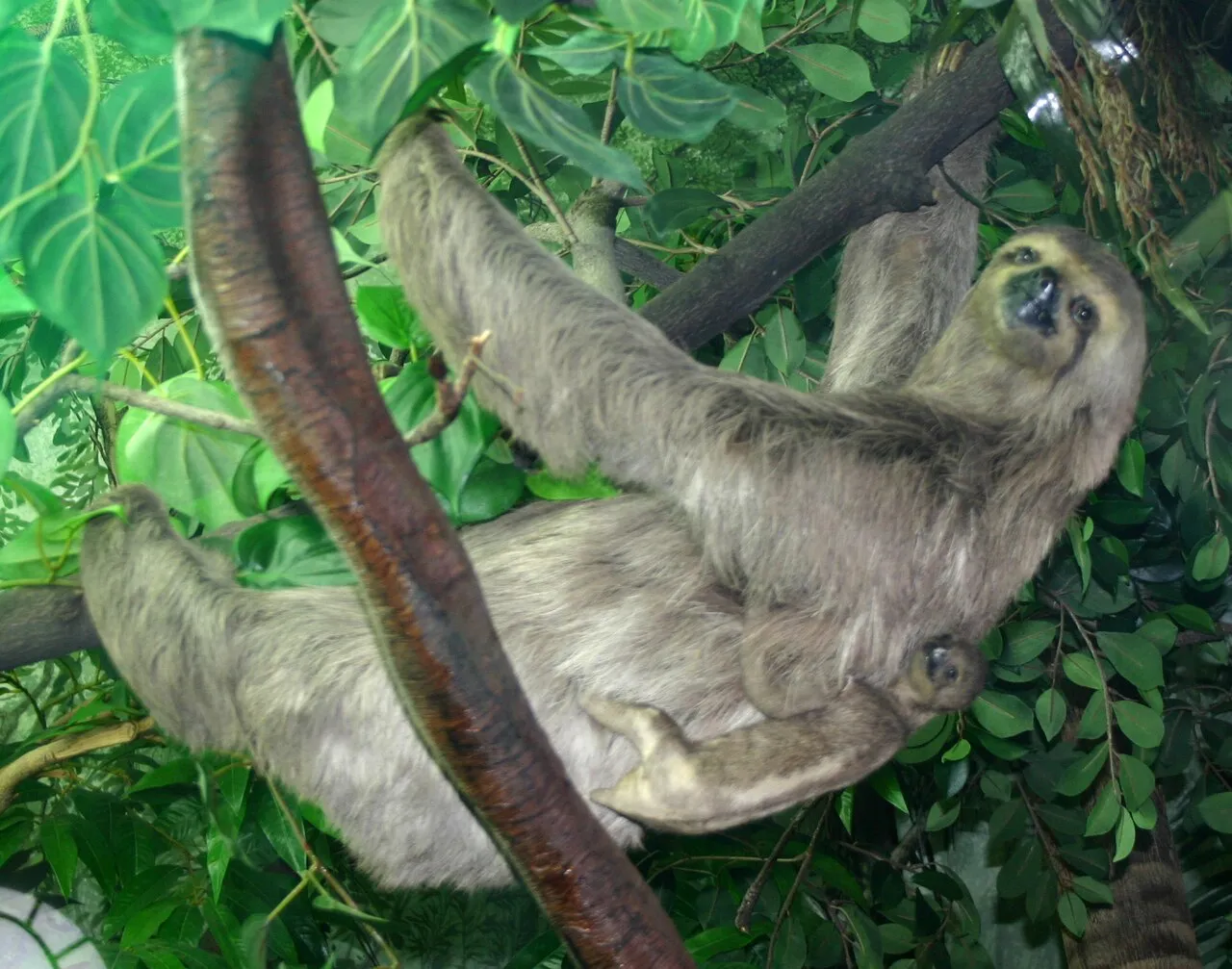
Three-toed sloths are mostly solitary. Apart from mothers with young, they seldom associate with one another. Each occupies a home range of a few hectares that may overlap with neighbours, often centred on a handful of trees, and the typical daily movement is only around 40 metres.
The famous claim that sloths sleep 20 hours a day came mainly from captive animals. A 2008 study fitted wild brown-throated sloths with brain-activity recorders and found they slept only about 9 to 10 hours a day. Captive sloths, with no predators and nothing to do, apparently sleep more. Even in the wild, though, sloths spend long periods awake but motionless.
Three-toed sloths alternate short bouts of activity and rest throughout the day and night. Because their body temperature tracks their surroundings, they climb into sunny treetops in the morning to warm up and move into shade when it gets hot, regulating temperature by basking, a little like a lizard.
Surprisingly, sloths are excellent swimmers. Using their long arms in a kind of breaststroke, they move about three times faster in water than on land. They swim across rivers to reach new forest and through flooded woodland, and they can slow their heart rate to hold their breath for a long time.
7. Diet and feeding
Three-toed sloths are leaf specialists. They prefer young leaves and buds and occasionally eat flowers or fruit. Although they eat leaves from dozens of tree species, each individual tends to focus on a few. Young sloths learn what to eat by sampling leaves from their mother's trees, so diets are inherited and vary between individuals, and a sloth moved to an unfamiliar forest may fail to find food it recognizes.
Leaves are low in nutrients and loaded with tough fibre and defensive plant chemicals. Sloths have a large, multi-chambered stomach in which microbes ferment fibre, somewhat as in cattle; the stomach and its contents can make up a substantial share of body weight. Digestion is extraordinarily slow, and food may take a week or more, by some estimates nearly a month, to pass through the body.
To cope, sloths have reduced energy use to an extreme. Their metabolic rate is less than half that expected for a mammal of their size, and their daily energy expenditure is among the lowest of any mammal. Low muscle mass, minimal spending on body heat and minimal movement are all part of the strategy. Sloths rarely drink, getting water from leaves and dew.
7.1. The sloth, the moth and the algae
About once a week a three-toed sloth climbs down to the forest floor to defecate. At the base of a tree it digs a small hollow with its stubby tail, relieves itself and covers the spot, wiggling its hips in what has been nicknamed the poo dance. A single bout may release a large fraction of body weight, by some accounts up to a third.
This habit was a puzzle. A sloth on the ground is at its most vulnerable, and predation during these trips appears to account for a meaningful share of sloth deaths. Why take the risk?
A 2014 study proposed an intriguing explanation. The moths living in sloth fur leave their host when it descends and lay eggs in its dung. The larvae feed on the dung, and the adult moths fly up into the canopy to find a sloth. When moths die and decompose in the fur, they release nitrogen and other nutrients that fertilize the algae growing there. The researchers suggested that sloths may eat this algae while grooming, gaining a nutritious supplement. Descending to defecate may thus be part of a three-way partnership: the sloth farms moths, the moths feed the algae, and the algae help feed the sloth.
Two-toed sloths carry far fewer moths and sometimes defecate from the trees. The hypothesis remains debated, and another idea is that dung middens serve as scent signals for finding mates.
8. Reproduction and life cycle
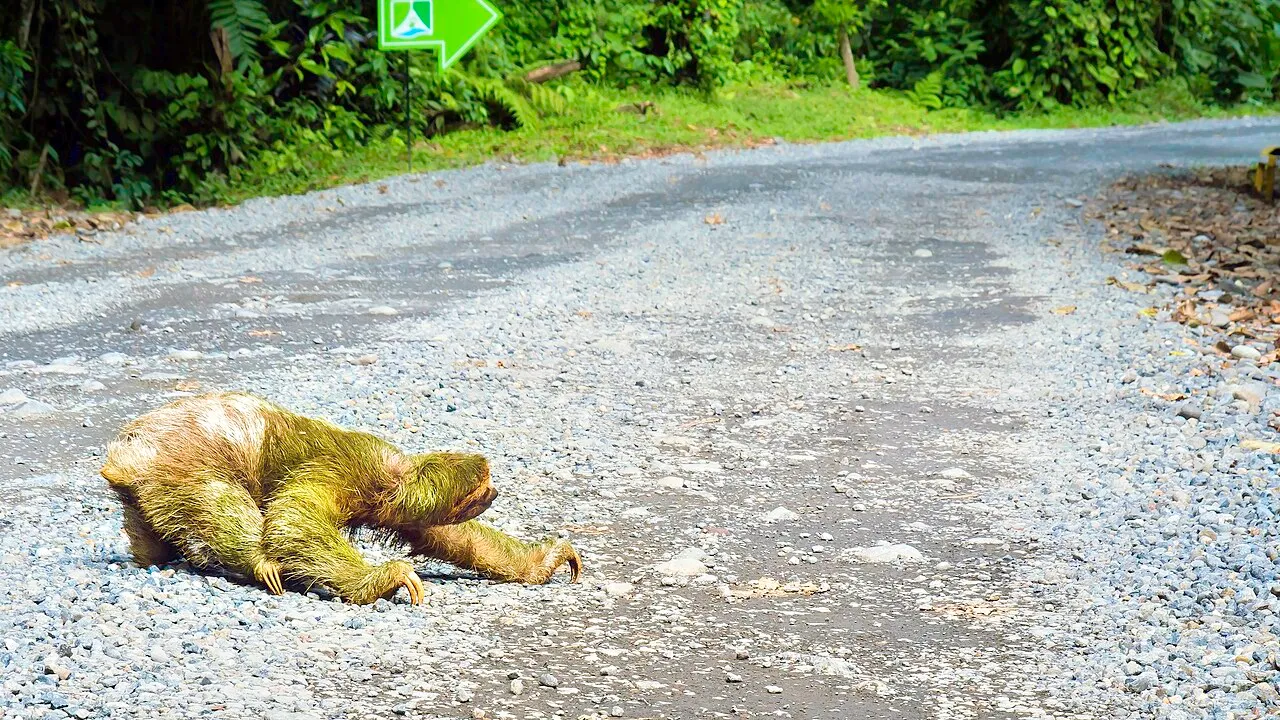
Ian D. Keating · CC BY 2.0
Three-toed sloths can breed year-round, though breeding peaks in some regions. A receptive female gives a high-pitched, piercing call, sometimes described as sounding like ai, which is said to be the origin of a local name for the animal. Males follow the call to her tree, and rivals fight by shoving one another while hanging from branches. Mating also takes place while hanging.
Gestation lasts about five to six months, and a single young is born, again while the mother hangs in the tree. The newborn immediately grips its mother's belly fur.
| Stage | Age | What happens |
|---|---|---|
| Newborn | 0 to 1 month | Born furred; clings to mother's belly and nurses |
| First tastes | from 2 to 4 weeks | Licks leaf fragments from mother's lips and begins learning the diet |
| Dependent | 1 to 6 months | Rides on mother, eating more leaves over time |
| Independence | about 6 to 9 months | Mother often leaves part of her home range to the young |
| Maturity | about 2 to 3 years | Begins breeding |
Independence comes in an unusual way. After showing her offspring which trees to feed in, a mother often moves away and leaves part of her home range to it, so the young sloth can live among trees it already knows.
A young sloth separated from its mother calls loudly, but mothers seldom descend to retrieve a fallen baby, so a youngster that falls from the canopy has poor chances.
Wild lifespan is not well known but is estimated at roughly 10 to 20 years. Three-toed sloths rarely survive long in captivity, whereas two-toed sloths have lived more than 40 years in zoos.
9. Intelligence, communication and special abilities
Being solitary, three-toed sloths have a simple communication system. The main sounds are the high calls of breeding females and the cries of young separated from their mothers. Scent also matters: dung middens and gland secretions rubbed on trees probably carry information for other sloths.
Sloth eyesight is poor. Three-toed sloths appear to see little or no colour and cope badly with bright light, and their hearing is not especially sharp. They rely on smell and touch to find leaves and branches.
Their special talents are extreme energy economy and resilience. Sloths often survive falls from great heights, and they are reported to resist infection in wounds. Some fungi living in sloth fur produce antimicrobial compounds, making sloth fur a target in the search for new antibiotics. Their ability to hang for hours with almost no muscular effort comes from the structure of their claws and tendons.
10. Predators and survival
Three-toed sloths face predators from above and below. Large raptors such as harpy eagles and crested eagles are the biggest threat; in some areas sloths make up a large share of the harpy eagle's diet. Jaguars, ocelots and margays hunt sloths in the trees and on the ground, and anacondas and caimans take them near water.
The sloth's defence is not being noticed. Its near-stillness defeats predators that hunt by detecting movement, algae-tinted fur blends with foliage, and sloths give off very little odour. Hanging from thin branches high in the canopy also keeps heavy predators at bay.
When attacked, sloths swing their long claws in defence. Three-toed sloths are milder than two-toed sloths, but their claws can still inflict serious wounds, and tough skin and thick fur offer some protection.
Today the greater dangers are human-made. Roads and power lines fragment the forest, forcing sloths to cross on the ground, where they are hit by cars, or to climb power lines, where they are electrocuted. Attacks by domestic dogs are also common.
11. Relationship with humans
In Indigenous South American cultures, sloths were both game and figures in myth. In some Amazonian stories they are linked to the world tree or portrayed as slow but wise.
When European explorers first encountered sloths in the sixteenth century, they described them as the most useless and lazy of creatures. The eighteenth-century French naturalist Buffon portrayed sloths almost as nature's failures, an image that lingered for centuries. We now understand that slowness is a sophisticated adaptation, not a defect.
Today the most pressing issue is wildlife selfie tourism. In parts of the Amazon, sloths taken from the wild are passed around for tourists to hold for photos. An investigation by an international animal welfare organization in the late 2010s found that many such animals are poached, kept in poor conditions and die within months. A sloth held by a person may look calm, but it can be under severe stress; it is simply too slow to resist.
The illegal pet trade is another serious problem. In Colombia and elsewhere, poachers kill mothers to take their babies, and authorities seize many sloths. Rescue centres in Costa Rica, Panama, Colombia and other countries treat injured sloths and orphans and release them back into the wild when possible.
12. Conservation status
The four three-toed sloth species have very different prospects.
- The brown-throated and pale-throated sloths are listed as Least Concern because they are widespread and common in protected areas, though they decline where forests are cleared.
- The maned sloth is Vulnerable. Brazil's Atlantic Forest has lost most of its original extent, by many estimates more than 80 percent, and what remains is fragmented.
- The pygmy sloth is Critically Endangered. It lives on a single small island, and estimates vary widely with survey method and year, from a few dozen to a few hundred animals. Threats include mangrove cutting, increasing visits by fishers and tourists, and past attempts to capture animals illegally.
Shared threats include:
- Destruction and fragmentation of tropical forest for farming, ranching and plantations
- Roads and power lines, causing collisions and electrocutions
- Illegal trade and selfie tourism
- Climate change: research suggests sloths, with their limited ability to regulate body temperature, may struggle as temperatures rise, especially high-altitude populations whose energy budgets are already tight
The brown-throated three-toed sloth is listed on CITES Appendix II, and range countries prohibit or restrict capture and trade under national laws.
13. In zoos
Three-toed sloths are notoriously difficult to keep. Many depend on fresh leaves from particular trees, which is almost impossible to supply in zoos far from their native forests, and animals that do not adapt to substitute diets often die of malnutrition or digestive problems. Most zoo sloths worldwide are therefore two-toed sloths, which readily eat leaves, vegetables and fruit.
Even two-toed sloths need thoughtful care: tall, complex climbing structures, warm and humid conditions, places to hide and minimal handling. Animal welfare groups criticize sloth encounter programmes in which visitors touch or hold sloths for photos, since handling can be stressful.
Sloths are never suitable pets. They need tropical conditions and specialized food, spend most of their time motionless or active at night, dislike being handled and are very hard to treat medically. Above all, demand for pet sloths drives poaching of babies from the wild. People who love sloths can help more by supporting rescue centres or watching wild sloths from a distance with responsible ecotourism operators.
14. In culture
Sloths have become cultural icons of slowness and calm. A three-toed sloth working at a vehicle licensing office in a 2016 Disney animated film had audiences in stitches with his glacial speech and became a meme for slow bureaucracy. The chatty sloth of an ice-age animated franchise that began in 2002 is also famous, although he was modelled on extinct ground sloths.
In the 2010s sloths took over social media: smiling sloth photos, videos of baby sloths in rescue centres, and sloth plushies and stationery everywhere. They became unofficial mascots of the slow living movement, and some conservation groups mark an International Sloth Day each October.
Because sloth is the name of a deadly sin, Western art and literature long used the animal as a symbol of laziness. Today it is more often reimagined as a reminder of the value of rest in a hurried world.
In Costa Rica sloths are emblems of ecotourism, and in 2021 the country's legislature declared its two sloth species national symbols.
15. Trivia
- Sloths can digest food and even give birth while hanging upside down.
- A three-toed sloth's body temperature can swing several degrees over a day, unusual for a mammal.
- Some fungi and bacteria isolated from sloth fur have shown activity against parasites, bacteria and even cancer cells in laboratory tests.
- Sloths fall from trees more often than you might think, and some survive drops of nearly 30 metres.
- Sloths often return to the same tree base each time they descend to defecate.
- Newborn three-toed sloths weigh roughly 200 to 300 grams.
- For all their slowness, a defensive swipe of a sloth's forelimb can be surprisingly quick.
- The male's back patch varies between individuals and helps researchers recognize them.
Wild animals are not pets. Catching, trading or keeping them is illegal in most places. If you find an injured wild animal, call your local wildlife rescue centre.
FAQ
How do I tell a three-toed sloth from a two-toed sloth?
Count the front digits: both have three toes on the hind feet, but three-toed sloths have three front fingers and two-toed sloths two. Three-toed sloths also have rounder faces, dark eye stripes and a short tail.
Do sloths sleep 20 hours a day?
That figure came mainly from captive animals. A study of wild brown-throated sloths found they slept about 9 to 10 hours a day, though they spend much of their waking time motionless.
Is it OK to hold a sloth for a photo at a tourist spot?
Please don't. Photo-prop sloths are often poached from the wild, and being held is highly stressful; they are simply too slow to resist. Supporting rescue centres or watching wild sloths from a distance is far better.
Photo credits
Photos are freely licensed images from Wikimedia Commons. Authors and licenses are listed below.
- Bradypus.jpg — Stefan Laube (Tauchgurke) · Public domain
- Bicho-preguiça 3.jpg — Daniella Maraschiello · CC BY-SA 4.0
- Bradypus torquatus 47880997.jpg — deboas · CC BY 4.0
- Bradypus tridactylus.jpg — Giovanni Dall'Orto · CC BY-SA 2.5 it
- Three-toed sloth crossing road in Costa Rica.jpg — Ian D. Keating · CC BY 2.0