TailVille
At a glance
Rough ranges for supplies, food and electricity in Korea (USD is approximate). Purchase or adoption fees are not included.
Anyone wanting dog-like interaction in a small package, including families with school-age children who help under supervision.
Households where anyone is uneasy around rats, or people who would find frequent, early losses too hard.
1. Overview
Fancy rats are domesticated brown rats, Rattus norvegicus, shaped by generations of selective breeding into companion animals. Fancy is the old English word for the hobby of breeding and showing a particular animal, as in the pigeon fancy or the mouse fancy. Pet rats belong to the same species as the wild rats of city streets, but long domestication has made them calm and people-oriented, and breeders have developed a wide range of colours, markings, coat types and ear shapes.
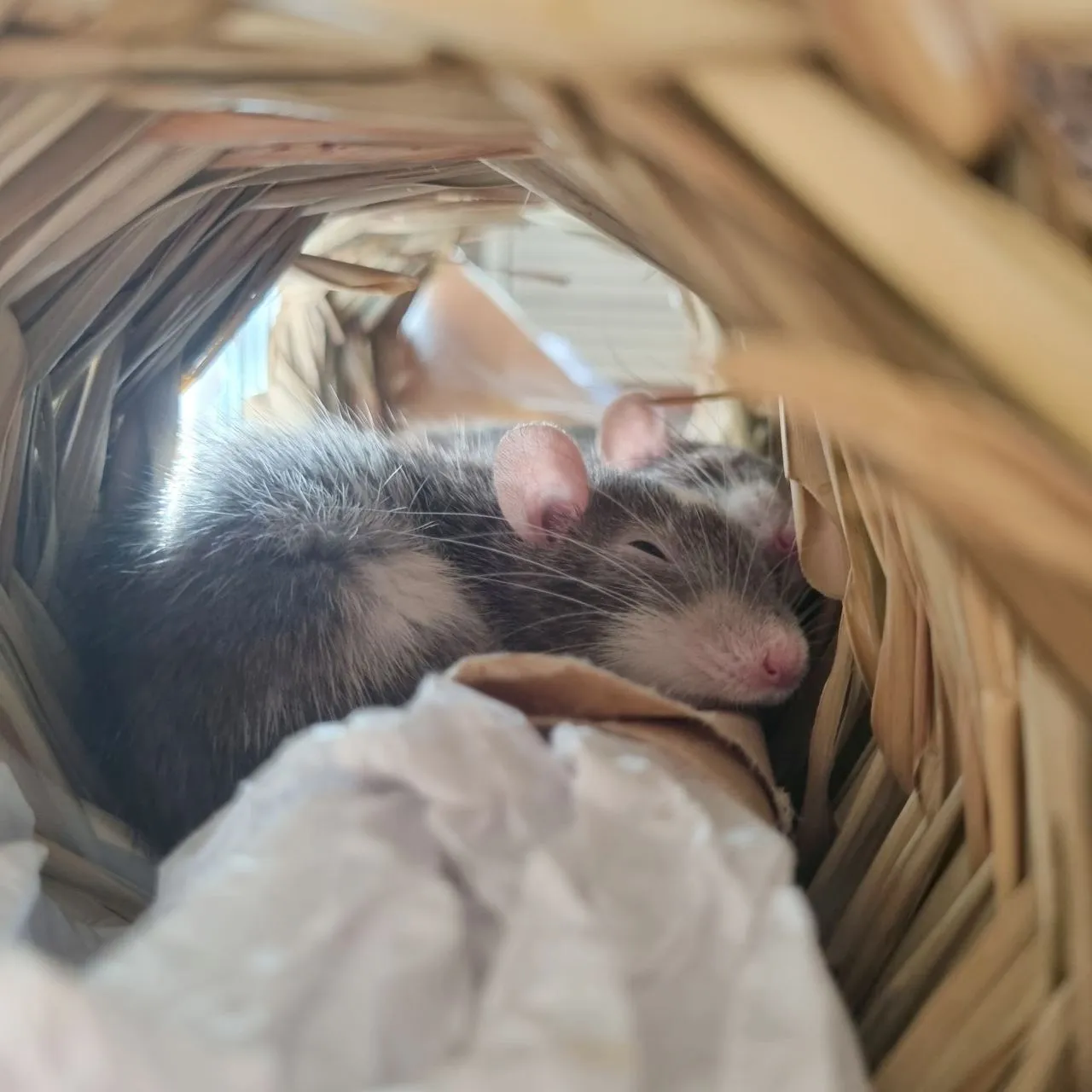
Among small pets, rats stand out for intelligence and sociability. Many learn their names, pick up tricks, and love riding around on a shoulder. They live in groups, so two or more of the same sex is the standard, and cage mates spend hours grooming each other and sleeping in heaps.
The hardest part is their short life. Most live only two to three years, and owners often find themselves saying goodbye just as the bond feels complete. Respiratory disease and tumours are common, so budget for vet care in old age. Rats still carry a stigma, yet people who have lived with them often describe them as small animals with a dog's personality. This article covers classification, history, anatomy, varieties, behaviour, housing, diet, health, breeding, costs, law and culture.
2. Name and classification
2.1. Taxonomy
Fancy rats are the domesticated form of the brown rat, in the rodent family Muridae and the genus Rattus. The label Rattus norvegicus domestica is often used to distinguish them from wild rats, though it is more a convention than a formally recognised subspecies.
| Rank | Name |
|---|---|
| Order | Rodentia |
| Family | Muridae |
| Genus | Rattus |
| Species | Brown rat, Rattus norvegicus |
| Pet form | Fancy rat, sometimes written R. n. domestica |
| Similar species | Black rat (Rattus rattus), house mouse (Mus musculus) |
The black rat is slimmer, longer-tailed and a better climber. House mice are a separate, much smaller genus and the ancestor of fancy mice. People often treat rats and mice as interchangeable, but their size, temperament and care differ considerably.
2.2. Name
Norvegicus means Norwegian, and the animal is also called the Norway rat, yet it has nothing to do with Norway. An eighteenth-century naturalist reportedly believed it had arrived in Britain on Norwegian ships. Genetic studies now place its origin in Asia, probably northern China and Mongolia. The everyday English name brown rat is more accurate. Pet owners simply say rats, or fancy rats, and in Korea the English word is used precisely to avoid the gutter associations of the native name, which literally refers to drains.
3. History
3.1. From rat-catchers to rat shows
Brown rats spread out of Asia along human trade routes and had reached most of Europe by the eighteenth century. In nineteenth-century Britain, rat-baiting, a brutal sport in which dogs killed rats in a pit, created demand for professional rat-catchers. The best known, Jack Black, who styled himself rat-catcher to Queen Victoria, is said to have kept unusually coloured rats, bred them and sold them as pets. He is often credited as one of the founders of the rat fancy.
In the early twentieth century British mouse and rat enthusiasts organised clubs and shows, and in 1976 the National Fancy Rat Society was founded in the UK, formalising breed standards and showing. Similar clubs followed in the United States and across Europe, and new coat types and markings kept appearing.
3.2. The laboratory rat
The laboratory rat is a big part of the story. White rats entered physiology labs in the late nineteenth century, and in 1906 the Wistar Institute in Philadelphia developed a standardised strain, the Wistar rat, that made rats the workhorse of medical and psychological research. Lab and pet rats are the same species but are bred for different purposes. Decades of research into rat learning, social behaviour and emotion have also helped show the public how capable these animals are.
3.3. Fancy rats in Korea
In Korea rats were long seen as grain thieves and disease carriers, and the government even ran nationwide rat-catching campaigns in the 1970s, so the idea of a pet rat took time to catch on. As hamster keeping grew in the 2000s, people looking for a bigger, more interactive rodent discovered fancy rats, and in the 2010s photos of round-eared dumbo rats and trick videos spread on social media. Resistance from family members and neighbours is still common there, so it is worth talking things over with your household before bringing rats home.
4. Body
AviationFreak · CC BY-SA 4.0
4.1. Size and build
Adults measure 20–25 cm in the body with an 18–23 cm tail. Females weigh roughly 250–400 g and males 400–700 g, so bucks are noticeably bigger. Does are often described as slim and busy, bucks as large and laid-back lap-loungers, though individual personality varies a lot.
The tail is not just decoration. It helps with balance and is a major radiator, because rats can barely sweat and lose heat by widening blood vessels in the tail. Lifting a rat by its tail can strip the skin or break it.
4.2. Senses and quirks
Rats have poor eyesight, and pink-eyed rats see even less. You will often see them swaying their heads from side to side to judge distance. Smell and touch make up for it: whiskers map surroundings in fine detail, and scent identifies cage mates and people. Hearing extends well into the ultrasonic range, where much rat conversation happens.
Rats cannot vomit. The structure of the oesophagus and stomach prevents it, so anything toxic they swallow stays in, which makes safe food choices and rat-proofing especially important. They also have no gallbladder. Their incisors grow throughout life and are naturally yellow-orange. Reddish crust around the eyes and nose looks like blood but is usually porphyrin, a pigment that increases with stress or illness.
4.3. Sexing
Adult males are easy to identify by their large, obvious testicles beneath the tail. In youngsters, look at the distance between the genitals and anus: longer in males, shorter in females, who also show two rows of nipples along the belly. Rats can breed from about five weeks old, so sex and separate them before then.
5. Varieties, coats and markings
Fancy rats are not divided into body-type breeds so much as described by combinations of coat, ear type, marking and colour. Clubs differ somewhat in names and standards.
| Category | Name | Description |
|---|---|---|
| Coat | Standard | Short, sleek fur, the basic type |
| Coat | Rex | Curly coat and curly whiskers |
| Coat | Double rex | Patchy coat that sheds and regrows in cycles |
| Coat | Satin | Fine, glossy hair |
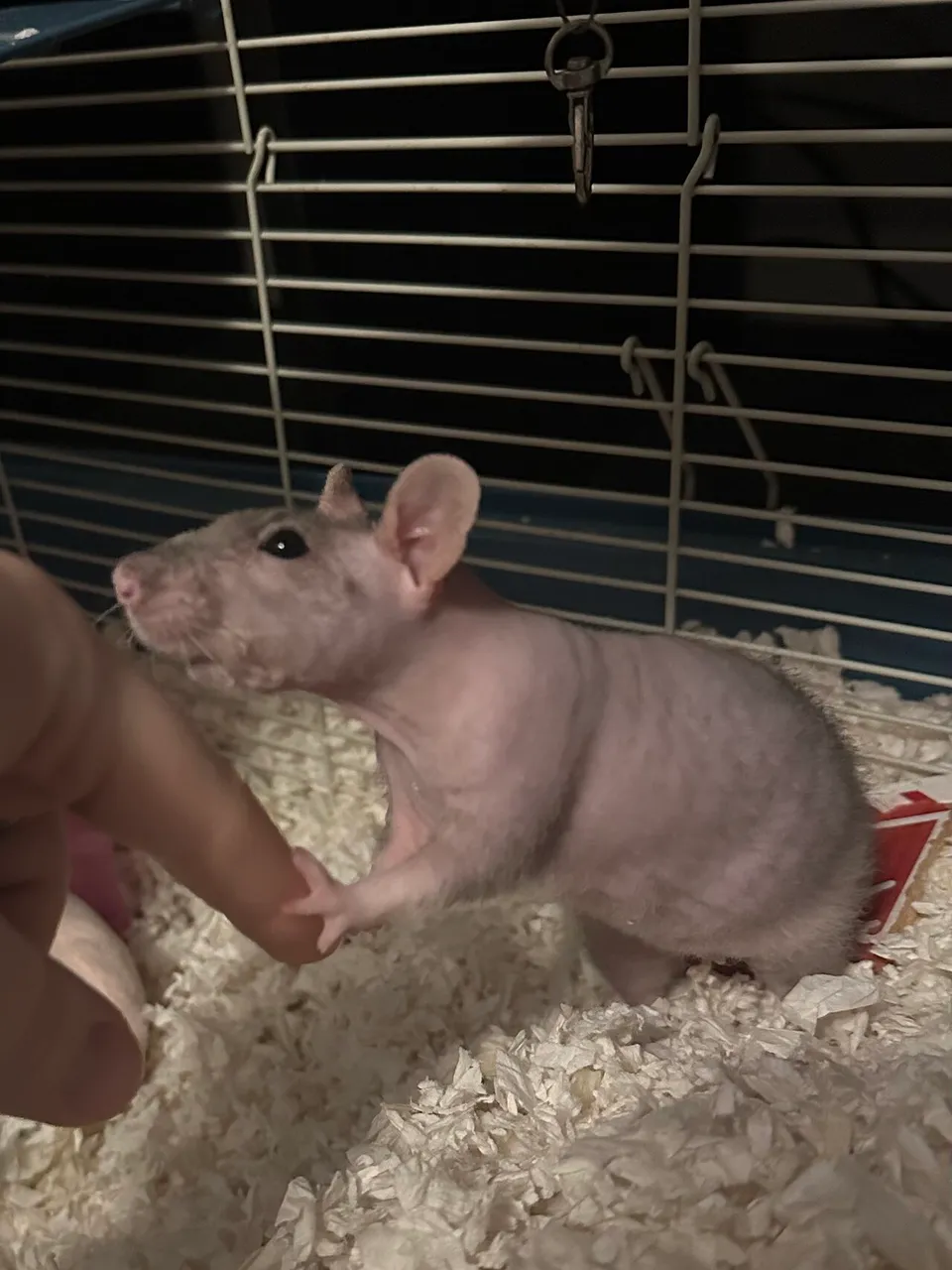
| Coat | Hairless | Almost no fur; needs extra warmth and skin care |
| Body | Manx (tailless) | No tail or a very short one; controversial because of heat regulation and skeletal problems |
| Ears | Dumbo | Round ears set low on the sides of the head |
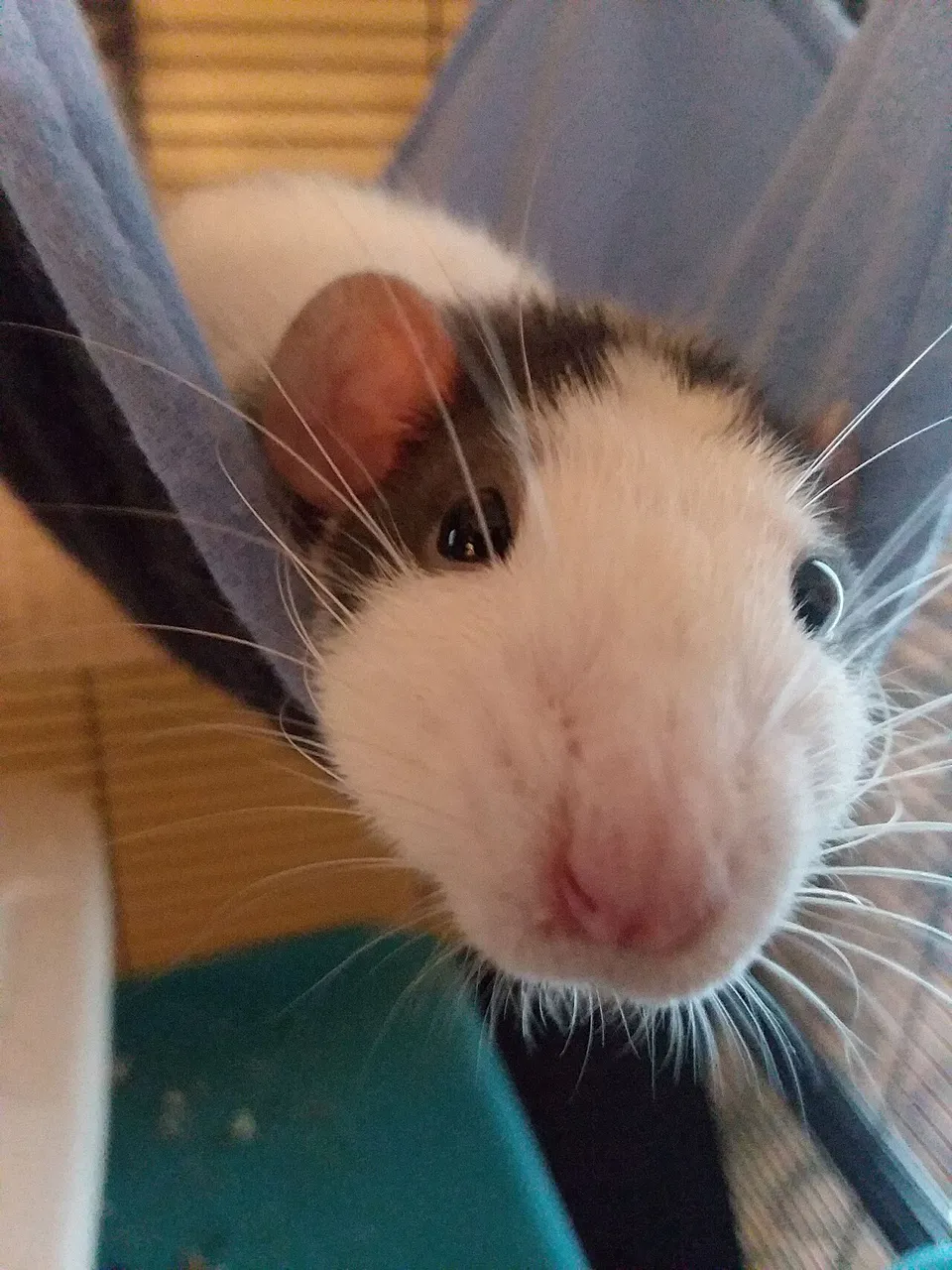
| Marking | Hooded | Coloured head, shoulders and spine stripe on white |
| Marking | Berkshire | Coloured top, white belly |
| Marking | Irish | White triangle on the chest or belly |
| Marking | Capped | Colour on the head only |
| Marking | Self | One solid colour |
| Marking | Blazed | White stripe down the face |
| Marking | Husky (roan) | White hairs increasing with age |
| Colour | Agouti, black, blue, mink, champagne, pink-eyed white, Siamese, Himalayan, Russian blue and more | Countless combinations |
Dumbo ears are purely cosmetic as far as is known. Blazed and some heavily white-marked lines, however, have been linked to megacolon, a developmental defect of the gut nerves, and hairless and tailless types remain controversial among keepers because of skin, temperature and skeletal problems. Choose a breeder who puts health ahead of novelty.
6. Behaviour
6.1. Wild rats and pet rats
Wild brown rats live in colonies of dozens in burrows, sewers and building cavities. Colonies have a hierarchy, and rats learn from each other, for example by smelling a cage mate's breath to find out which foods are safe. They are cautious eaters, nibbling a little of something new and waiting before eating more, a habit thought to be linked to their inability to vomit.
Pet rats are far less fearful and much more tolerant of people. They are naturally most active around dusk and at night, but many adjust to their owners and come to the cage door in the evening asking to play.
6.2. At home
Rats are curious explorers. During free-roam time they investigate under the sofa, inside bags and in pockets, and carry favourite finds back to their nest. They are clever enough to learn their name, climbing onto a hand, jumping through a hoop or pushing a ball for food rewards, and they master mazes and puzzle feeders quickly.
Rats must live in groups. However much time you spend with a single rat, you cannot replace the grooming and wrestling it shares with its own kind. Two of the same sex is the minimum, and three means that when one dies the others are not left alone. Males usually get along well, though rank squabbles can flare during adolescence.
6.3. Reading the signals
- Bruxing: gently grinding the incisors with a soft chattering sound, a sign of contentment.
- Boggling: eyes vibrating in and out rapidly during intense bruxing, seen when a rat is very relaxed or happy.
- Heeling: following you around like a puppy, a sign of trust.
- Grooming: licking or nibbling a cage mate or your hand, meaning you are part of the group.
- Puffed fur and sideways stepping: a threat display, common in rank disputes between males.
- Fast tail swishing: excited or tense.
- Loud squeaking: pain, fear, or telling a cage mate to back off.
Rat laughter is real, too. Tickled rats emit short, high ultrasonic chirps beyond the range of human hearing and chase the hand to be tickled again, a finding associated above all with neuroscientist Jaak Panksepp.
7. Life stages
A rat's life moves fast. Sexual maturity arrives within weeks, and ageing signs start to show from around eighteen months.
| Stage | Age | What happens |
|---|---|---|
| Newborn | 0–1 week | Pink and hairless, eyes and ears closed |
| Pup | 1–3 weeks | Fur grows, eyes open at about two weeks, starts leaving the nest |
| Weaning | 3–5 weeks | Eats solid food, weaned around four weeks |
| Sex separation | Around 5 weeks | Separate males and females before this point |
| Juvenile | 6 weeks–6 months | Usually rehomed at 6–8 weeks, peak energy and mischief |
| Adult | 6 months–1.5 years | Weight and personality settle; males mellow |
| Senior | From 1.5–2 years | Tumours, respiratory disease, weak hind legs, weight loss |
Average lifespan is two to three years, and few rats pass three. Many seniors develop a degenerative weakness in the hind legs, so lower the cage levels, hang hammocks near the floor and add ramps. Soak pellets or add soft food if teeth become a problem. Feeling your rats over for lumps every week is the cornerstone of senior care.
8. Housing
Okraaa · CC0
8.1. The cage
Rats climb and live in groups, so a large, multi-level wire cage is the best fit. For two, aim for at least 80 × 50 × 80 cm, and more for bigger groups. Bar spacing should be 1.3 cm or less for adult males and 1 cm or less for females and youngsters. Glass tanks and plastic tubs trap ammonia and are not recommended.
Cover wire floors and shelves with boards or fabric to prevent bumblefoot. Hang hammocks, ropes, tunnels and hides at different heights to make the space three-dimensional. Rats tend to choose one toilet corner, and a small litter tray placed there is used by many of them.
8.2. Temperature, humidity and ventilation
Keep the room at 18–26 °C and 40–70% humidity. Rats barely sweat and cope poorly with heat, so cool the room above about 28 °C and keep a ceramic tile or frozen bottle on hand. Very low humidity has been linked to ringtail, a constricting ring on the tails of young pups.
Ventilation matters most of all. Ammonia from urine damages the airways and makes respiratory disease caused by Mycoplasma, which many rats carry, much worse. Change all bedding once or twice a week and spot-clean the toilet corner daily. Place the cage somewhere airy but out of direct draughts.
8.3. Equipment
- Multi-level wire cage with 1–1.3 cm bar spacing
- Bedding: low-dust paper bedding, paper pellets or aspen. Avoid pine and cedar shavings.
- Two or more hammocks, plus hides, tunnels and ropes
- Heavy ceramic bowl and a water bottle
- Litter tray with paper-pellet litter
- Chews: untreated wood, cardboard boxes, tubes
- Foraging toys: kibble wrapped in paper, puzzle feeders
- A thermo-hygrometer, a gram scale and a travel carrier
At least an hour a day outside the cage makes a big difference to a rat's wellbeing. Rats adore cables and chargers, so remove or sleeve every wire in the play area and block off sofa and bed interiors and the gaps behind appliances.
9. Diet
9.1. Staple diet
Rats are omnivores. The best staple is a rat block or lab block, a uniform kibble in which every piece is nutritionally complete, so rats cannot pick and choose. About 20–25 g per adult per day is a typical starting point, adjusted for weight and activity. Muesli-style mixes of seeds, grains and dried fruit are a poor staple because rats fish out the sunflower seeds and corn and leave the rest, leading to obesity and deficiencies.
Add a tablespoon or two of fresh vegetables a day, such as broccoli, kale, bell pepper, courgette, bok choy or peas, and small amounts of fruit like apple, blueberries or banana as treats. For extra protein, a little boiled egg, cooked chicken or cooked fish once or twice a week is common. High-protein diets are often said to strain the kidneys of older rats and males, so many owners choose a block with moderate protein.
9.2. Treats and feeding tips
Food is often the way into a rat's heart, which makes treats ideal for training and bonding. A piece of unsweetened cereal, a strand of cooked pasta, a sunflower seed or a small bite of vegetable all work. Keep treats under about 10% of the daily diet.
Because rats cannot vomit, introduce new foods in tiny amounts and watch for any reaction before giving more. Wrapping kibble in paper or scattering it in hay turns dinner into a foraging game.
9.3. Foods to avoid
- Raw beans and raw peanuts: contain anti-nutrients. Small amounts cooked are generally considered fine.
- Green or sprouting potatoes and their skins
- Chocolate, coffee and caffeinated drinks
- Fizzy drinks and alcohol; rats cannot burp and gas builds up
- Sticky clumps such as globs of peanut butter, a choking risk
- Large amounts of orange peel or juice for males; a compound in citrus peel has been linked to kidney problems in male rats
- Lots of raw red cabbage or Brussels sprouts: gas and indigestion
- Large amounts of onion or garlic, avocado skin and stone
- Salty, greasy or spoiled human food
Many houseplants are toxic to rats, so move them out of the play area.
10. Health
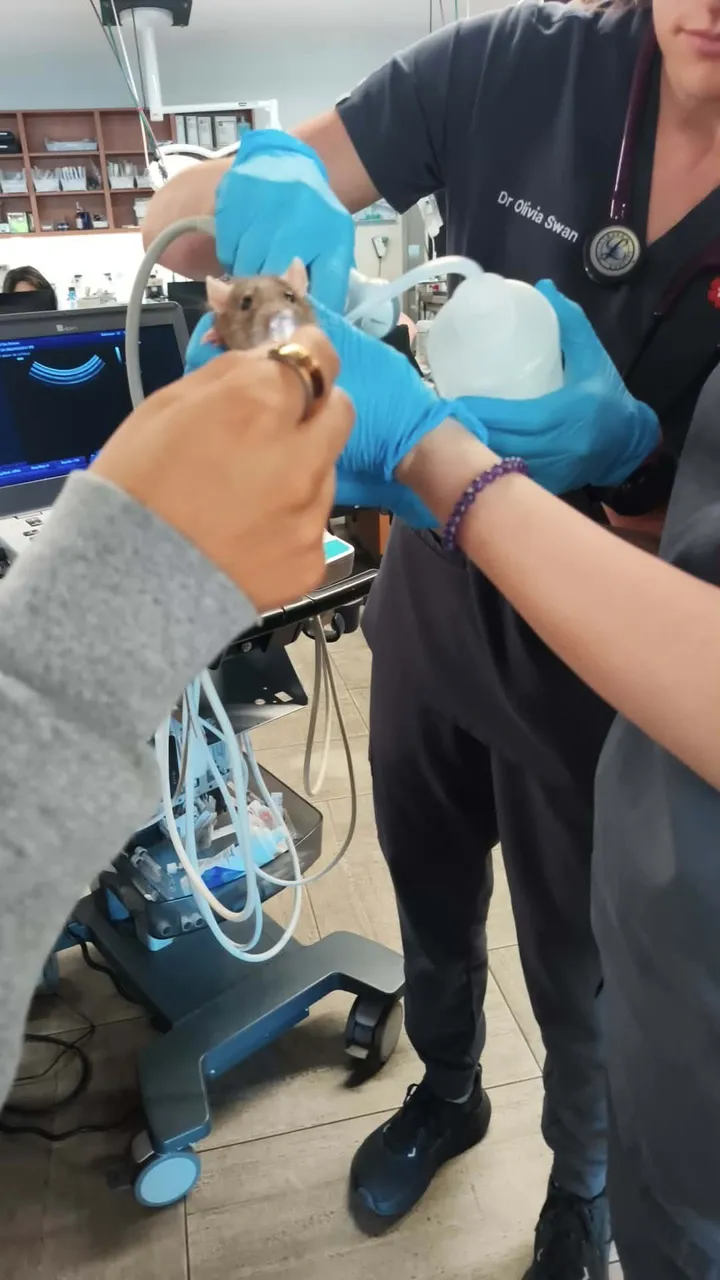
Rats face a lot of illness in a short life. Respiratory disease and tumours are especially common and can progress quickly, so see an exotic vet experienced with rats as soon as you notice something. The following is background information only.
10.1. Common conditions
| Condition | Cause | Signs | Prevention or response |
|---|---|---|---|
| Chronic respiratory disease | Mycoplasma pulmonis and others, worsened by ammonia and dust | Snuffling, sneezing, porphyrin discharge, laboured breathing | Ventilation, low-dust bedding, early vet treatment and antibiotics |
| Mammary tumours | Very common in females, usually benign fibroadenomas | Soft lumps on the armpit, belly or groin | Weekly lump checks, early surgery, early spaying lowers risk |
| Pituitary tumours | Common in older rats, especially females | Head tilt, weak front paws, trouble eating, one eye bulging | Vet care to ease symptoms |
| Bumblefoot | Wire floors, obesity, poor hygiene | Red lumps and scabs on the soles, limping | Covered floors, weight control, hygiene |
| Hind-leg degeneration | Age-related nerve degeneration | Dragging or weak back legs | Lower cage layout, supportive care |
| Middle ear infection | Spread of respiratory infection | Head tilt, circling, loss of balance | Vet, antibiotics |
| Mites and lice | Introduced by new rats or bedding | Scratching, scabs, hair loss | Quarantine newcomers, treatment |
| Sialodacryoadenitis virus (SDA) | Contagious virus | Swollen neck, eye problems, sneezing | Two to three weeks' quarantine for newcomers, vet |
| Overgrown teeth | Malocclusion, nothing to gnaw | Long, curving incisors, trouble eating | Chews, trimming by a vet |
Many rats carry Mycoplasma from an early age, so the realistic goal is to keep it from flaring up through good air quality rather than to avoid it entirely. Mammary tumours are mostly benign but can grow large enough to hamper movement, and removing them while small gives the best recovery.
10.2. Warning signs and home checks
- Clicking or wheezing breaths with heaving flanks
- Red porphyrin crust around the eyes and nose for several days
- Any new lump anywhere on the body
- Head tilt or loss of balance
- Eating poorly for a day or losing weight quickly
- Sitting hunched with fluffed-up fur
- Blood in the urine or diarrhoea
Once a week, run your hands over each rat to feel for lumps, weigh it, and check incisor length and the soles of the feet. Quarantine new rats in a separate room for two to three weeks before introducing them to reduce the risk of bringing in disease.
11. Breeding
Rats breed astonishingly fast. Both sexes can be fertile from about five weeks, and females cycle every four to five days. Gestation is about 21–23 days, and litters of six to twelve are typical, with occasional litters approaching twenty. Females come back into season right after giving birth, so a doe left with a buck can be nursing one litter while carrying the next. On paper, a single pair could give rise to hundreds of rats within a year.
Pups are born hairless with eyes closed, open their eyes at about two weeks and are weaned at three to four weeks. They must be sexed and separated before five weeks. Breeders often say a doe should have her first litter before she is too old, though very young does are not physically ready either.
Home breeding is not something to undertake lightly. A litter of ten or so needs ten homes, each with same-sex companions, and without them space and costs balloon. Tumours and respiratory problems in rats have a strong inherited component, so pairing animals of unknown background passes those problems on. Responsible breeders keep records of lifespan, tumour history and temperament. Without that kind of planning, keep same-sex groups, and if you want a mixed group, talk to a vet about neutering the males.
12. Costs
Rough Korean figures for a pair, excluding purchase price. Rats themselves are inexpensive to buy, but veterinary care in later life can be the largest cost.
| Item | Approximate cost (KRW) | Notes |
|---|---|---|
| Multi-level wire cage | 120,000–300,000 | 80 × 50 × 80 cm or larger |
| Hammocks, hides, tunnels, ropes | 30,000–70,000 | Spares for washing |
| Bowl, bottle, litter tray | 20,000–40,000 | |
| First bedding and toys | 20,000–40,000 | |
| Thermo-hygrometer, scale, carrier | 30,000–50,000 | |
| First vet check for two | 40,000–100,000 | |
| Starting total | about 200,000–450,000 | |
| Monthly rat blocks, vegetables, treats | 15,000–35,000 | |
| Monthly bedding and litter | 15,000–25,000 | Frequent changes for air quality |
| Respiratory treatment | tens of thousands per course, more for long-term medication | Relapses are common |
| Tumour removal | in the hundreds of thousands | Depends on size, location and clinic |
With a short lifespan, medical spending tends to be concentrated into two or three years. Mammary tumour surgery and long-term respiratory treatment in particular can add up, so plan a medical fund before you bring rats home.
13. Before you get one
- Short life: be ready for a goodbye in two or three years, and if you have children, think about how you will talk about it with them.
- Two or more: plan to bring home at least two rats of the same sex.
- Household and landlord: make sure no one at home is strongly opposed and check leases or building rules about small animals.
- Other pets: cats, dogs and ferrets see rats as prey. Never let them share a room unsupervised.
- Time: at least an hour a day of out-of-cage play and company.
- Vet access: find an exotic vet who treats rats and can remove tumours.
- Source: choose a breeder who records lifespan and tumour history and separates sexes properly. Rats mass-bred as reptile food come with unknown health and little socialisation.
- Healthy animal: clear eyes without porphyrin, quiet breathing, a smooth glossy coat, and a rat that comes forward to sniff your hand.
For the first few days, rest your hand in the cage with a treat and let the rats learn your scent. Rats adapt quickly, and most are climbing onto hands and responding to their names within a week or two.
14. Laws
Fancy rats are domesticated animals and in most countries are not covered by wildlife or endangered-species laws, CITES included. Registration is generally not required. Animal welfare laws, however, apply to rats just as to any other pet, and abandoning or releasing a pet rat is an offence in many places. Pet rats rarely survive outdoors and can mix with wild populations, which creates its own hygiene concerns.
Housing rules are worth checking too: some leases and building or homeowner association rules restrict small animals, and rats specifically can cause friction with neighbours. A few jurisdictions control the import of rodents; Alberta in Canada, for example, is well known for its long-standing campaign to keep rats out of the province, and pet rats there are tightly restricted. If you are moving abroad with rats, check the destination's quarantine and import rules first, and confirm current local regulations with your national or municipal authority.
15. Rats in culture
In East Asia the rat is the first animal of the zodiac. The legend says the rat rode on the ox's back in the great race and leapt off just before the finish to win, so people born in the year of the rat are thought to be clever, quick and good with money. Korean proverbs are full of rats too: one says that even a rat hole gets sunshine someday, another that birds hear what is said by day and rats what is said by night.
In Europe rats were long symbols of plague and disaster, as in the tale of the Pied Piper of Hamelin. Modern popular culture has been kinder. Pixar's Ratatouille (2007) made a hero of Remy, a rat who dreams of cooking in Paris. Splinter, the martial-arts master of the Teenage Mutant Ninja Turtles, and Scabbers from Harry Potter are other famous rats, while the 1971 film Willard and its sequel Ben took a darker view of the bond between rats and people.
Science has given us the phrase lab rat as everyday shorthand for a test subject. And African giant pouched rats, trained to sniff out landmines and tuberculosis, have earned international fame, though they are a different species from the fancy rat.
16. Trivia
- Unable to vomit, rats protect themselves by tasting a little of anything new and waiting, which is one reason poison baits often fail against them.
- In one well-known experiment, rats repeatedly opened a small door to free a trapped cage mate, fuelling debate about empathy in rodents.
- Rat incisors can grow more than 10 cm a year if not worn down, which is why constant gnawing is essential.
- So much heat escapes through the tail that it feels noticeably warm on hot days.
- Rats talk in ultrasound, and the calls they make while playing differ in pitch from those they make when anxious.
- Cage mates love sleeping in a single heap, so even with several hammocks you will often find everyone crammed into one.
- Rats can swim but most dislike water. Bath only when truly necessary, briefly, in lukewarm water.
Health notes are general information. If something seems wrong, contact a vet who treats this species.
FAQ
How are rats different from hamsters?
Hamsters are solitary and nocturnal, while rats are group animals that actively seek out people. Rats are bigger, smarter and far more trainable.
Do pet rats stink?
The rats themselves smell little; most odour comes from urine ammonia. Daily spot-cleaning and a weekly full clean keep a living-room cage pleasant.
Are males or females better?
Bucks tend to be larger and lap-loving, does smaller and more adventurous. Either way, keep at least two of the same sex.
Further reading
- 🗳️ Can fancy rats make great pets?
- 🏠 How to Adopt a Shelter or Rescue Animal
- 🏢 Choosing a Pet When You Live Alone or Work Full Time
Photo credits
Photos are freely licensed images from Wikimedia Commons. Authors and licenses are listed below.
- Lyonblackandwhitehoodedrat (cropped).jpg — Editor012456 · CC BY-SA 4.0
- Dwarf rats sleeping.jpg — Tzirtzi · CC BY-SA 4.0
- Fancy Rat Dalmatian.jpg — AviationFreak · CC BY-SA 4.0
- Hairless Rat Bald Mag.jpg — Sunflwers · CC BY 4.0
- Rat at Hospital.jpg — Okraaa · CC0