TailVille
At a glance
Rough ranges for supplies, food and electricity in Korea (USD is approximate). Purchase or adoption fees are not included.
Keepers who want a hands-on, interactive lizard and have the floor space and budget for a large, well-lit enclosure.
Anyone short on space or money, or without time to prepare fresh greens and manage insects every day.
1. Overview
The bearded dragon is an agamid lizard from the arid interior of Australia. When it feels threatened or excited it inflates the spiny skin under its throat and turns it dark, and the result looks like a beard, hence the name. The species kept as a pet almost everywhere is the central bearded dragon, Pogona vitticeps, which grows to 40 to 60 cm including the tail and weighs 300 to 600 grams.
It is active by day, notices the people around it, and many individuals sit calmly on a lap, so it is often described as the most dog-like lizard. Head bobs, arm waves and color changes give it a wide expressive range, and it is especially popular with keepers who want an animal that seems to interact with them.
It is also considerably more demanding than leopard or crested geckos. You will need an enclosure of at least 120 cm, a basking spot around 40 °C, and a high-output UVB lamp, plus live insects for youngsters and fresh greens every day for adults. All that equipment means higher setup costs and electricity bills, so run the numbers before committing. Typical captive lifespan is 10 to 15 years.
2. Name and classification
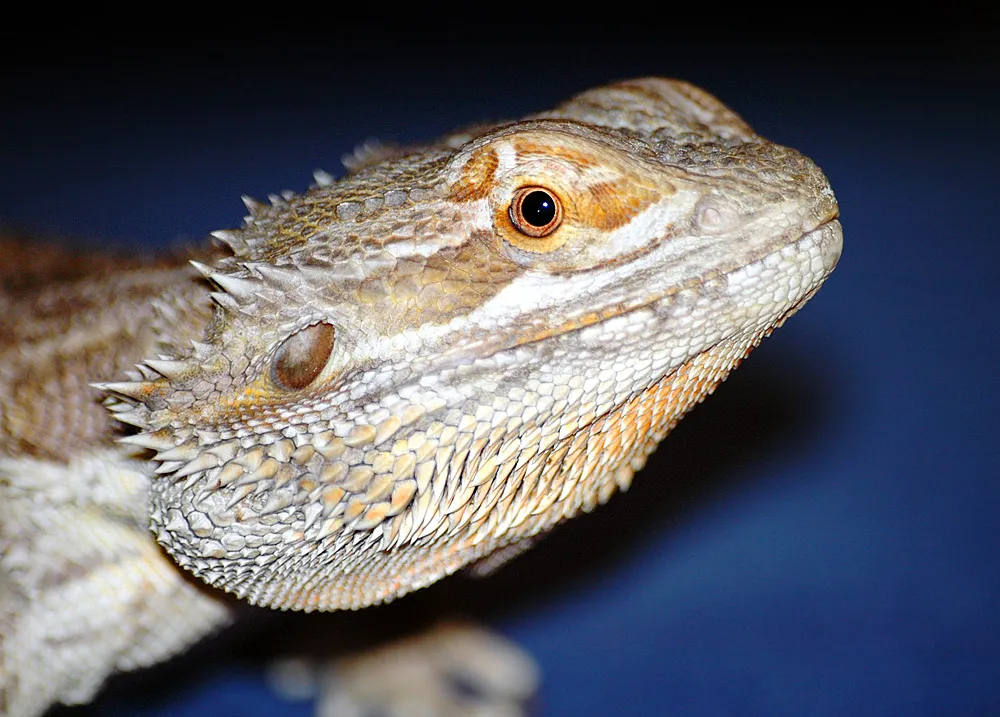
André Karwath aka Aka · CC BY-SA 2.5
2.1. Scientific name and meaning
The genus name Pogona comes from the Greek pōgōn, meaning beard. The species name vitticeps combines the Latin vitta, a band, with ceps, head, usually read as a reference to the banded markings on the head. Ernst Ahl described the species in 1926, and it has also been placed in the genus Amphibolurus in the past.
In English the affectionate nickname beardie is nearly universal. Korean keepers mostly use a transliteration of the English name or a shortened form of it, although a native Korean name meaning beard lizard also exists.
2.2. Family and relatives
Bearded dragons belong to the family Agamidae, which includes other distinctive Australian lizards such as the frilled lizard, the eastern water dragon and the thorny devil, along with many agamas from Asia and Africa. The genus Pogona contains several species, a few of which appear in the pet trade.
| Species | Scientific name | Notes |
|---|---|---|
| Central bearded dragon | P. vitticeps | The standard pet, up to around 60 cm |
| Eastern bearded dragon | P. barbata | Darker, more prominent beard, often more nervous |
| Rankin's (Lawson's) dragon | P. henrylawsoni | Small, about 30 cm, rounder head, smaller spines |
| Western bearded dragon | P. minor | Slender and small, rarely available |
Crosses between Rankin's and central bearded dragons have been sold under the name Vittikins. Keepers who value pure lines generally frown on hybrid breeding.
3. History
Central bearded dragons live across the deserts, scrublands and dry woodlands of inland Australia, ranging through Queensland, New South Wales, Victoria, South Australia and the Northern Territory. After sunrise they climb onto rocks, fallen logs and fence posts to bask, and as omnivores that eat both insects and plants they are well suited to a harsh, dry climate.
Australia has strictly banned the commercial export of its native wildlife since the 1960s. The bearded dragons kept worldwide are therefore understood to descend from a limited number of animals that left the country before the ban or through later legal and illegal routes. Large-scale breeding took hold in the United States and Europe in the 1990s, turning the species into the flagship pet lizard, and improvements in heating and UVB technology dramatically raised keeping success.
The species reached Korea through reptile shops in the 2000s and grew popular after the 2010s as videos of affectionate dragons spread on social media. It is now a common first lizard for people who want an interactive reptile. At the same time, the challenge of fitting a large enclosure and strong lighting into an apartment has led to a rise in dragons acquired without enough preparation and suffering health problems as a result. The same pattern has been seen in many other countries.
4. Body
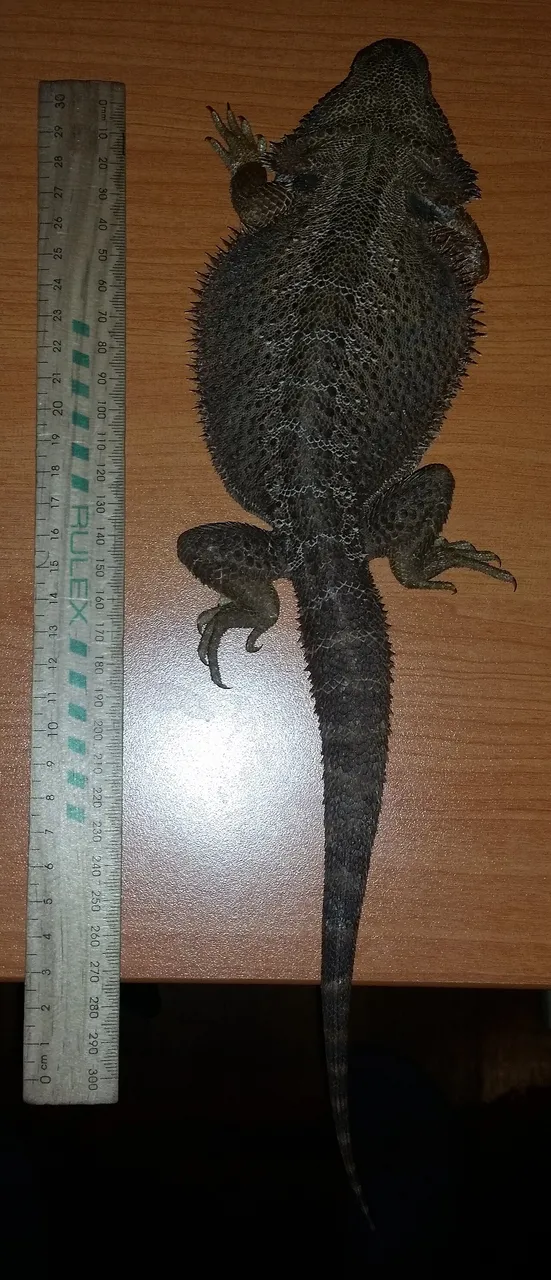
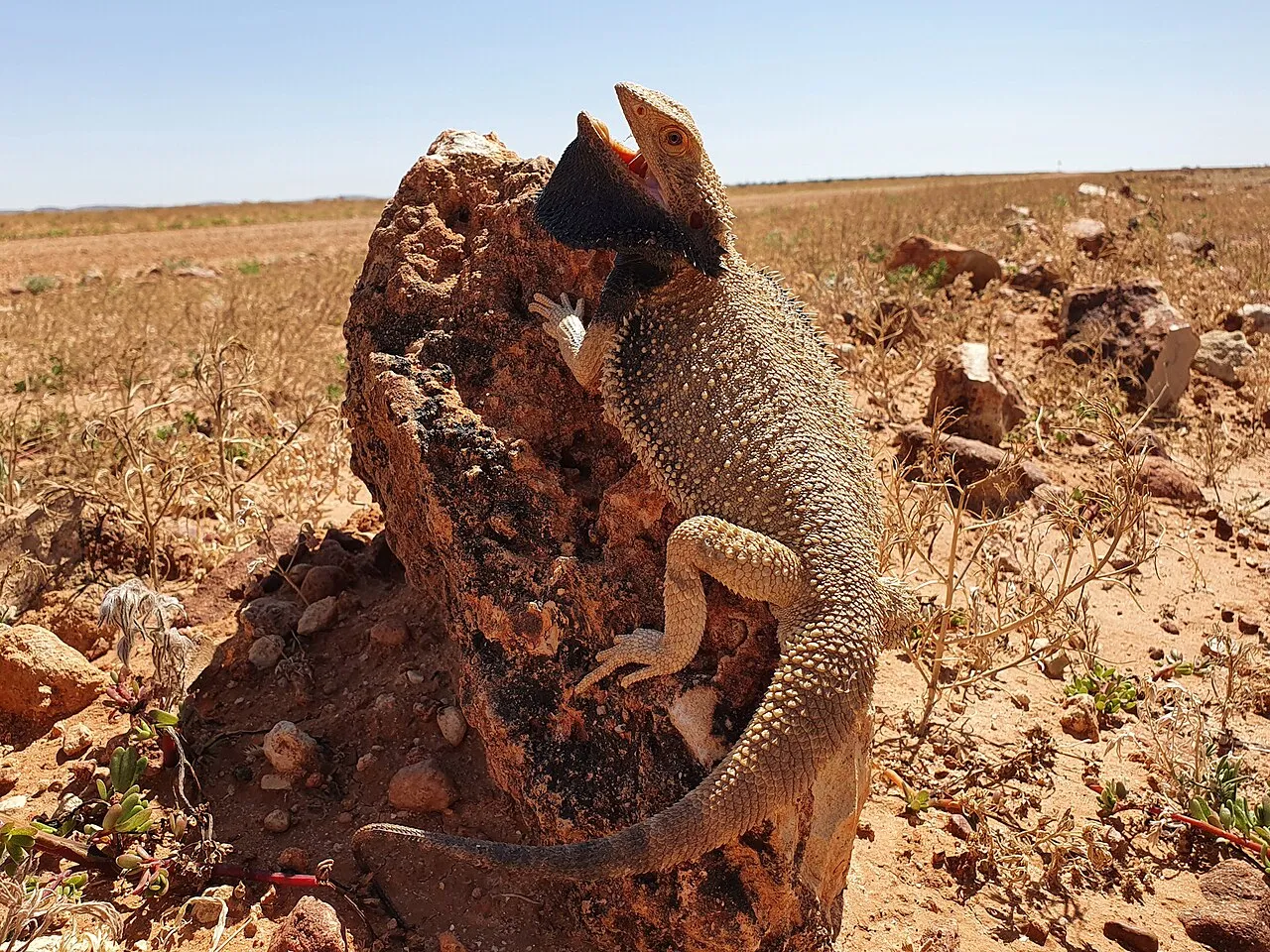
Emrsn1 · CC BY-SA 4.0
4.1. Size and build
A hatchling measures about 8 to 10 cm including the tail and weighs 2 to 4 grams. Growth in the first year is remarkably fast, and most are close to adult size by 12 to 18 months. Adults reach 40 to 60 cm, about half of it tail, and usually weigh 300 to 600 grams, with some large lines heavier still.
The body is broad and fairly flat, and when basking the dragon spreads itself out to maximize the area facing the heat. The head is triangular, and rows of spiky scales line the sides of the head and body. They look fierce but feel only slightly rough to the touch. A healthy adult has a thick tail base, hips that do not jut out, and modest fat pads on either side of the back of the head.
4.2. The beard and color change
The famous beard is an area of stretchy skin and spiny scales under the throat. When threatened, the dragon pushes it outward using the hyoid bones, opens its mouth to flash the yellow lining, and flattens its body to look larger. Males also turn the beard jet black during courtship and territorial displays.
Body color shifts too. A cold dragon darkens to absorb heat faster and lightens once warmed up. Under stress, dark ovals or stripes can appear on the belly; keepers call these stress marks. A new environment, another dragon nearby or pain can all trigger them.
4.3. Senses and the parietal eye
The eyes are built for daytime life, with good color vision and a sharp eye for movement. Ear openings sit visibly behind the eyes. In the center of the head is a small, slightly translucent scale: the parietal eye. It cannot form images, but it senses changes in light, helping regulate daily rhythms and body temperature, and it is thought to help detect shadows passing overhead. That is one reason a hand swooping down from above startles many dragons.
Most of the teeth are fused to the jawbone (acrodont teeth), and lost ones in those areas do not regrow. Dental and gum disease can develop, which is one more reason not to overdo sweet fruit.
4.4. Telling males from females
Sexing becomes easier from about three to six months, when the dragon is 20 to 25 cm long. Gently lift the tail and look at the underside just behind the vent: males show two bulges side by side, where the hemipenes sit, with a groove between them, while females usually show a single central bump. Femoral pores along the inner thighs are larger and more obvious in males. Adult males have bigger heads, blacken their beards more often and have wider vents. With youngsters, some keepers shine a flashlight through the tail base from above, but when in doubt, wait and check again later.
5. Morphs and colors
Bearded dragons, too, come in many morphs. Color lines are mostly the result of selective breeding, while several morphs that change scale structure or pigment cells are inherited through single genes.
| Morph | Inheritance | What it looks like |
|---|---|---|
| Normal (wild type) | - | Tan or gray-brown wild coloration |
| Red, orange, citrus, yellow | Line-bred | Strongly expressed color lines |
| Hypomelanistic (hypo) | Recessive | Reduced dark pigment, lighter colors, clear nails |
| Translucent (trans) | Recessive | See-through scales; juveniles often have solid dark eyes |
| Leatherback | Incomplete dominant | Reduced dorsal spines, smoother skin |
| Silkback | Super form of leatherback | Nearly scaleless, very soft skin, difficult to care for |
| Dunner | Reported as dominant | Irregular scale arrangement and unusual pattern |
| Zero | Recessive | Patternless white or gray |
| Witblits | Recessive | Patternless, pale solid color |
| Wero | Zero and witblits combined | White with some pattern remaining near the base of the tail |
| German giant | Line-bred | Lines selected for large size |
Combinations such as hypo trans, often with a scale morph like leatherback added, are common. Naming varies somewhat between breeders.
Silkbacks lack most of the scales that protect the skin, leaving them prone to dryness, stuck shed, injuries and UV-related skin damage, and many keepers are critical of breeding them at all. Translucent dragons have dark-looking eyes, so their eye health deserves extra attention. For a first dragon, choosing a healthy, eager eater matters far more than an eye-catching morph.
6. Behaviour
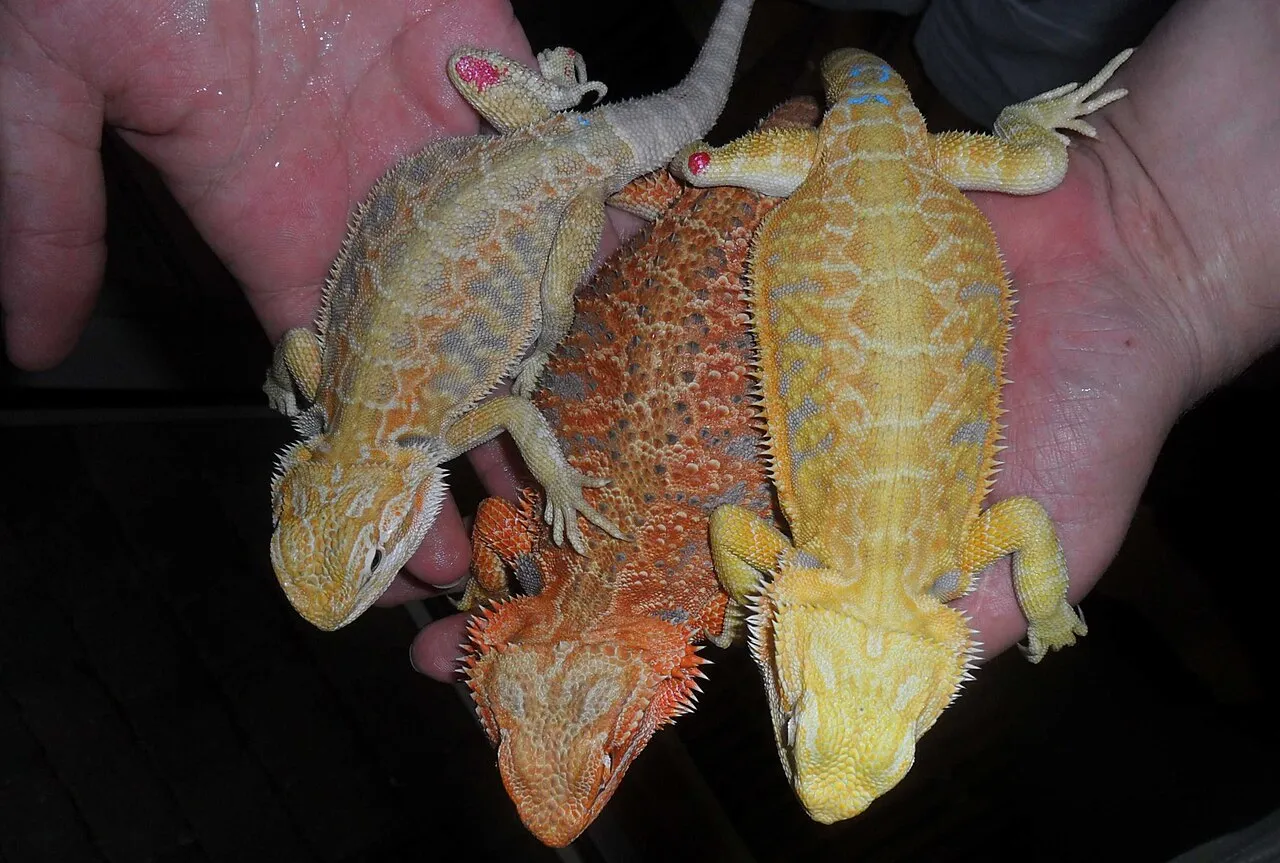
Dragoncolony · CC BY-SA 3.0
6.1. Life in the wild
In the wild, a bearded dragon climbs to a high perch after sunrise and basks until its body reaches around 35 °C, then goes foraging for insects, small vertebrates, flowers, leaves and fruit. During the worst midday heat it retreats to a burrow or shade before becoming active again in the afternoon. In the cooler months it may spend weeks or months underground with greatly reduced activity, a state called brumation. Dragons are mostly solitary, and males compete over the best basking perches.
6.2. At home
When the lights come on in the morning, a captive dragon climbs to its basking spot to warm up, then spends the day exploring and watching the room. Many come to the front of the enclosure when people approach, hoping for food, and once used to handling will rest on a shoulder or lap for long periods. Short daily handling builds trust quickly, but body temperature drops outside the enclosure, so keep sessions brief when the room is cool.
Repeatedly running up and down and scratching at the glass, known as glass surfing, can mean the dragon sees its reflection as a rival, the enclosure is too small, temperatures are wrong or it is hungry. Occasional surfing is normal; constant surfing is a reason to review the setup.
6.3. Reading the signals
Bearded dragons are famous for communicating through body language. These are the main signals.
| Behavior | Meaning |
|---|---|
| Fast up-and-down head bobbing | A male showing dominance, claiming territory or courting |
| Slow head bobbing | Acknowledging another dragon; a female's response to courtship |
| Arm waving in slow circles | Submission or no intention to fight, common in juveniles |
| Puffed, blackened beard | Threat, excitement or male display |
| Sitting with the mouth open (gaping) | Usually releasing heat; sometimes a threat |
| Flattening the body | Absorbing heat, or looking bigger in defense |
| Dark marks on the belly | Stress or discomfort |
| Hissing | Strong warning; give it space |
| Bulging the eyes | Thought to loosen the skin around the eyes before a shed |
Gaping on the basking spot is usually normal temperature control. Open-mouth breathing away from the heat, especially with mucus or wheezing, may signal a respiratory infection.
6.4. Brumation
Between autumn and winter a dragon may suddenly stop eating and spend most of its time asleep in a hide or on the cool side. This is brumation, a dormancy similar to hibernation, and it can last from a few weeks to two or three months. Even indoors, dragons pick up on shortening days and cooler rooms and slow down naturally.
The difficulty is telling brumation apart from illness. Before letting a dragon brumate, have a vet run a fecal test and basic checkup to rule out parasites and disease. During brumation, keep fresh water available and weigh the dragon every two weeks. If it loses more than 10 percent of its weight, its eyes sink in, or it is weak even when awake, it may not be brumation at all, so go back to the vet. Dragons under a year old usually do not brumate, so a youngster that stops eating should be treated as potentially sick.
7. Life stages
Bearded dragons grow especially fast in their first year, and their diet then looks very different from what they need as adults. Shifting the balance between insects and greens as the dragon ages is the key.
| Stage | Age | Approx. length and weight | Diet balance | Notes |
|---|---|---|---|---|
| Hatchling | 0-3 months | 8-20 cm, 2-40 g | Insects 70-80%, greens 20-30% | Fed two or three times a day, very rapid growth |
| Juvenile | 3-12 months | 20-45 cm, 40-300 g | Insects 50-60%, greens 40-50% | Insects once or twice daily, sexable |
| Subadult | 12-18 months | 45-55 cm, 300-450 g | Insects 30%, greens 70% | Growth slows, more greens |
| Adult | 18 months-8 years | 40-60 cm, 300-600 g | Insects 20%, greens 80% | Weight control matters; may brumate |
| Senior | 8 years and up | Varies | Mostly greens | Less active; more joint and kidney problems |
Typical captive lifespan is 10 to 15 years, and well-kept dragons can live longer. With age they bask less often and move more slowly, and arthritis, kidney disease and gum disease become more common. For older dragons, provide a gentle ramp up to the basking spot, record weight monthly and arrange at least a yearly checkup that includes blood work. Obesity in adults leads to fatty liver and joint trouble, so cut back on insect treats and keep the diet built around vegetables.
8. Housing
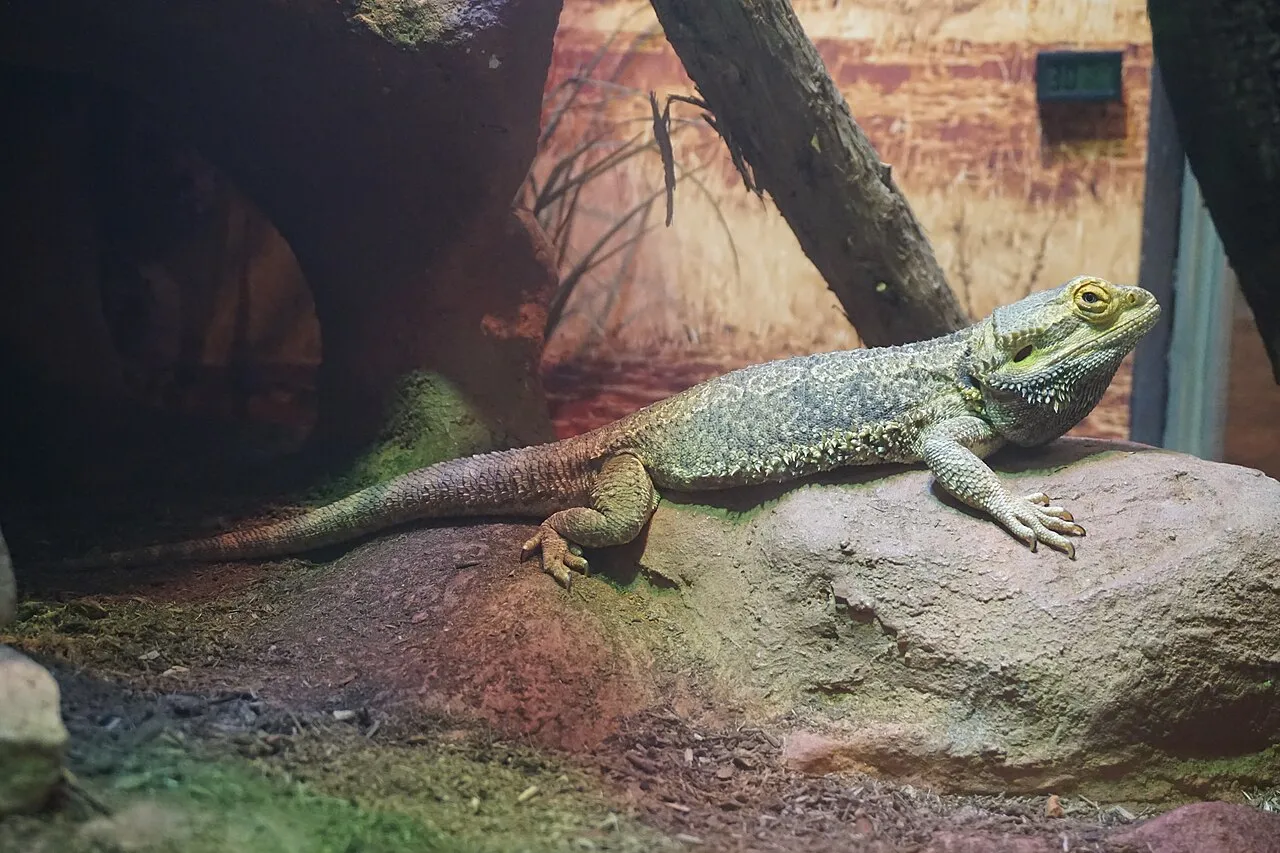
8.1. Enclosure
An adult needs an enclosure of at least 120 x 60 x 60 cm, and 150 x 60 x 60 cm or larger is better. An animal more than 50 cm long needs enough length to move between a hot basking spot and a cool end and pick the temperature it wants. Young dragons can go straight into a full-size enclosure, but keep the decor simple at first so feeder insects have fewer places to hide.
Front-opening glass or PVC enclosures hold heat well and make access easy. Put a flat stone or thick branch under the basking lamp so the whole body receives heat, and provide one hide beneath or near the basking area and another on the cool side. If a dragon reacts badly to its own reflection, attach backgrounds to the sides and back.
8.2. Temperature
Bearded dragons need a hot basking spot and a wide temperature range. Measure the basking temperature as a surface reading on the stone or floor with an infrared thermometer, not as air temperature.
| Zone | Hatchlings and juveniles | Adults |
|---|---|---|
| Basking surface | 40-45 °C | 38-42 °C |
| Warm-side air | 30-33 °C | 29-32 °C |
| Cool side | 24-29 °C | 24-29 °C |
| Night | 18-22 °C | 18-22 °C |
Overhead halogen or incandescent heat lamps work best for basking, because dragons are adapted to absorbing heat through their backs from above; an under-tank mat alone is not enough. Connect every heat source to a thermostat or dimmer, and switch off all light-emitting heat at night. If the room falls below about 18 °C in winter, use a ceramic heater, which gives off no light, on a thermostat to hold night temperatures. Heat rocks are not recommended, as their surfaces can overheat and cause serious burns.
8.3. UVB lighting
For bearded dragons, UVB is not optional. They need it to make vitamin D3 in the skin and absorb calcium, and without it metabolic bone disease follows. The most widely recommended option is a T5 high-output 10 to 12 percent UVB tube, mounted over the basking side and running about two-thirds of the enclosure's length.
- Run it 12 to 14 hours a day, reducing to 10 to 12 hours in winter if you like.
- Follow the manufacturer's recommended distance between the tube and the basking spot. Mesh lids block a significant share of UVB.
- Replace tubes every 6 to 12 months, because UVB output fades long before the visible light does. Write down the date.
- Sunlight through window glass contains almost no UVB, so a sunny window is no substitute and can cause overheating.
- Compact coil UVB bulbs tend to be weak or uneven and are not recommended.
If you have a UV index meter, you can adjust the distance until the basking spot reads about UVI 3 to 6.
8.4. Substrate and equipment
Young dragons often swallow substrate while lunging at insects, so paper towel, tile or reptile carpet are the safe choices. Some keepers move adults onto a packed soil and sand mix, but avoid calcium sand or fine loose sand on its own because of impaction risk. Keep humidity low, around 30 to 40 percent; a large water bowl inside raises humidity, so many keepers use a small dish and provide water through regular baths.
- Enclosure of at least 120 x 60 x 60 cm
- Basking lamp with a dimmer or thermostat
- Ceramic heater for winter nights
- T5 HO 10-12 percent UVB tube with reflector and timer
- Infrared thermometer and two digital thermometer-hygrometers
- Basking stone or branch and two hides
- Salad dish, small water dish, insect bowl
- Calcium with and without D3, plus a multivitamin
- Bathing tub and a kitchen scale
9. Diet
9.1. Insects
Young bearded dragons need plenty of protein for growth, so insects make up most of their diet. Dubia roaches, crickets, black soldier fly larvae and silkworms are good staples, while superworms and hornworms work as treats. Mealworms have tough shells and are best avoided for juveniles.
| Age | Insect feeding |
|---|---|
| 0-3 months | Two or three times a day, as many as eaten in 10-15 minutes |
| 3-12 months | Once or twice a day |
| 12-18 months | Once a day or every other day |
| Adult | Two or three times a week, around ten insects |
Insects must be smaller than the gap between the eyes. Swallowing oversized prey is widely reported to press on the spinal nerves and cause hind-leg paralysis. Gut-load insects before feeding and dust them with calcium at almost every feeding while the dragon is growing. Remove leftover crickets, which may bite a sleeping dragon.
9.2. Greens and fruit
An adult bearded dragon's diet should be roughly 80 percent vegetables. Fill a fresh salad dish every morning and remove leftovers in the evening. Chopping the greens finely and mixing them helps prevent picky eating.
| Category | Examples |
|---|---|
| Daily staples | Collard greens, mustard greens, dandelion greens, turnip greens, endive, bok choy, kale, raw grated squash |
| Occasional | Broccoli, carrot, bell pepper, green beans, zucchini |
| Small amounts only | Spinach and chard (high in oxalates), cabbage (possible thyroid effects) |
| Fruit treats, weekly at most | Blueberries, strawberries, apple without seeds, papaya, mango |
Watery, low-nutrient greens such as iceberg lettuce are poor staples. Fruit is high in sugar and contributes to obesity and gum disease, so keep it under about 10 percent of the diet.
9.3. Supplements and water
While growing, dust insects with calcium at nearly every feeding and with a multivitamin once or twice a week. Adults do well with calcium three or four times a week and a multivitamin about once a week. With good UVB, many keepers limit calcium with D3 to once or twice a week, since too much supplementation can cause vitamin toxicity.
Bearded dragons often fail to recognize still water and may rarely drink from a bowl. Misting the greens, or a 10- to 15-minute bath in lukewarm water around 30 °C two or three times a week, helps keep them hydrated; many drink and pass droppings during the bath. Keep the water no deeper than the armpits of the front legs, and never leave a bathing dragon unattended.
9.4. Forbidden foods
- Fireflies: they contain toxins that are deadly to bearded dragons, even in small numbers.
- Avocado: considered toxic.
- Onion, garlic, leeks and chives: can damage red blood cells.
- Rhubarb leaves and stalks: extremely high in oxalates.
- Wild-picked plants and wild-caught insects: possible pesticides, herbicides, exhaust residue and parasites.
- Spinach as a staple: interferes with calcium absorption.
- Human food, processed food and dairy: indigestible and too salty or fatty.
- Oversized insects, or large amounts of mealworms for juveniles: impaction risk.
10. Health
(c) Lewis, some rights reserved (CC BY-SA) · CC BY-SA 4.0
Bearded dragon health is tied closely to UVB, temperature, prey size, diet balance and hygiene. Because the species depends on so much equipment, a single failed lamp or an expired UVB tube can turn into a health problem quickly.
| Condition | Main causes | Signs | Prevention |
|---|---|---|---|
| Metabolic bone disease | Lack of UVB or calcium, old UVB tubes | Trembling, jaw deformity, bowed legs, fractures, inability to stand | Replace T5 HO UVB on schedule, calcium |
| Impaction | Oversized prey, swallowed sand or bark, low heat | No droppings, hind-leg paralysis, bloated belly | Correct prey size, safe substrate |
| Adenovirus infection | Viral, common in young dragons | Poor growth, lethargy, refusing food, neurological signs | Reputable source, testing, quarantine |
| Yellow fungus disease | Nannizziopsis fungi | Yellow or brown spreading skin lesions and crusts | Hygiene, prompt diagnosis, isolation |
| Parasites (coccidia, pinworms) | Infected animals or insects | Runny, foul droppings, weight loss | Regular fecal tests |
| Respiratory infection | Low temperatures, high humidity | Mucus, gaping, wheezing | Proper gradient, dry setup |
| Mouth rot | Injury, weak immunity | Swelling around the mouth, pus | Hygiene, early treatment |
| Egg binding | No laying site, low calcium | Swollen belly, lethargy, digging then stopping | Laying box, calcium |
| Tail or toe necrosis | Stuck shed, injury, poor circulation | Tip turns dark and dries | Shed care, no cohabitation |
Females can lay infertile eggs without ever meeting a male, so a lone female can still become egg-bound. If an adult female's belly swells and she digs restlessly, add a deep box of moist soil for laying.
Bearded dragons can carry Salmonella. Always wash your hands after handling, and never bathe a dragon in a kitchen sink or a baby bath. Children under five, pregnant people and anyone with a weakened immune system should be especially careful.
See an exotic vet if the dragon trembles, drags its back legs or cannot stand, passes no droppings for over a week with a swollen belly, develops yellow or brown spreading skin patches, refuses food and loses weight outside the brumation season, or seems to struggle to breathe. A fecal parasite test soon after arrival and a yearly checkup afterward are recommended.
11. Breeding
Bearded dragons can be bred at home, but the sheer number of eggs makes it a heavy responsibility. A clutch typically contains 15 to 30 eggs, and females often lay several clutches a season, which can mean dozens of babies a year and occasionally close to a hundred. Every hatchling needs its own space, insects and UVB, so breeding without homes already lined up is strongly discouraged.
Females should be at least 18 months old and over 350 grams before breeding. Typically, after a winter brumation or cooling period, the male courts in spring with rapid head bobbing, and a receptive female answers with arm waves or slow bobs. Males often bite the female's neck during mating, which can leave wounds. Around four to six weeks after mating she will start digging; provide a laying box with about 30 cm of moist soil and sand.
Incubate the eggs in damp vermiculite or perlite at 27 to 30 °C for roughly 55 to 75 days. Sex in bearded dragons is determined by ZW sex chromosomes, but incubation at high temperatures, roughly above 32 °C, can cause genetically male embryos to develop as females, a well-documented sex reversal. Avoid incubating too hot for that reason.
Hatchlings start eating a day or two after hatching, once the yolk is absorbed. Groups of babies frequently bite each other's toes and tails, leading to tissue loss, so sort them by size and move them to individual enclosures as early as you can. A female who has just laid has spent a great deal of calcium and energy, so give her rest and extra calcium. If you plan to sell offspring, find out whether a business license is required.
12. Costs
With all its equipment, the bearded dragon is one of the more expensive pet reptiles to set up and run. Winter is the costliest season, because basking lamps, UVB and ceramic heaters stay on for long hours. These are ballpark Korean prices, shown in won.
| Item | Typical cost (KRW) | Notes |
|---|---|---|
| Enclosure | 250,000-600,000 | 120-150 cm, front-opening |
| T5 HO UVB tube and reflector | 70,000-150,000 | Replacement tubes extra |
| Basking lamp, dimmer, thermostat | 70,000-150,000 | - |
| Ceramic heater | 30,000-60,000 | For winter nights |
| Thermometers, IR thermometer, scale | 30,000-60,000 | - |
| Rocks, branches, hides, dishes | 50,000-100,000 | - |
| First checkup and fecal test | 50,000-100,000 | - |
| Initial total (excluding the dragon) | About 600,000-1,200,000 | - |
| Monthly insects and greens | 30,000-70,000 | Insects cost more for juveniles |
| Monthly supplements and supplies | 5,000-10,000 | - |
| Monthly electricity | 20,000-40,000 | Depends on season and gear |
| Monthly total | About 60,000-120,000 | - |
| Yearly UVB replacement | 30,000-60,000 | Every 6-12 months |
Normal dragons are relatively inexpensive, while morphs such as hypo trans, zero or wero can cost several hundred thousand won or more. A basic exam with a fecal test runs to tens of thousands of won, X-rays and blood work add more, and surgery for impaction or egg binding can cost several hundred thousand won.
13. Before you get one
- Do you have room for a 120 to 150 cm enclosure, a floor that can bear its weight and outlets in the right place?
- Can you afford the setup cost and the monthly bill, including higher electricity in winter?
- Juveniles need insects two or three times a day. Are you comfortable keeping crickets or roaches at home?
- Will you chop fresh greens every day and make vegetables part of every shopping trip?
- Can you give 30 minutes to an hour a day to care and interaction?
- Is there an exotic vet nearby who treats reptiles?
- If young children live with you, can you enforce strict handwashing?
When buying, ask for the hatch date, weight, current insects and greens, and the type of UVB in use. A healthy dragon has clear, bright eyes, lifts its head to watch you approach and feels strong and firm in your hand. Avoid dragons with bony hips and a thin tail base, trembling legs, persistent stress marks on the belly, or dark, shriveled tail and toe tips. If it comes from a shared tub, check that every toe and the tail tip are intact. Hatchlings under three months are fragile, so a first-time keeper is better off with a juvenile of three to six months or older.
14. Laws
Bearded dragons are not listed under CITES. Australia, however, bans the commercial export of its native wildlife, so every dragon in the international pet trade should be captive-bred outside Australia. A seller offering wild-caught animals should make you question whether the trade is legal at all.
In Korea, amendments to the wildlife act are phasing in licensing for wildlife sellers and importers, along with a system specifying which species may be imported and sold. Which list bearded dragons fall under and what private rehoming requires may change over time, so check with the Ministry of Environment or a regional environmental office. Within Australia itself, most states require a reptile keeper's license even for local residents. Elsewhere, rules range from none at all to permits for any exotic pet, so look up the regulations where you live.
Bearded dragons cannot survive cold winters outdoors, and they should never be released. If you can no longer keep one, contact the seller, a reptile club or a rescue organization.
15. In culture
In Western popular culture the bearded dragon is the go-to image of a pet lizard. It turns up as a main character's pet in films and cartoons, as the classroom animal in school stories and as background color in family sitcoms. Classroom lizards have become such a familiar idea that animated comedies regularly build whole storylines around them.
Online, photos of dragons wearing tiny hats, videos of them dozing on a lap and clips of the slow arm-wave greeting have all become memes. Because the beard darkens when the animal is annoyed, a black-bearded dragon is a popular reaction image for a bad mood. Video channels following the daily life of a pet beardie are common in many languages.
In Australia it is one of the emblematic animals of the outback and appears on stamps, souvenirs and zoo education programs. Lizards feature in many Aboriginal stories and artworks, but traditions differ from community to community, and it is hard to say with confidence which, if any, refer specifically to bearded dragons.
16. Trivia
- Research suggests the bearded dragon's lineage carries genes associated with primitive venom glands, but it poses no venom risk to people.
- Studies of its brain activity during sleep found stages resembling REM sleep, making it a frequently cited animal in research on reptile sleep.
- The arm wave looks like a friendly hello, but it is really a signal that the dragon does not want a fight.
- A well-basked dragon becomes noticeably lighter, so the same animal can look quite different in the morning and the afternoon.
- A reflective surface in the enclosure can provoke a dragon to puff its beard and bob at its own image as if facing a rival.
- Two dragons piled on top of each other may look affectionate, but the one on top is usually claiming the heat and the higher position.
- Many dragons enjoy baths, but not all of them do; keep baths short for those that dislike water.
- Like most agamids, bearded dragons cannot drop their tails, and a damaged tail tip does not grow back.
Health notes are general information. If something seems wrong, contact a vet who treats this species.
FAQ
Are males or females friendlier?
Individual personality matters more than sex. Males can get touchy and black-bearded in breeding season, while females may lay infertile eggs without a male, so they need a dig box and extra calcium.
My dragon refuses to eat greens. What can I do?
Dragons raised mostly on insects can be stubborn. Offer the salad first thing and insects later in the day, scatter a few live insects on top, or add colorful squash or bell pepper to catch its eye.
Can window sunlight replace a UVB lamp?
No. Window glass filters out most UVB, and direct sun on a glass tank can push it past 50 °C within minutes. Use a proper UVB tube, and treat supervised time in a shaded outdoor pen on a fine day as a bonus.
Further reading
- 🗳️ Can reptiles make genuinely good pets?
- 🗳️ Should bearded dragons get occasional outdoor sunbathing?
- ❄️ Winter Care: Keeping Pets Warm and Heaters Safe
- 🦎 Finding an Exotic Pet Vet and Planning Checkups
- 🚗 Moving House and Traveling With Pets
Photo credits
Photos are freely licensed images from Wikimedia Commons. Authors and licenses are listed below.
- Bartagame (fcm).jpg — Photograph: Frank C. Müller, Baden-Baden · CC BY-SA 2.5
- Bearded Dragon - close-up.jpg — André Karwath aka Aka · CC BY-SA 2.5
- Bearded Dragon South Australia.jpg — Emrsn1 · CC BY-SA 4.0
- Dragoncolonydotnl.jpg — Dragoncolony · CC BY-SA 3.0
- Milwaukee Public Museum March 2023 09 (Survival of the Slowest--central bearded dragon).jpg — Michael Barera · CC BY-SA 4.0
- Pogona vitticeps, Durham QLD 4492, Australia imported from iNaturalist photo 403916931 (cropped).jpg — (c) Lewis, some rights reserved (CC BY-SA) · CC BY-SA 4.0