TailVille
At a glance
Rough ranges for supplies, food and electricity in Korea (USD is approximate). Purchase or adoption fees are not included.
Patient people who want a quiet pet and can dedicate part of a room to free-roaming time.
Families who expect a young child to be the main carer, or who want a pet that enjoys being picked up and carried.
1. Overview
Rabbits are herbivores in the order Lagomorpha, and every domestic rabbit, from the tiniest dwarf to the largest giant, belongs to a single species: the European rabbit, Oryctolagus cuniculus. Long ears, a fluffy scut of a tail, powerful hind legs and teeth that never stop growing are their defining features.
They are almost silent, they can be litter-trained, and once they trust you they show a surprising range of emotion, from racing laps around the sofa to flopping contentedly at your feet. That makes them well suited to flat and apartment life.
They are also long-lived for a small mammal, typically eight to twelve years, and they need a hay-based diet, several hours of free exercise every day, a home protected from their chewing, and a vet who understands rabbits. This article covers their origins, anatomy, breeds, behaviour, housing, diet, health, breeding, costs, legal points and cultural significance.
2. Name and classification
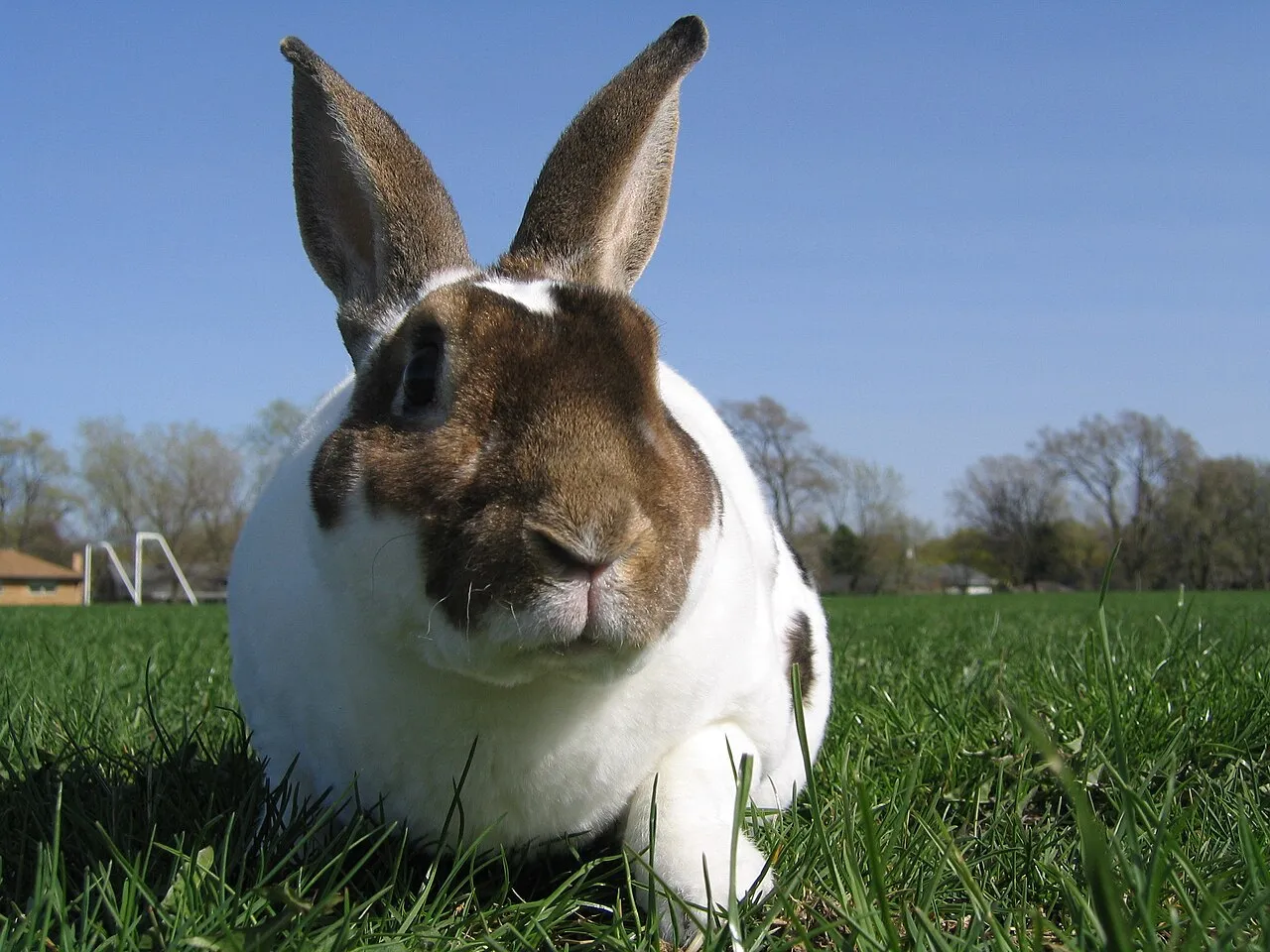
PD-user-en/Mr. Rex · CC BY-SA 4.0
2.1. Scientific name and taxonomy
In Oryctolagus cuniculus, the genus name comes from Greek for digging hare and cuniculus is Latin for rabbit, or for an underground passage. The name fits: this is a burrowing, colonial animal.
Rabbits were long lumped in with rodents because of their gnawing habits, but in the early 20th century they were placed in their own order, Lagomorpha. The giveaway is dental: rabbits have a second, tiny pair of peg teeth tucked behind the large upper incisors. The order also contains the pikas, small round-eared relatives that live among rocks in mountains and steppes.
2.2. Rabbits versus hares
Everyday language often blurs them, but rabbits and hares are different animals in different genera. Hares (Lepus) do not dig burrows; they rest in shallow scrapes above ground and tend to live alone, relying on speed to escape.
The clearest difference is at birth. Rabbit kits are born naked, blind and helpless in a fur-lined nest, whereas leverets are born fully furred with open eyes and can move within hours. The two cannot interbreed. Confusingly, the Belgian Hare is actually a domestic rabbit breed, named for its lean, hare-like look.
2.3. Where the words come from
The English word rabbit originally meant a young animal, while adults were called coneys, a term still found in place names such as Coney Island. Bunny probably comes from bun, an old dialect word for something small and round, or for a squirrel or rabbit's tail.
In Korean the animal is called tokki, a native word, and it is the fourth animal of the East Asian zodiac, where the Year of the Rabbit comes round every twelve years.
3. History
The European rabbit originally lived on the Iberian Peninsula and in southern France. The Romans kept rabbits in walled enclosures called leporaria for meat and fur, spreading the practice around the Mediterranean, though these animals were only semi-wild. Full domestication came gradually over the following centuries.
A popular story credits medieval French monks with taming the rabbit in a single step, but recent genetic research favours a long, gradual process centred on southern France rather than one decisive event. Through the Middle Ages, rabbits were raised for meat and fur by nobles and farmers alike, and in the 18th and 19th centuries the fashion for exhibitions drove the development of distinctive coat colours, ear shapes and sizes.
Rabbits travelled the world with people, sometimes disastrously. Rabbits released in Australia in the 19th century multiplied explosively without natural predators, devastating farmland and native ecosystems, and control efforts continue today.
The idea of the indoor house rabbit took hold in Britain and North America in the late 20th century, as owners discovered that litter-trained, free-roaming rabbits made engaging companions. Rabbits are now among the most commonly kept pets in the UK and are also one of the most commonly surrendered, a reminder of how often their needs are underestimated.
4. Body and anatomy
Roberto Reyes Reyes21045 · CC BY-SA 3.0
4.1. Size and skeleton
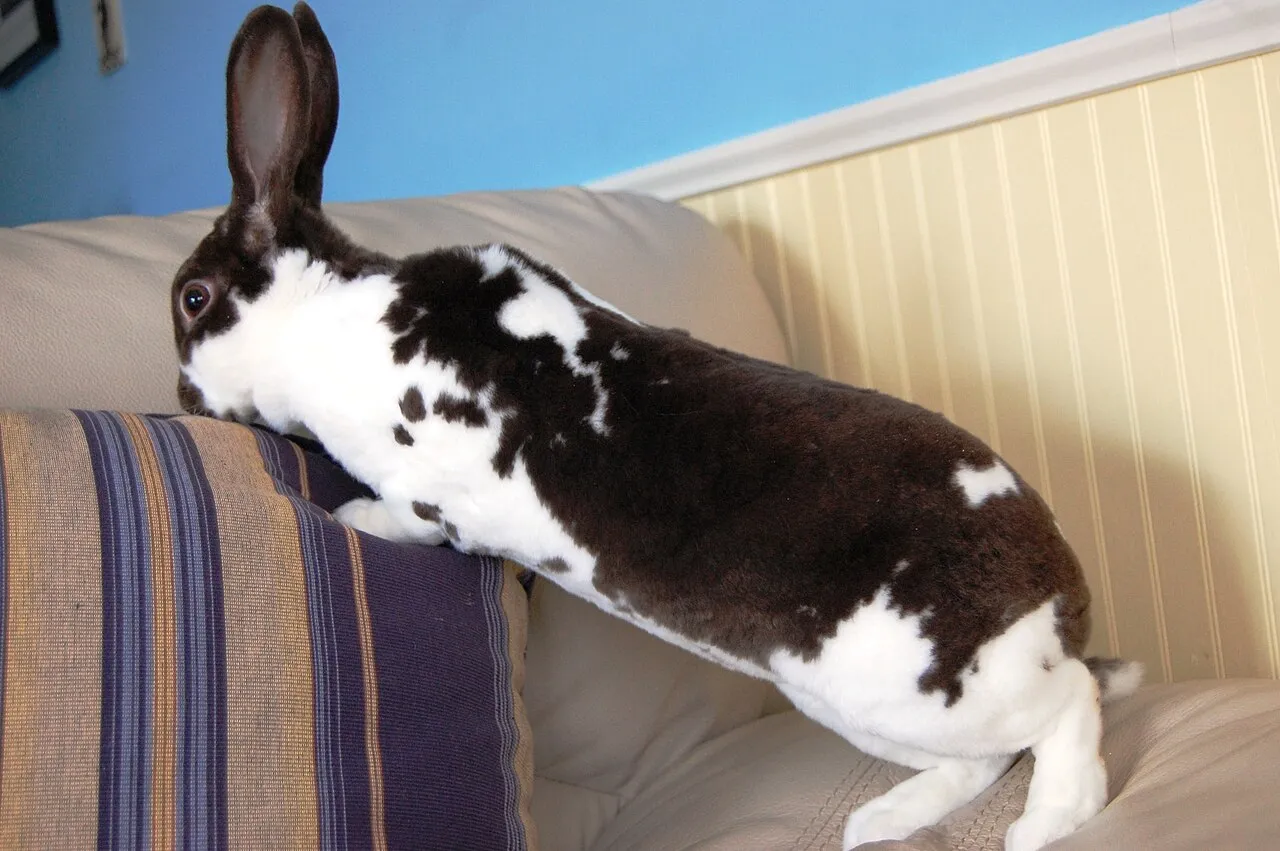
Domestic rabbits range from barely 1 kg for a Netherland Dwarf to 6–10 kg for a Flemish Giant, nearly a tenfold difference within one species. Most small and medium breeds and mixed rabbits weigh 1.5–3 kg.
A rabbit's skeleton is remarkably light for its size, while its hind-leg muscles are very strong. A panicked kick while the back legs are unsupported can be enough to fracture the spine, which is why the hindquarters must always be supported when lifting. Rabbits have no paw pads; thick fur cushions the feet instead, so hard or wire floors easily cause sore hocks.
4.2. Teeth and digestion
Rabbits have 28 teeth, and both incisors and cheek teeth grow throughout life; the incisors are often quoted as growing around 2 mm a week. Only constant chewing of coarse hay wears them correctly. On a diet of soft pellets with too little hay, the molars develop sharp spurs that cut the tongue and cheeks.
Rabbits are hindgut fermenters with an enormous caecum. Microbes there break down fibre and produce caecotrophs, soft, shiny clusters of droppings that the rabbit eats straight from its bottom to absorb vitamins and protein. Rabbits also cannot vomit, so anything that slows the gut can quickly become an emergency.
4.3. Senses and ears
With eyes set high on the sides of the head, a rabbit sees almost all the way around, but there is a blind spot right in front of the nose and under the chin. A hand thrust straight at its face may therefore startle it. The nose twitches constantly, and scent glands under the chin are rubbed on objects in a behaviour called chinning.
The long ears gather sound and also act as radiators, with a dense network of blood vessels that sheds heat. Lop-eared breeds have poorer ventilation in the ear canal and are more prone to wax build-up and ear infections.
4.4. Coat and sexing
Rabbits typically moult two to four times a year, sometimes shedding in clumps. Unlike cats they cannot bring up hairballs, so regular brushing to remove loose fur is genuinely important.
Mature females often develop a dewlap, a fold of skin under the chin, from which they pull fur to line a nest. Males' testicles usually descend at around 10–12 weeks, and before that young rabbits are easily mis-sexed.
5. Breeds
Bodies such as the American Rabbit Breeders Association recognise around 50 breeds. Some of the most commonly kept are summarised below.
| Breed | Adult weight | Coat | Notes |
|---|---|---|---|
| Netherland Dwarf | about 0.9–1.1 kg | Short | Round face, tiny ears, can be skittish |
| Holland Lop | about 1.4–1.8 kg | Short | Small lop, very popular |
| Mini Lop | about 2.5–3 kg | Short | Sturdy and usually laid-back |
| Mini Rex | about 1.5–2 kg | Plush rex | Dense, velvety fur |
| Lionhead | about 1.3–1.7 kg | Mane | Woolly mane needs regular grooming |
| Dutch | about 2–2.5 kg | Short | Classic white blaze and saddle pattern |
| Dwarf Hotot | about 1.3–1.5 kg | Short | White with dark eye rings |
| Jersey Wooly | about 1.3 kg | Wool | Small body, soft long coat |
| English Angora | about 2–3.5 kg | Very long wool | Needs daily grooming |
| English Lop | 4.5 kg+ | Short | Extraordinarily long ears |
| Flemish Giant | 6–10 kg | Short | The giant, needs a lot of space |
In practice many pet rabbits are mixed breeds. Rabbits sold as minis frequently grow past 3 kg, so do not judge adult size from a baby.
The dwarfing gene behind Netherland Dwarfs is a double-edged sword: kits that inherit two copies usually die within days, so breeders plan pairings carefully. The Himalayan pattern, with dark nose, ears, feet and tail on a white body, comes from a temperature-sensitive pigment gene that colours only the cooler extremities.
6. Behaviour
ItsWolfeh · CC BY-SA 3.0
6.1. Life in the wild
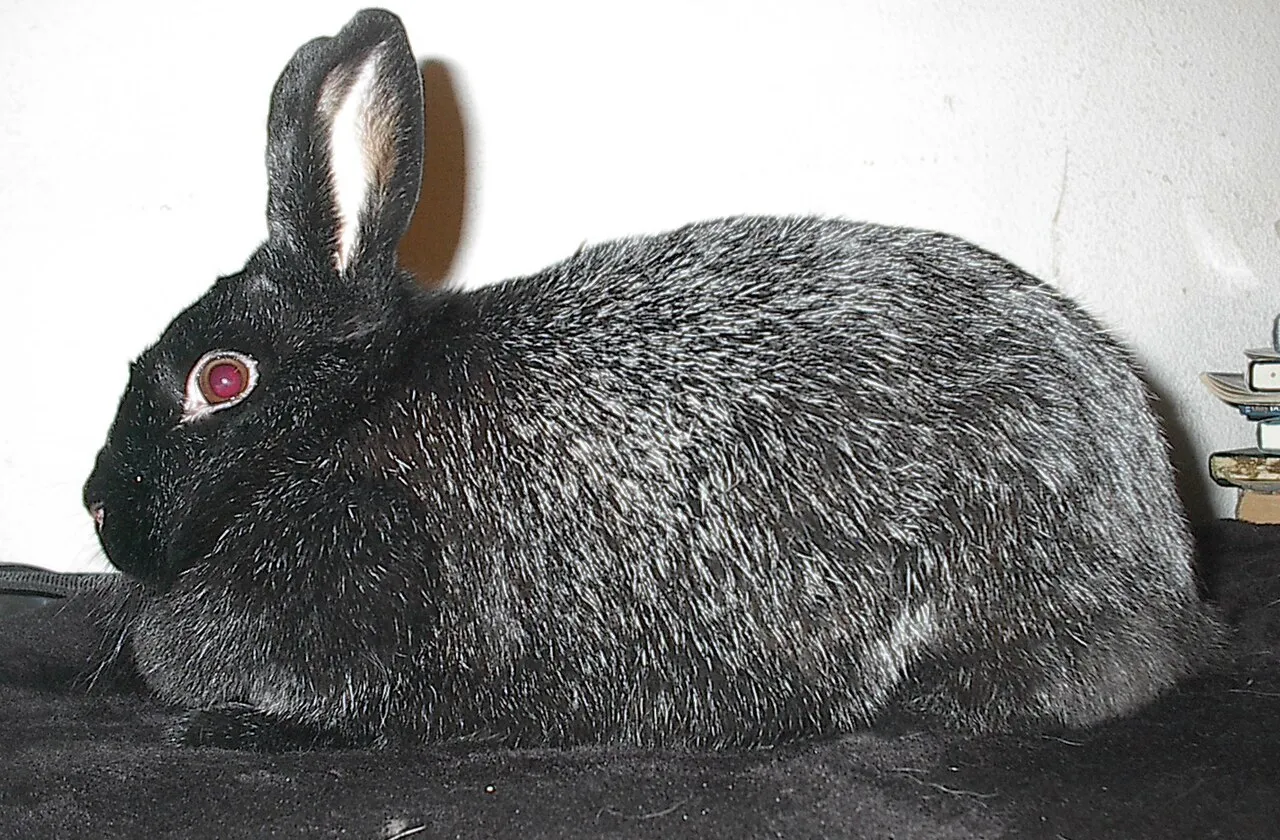
Wild European rabbits dig complex burrow systems called warrens and live in groups ranging from a few individuals to dozens. Groups have a hierarchy in which dominant males and females claim the best burrows and grazing. They are crepuscular, emerging at dawn and dusk to feed and resting underground through much of the day and night.
As prey for foxes, raptors, stoats and many others, they are constantly alert. A rabbit that senses danger thumps the ground with its hind feet to warn the group, then bolts for the nearest burrow.
6.2. Behaviour at home
House rabbits keep the dawn-and-dusk rhythm, stretching out or flopping on their side to doze in the middle of the day. Their digging instinct turns on carpets and bedding, and the urge to wear down their teeth turns on cables, skirting boards and book spines. Scolding does not remove these instincts, so give them legitimate outlets such as dig boxes, cardboard castles, hay and safe wood.
Rabbits are social and can become listless when left alone for long periods. A neutered male and female pair is usually the easiest combination, but unfamiliar rabbits may fight viciously, so bonding should take place gradually on neutral ground over days or weeks.
6.3. Reading the signals
Rabbits rarely vocalise, but their whole body talks.
- Binky: a leap into the air with a twist of the body or head, pure joy.
- Flop: suddenly tipping over onto the side, a sign of deep relaxation.
- Soft tooth purring: gentle grinding while being stroked shows contentment, while loud grinding in a hunched rabbit can signal pain.
- Thumping: a hard stamp of the hind feet signals alarm or displeasure.
- Circling: running around your feet, often with soft honking, is courtship or a demand for attention.
- Head nudging: lowering the head under your hand is a request to be groomed.
- Ears pinned back with a low body: fear or tension.
- Growling and lunging with the front paws: a territorial warning.
- Screaming: only heard in extreme fear or pain, and always worth investigating immediately.
7. Life stages
Growth rates depend on breed size, but a small or medium rabbit typically develops as follows.
| Stage | Age | What happens |
|---|---|---|
| Newborn | 0–10 days | Hairless, eyes and ears closed, fed once or twice a day |
| Eyes open | about 10 days | Fur grows and kits move around the nest |
| Leaving the nest | about 3 weeks | First nibbles of hay and solid food |
| Weaning | 6–8 weeks | Fully weaned, 8 weeks is the earliest sensible rehoming age |
| Adolescence | 4–6 months | Marking, spraying and moodiness, time to discuss neutering |
| Young adult | 6 months–2 years | Energetic and mischievous |
| Adult | 2–6 years | Settled personality and routine |
| Senior | from about 6–7 years | Arthritis, weight changes, more dental trouble |
The average lifespan is eight to twelve years, while giant breeds often live five to eight. Neutering, a hay-based diet and indoor living are all associated with longer lives.
Signs of ageing include lower jumps and reluctance to climb, a messy coat or caecotrophs stuck to the rear because the rabbit can no longer groom properly, and weight loss or, in less active rabbits, weight gain. Give a senior rabbit a low-entry litter tray, non-slip flooring and soft resting spots, and arrange check-ups every six months.
8. Housing
Bcwarner · CC BY-SA 4.0
8.1. Space
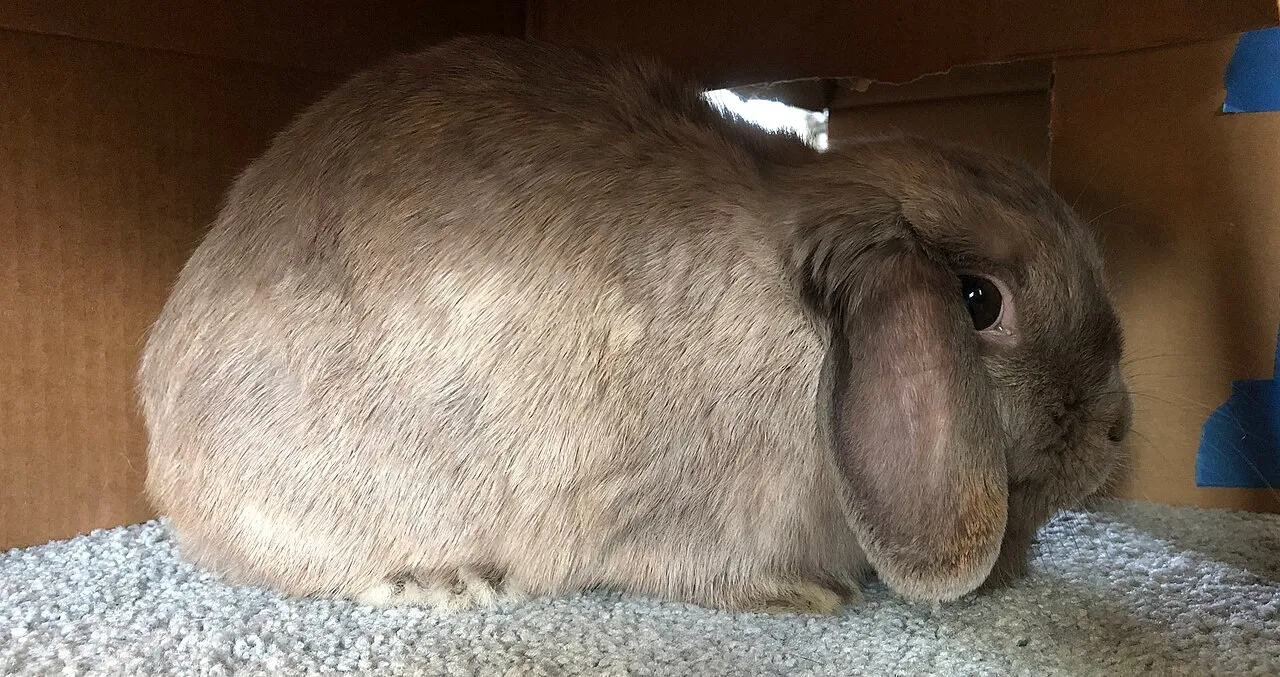
For a rabbit, the cage is less a home than a base camp with a bed and a litter tray. Attach a pen giving at least 2–3 m², and ideally let your rabbit roam a rabbit-proofed room for several hours each day. The UK's Rabbit Welfare Association recommends a permanent living space of around 3 m by 2 m and 1 m high for a pair.
At minimum, your rabbit should be able to stand upright without its ears touching the roof, stretch out fully lying down and take at least three hops in a row. Outdoor housing is still common in some countries but exposes rabbits to heat, cold, predators and insect-borne disease, so it must be secure, sheltered and generously sized.
8.2. Flooring, temperature and rabbit-proofing
Cover floors with non-slip mats or rugs to protect joints and feet, and never leave bare wire underfoot. Rabbits are comfortable at 15–24°C. They cannot sweat, so above about 28°C heatstroke becomes a serious risk; use air conditioning in hot weather and offer a frozen water bottle wrapped in a towel. They tolerate cool weather better than heat but should be kept out of drafts.
Rabbit-proofing is a lot like baby-proofing. Sleeve or hide every cable, move houseplants out of reach, and block gaps under sofas and behind furniture where a rabbit could wedge itself.
8.3. Shopping list
- A large cage or pen with at least 2–3 m² of exercise space
- Non-slip mats or rugs
- A large litter tray with paper pellets (avoid clumping clay and scented litters)
- A hay rack or hay box
- Heavy ceramic food and water bowls (most rabbits drink more from a bowl than a bottle)
- Hides, tunnels and cardboard boxes
- Chews such as apple sticks, untreated wood and woven grass toys
- A slicker brush, a rubber grooming mitt and rabbit nail clippers
- A sturdy carrier
- Cable protectors and baby gates
9. Diet
Hay is the heart of a rabbit's diet. Grass hays such as timothy, orchard grass or meadow hay should make up at least 80% of what your rabbit eats, with a fresh pile about the size of the rabbit offered every day. Long chewing on hay keeps the teeth properly worn and the gut moving.
| Category | Examples | Guide amount |
|---|---|---|
| Grass hay | Timothy, orchard grass, meadow | Unlimited, refreshed daily |
| Pellets | High-fibre rabbit pellets | About 20–25 g per kg of body weight per day for adults |
| Leafy greens | Romaine, bok choy, coriander, parsley, endive, basil | About 80–100 g per kg per day, in variety |
| Treats | Apple without seeds, banana, blueberries, carrot | Thumbnail-sized, no more than two or three times a week |
| Water | Clean, fresh water | Always available, changed daily |
Alfalfa hay is rich in protein and calcium and suits rabbits under six months or underweight seniors, while healthy adults should be on grass hay. Introduce new greens one at a time in small amounts and watch the droppings. Commercial treats containing seeds, grains or yoghurt coatings are bad for the gut.
Never feed onions, garlic or leeks, chocolate, avocado, potatoes or their sprouts, bread, biscuits or cereal, large amounts of iceberg lettuce, or toxic plants such as lilies, azaleas and dieffenbachia. Change foods gradually over one to two weeks, because sudden switches can upset the gut flora.
10. Health and disease
As prey animals, rabbits instinctively hide illness until they are very unwell. Checking appetite and the size and number of droppings every day is the most valuable habit an owner can build. Many general clinics see few rabbits, so register with a rabbit-experienced exotic vet before you need one.
10.1. Common conditions
| Condition | Cause | Main signs | Prevention and response |
|---|---|---|---|
| Gut stasis | Low fibre, stress, pain, dehydration | Reduced appetite, small or no droppings, hunched posture | Hay-based diet, no food for 12 hours is an emergency |
| Dental disease | Too little hay, genetics, injury | Drooling, picky eating, weight loss, runny eyes | Plenty of hay, regular dental checks |
| Uterine disease | Age in unspayed females | Bleeding that looks like bloody urine, swollen belly | Discuss spaying with your vet |
| Encephalitozoonosis | The parasite E. cuniculi | Head tilt, loss of balance, hind-leg weakness | Testing, antiparasitic treatment |
| Snuffles | Pasteurella and other bacteria | Nasal discharge, sneezing, matted front paws | Low-dust hay, good ventilation, early treatment |
| Sore hocks | Hard or wet floors, obesity | Bald, red or ulcerated heels | Soft flooring, weight control |
| Flystrike | Flies laying eggs on a soiled rear | Wounds and maggots around the tail, lethargy | Daily bottom checks in summer, emergency care |
| Bladder sludge and stones | Excess calcium, low water intake, obesity | Thick, chalky urine, pain when urinating | Plenty of water, avoid excess calcium |
| Ear mites | Psoroptes mites | Brown crusts in the ears, head shaking | Diagnosis and medication |
| Rabbit haemorrhagic disease | RHDV viruses | Sudden death, nosebleeds, fever | Hygiene, vaccination where available |
Rabbit urine can naturally be orange or red because of plant pigments, which is easily mistaken for blood. If the colour worries you, a vet can test a sample.
In many countries vets recommend vaccinating against myxomatosis and the RHDV1 and RHDV2 strains of haemorrhagic disease; which vaccines are available and advised depends on where you live. Some antibiotics, including oral penicillins, can destroy a rabbit's gut flora with fatal results, so never give medication prescribed for another animal or a person.
10.2. Neutering
Studies have consistently found that unspayed female rabbits face a high and rising risk of uterine disease, particularly uterine adenocarcinoma, as they age. Estimates vary between studies, but they are high enough that many vets recommend spaying once a doe is mature. Neutering males reduces spraying, marking and aggression and makes bonding far easier.
Rabbit anaesthesia is more delicate than in cats or dogs, so choose a clinic that operates on rabbits routinely and decide on timing together with your vet.
10.3. When to see a vet
- No eating or no droppings for 12 hours or more
- Sitting hunched and still, grinding the teeth loudly
- A bloated, tight belly
- A head tilt, rolling or circling
- Open-mouth breathing or persistent nasal discharge
- Wounds or maggots around the rear (a true emergency)
- Drooling or a wet chin
- Lethargy and hot ears on a warm day
- Inability to use the back legs after a fall
11. Breeding
The phrase breeding like rabbits exists for a reason. Does are induced ovulators with no fixed cycle: mating itself triggers ovulation, so a mature female can conceive almost any time. Small breeds can breed from four to five months and large breeds from six to nine months.
Pregnancy lasts about 31 days (28–33), and litters typically number four to eight. Shortly before giving birth, the doe gathers hay and pulls fur from her chest and dewlap to line a nest. She then nurses only once or twice a day for a few minutes and otherwise stays away, a natural strategy to avoid drawing predators to the nest, so owners should not assume the kits have been abandoned. A doe can also conceive again within hours of giving birth, so a pair left together can produce a litter every month.
False pregnancies, with nest-building that lasts around two to three weeks, are common in unspayed does. Breed only if you can guarantee lifelong homes for every kit. Rescues are already full of rabbits waiting for adoption, and inbreeding or pairing two carriers of the dwarf gene causes real health problems. Selling kits can also bring licensing obligations depending on where you live.
12. Costs
Because rabbits are small, people often assume they are cheap. In reality they eat a lot of hay and live a long time, so costs add up. The figures below are approximate Korean prices.
| Item | Approximate cost (KRW) | Notes |
|---|---|---|
| Rabbit (adoption or purchase) | free to 200,000+ | Varies by breed and source |
| Cage and pen | 100,000–250,000 | A large pen is best |
| Mats and rugs | 30,000–100,000 | Non-slip |
| Litter tray, hay rack, bowls | 30,000–60,000 | |
| Carrier, brushes, nail clippers | 30,000–60,000 | |
| First health check | tens of thousands | Varies by clinic |
| Setup total, excluding neutering | about 300,000–600,000 | |
| Monthly hay | 20,000–50,000 | Cheaper in bulk |
| Monthly pellets and greens | 20,000–40,000 | |
| Monthly litter and supplies | 10,000–20,000 | |
| Monthly total | about 50,000–100,000 |
Neutering commonly costs several hundred thousand won depending on the clinic, the rabbit's sex and pre-operative tests. Dental treatment or hospitalisation for gut stasis can easily run to similar sums, and check-ups become more frequent in old age. Over a life of around ten years, a total in the millions of won is realistic, and pet insurance for rabbits, where available, is worth comparing.
13. Before you get one
Before you commit, work through these questions.
- Can you plan for a companion that may live ten years or more, through moves, new jobs, relationships and children?
- Can you give a rabbit part of a room and keep cables tidied away?
- Will you refill hay, clean the litter tray and supervise several hours of free time every day?
- Does anyone in the household react to hay or rabbit fur? Spending time with rabbits at a rescue first is a good test.
- Is there a rabbit-savvy vet within reach?
- Can you afford neutering and emergency treatment?
A healthy rabbit has bright eyes, a dry nose, a clean bottom, evenly meeting incisors and a coat free of fleas or dandruff. Very young kits have fragile digestion and can develop dangerous diarrhoea after a move, so eight weeks is the minimum age to take one home.
Rabbit rescues have no shortage of adults looking for homes. Adopting an adult lets you see the personality you are getting, and many rescue rabbits are already neutered and sometimes bonded in pairs.
14. Laws and regulations
Pet rabbits are legal almost everywhere, but there are important exceptions. Queensland in Australia prohibits keeping rabbits as pets at all, with heavy penalties, because of the damage feral rabbits have done to the state's agriculture and wildlife; other Australian states permit them under varying conditions. Some countries also regulate how rabbits must be housed, and boarding facilities or international travel may require proof of vaccination.
In South Korea, rabbits are one of the six companion-animal types listed under the Animal Protection Act, so pet shops selling them need a pet business licence, and protections against cruelty and abandonment apply. Owners do not have to register rabbits with the local authority, unlike dogs. Rabbits are also listed as livestock under Korea's livestock law, which matters for farms rather than pet owners.
Abandoning a rabbit is illegal in many jurisdictions and is cruel everywhere: domestic rabbits rarely survive outdoors, and dumped rabbits have become pests in parks and on islands in several countries. Check your national animal welfare authority for current rules.
15. Rabbits in culture
Across East Asia, rabbits are tied to the moon: the markings on its face are traditionally read as a rabbit pounding rice cakes or the elixir of life with a mortar and pestle, and the rabbit stands for longevity and prosperity. In the Korean folk tale of the rabbit and the turtle, a quick-witted rabbit tricked into visiting the Dragon King's undersea palace talks its way out by claiming to have left its liver at home.
Western literature is full of rabbits. Beatrix Potter's The Tale of Peter Rabbit appeared in 1902; Lewis Carroll's anxious White Rabbit leads Alice down the rabbit hole, a phrase that now means any absorbing detour; and Richard Adams's Watership Down (1972) turned a warren's search for a new home into an epic. Bugs Bunny, Dick Bruna's Miffy, Roger Rabbit and Zootopia's Judy Hopps have kept rabbits on screen for decades.
Rabbits also carry symbolic weight as emblems of spring and fertility, from the Easter Bunny to the old belief in a lucky rabbit's foot. Chinese proverbs about the cunning rabbit with three burrows, or the farmer who waited by a tree stump for another rabbit to run into it, are still quoted today.
16. Trivia
- Rabbits are obligate nose-breathers, so breathing through an open mouth is a sign of serious respiratory distress.
- The stage magician's trick of lifting a rabbit by the ears is genuinely harmful, damaging cartilage and blood vessels.
- English Lops can have an ear span, tip to tip, of more than 70 cm.
- Rabbits eat most of their caecotrophs at night or in the early morning, which is why many owners never notice it happening.
- A rabbit can see almost directly behind itself yet cannot see a treat held right under its nose, finding it by smell and whiskers instead.
- A resting rabbit's heart beats roughly 130 to 300 times a minute.
- An offended rabbit will often sit with its back to its owner, a snub familiar to anyone who has trimmed a rabbit's nails.
- Large Flemish Giants can approach a metre in length when stretched out, the size of a small dog.
Health notes are general information. If something seems wrong, contact a vet who treats this species.
FAQ
Can rabbits really be litter-trained?
Yes. Rabbits naturally choose a toilet spot, and placing hay over the litter tray encourages them to use it because they like to eat and toilet at the same time. Neutering cuts down territorial marking and makes training much easier.
Should I bathe my rabbit?
No. Rabbits groom themselves, and a full soak can chill them or send them into shock. Clean a dirty bottom with a damp cloth, and if it keeps happening, ask your vet about diet, weight or dental issues that stop proper grooming.
How can I tell if my rabbit likes me?
Head nudges, licking your hand and flopping over beside you are all signs of trust. Ears pinned flat with a tense, crouched body mean your rabbit is nervous and wants space.
Further reading
- 🗳️ Should house rabbits free-roam instead of living in a cage?
- 🗳️ Should rabbits go on harness walks outdoors?
- 📋 Before You Get a Pet: An Honest Checklist
- 🏠 How to Adopt a Shelter or Rescue Animal
- 🐾 The First Week Home With a New Pet
- ☀️ Keeping Pets Safe in Summer Heat
Photo credits
Photos are freely licensed images from Wikimedia Commons. Authors and licenses are listed below.
- Heimtier 004 2023 08 26.jpg — Friedrich Haag · CC BY-SA 4.0
- Broken Castor Rex Rabbit.JPG — PD-user-en/Mr. Rex · CC BY-SA 4.0
- Broken Mini Rex.JPG — Roberto Reyes Reyes21045 · CC BY-SA 3.0
- Eithel, black Silver Fox doe.jpg — ItsWolfeh · CC BY-SA 3.0
- Holland Lop Enclosure.jpg — Bcwarner · CC BY-SA 4.0