TailVille
At a glance
Rough ranges for supplies, food and electricity in Korea (USD is approximate). Purchase or adoption fees are not included.
Someone who wants an intense one-on-one bond with a small bird and can live with some attitude and noise.
Families whose young kids want a bird to handle often, or anyone hoping for a quiet pet.
1. Overview
Lovebirds are the nine small parrots of the genus Agapornis, native to mainland Africa and Madagascar. The name comes from the way bonded pairs sit pressed together, preening each other for long stretches. At 13 to 17 cm and 40 to 60 grams they are small, but their short, stocky bodies and blunt tails give them a very different outline from the slender budgie.
The peach-faced lovebird, Agapornis roseicollis, is by far the most common pet, followed by the white eye-ringed Fischer's and masked lovebirds. Behind the cute face is a feisty, territorial character that will readily use its beak to defend its cage or its favourite person. The reverse of that coin is intense, persistent affection for whoever earns its trust.
This article covers classification and species, history, anatomy, behaviour, housing, diet, health, breeding, costs, legal status and the lovebird's role in film and idiom. Understanding that each species differs in temperament and legal status is central to keeping lovebirds well.
2. Name and classification
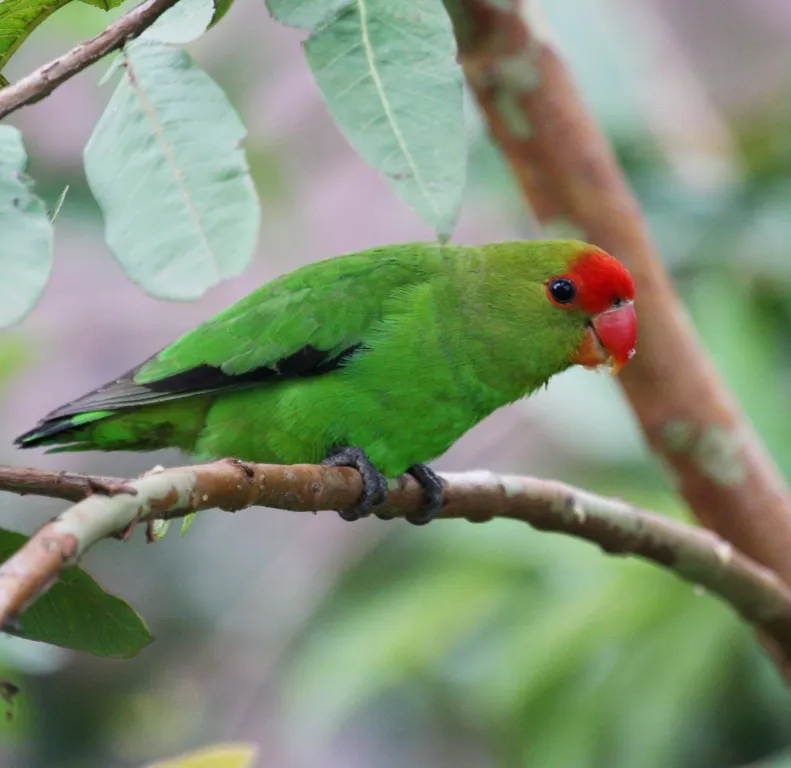
2.1. Scientific name and etymology
Agapornis combines the Greek agape, love, with ornis, bird, so the genus name itself means 'love bird'. The peach-faced lovebird's species name roseicollis is Latin for 'rosy neck', describing the pink that runs from face to throat. Fischer's lovebird, A. fischeri, honours the German explorer-naturalist Gustav Fischer, who worked in East Africa in the nineteenth century, and the masked lovebird's name personatus means 'wearing a mask'.
The Korean name moran-aengmu, 'peony parrot', uses the same characters as the Japanese botan-inko, so it is widely thought to have arrived via Japan; the peony's rich red bloom is taken as a reference to the birds' vivid faces. Korean keepers often just use shortened English names such as 'peach', 'Fischer' and 'mask'.
2.2. The nine species
The genus is usually divided into nine species, often grouped by whether they have a ring of bare white skin around the eye.
| Species | Scientific name | Range | Notes |
|---|---|---|---|
| Peach-faced (rosy-faced) | A. roseicollis | Namibia, SW Angola, NW South Africa | Most common pet; no eye-ring |
| Fischer's | A. fischeri | Northern Tanzania | Orange face, red bill, white eye-ring |
| Masked (yellow-collared) | A. personatus | Tanzania | Black head, yellow collar, white eye-ring |
| Lilian's (Nyasa) | A. lilianae | Malawi, Zambia and neighbours | Like a small, paler Fischer's |
| Black-cheeked | A. nigrigenis | A small area of SW Zambia | Very restricted range; conservation concern |
| Grey-headed (Madagascar) | A. canus | Madagascar | Male has a grey head; among the smallest |
| Red-headed (red-faced) | A. pullarius | West and Central Africa | Tunnels into termite mounds to nest |
| Black-winged (Abyssinian) | A. taranta | Ethiopian highlands | Largest species; male has a red forehead |
| Black-collared | A. swindernianus | Central African forests | Fig specialist, almost never kept |
The grey-headed, red-headed and black-winged lovebirds are sexually dimorphic; the rest look alike in both sexes.
2.3. Relationships
Lovebirds belong to the family Psittaculidae, and genetic studies place them close to the hanging parrots of Asia and the Pacific (genus Loriculus), which famously sleep upside down and share the lovebird's compact build.
The four eye-ringed species, Fischer's, masked, Lilian's and black-cheeked, are so closely related that they hybridise readily in captivity and in some wild areas, and the hybrids are often fertile. Breeders who want to conserve pure species pair only birds of confirmed identity.
3. History
3.1. Into European aviculture
Several Agapornis species were first known to European naturalists from museum skins in the eighteenth and nineteenth centuries, and live birds began arriving in numbers between the late 1800s and early 1900s. The peach-faced lovebird was described in the nineteenth century but only bred widely in the twentieth, while Fischer's and masked lovebirds reportedly flooded into Europe and America around the 1920s.
As African countries restricted bird exports and CITES controls tightened, pet lovebirds became almost entirely captive-bred. The prolific peach-faced lovebird in particular has been bred into dozens of colour combinations around the world.
3.2. Lovebirds in Korea
When lovebirds first reached Korea is unclear, but they have been sold alongside budgies in bird markets for a long time, and their cuddled-up pairs fed into the popular image behind the phrase ingkko bubu, 'lovebird couple'. Where people once bought a pair to admire in the living room, since the 2000s it has become far more common to keep a single hand-fed bird in a one-to-one bond with its owner.
Peach-faced colour mutations, Fischer's and masked lovebirds are all readily available today, and Korean online communities share a great deal of advice on managing their intense attachment, jealousy and biting.
4. Physical characteristics
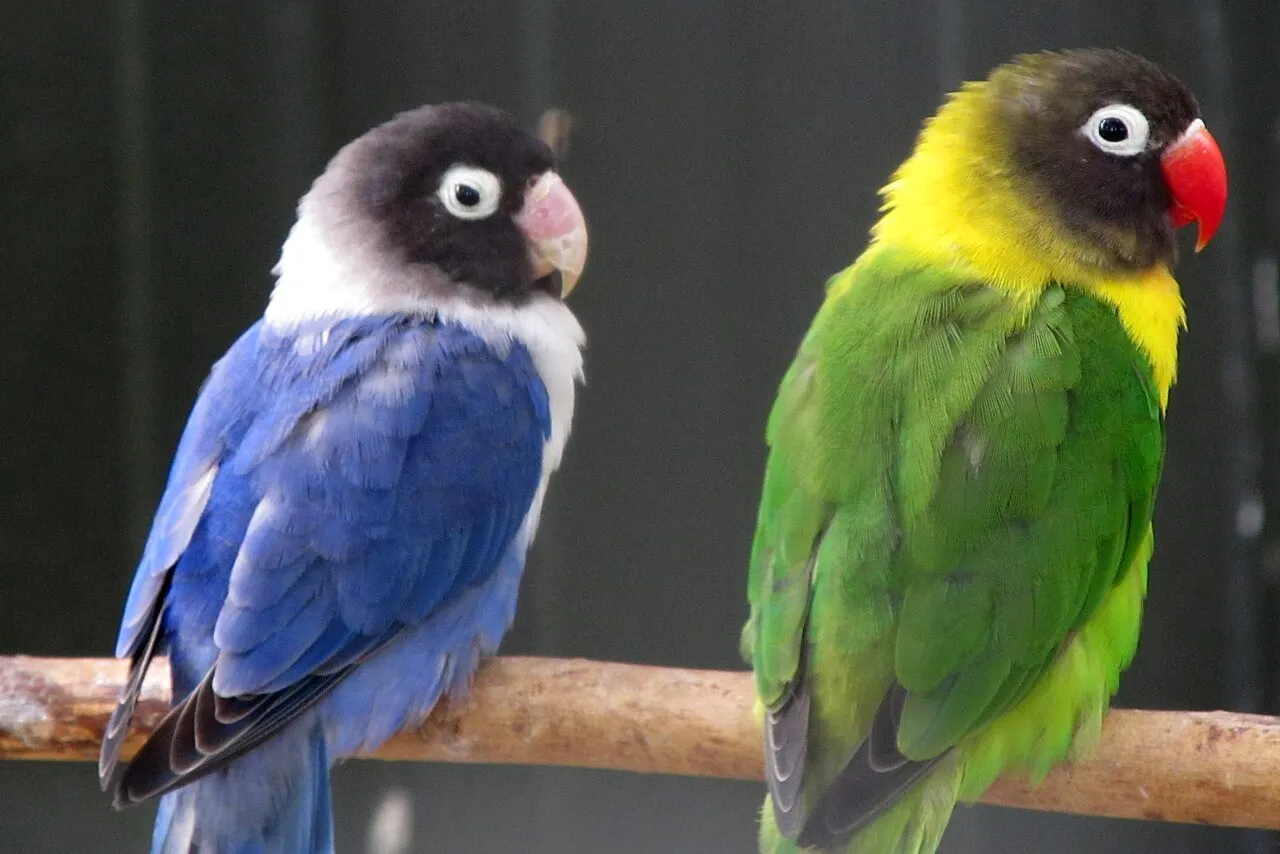
Donar Reiskoffer · CC BY 3.0
4.1. Build
Lovebirds have a large head, a short body and a short, rounded tail, so a perched bird with wings folded looks almost spherical. The bill is big and thick for the bird's size and strong enough to crack hard seeds and strip bark, which is why a lovebird bite can draw blood. Like all parrots they have zygodactyl feet and are expert climbers and hangers.
Peach-faced lovebirds measure about 15 to 17 cm and 45 to 60 grams, while Fischer's and masked lovebirds are slightly smaller at about 14 to 15 cm and 40 to 55 grams. Size varies noticeably between captive lines.
4.2. Colour and markings
Wild-type peach-faced lovebirds are green with a red forehead, a pink face and throat and a bright blue rump; in flight, bands of orange and black flash on the inner tail feathers. Fischer's lovebirds have an orange face shading to olive on the back of the head and a coral-red bill. Masked lovebirds have a black head and a yellow collar, giving the masked look their name describes.
The white eye-ring of the eye-ringed species is bare skin rather than feathers, and it may look dull or swollen when the bird is unwell. Juveniles have dark marks on the upper bill and paler faces, gaining adult colour after their first moult at around four months.
4.3. Sexing
The commonly kept species, peach-faced, Fischer's and masked, look virtually identical in both sexes. Hens are said to be slightly larger, broader at the rump and wider-stanced, with more space between the pelvic bones, but even experienced breeders are often wrong. Cutting and carrying nest material or laying an egg settles the question for a female; before that, a DNA test is effectively the only reliable method. Two hens bonding as a 'pair' and laying infertile eggs is a common surprise.
5. Colour mutations
Peach-faced lovebirds have the widest range of mutations, though Fischer's and masked lovebirds have many too. Here are the names you are most likely to see.
| Mutation | Main species | Appearance |
|---|---|---|
| Normal green | All | Wild colouring |
| Lutino | Peach-faced, Fischer's | Green replaced by yellow; face colour kept; red eyes |
| Dutch blue (aqua) | Peach-faced | Sea-green body, pale apricot face |
| Turquoise | Peach-faced | Turquoise body with a whitish face |
| Blue | Masked, Fischer's | Blue body, white face or collar; often called blue masked |
| Violet | Peach-faced, eye-ringed species | Purplish body tone |
| Pied | Peach-faced and others | Patches of yellow on green |
| Opaline | Peach-faced | Face colour extends over the head |
| Cinnamon | Peach-faced | Brownish flight feathers, soft tones |
| Orange-face | Peach-faced | Orange instead of pink face |
| Creamino and albino | Peach-faced, eye-ringed species | Near-white body, red eyes |
Mutation names vary between countries and societies, so the same bird may be sold under different labels. Hybrids between eye-ringed species are also sometimes sold as pure birds; if species purity matters, choose a breeder who can show you the parents.
6. Behaviour
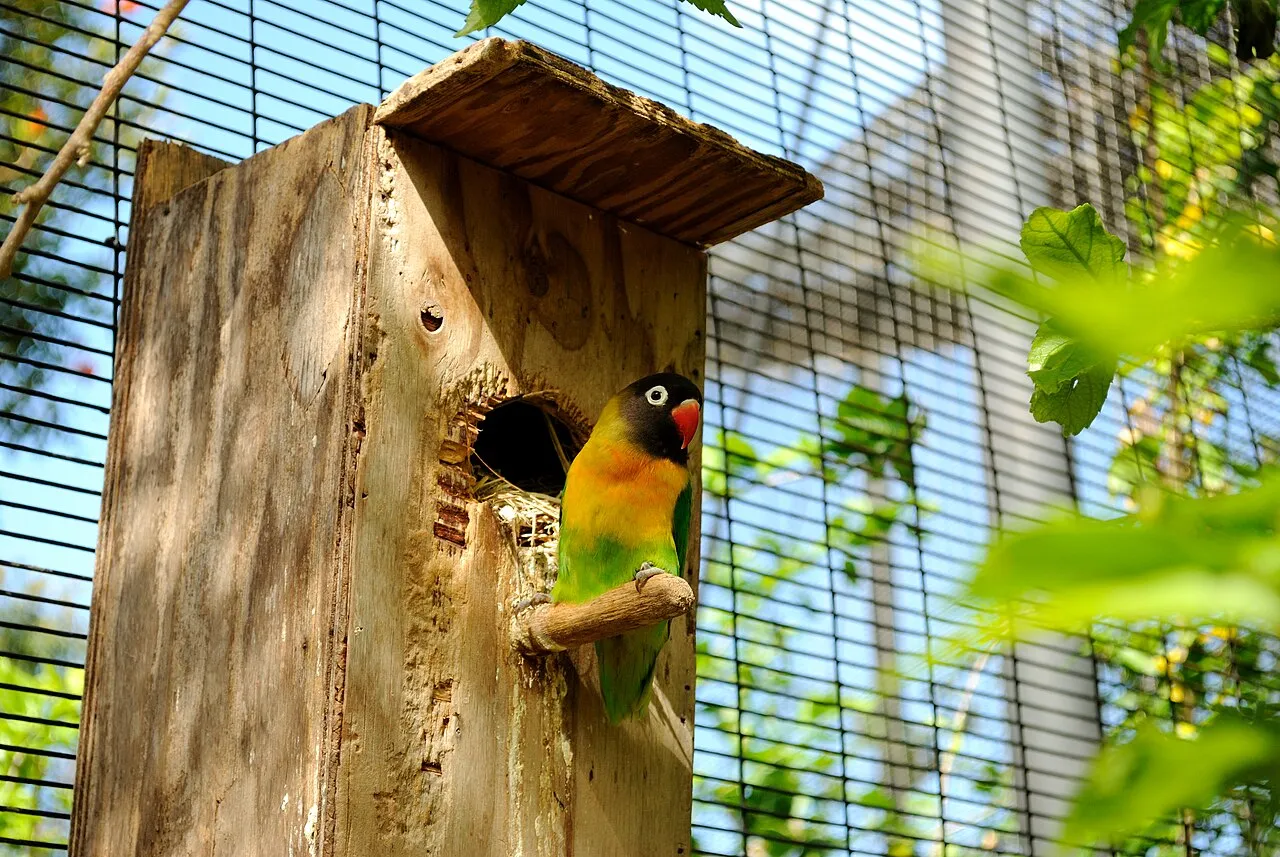
6.1. In the wild
Wild peach-faced lovebirds live in dry, rocky country and savanna in south-western Africa, in flocks of a few dozen that stay close to water. They feed on grass seeds, grain, fruit and buds, drinking several times a day, and at dusk they retreat into rock crevices, nest holes or even the huge communal nests built by sociable weavers.
When nesting, peach-faced hens cut long strips of grass or bark and tuck them into their back and rump feathers to carry home, while eye-ringed species such as Fischer's carry material in the bill. That difference within one genus caught the attention of ethologists, and a classic study examined which method hybrids between the two types would use.
6.2. At home
Pet lovebirds are busy, inquisitive birds that spend the day chewing, hanging and exploring. Paper is a particular passion, and they will happily snip long strips from cage liners, calendars and book corners. A hand-tame single bird loves to burrow into a collar, a hoodie or a cupped hand.
They tend to bond strongly with one person, showering that person with affection while being sharply wary of other family members and visitors. Territorial instincts are strongest inside the cage, so take the bird out before changing food or cleaning to avoid bites. Their short, piercing contact calls are surprisingly loud for the bird's size and can carry to neighbours if repeated when you are out of sight.
Few lovebirds learn words, though some pick up a whistle or household sounds. They are very good at reading routines, however, and many will watch the door when it is time for their person to come home.
6.3. Body language
- Softly fluffed with eyes half closed: relaxed or sleepy.
- Crouched low and advancing with beak open: a territorial warning; withdraw your hand slowly.
- Feathers sleeked down and body stretched tall: frightened or tense.
- Head-bobbing and regurgitating: affection towards a mate or owner, though frequent bouts signal hormones.
- Tail fanned with side-to-side swaying: excitement or display.
- Snipping paper strips and tucking them into the rump: nest-building by a peach-faced hen.
- Beak grinding on one leg: settled and resting.
- Repetitive shrill calling: looking for you, bored or frustrated.
7. Life stages
Lovebirds usually live 10 to 15 years, and some go well beyond that in good conditions. That is long for such a small bird, so think long term.
| Stage | Age | What happens |
|---|---|---|
| Egg | About 22 to 24 days | Incubated mainly by the hen |
| Chick | 0 to 3 weeks | Hatches in red or white down; eyes open around day 10 |
| Nestling | 3 to 6 weeks | Feathers grow in; parents feed it |
| Fledgling | 6 to 8 weeks | Leaves the nest; dark marks on the bill |
| Juvenile | 2 to 4 months | Feeds itself; face colours still pale |
| Adolescent | 4 to 10 months | Adult colours after first moult; nipping and independence increase |
| Adult | 1 to 8 years | Breeding age; personality fully formed |
| Senior | 9 years and up | Slower, longer moults, higher tumour and liver disease risk |
Older lovebirds spend more time fluffed on a perch and lose some of their zest for chewing and play. Nails may grow faster and the skin on the feet thins, so softer perches and lower food bowls help. Gradual weight loss is easy to put down to age but is often a sign of illness, so have it checked.
8. Housing
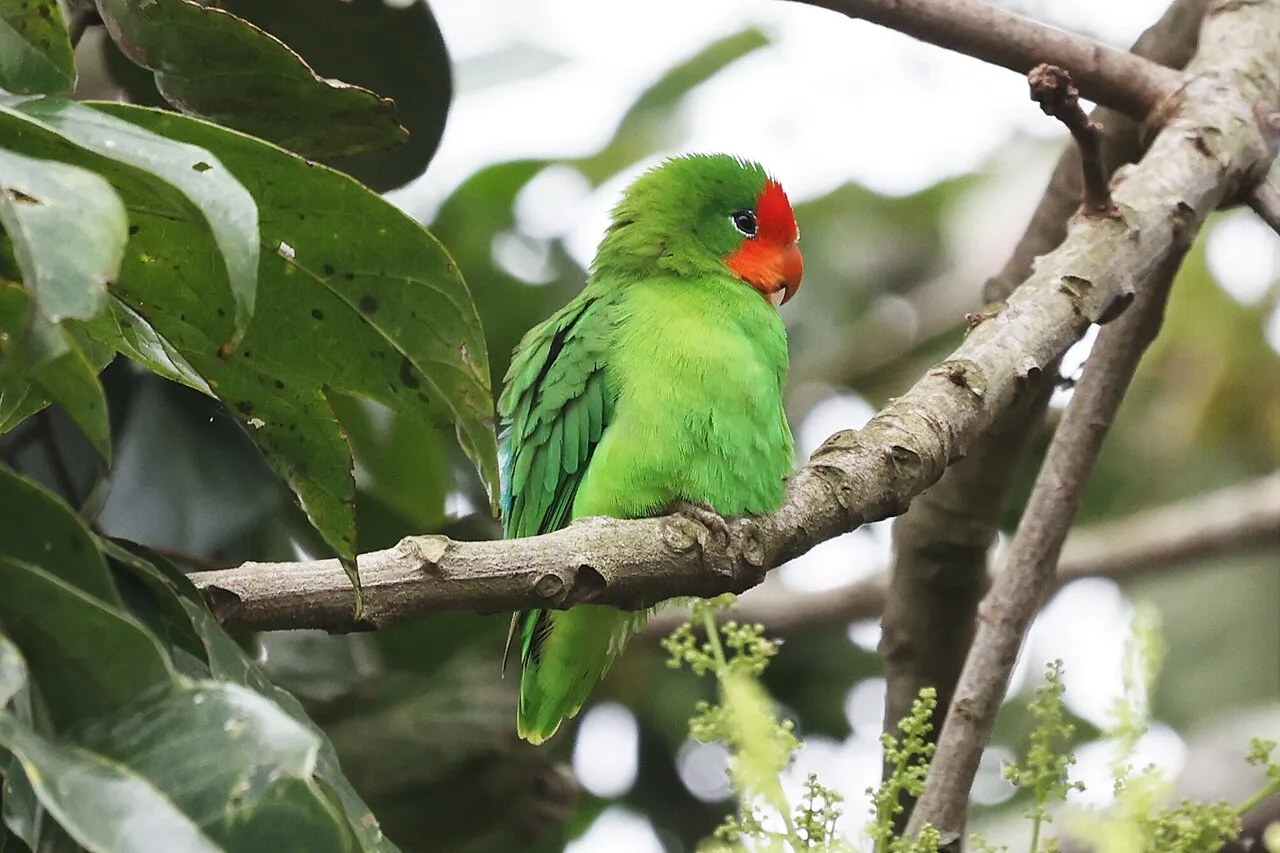
Tommy Andriollo · CC BY 4.0
8.1. Cage and placement
Provide at least 60 by 40 by 50 cm for one bird and 80 cm or more in width for a pair. Lovebirds chew constantly and have powerful beaks, so choose a sturdy cage with a durable finish and avoid galvanised wire. Bar spacing should be 1 to 1.2 cm or less.
If you keep several, the rule is one pair per cage. Mixing unfamiliar lovebirds, or lovebirds with other species, can lead to vicious fights in which toes are bitten off or beaks injured. Place the cage against a wall in a busy room, away from the kitchen, windows and direct air-conditioning.
8.2. Climate and light
Keep lovebirds at 21 to 28°C with humidity around 50 to 60 percent. Coming from warm regions, they dislike cold, so add a heat lamp or panel heater if the room drops below 15°C. In midsummer above 30°C, offer frequent baths and a shaded, cooler spot.
Give 10 to 12 hours of dark, quiet sleep. Wild lovebirds roost in cavities and pets love a hidey-hole, but fabric sleeping huts and nest-style hides can unravel into threads that trap toes or are swallowed, and they also trigger breeding hormones. Unless you plan to breed, a cage cover is a safer way to create darkness.
8.3. Equipment checklist
- A sturdy cage with a non-toxic finish and bars no wider than 1 to 1.2 cm
- Two or three natural-wood perches of different thicknesses, plus a rope perch checked often for fraying
- At least two food and two water bowls
- Small-to-medium parrot pellets and a seed mix
- A cuttlebone or mineral block for calcium
- Shreddable toys in wood, palm leaf, cork and undyed paper
- A shallow bath dish
- A cage cover
- A digital gram scale
- A travel carrier
- A spare cage for quarantining newcomers
- Uncoated paper for the floor
9. Diet
9.1. Staples and portions
A typical recommendation is pellets for at least 60 percent of the diet, with a seed mix and fresh vegetables making up the rest. One bird eats roughly 10 to 15 grams a day, about one to two tablespoons. A seed-only diet is high in fat and low in vitamin A and calcium, leading to obesity, fatty liver and poor feathers.
Birds used to seed often ignore pellets at first. Mix pellets into the seed and change the ratio gradually over several weeks, weighing frequently to make sure the bird isn't losing weight quickly. Lovebirds enjoy crushing their food, so harder pellets and some seeds in the husk double as beak exercise.
9.2. Fresh food and treats
Offer a little fresh veg daily, such as kale, bok choy, broccoli, carrot, squash, bell pepper and celery leaves. Lovebirds prefer shredding to eating from a bowl, so a whole leaf clipped to the bars becomes both food and entertainment. Fruit such as seedless apple, pear, blueberries or pomegranate seeds two or three times a week is plenty.
Hens that are breeding or laying need much more calcium, so keep a cuttlebone available at all times and ask your vet about supplements if needed. Save sunflower seeds, peanuts and millet spray for small training rewards.
9.3. Foods and items to avoid
- Avocado, which is highly toxic to birds
- Chocolate, coffee, tea and anything else containing caffeine or theobromine
- Alcohol and fizzy drinks
- Onion and garlic
- Apple seeds and apricot, peach or cherry stones
- Salted nuts, crisps and processed snacks
- Mouldy seed or peanuts
- Galvanised wire, lead-containing ornaments and old paint flakes
- Scented candles, plug-in fresheners, aerosols and overheated non-stick cookware
Because lovebirds adore paper, avoid giving them heavily inked flyers, glossy coated paper or thermal till receipts. Plain undyed paper or bird-safe paper toys are the way to go.
10. Health and disease
Lovebirds look robust, but they are known to be relatively susceptible to certain viral diseases and behavioural problems. Quarantine any newcomer for 30 to 45 days while it is tested, and have an annual check-up with an avian vet after that. This information is a guide; treatment decisions belong with your vet.
10.1. Common conditions
| Condition | Cause | Main signs | Prevention and response |
|---|---|---|---|
| PBFD (psittacine beak and feather disease) | Circovirus | Deformed or missing feathers, beak changes, weakened immunity | Buy tested birds, quarantine; treatment options are limited |
| Polyomavirus | Virus | Sudden death in chicks, feather abnormalities, bleeding | Testing, hygiene, care when buying young birds |
| Psittacosis (chlamydiosis) | Bacteria | Eye and nasal discharge, green droppings, lethargy | Testing; transmissible to humans |
| Egg binding | Low calcium, excessive laying | Straining, crouching on the floor, tail-bobbing | Calcium, hormone management, emergency care |
| Feather-plucking and self-injury | Stress, boredom, skin disease, hormones | Bare chest or legs, skin wounds | Find the cause, enrich the environment |
| Aspergillosis | Fungus | Breathing difficulty, change in voice | Mould-free food and bedding, ventilation |
| Fight injuries | Mixing birds | Toe and beak wounds, bleeding | Keep pairs separately |
| Splay leg | Nutrition or slippery nest floor in chicks | Legs splayed sideways | Proper nest substrate, early correction |
Feather-plucking and self-mutilation are a particular worry with lovebirds. Causes range from boredom to infections, parasites, nutritional deficiencies and hormones, so rule out medical problems with a vet before relying on behaviour changes alone.
10.2. When to see a vet
- Fluffed up and dozing through the day, or sitting on the floor
- Tail-bobbing, clicking or wheezing while breathing
- Sudden watery droppings or a change to green, black or red
- Not eating for more than a day, or a clear drop in weekly weight
- Abnormal feather loss, or a cracked or misshapen beak
- Plucking or biting at itself to the point of wounds
- A hen with a swollen belly straining for hours without passing an egg
- Bleeding from toes or beak after a fight
If a viral disease is suspected, separate the bird from others immediately and phone the clinic in advance so it can avoid contact with other birds in the waiting room.
11. Breeding
Lovebirds breed fairly readily in captivity, but because the sexes look alike, many 'pairs' turn out to be two birds of the same sex. If you plan to breed, confirm sex with a DNA test, make sure the two birds get along and preen each other, and only then add a nest box. Most keepers wait until birds are 10 to 12 months old and physically mature.
A peach-faced hen builds the nest herself, ferrying material tucked into her rump feathers, and usually lays four to six eggs on alternate days. She does most of the incubating, for about 22 to 24 days, while the male brings her food. Chicks leave the nest at about six weeks and most feed themselves by eight weeks, though they keep begging from their parents for a while. Don't rush the next round; give the pair proper rest.
- Eye-ringed species hybridise easily, so pair only birds of the same species if you care about purity.
- Low humidity in the nest can make hatching difficult, so provide damp twigs for nesting and a bath dish.
- Remove the nest box between rounds and avoid more than two clutches a year.
- If you cannot take responsibility for every chick, don't breed.
If a hen without breeding plans keeps laying infertile eggs, remove hides and nesting material, lengthen the nights and cut back on stroking. If laying persists, consult your vet.
12. Costs
Prices vary by species, mutation, tameness, country and clinic, so treat these as ballpark figures.
| Item | Typical range | Notes |
|---|---|---|
| Bird | 25 to 120 dollars | Hand-tame, rare colours and CITES-listed species can cost more |
| Cage | 60 to 160 dollars | Bigger for a pair |
| Basic equipment | 30 to 60 dollars | Perches, bowls, toys, carrier |
| First vet visit | 40 to 120 dollars | Higher with PBFD, polyomavirus and Chlamydia tests |
| Monthly food | 8 to 20 dollars | Pellets, seed and greens |
| Monthly toys and supplies | 12 to 20 dollars | They destroy toys quickly |
| Annual check-up | 40 to 120 dollars | |
| Emergencies | Several hundred dollars or more | Egg binding, injuries, infectious disease |
Because lovebirds shred toys so fast, consumables are a steady expense. Many owners make their own toys from untreated wood, palm leaf and plain paper.
13. Before you get one
Think through these questions before getting a lovebird.
- Will you keep one bird and act as its partner, or a pair that will focus mainly on each other?
- Can your home cope with short, piercing calls that neighbours may hear?
- If you have young children, can an adult supervise every handling session?
- If you already have birds, do you have space to house the lovebird separately, without mixing?
- Can you commit for 10 to 15 years, and is there an avian vet nearby?
- If the species is on CITES Appendix II, will the seller provide proof of legal origin?
At the seller, check for neat, complete plumage, a smooth beak surface, clean eyes and nostrils and lively behaviour. PBFD and polyomavirus may not be visible, so trust sellers who provide test results or encourage testing after purchase. Weaned hand-fed babies of two to three months are easiest to tame, but expect a phase of increased nipping as they reach adolescence.
14. Laws and regulations
The key legal point with lovebirds is that status depends on species. Nearly all parrots are on CITES Appendix II, but the common peach-faced lovebird, A. roseicollis, is exempt. Fischer's, masked, Lilian's, black-cheeked and the other Agapornis species remain on Appendix II.
- Importing an Appendix II species requires permits from both the exporting and importing countries; in Korea the Ministry of Environment and its regional offices handle this.
- When buying within a country, keep documents showing legal import or captive breeding. Whether you also need to register transfers or premises depends on national law, so check with the relevant wildlife authority.
- Animal welfare laws generally protect birds, so cruelty and abandonment can be prosecuted.
- Bird movements and sales may be restricted during avian-influenza outbreaks.
- Releasing a pet lovebird is abandonment in many places. In some warm regions escaped peach-faced lovebirds have established feral colonies, which is ecologically undesirable as well.
Hybrids and mutations can be hard to identify, so make sure the species named on paperwork matches the bird you receive.
15. Lovebirds in culture
No discussion of lovebirds in film can skip Alfred Hitchcock's 1963 thriller The Birds. A pair of caged lovebirds bought as a gift sets the story in motion, and their peaceful, affectionate presence contrasts sharply with the terrifying flocks that follow.
In English, 'lovebirds' is everyday shorthand for an affectionate couple or newlyweds, and the word has been the title of several romantic comedies and songs. Korean uses ingkko bubu in a similar way, and wedding cards and couples' merchandise often show two little birds pressed together that are clearly modelled on lovebirds.
Their big personality in a tiny body also makes them natural comic sidekicks in animation and webcomics, where they are often portrayed as jealous, possessive pet birds.
16. Trivia
- The popular belief that a lovebird will die of loneliness without its mate has no scientific support, though a bird that loses its partner may eat and play less for a while and deserves close attention.
- Escaped peach-faced lovebirds have established a thriving feral population in and around Phoenix, Arizona, where the dry climate resembles their homeland.
- In a 1960s study of hybrids between peach-faced and Fischer's-type lovebirds, the hybrids tried to tuck nest material into their feathers, mostly failed, and eventually carried it in the beak, a result often cited in discussions of how instinctive behaviour is inherited.
- Red-headed lovebirds dig nest chambers inside active termite mounds, where the stable temperature is thought to help protect eggs and chicks.
- The black-cheeked lovebird has such a small range that it is listed as threatened on the IUCN Red List and is especially sensitive to changes in local water sources.
- Lovebirds have strong beaks for their size and are notorious escape artists that work out how to open cage doors, so many owners add an extra clip.
Health notes are general information. If something seems wrong, contact a vet who treats this species.
FAQ
Do lovebirds need to be kept in pairs?
Despite the myth, a single lovebird won't pine away, but you become its partner and must provide plenty of daily attention.
Can lovebirds talk?
Rarely. They communicate mostly through chirps and shrill calls, so pick a budgie or another species if talking matters to you.
Can I stop my lovebird from biting?
Biting usually comes from territorial guarding or fear. Interact outside the cage, avoid big reactions to nips, and reward calm step-ups with treats; most birds improve with patience.
Further reading
Photo credits
Photos are freely licensed images from Wikimedia Commons. Authors and licenses are listed below.
- Rosy-faced lovebird (Agapornis roseicollis roseicollis).jpg — Charles J. Sharp · CC BY-SA 4.0
- 2009-0803-AgapTara-Ethiopia-BahirDar-016.jpg — Veli Pohjonen · Public domain
- 20110709 Harry Malter (0006).jpg — Donar Reiskoffer · CC BY 3.0
- Agapornis personatus -Honolulu Zoo, Hawaii, USA-8a.jpg — Daniel Ramirez from Oakland, USA · CC BY 2.0
- Agapornis pullarius 243325240.jpg — Tommy Andriollo · CC BY 4.0