TailVille
At a glance
Rough ranges for supplies, food and electricity in Korea (USD is approximate). Purchase or adoption fees are not included.
People who are home a lot, can play with a bird daily and live where loud calls won't be a problem.
Anyone in thin-walled housing, out for long hours, or wanting a quiet pet.
1. Overview
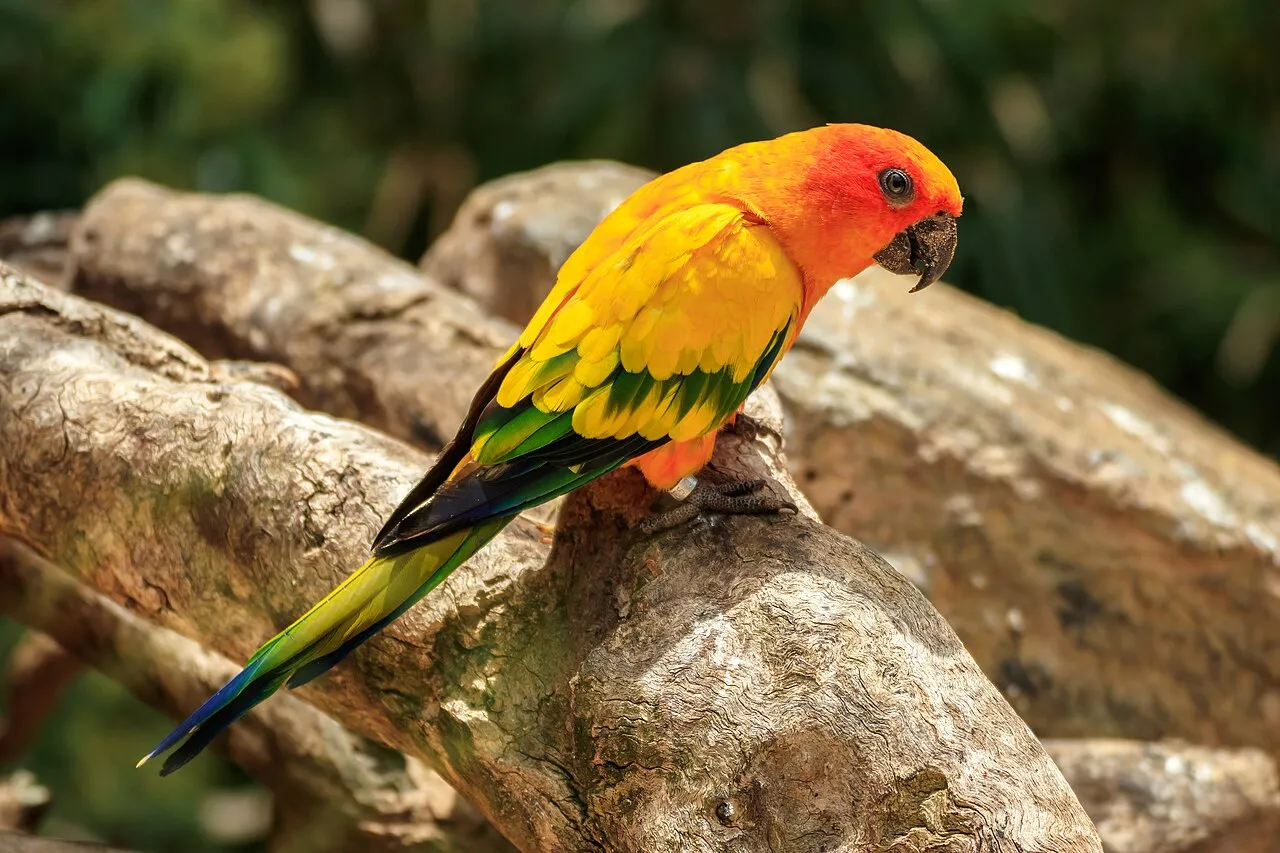
The sun conure is a medium-sized parrot from north-eastern South America whose adults blaze with yellow and orange from head to belly, hence the name. At around 30 cm long and 100–130 g it is no bigger than a cockatiel, yet it has a personality, and a voice, out of all proportion to its size.
Sun conures are famously affectionate and playful, popular with people who want a hands-on parrot. They ride on shoulders, burrow under shirts and duck their heads for scratches, and many owners fall for them instantly. The downside is noise. A sun conure's call is shrill and very loud, which can cause real trouble in apartments and is one of the most common reasons these birds are rehomed by first-time owners.
In the wild the sun conure is an endangered species. Its popularity in the pet trade drove heavy trapping that, together with habitat loss, caused steep declines. This article covers the sun conure's classification and history, appearance and colour development, personality, housing, diet, health, costs and the CITES rules that apply to it.
2. Name and classification
Chris Williamson · CC BY 2.0
2.1. Scientific name and etymology
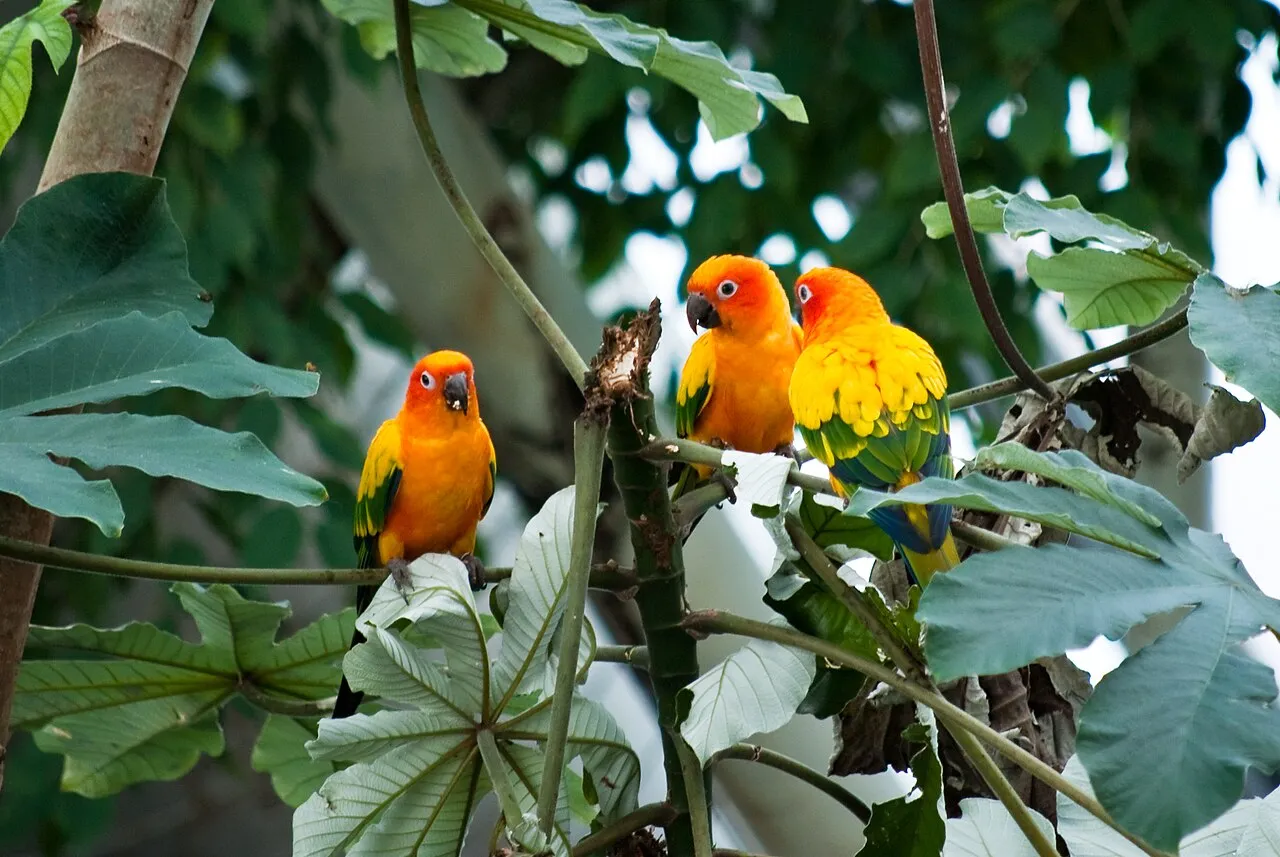
The scientific name is Aratinga solstitialis. Aratinga comes from the Tupi language of Brazil, where it referred to small parrots, and solstitialis is Latin for 'of the summer solstice', a reference to the sun-like plumage. English names include sun conure and sun parakeet.
2.2. What 'conure' means
'Conure' is an aviculture term, not a scientific group: it covers several genera of long-tailed small and medium parrots from Central and South America, including Aratinga and Pyrrhura, home of the popular green-cheeked conure. In Korean the bird is called sseonkonyueo or sometimes taeyang-aengmu, meaning sun parrot.
2.3. Close relatives
Its closest relatives are the jenday conure (Aratinga jandaya), with a yellow-orange head but green back and wings, and the golden-capped conure (Aratinga auricapillus), orange only on the forehead. They hybridise readily in captivity, and some authors treat the three as a species complex. Research in the 2000s also suggested that one population formerly included in the sun conure deserves recognition as a separate species.
3. History
3.1. From the wild to the pet trade
Sun conures inhabit dry savannah and palm-forest edges in Guyana, Suriname, south-eastern Venezuela and northern Brazil. In the late twentieth century their colour and charm created huge demand in North America and Europe, and large numbers of wild birds were trapped for export. Populations fell sharply, and in the late 2000s the IUCN uplisted the species to Endangered. Today the pet trade relies overwhelmingly on captive-bred birds.
3.2. Sun conures in Korea
In Korea sun conures became known through parrot clubs and specialist breeders from the 2000s, then gained broad popularity through parrot cafés and social media in the 2010s. Many people choose one as a step up from budgies and cockatiels, but stories of noise problems in apartments are common. Both domestically bred and imported birds are sold.
4. Physical characteristics
4.1. Size and build
| Measure | Typical range | Notes |
|---|---|---|
| Length | about 30 cm | Including tail |
| Weight | 100–130 g | Individual variation |
| Wing | about 14–16 cm | |
| Tail | Long and pointed | Nearly half the total length |
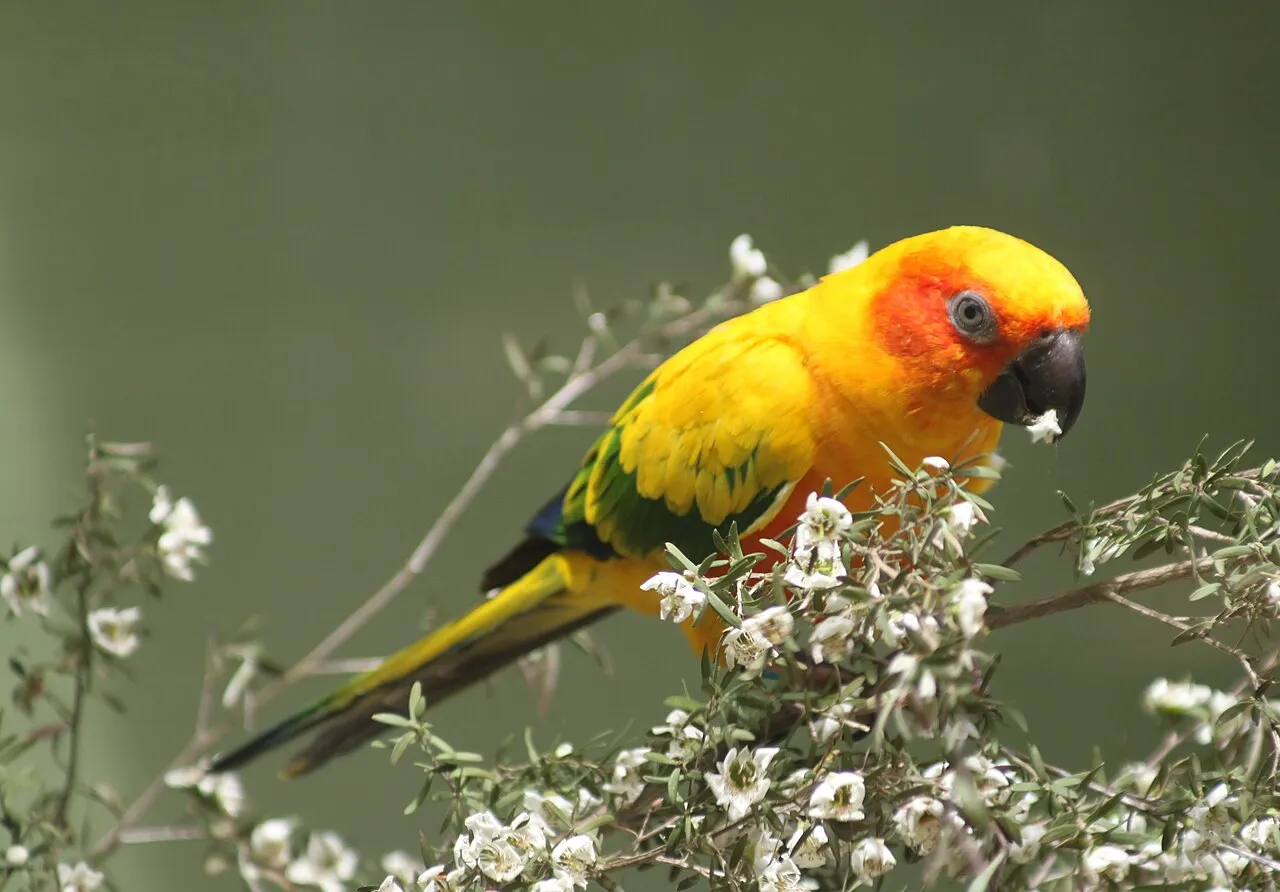
Sun conures are compact and sturdy with a long, tapering tail and a strong black beak. A ring of bare white skin around each eye gives them a wide-eyed look. Like all parrots they have two toes forward and two back, for gripping food and perches.
4.2. Plumage and colour development
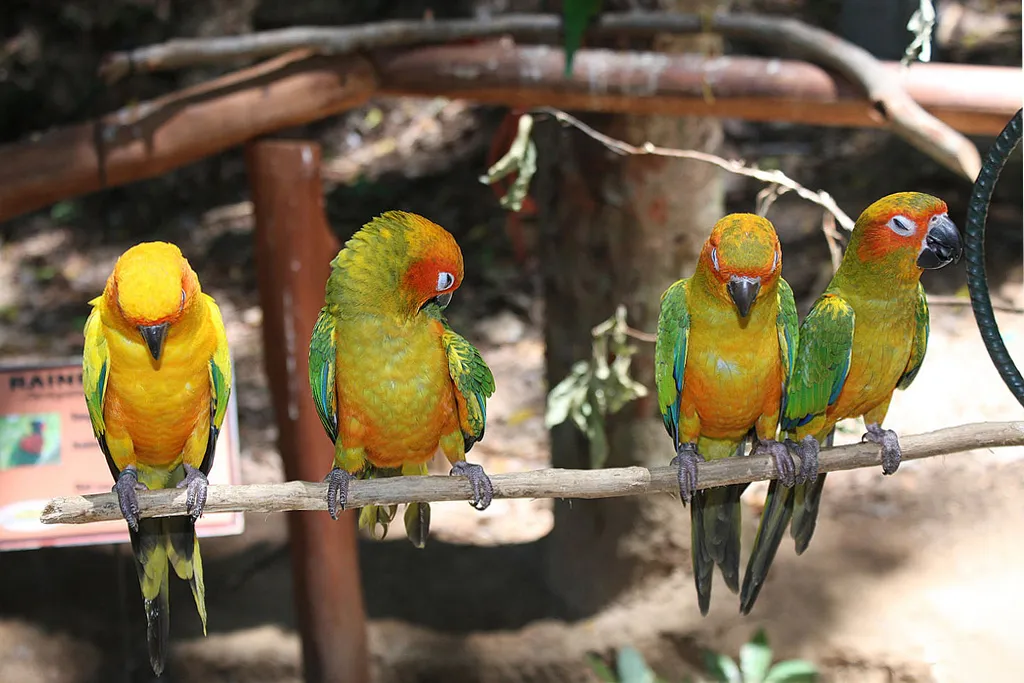
Adults have a bright yellow head, neck and underparts heavily washed with orange on the face and belly. Flight feathers mix green and blue, and the tail is olive green tipped with blue. Juveniles are much greener and paler, barely recognisable as the same bird, and gain adult colour through successive moults over roughly their first year. The intensity of orange varies, and poor nutrition can dull the colours or cause dark, stress-marked feathers.
4.3. Senses
Parrots have excellent eyesight that extends into the ultraviolet, so feathers may look quite different to them than to us. Their hearing is sharp too, and many conures learn to recognise their owner's footsteps or car. A thick, muscular tongue helps manipulate food and husk seeds.
4.4. Sexing
Males and females look virtually identical. Some keepers say males have a slightly larger, flatter head, but this is unreliable. DNA sexing from a feather or blood sample is the accurate method and is inexpensive.
5. Mutations and look-alikes
The sun conure itself has few colour mutations, but several variants and hybrids exist in aviculture.
| Name | Appearance | Notes |
|---|---|---|
| Normal sun conure | Yellow-orange body, green and blue wings | The standard bird |
| Red-factor lines | Especially deep orange-red | Usually from selective breeding |
| Cinnamon, pastel and other mutations | Paler or brown-tinged | Rare and expensive |
| Sunday conure | Sun x jenday hybrid | More green on the wings |
| Jenday conure | Separate species, green back and wings | Sometimes mistaken for a sun |
| Golden-capped conure | Separate species, orange forehead only |
Hybrids are not unhealthy, but they are sometimes sold without being labelled, so ask about the parents. Green-heavy juvenile suns are also easily confused with jendays or hybrids.
6. Behaviour
6.1. In the wild
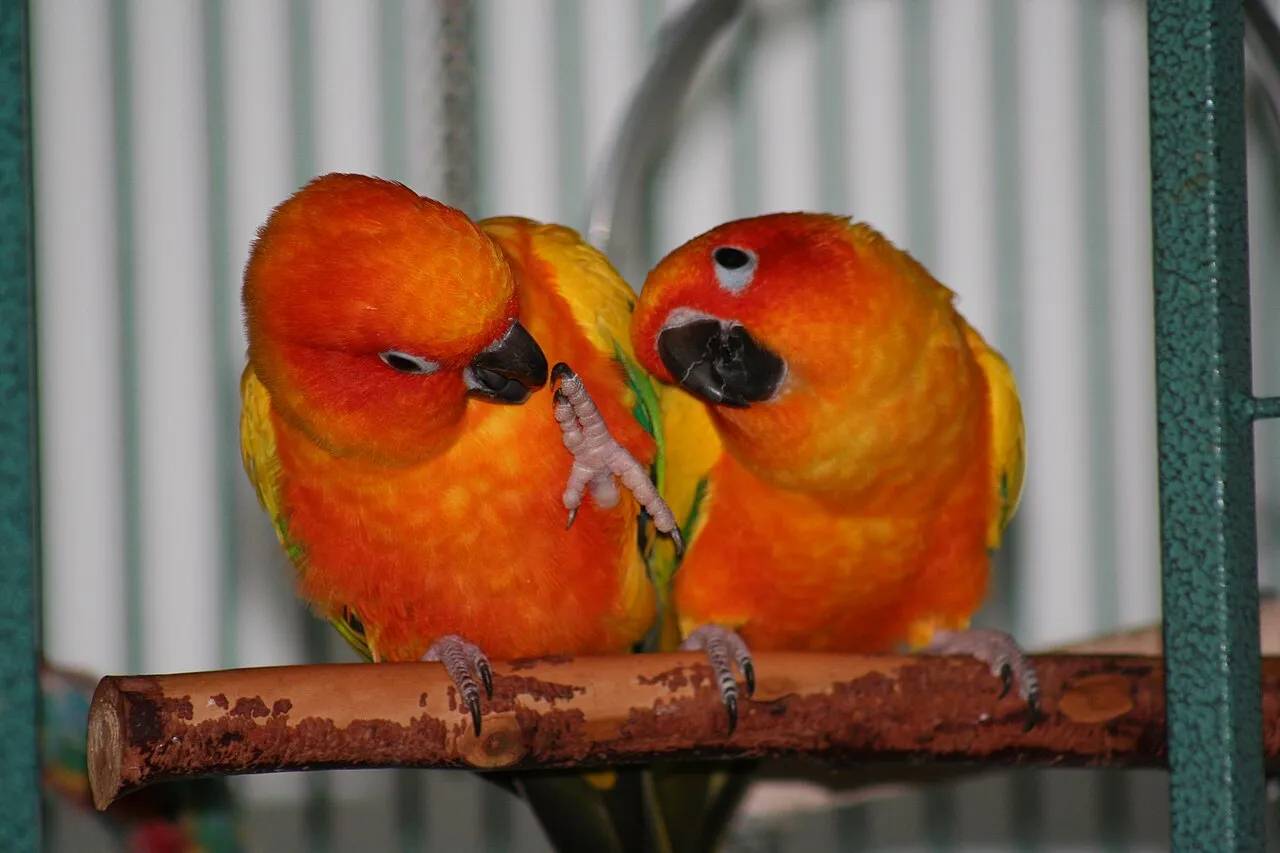
Wild sun conures travel in flocks, often of a few dozen birds, searching for fruit, flowers, seeds and buds. Loud contact calls keep the flock together across open country. They roost communally in tree cavities or palms and nest in hollows during the breeding season. Bonds are strong, with lots of mutual preening and huddling.
6.2. At home, including noise
At home a sun conure sees its person as flockmate or partner and wants company all day. When you leave the room it sends out a loud contact call, an instinctive attempt to locate the flock. Calling usually peaks at dawn and dusk.
Training can reduce the noise but never remove it. Rushing over when the bird screams teaches it that screaming summons you, so reward quiet moments instead and teach a softer contact signal, such as a whistle or a word, that you always answer. If you live in a thin-walled apartment, listen to a sun conure in person before committing.
Sun conures are clowns: they shred toys, hang upside down and even lie on their backs to play. Some learn a few words, usually not very clearly, but many prefer to copy household sounds such as phone ringtones and microwave beeps.
6.3. Reading the signals
- Head bowed with neck feathers fluffed: asking for a head scratch
- Pupils rapidly dilating and contracting (pinning): excitement, interest or an imminent bite
- Tail fanned and body crouched: arousal or territorial defence
- Beak grinding with slightly fluffed feathers: relaxed and sleepy
- Wings slightly raised with bouncing: excited or seeking attention
- Trying to regurgitate food for you: affection, and possibly hormonal behaviour
- Low crouch, open beak and hissing: a warning; a hand will probably be bitten
In hormonal periods conures may fixate on a hand or object and turn nippy. Stroking the back can stimulate breeding behaviour, so keep petting to the head and neck.
7. Life stages
| Stage | Age | What happens |
|---|---|---|
| Hatching | after about 23–27 days of incubation | Naked and fully dependent |
| Fledging | about 7–8 weeks | Leaves the nest and starts flying |
| Weaning | about 8–12 weeks | Eats independently; ready for a new home |
| Juvenile | 3 months to 1 year | Mostly green, colouring up through moults |
| Adolescent | about 1–2 years | Sexual maturity; nipping and hormonal behaviour may increase |
| Adult | from 2 years | Personality settles |
| Senior | from about 15–20 years | Slower, more joint, liver and heart problems |
Captive sun conures typically live 20–30 years, sometimes longer with excellent care. Adolescent nipping and screaming are often a phase, and consistent training helps a bird through it.
8. Housing
8.1. Choosing and placing the cage
A single sun conure needs a cage of at least 60 × 50 cm and 80 cm tall, and bigger is better so it can spread its wings. Bars should be about 1.5–2 cm apart and made of sturdy metal free of zinc or lead. Placing the cage against a wall in the family's main living area gives security; avoid direct sun, air-conditioner draughts and kitchen fumes.
The cage is a bedroom, not a whole world. Your conure needs at least two or three hours a day outside it with you, flying or playing on a stand, in a room checked for open windows, doors, fans and hot pans.
8.2. Temperature, humidity and light
Aim for 20–28°C and roughly 50–60% humidity. In dry winters a humidifier or frequent misting helps skin and feathers. Make sure the bird gets 10–12 hours of dark, quiet sleep, using a cover or a separate sleep cage if needed; sleep-deprived conures become cranky and hormonal. If natural light is limited, consider a full-spectrum bird lamp.
8.3. Equipment checklist
- Sturdy metal cage, at least 60 × 50 × 80 cm
- Three or four natural-wood perches of different diameters
- Destructible toys of wood, paper and palm leaf
- Foraging toys that hide food
- Ropes, swing and ladder
- Several stainless-steel food and water bowls
- Bath dish or mister
- Play stand
- Carrier for vet trips
- Digital gram scale
- Night cover
- Air purifier for feather dust
9. Diet
9.1. Staple diet
The staple should be a pellet formulated for medium parrots, making up roughly 60–70% of the diet, with the rest fresh vegetables, some fruit and a small amount of seed and nuts. Seed-raised birds often don't recognise pellets as food, so convert gradually over weeks, weighing daily to make sure the bird is actually eating.
9.2. Vegetables, fruit and treats
Offer vegetables such as broccoli, carrot, peppers, kale, cooked sweet potato, squash and peas daily. Fruit such as apple without seeds, pear, mango, papaya and berries can be given in smaller amounts than vegetables because of the sugar. Sunflower seeds, almonds and walnuts make excellent training rewards. Remove fresh food within a few hours to prevent bacterial growth.
9.3. Amounts
| Item | Approximate daily amount | Notes |
|---|---|---|
| Pellets | 15–20 g | Adjust for weight and activity |
| Vegetables | 1–2 tablespoons | Variety matters |
| Fruit | about 1 teaspoon | |
| Seeds and nuts | A few pieces | As training rewards |
| Water | Always available | Change once or twice daily |
Weighing at least weekly and keeping a record helps catch overeating or illness early.
9.4. Foods to avoid
- Avocado, which is toxic to birds
- Chocolate, coffee, caffeinated drinks and alcohol
- Onion and garlic
- Apple seeds and cherry, peach or plum pits
- Salty or fatty human food and snacks
- Raw beans
- Xylitol and other artificial sweeteners
10. Health and disease
10.1. Common conditions
| Condition | Cause | Signs | Prevention |
|---|---|---|---|
| Feather plucking | Boredom, loneliness, poor sleep, illness | Patchy feathers, bare skin | Interaction, foraging, sleep routine |
| Psittacine beak and feather disease (PBFD) | Virus | Abnormal or lost feathers, beak deformities | Test and quarantine new birds |
| Psittacosis (chlamydiosis) | Bacteria, can infect people | Nasal discharge, green droppings, lethargy | Testing and hygiene |
| Aspergillosis | Fungus | Breathing difficulty, voice change | Clean food, ventilation |
| Vitamin A deficiency | Seed-based diet | Respiratory infections, mouth lesions | Pellets plus orange and green veg |
| Proventricular dilatation disease (PDD) | Linked to avian bornavirus | Whole seeds in droppings, weight loss | Screening new birds |
| PTFE toxicity | Overheated non-stick cookware | Sudden breathing distress, death | Avoid or never overheat coated pans |
| Egg binding | Low calcium, chronic laying | Fluffed, straining, tail bobbing | Balanced diet, manage hormones |
Birds hide illness instinctively, so by the time signs show a problem is often advanced.
10.2. When to see a vet
- Sitting fluffed up and sleepy for long periods
- Tail bobbing with each breath or open-mouthed breathing
- Sudden change in droppings, or whole seeds passing through
- Wet or blocked nostrils
- Not eating, or losing 5–10% of body weight within a week
- Sitting on the cage floor instead of perching
- Bleeding or beak and nail abnormalities
See an avian vet rather than a general practice, and get a baseline check soon after bringing a new bird home.
11. Breeding
Sun conures generally reach breeding age at around two years and lay clutches of about three to five eggs in a wooden nest box. Incubation takes roughly 23–27 days, chicks fledge at seven to eight weeks and continue to be fed by their parents for several more weeks. Bonded pairs share chick-rearing.
Breeding at home deserves serious thought. Every chick needs a home for twenty years or more, and hand-feeding is skilled, time-consuming work. As a CITES-listed species, captive breeding may also involve paperwork for certificates. If you are not breeding, don't provide a nest box, and reduce hormonal triggers such as back-stroking, dark hidey-holes and very rich food.
12. Costs
Rough 2026 ranges for Korea:
| Item | Estimated cost (KRW) | Notes |
|---|---|---|
| Bird | several hundred thousand to around a million | Hand-tame status, colour and paperwork |
| Cage | 150,000–400,000 | Sturdy metal |
| Perches, toys, bowls | 100,000–200,000 | Toys need constant replacing |
| Play stand and carrier | 50,000–150,000 | |
| First check and DNA sexing | 100,000–300,000 | More with disease screening |
| Start-up total (excluding bird) | about 400,000–900,000 | |
| Monthly pellets and fresh food | 20,000–40,000 | |
| Monthly toys and supplies | 20,000–40,000 | Mostly destructible toys |
| Annual check-up | 100,000–300,000 | |
| Emergency care | hundreds of thousands to millions | Egg binding, toxicity |
Conures destroy toys at a remarkable rate, so budget for a steady supply, or get creative with homemade paper and wood toys.
13. Before you get one
- Hear it first: listen to an adult sun conure in person and be honest about your walls and neighbours.
- Paperwork: as a CITES Appendix II species, it should come with captive-breeding or import documents; keep them.
- Health: clear eyes, clean nostrils, even feathers and a clean vent. Ask for PBFD and psittacosis test results if possible.
- Weaning: first-time owners should choose a fully weaned bird; hand-feeding mistakes can be fatal.
- Time: can you give several hours of interaction every day, and are long trips away rare?
- The long view: plan for 20–30 years, including moves and life changes.
- Vet: confirm there is an avian vet within reach.
- Other pets: cats, dogs and ferrets are serious dangers to birds.
- Consider adoption: many sun conures are rehomed because of noise, and adopting an adult lets you know its personality and volume in advance.
14. Laws and regulations
The sun conure is listed on Appendix II of CITES, the Convention on International Trade in Endangered Species. This is general information; rules change, so check with your national wildlife authority before buying, selling or moving a bird across borders.
- International trade: Appendix II species require an export permit from the country of origin, and many importing countries, including Korea and EU states, require their own import permits.
- Domestic keeping: keep captive-breeding certificates, ring numbers and purchase records that prove legal origin. Some countries also require registration of CITES-listed birds or notification when they are sold, transferred or die.
- Changing rules: several countries, Korea among them, have been tightening controls on the import and sale of wild animal species, which can bring new duties for sellers and keepers.
- Release: never release a pet parrot. It is unlikely to survive, can spread disease and may be illegal.
If you travel or move internationally with your bird, expect CITES paperwork, veterinary certificates and possibly quarantine.
15. Sun conures in culture
With its blazing colours, the sun conure is a favourite image for anything tropical or South American in advertising, photography and illustration. Animated parrots are more often macaws or greys, but many yellow-orange cartoon parrots look strongly sun-conure inspired.
In Korea, parrot YouTube channels and social media accounts made sun conures stars in the 2010s, with viral clips of birds burrowing into hoodies or playing on their backs. Alongside the cute videos came a widely shared piece of advice: search for a sun conure's call before you buy one. They are also a familiar sight greeting visitors in parrot cafés.
16. Trivia
- Juvenile sun conures are so much greener than adults that new owners sometimes wonder if they were sold the wrong species.
- Their calls are often quoted at around 100 decibels at close range, though figures depend heavily on how they are measured.
- Lying on their backs and juggling toys with their feet is a signature conure behaviour.
- A wild flock taking flight has been described as a shower of sparks crossing the sky.
- A sun conure crossed with a jenday is known in English as a Sunday conure.
- Parrots make their reds and yellows from unique pigments called psittacofulvins, found in no other group of birds, and these give the sun conure its glow.
Health notes are general information. If something seems wrong, contact a vet who treats this species.
FAQ
How loud are sun conures?
Among the loudest medium parrots; their shriek can be heard well outside the home. Training can reduce it but never eliminate it.
Can sun conures talk?
Some learn a handful of words or sounds, but they are not strong talkers like African greys or Amazons.
Why is my young conure mostly green?
Juveniles carry a lot of green and gain their full yellow and orange over successive moults in roughly their first year.
Photo credits
Photos are freely licensed images from Wikimedia Commons. Authors and licenses are listed below.
- Aratinga solstitialis -captive-two-8a.jpg — Wayne Deeker · CC BY 3.0
- Aratinga solstitialis -Baltimore Aquarium, USA-8b.jpg — Chris Williamson · CC BY 2.0
- Aratinga solstitialis -Hamilton Zoo -white flowers-8.jpg — Brian Gratwicke · CC BY 2.0
- Aratinga solstitialis -four on a perch in captivity-8a.jpg — Jun Dela Cruz · CC BY 2.0
- Aratinga solstitialis -two pets-6a.jpg — lionpro2006 · CC BY 2.0
- Aratinga solstitialis - Loro Parque 01.jpg — H. Zell · CC BY-SA 3.0