TailVille
At a glance
Rough ranges for supplies, food and electricity in Korea (USD is approximate). Purchase or adoption fees are not included.
Night owls who are home in the evenings and enjoy researching diets, ready to care for a pair for well over a decade.
Early risers with only a bedroom to spare, or families looking for an easy first pet for young children.
1. Overview
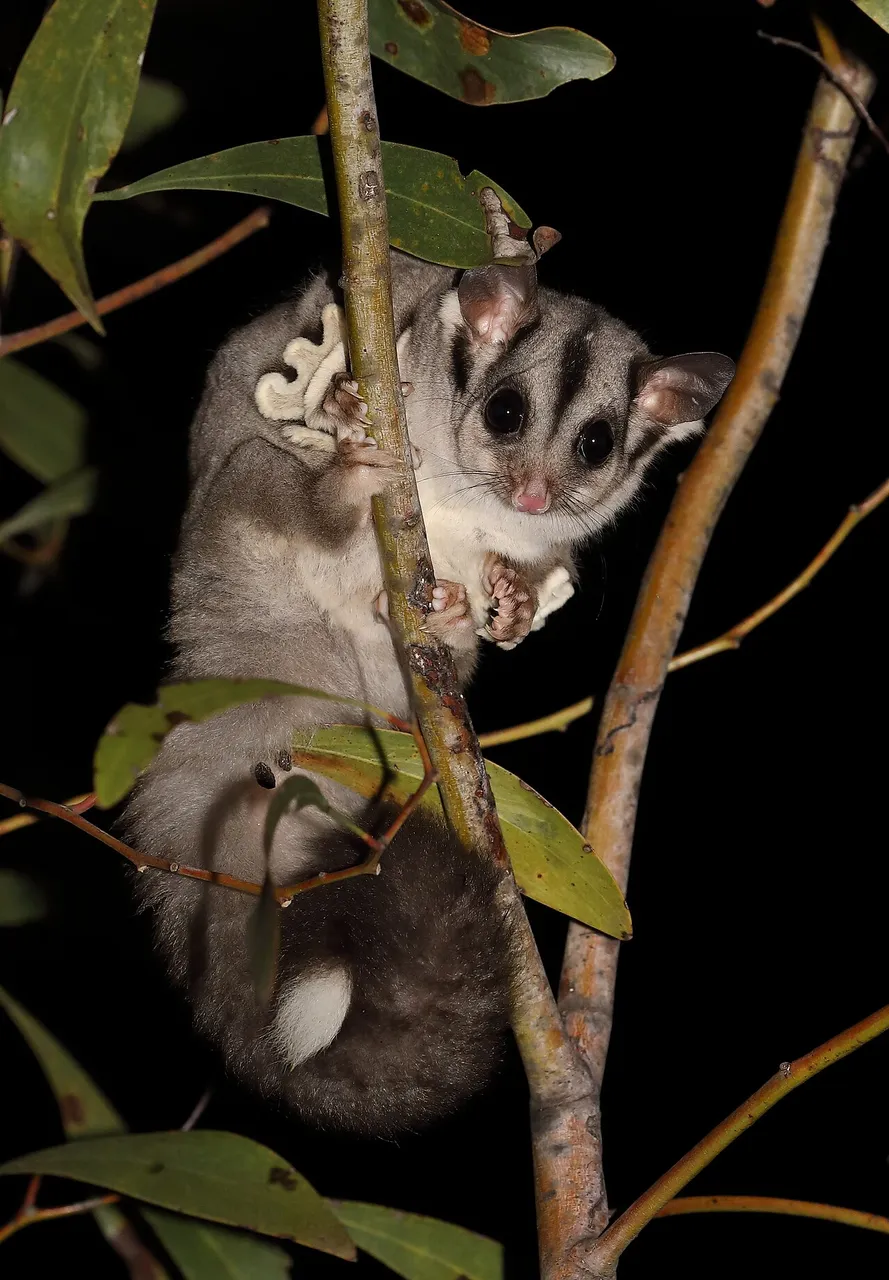
Sugar gliders are small marsupials from the forests of northern and eastern Australia and New Guinea. They look a lot like flying squirrels, but they are on a completely different branch of the mammal tree: like kangaroos and koalas, the females raise their young in a pouch. A thin membrane of skin stretches from each wrist to each ankle, and when they leap it opens like a parachute so they can glide from tree to tree.
The body is 15–20 cm long with a tail just as long again, and adults weigh only about 90–160 g. Big round eyes and a dark stripe down the back are their trademarks. They live in close-knit family groups and bond strongly with their companions, and with people, which is why so many owners carry them around in a bonding pouch or a shirt pocket.
They are not low-maintenance, though. Sugar gliders are nocturnal, so their busy hours are your sleeping hours. Kept alone they often become depressed and may self-harm, so two or more is the norm. Their natural diet of sap, nectar and insects means owners usually prepare food themselves, and they live 10–15 years. This article covers their classification, history, anatomy, colours, behaviour, housing, diet, health, breeding, costs, law and culture.
2. Name and classification
patrickkavanagh · CC BY 2.0
2.1. Taxonomy
Sugar gliders are marsupials in the order Diprotodontia and the family Petauridae. For decades they were treated as one species, Petaurus breviceps, but a 2020 study by Australian researchers using body measurements and genetics proposed splitting them into three.
| Rank | Name |
|---|---|
| Class | Mammalia, infraclass Marsupialia |
| Order | Diprotodontia |
| Family | Petauridae |
| Genus | Petaurus |
| Species under the 2020 proposal | P. breviceps, P. notatus (Krefft's glider), P. ariel (savanna glider) |
| Relatives | Squirrel glider (P. norfolcensis), mahogany glider and others |
Under that scheme the true P. breviceps is restricted to a strip of south-eastern Australia, while Krefft's glider is the most widespread. Pet populations are generally said to trace back to New Guinea or Indonesian stock, so which name strictly applies to them is unsettled. Care sheets and laws still use Petaurus breviceps by convention.
2.2. Name
The name is simple: sugar for its love of sweet sap and nectar, glider for the way it travels. The genus Petaurus comes from a Greek word for an acrobat or rope-dancer, and breviceps is Latin for short-headed. Korean owners use the English name and often shorten it to an affectionate nickname. Despite the resemblance, sugar gliders are not related to true flying squirrels, which are placental rodents.
2.3. Convergent evolution
Sugar gliders and northern flying squirrels last shared an ancestor well over a hundred million years ago, yet both evolved gliding membranes, huge eyes and a nocturnal lifestyle. Biology textbooks often use the pair as a classic example of convergent evolution: unrelated animals arriving at the same solution to the same problem.
3. History
Aboriginal Australians have known sugar gliders for millennia, and European naturalists described them in the late eighteenth century. Australia strictly bans the export of its native wildlife, so the global pet population is generally said to descend from Indonesian and New Guinean animals, with serious captive breeding in the United States taking off around the 1990s. Popularity soared there, fuelled partly by mall kiosks and travelling sellers, and impulse buying led to many gliders being kept without much understanding of their diet or social needs.
In Korea, sugar gliders became known from the late 2000s through exotic pet shops and online communities. Their tiny size and pocket-friendly image made them fashionable, but plenty of new owners struggled with the nocturnal schedule, the male's musky scent and the complicated diet, and rehoming was common. Today keeper communities treat a tested diet, group housing and a tall, roomy cage as the baseline.
4. Body
Greg Tasney · CC BY-SA 4.0
4.1. Size and the gliding membrane
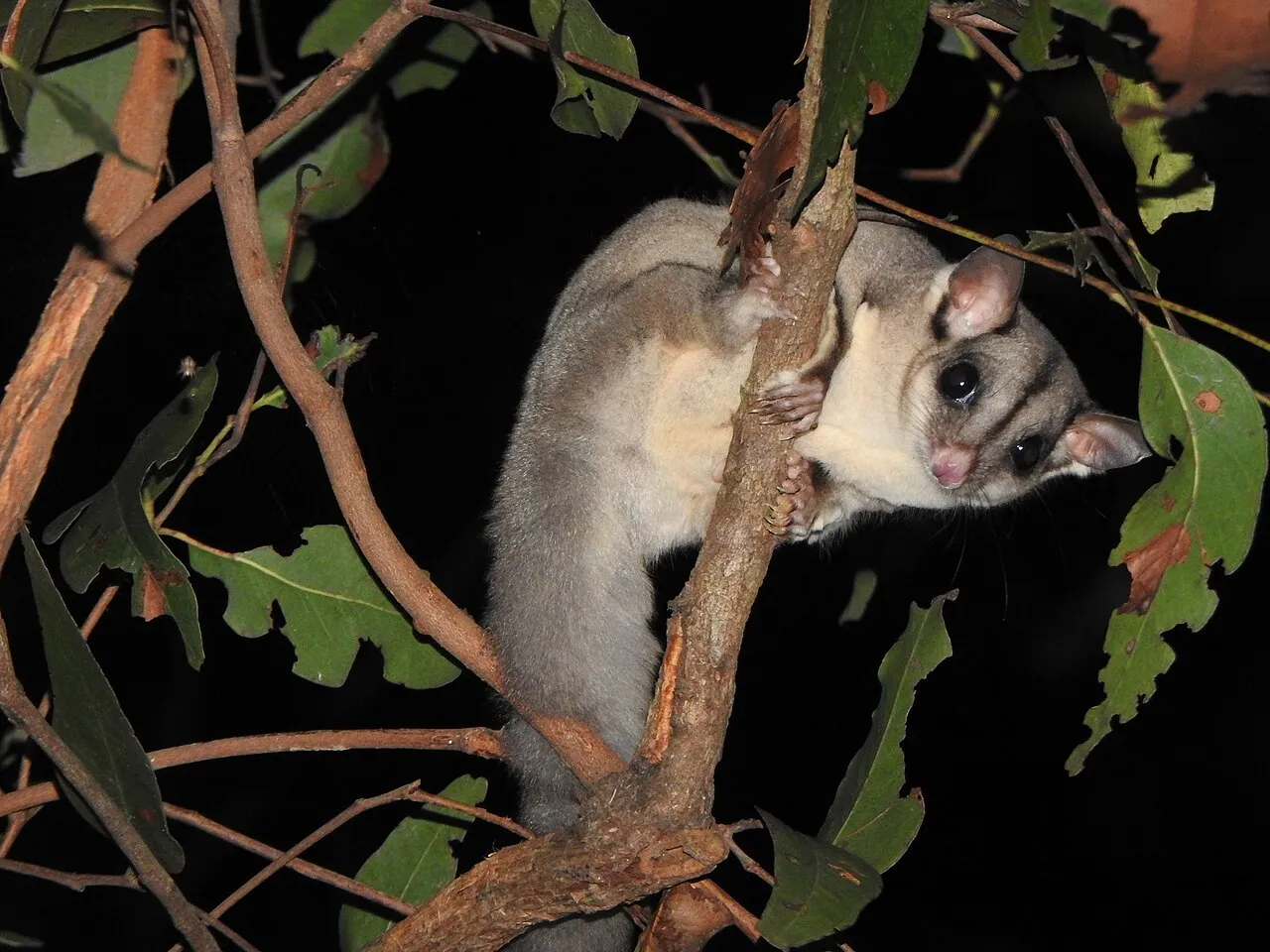
Adults are 15–20 cm long with a tail of roughly the same length, and weigh 90–160 g, males usually a little more. The gliding membrane, or patagium, runs from the fifth finger of each forefoot to the first toe of each hind foot. At rest it folds along the flanks like a ruffle; when the limbs stretch out it becomes a wide wing. Wild gliders can cover around 50 m in a single glide, steering with the tail.
The second and third toes of the hind foot are fused into a grooming comb, and the big toe is opposable for gripping branches. The tail is only weakly prehensile, but it can curl around a bundle of leaves to carry nesting material.
4.2. Senses and teeth
The large, bulging eyes gather as much light as possible in the dark canopy, and the thin, mobile ears pinpoint faint sounds. Smell is the main language of a sugar glider: group members and territory are all recognised by scent.
Two long lower incisors jut forward and are used to gouge bark so that sap and gum flow. Unlike rodent teeth, glider teeth do not grow continuously, so there is no need for chew blocks, but tartar and gum disease are a concern.
4.3. Scent glands and sexing
Mature males develop a bald, diamond-shaped scent gland on the forehead, plus glands on the chest and near the genitals. They rub this scent onto group mates and territory to mark everyone as family, which is why intact males smell distinctly musky. The penis is forked at the tip, and the scrotum sits on the belly, often looking like a small furry pompom.
Females are easy to identify by the pouch in the middle of the belly. It usually holds four teats and looks like a small vertical slit when empty.
5. Colours
The wild type is the classic or standard grey: grey fur, a black dorsal stripe and eye markings, and a cream belly. Captive breeding has produced many variants, and the genetics behind some of them are still debated, so sellers do not always describe them the same way.
| Colour | Appearance |
|---|---|
| Classic grey | Grey fur, black stripe and facial markings, wild type |
| Black beauty | Very dark stripe and markings, darker body |
| White face | Facial markings reduced or white |
| Platinum | Pale silvery body with a faint stripe |
| Leucistic | All white with black eyes, reduced pigment |
| Creme ino | Cream body, light brown markings, red eyes |
| Albino | No pigment at all, red eyes |
| Mosaic | Irregular white patches |
Rare colours fetch higher prices, but there is no known link between colour and temperament. Red-eyed gliders may be sensitive to bright light. Ask about lineage first: a breeder who tracks family trees and avoids repeated inbreeding is a better guarantee of health than any colour.
6. Behaviour
george_vaughan · CC0
6.1. In the wild
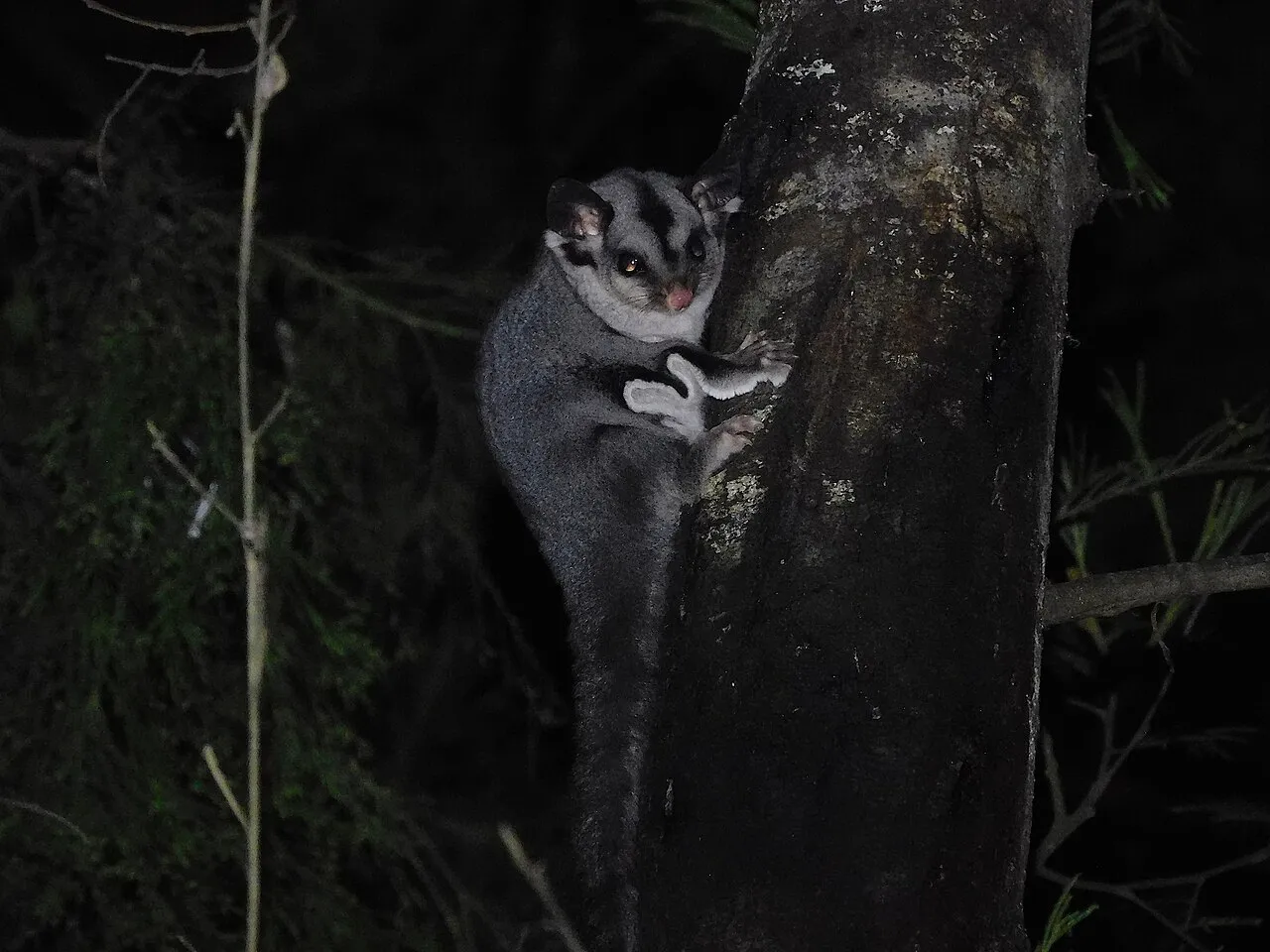
Wild sugar gliders live in eucalyptus and acacia woodland in groups of around seven. By day they curl up together in a tree hollow lined with leaves; at dusk they set out across the canopy to feed. In spring and summer insects and spiders supply protein, and in winter they rely on acacia gum, eucalyptus sap, nectar and honeydew.
When food is short or nights are cold they can drop into torpor for several hours, lowering body temperature to save energy. Within the group a dominant male scent-marks the others, and mutual grooming keeps the bonds strong.
6.2. At home
At home gliders spend the day piled together in a sleeping pouch. At night they race around the cage, spin on the wheel, rummage through foraging toys and may launch themselves from a high perch onto your shoulder or the curtains. With cage mates they groom and sleep together, which is a big part of feeling secure.
A bond with people is built through a process owners call bonding. Common methods include carrying a sleeping glider in a bonding pouch during the day and tucking a worn T-shirt into the nest so your scent becomes part of the group's smell. It can take weeks or months, and dragging a glider out to be handled usually sets things back.
The behaviour to watch for is self-mutilation and overgrooming. Loneliness, a cramped cage, constant daytime disturbance or a poor diet can lead to persistent licking and biting at the tail, legs or genitals. Treat it as an urgent problem: find the cause and see a vet.
6.3. Sounds and signals
- Crabbing: a crackly, buzzing alarm call meaning frightened or annoyed. Gliders also crab when woken suddenly.
- Barking: a repetitive yap, used to call companions or demand attention.
- Hissing or sneezing sounds: short noises while investigating a scent or a stranger.
- Soft chirping or humming: contentment.
- Calm approach and sniffing: curiosity, defences down.
- Licking you or marking you with a little urine: part of making you smell like family.
Pushing your hand closer to a crabbing glider invites a bite. Wait for the noise to stop, or offer a piece of fabric that smells of you first; that often settles them quickly.
7. Life stages
Because they are marsupials, sugar glider young are born tiny and unfinished and do most of their early growing inside the pouch.
| Stage | Timing | What happens |
|---|---|---|
| Birth | About 15–17 days after mating | Rice-grain-sized joey crawls into the pouch and latches onto a teat |
| In the pouch | About 70 days | Grows inside; the pouch bulges visibly near the end |
| Out of pouch | Around day 70–74 | Emerges furred but with eyes closed, stays in the nest with the parents |
| Eyes open and weaning | About 2–6 weeks after leaving the pouch | Starts on solid food |
| Independence | About 8–12 weeks out of pouch | Ready for a new home |
| Sexual maturity | Roughly 8–12 months, varies widely | Male forehead gland develops |
| Adult | 1–8 years | Stable weight and personality |
| Senior | Roughly 8–10 years on | Less active, cataracts, weight loss, dental trouble |
Captive lifespan is usually 10–15 years. Older gliders glide shorter distances and may fall, so reduce height differences in the cage and put soft padding on the floor. Gradual weight loss or cloudy eyes call for a vet check and a look at the diet.
8. Housing
Inconnu(e) · CC0
8.1. The cage
Height matters more than floor space. For a pair, the usual minimum is 60 × 60 cm of floor and 90 cm of height, and many owners use tall bird flight cages of 150 cm or more. Bar spacing must be 1.3 cm or less so heads cannot get stuck and gliders cannot squeeze out. Horizontal bars make climbing easy, and powder-coated metal resists rust. Avoid galvanised mesh, which has been linked to zinc toxicity when chewed.
Fill the space with branches at different heights, ropes and ladders, and hang at least one sleeping pouch near the top. A tray with paper bedding is easy to clean. Gliders fling food and urinate wherever they please, so a splash guard or washable cover around the cage saves a lot of scrubbing.
8.2. Temperature, humidity and light
Keep the room at 24–27 °C with 40–60% humidity. Below about 20 °C gliders become sluggish, and an animal that cannot hold its body temperature is in danger. In cold winters most owners heat the whole room and add a small thermostat-controlled heater near the sleeping pouch. Heat above about 32 °C is stressful too, so avoid direct sun and use cooling in summer.
As nocturnal animals they need a quiet, dim daytime, but they still need a clear day-night cycle. Many owners watch them at night under a red or very dim light. Place the cage in a calm corner rather than a hallway or next to the television.
8.3. Equipment
- Tall wire cage with bar spacing of 1.3 cm or less
- At least two sleeping pouches, so one can be washed
- Wheel: 28 cm or larger, solid track, no central axle, made for gliders. Wheels with X-shaped supports or wire tracks injure tails and membranes.
- Branches, ropes, ladders and swings
- Food dishes mounted high; many gliders are uneasy eating on the floor
- Water bottle plus a small dish
- Foraging toys and puzzle feeders
- Bonding pouch, carrier, thermo-hygrometer and a 1 g scale
Plan for accidents too. Before free-roaming time, switch off fans, shut windows, close toilet lids, and remove cups of water, pots and anything hot. Drowning in uncovered containers is a recognised cause of death in pet gliders.
9. Diet
9.1. Principles
Diet is the hardest and most important part of glider care. In the wild they mix sugary sap, gum and nectar with insect protein in proportions that change with the seasons, and the general view among experienced keepers is that no single commercial pellet reproduces that on its own. Long-term imbalance commonly leads to metabolic bone disease from calcium deficiency.
Most keepers therefore build on long-established recipes such as BML (Bourbon's Modified Leadbeater's) or HPW (High Protein Wombaroo), adding insects, fruit and vegetables. The key is to follow the recipe exactly; dropping or swapping ingredients can wreck the calcium-to-phosphorus balance, which should sit at roughly 2:1 across the whole diet.
9.2. Portions and timing
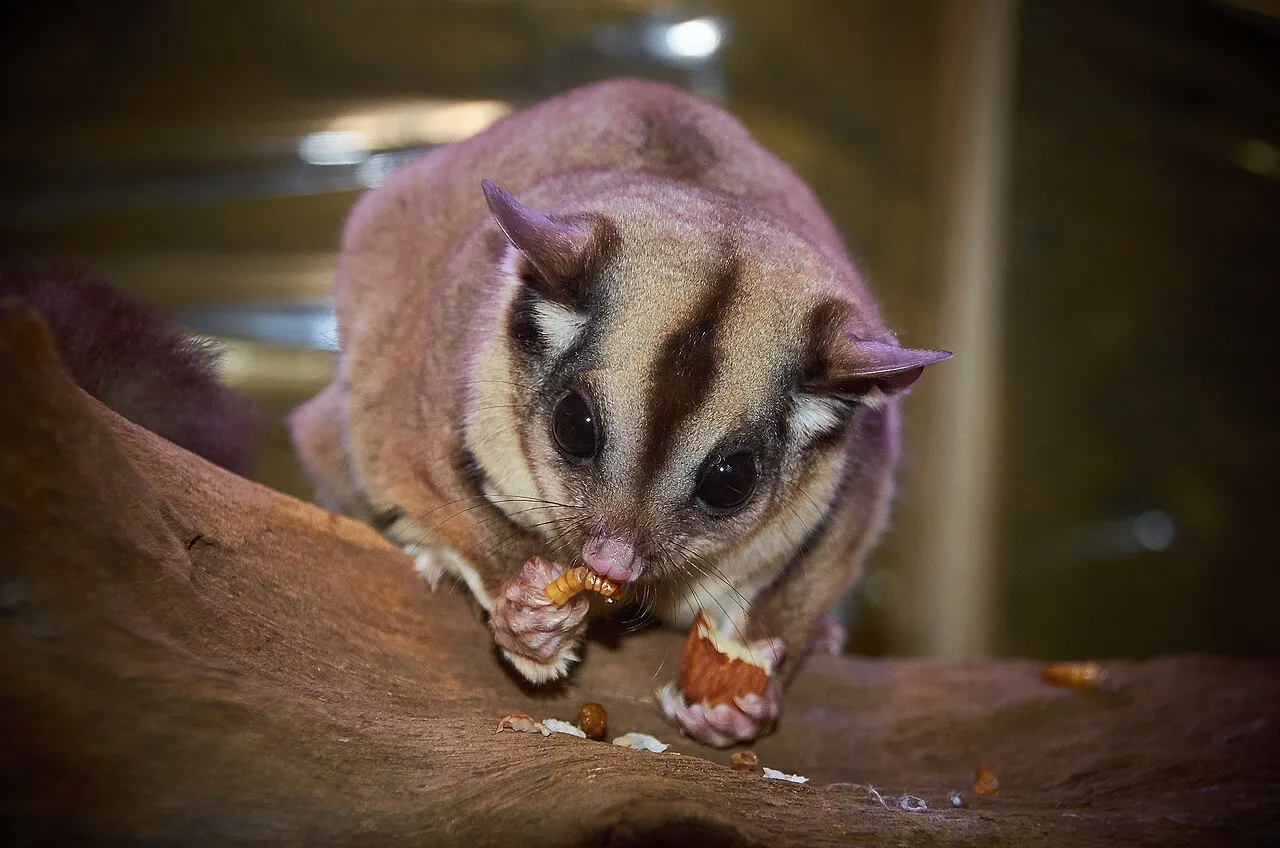
Feed once a day in the evening as the gliders wake up. Daily intake is commonly put at about 15–20% of body weight, so a 120 g adult eats around 18–24 g. A typical plate looks like this.
| Component | Example per glider per day | Notes |
|---|---|---|
| Tested recipe such as BML or HPW, or a complete glider diet | About 1–1.5 tablespoons | The backbone |
| Insects: mealworms, crickets, dubia | 2–3 | Often dusted with calcium |
| Fruit and vegetables | About 1 tablespoon | Lean toward vegetables, rotate variety |
| Treats | A tiny amount | Gum arabic and similar |
What is left in the morning tells you what is being skipped. Gliders that pick out favourite fruit can be fed a finely chopped mix. Weigh weekly and keep a log.
9.3. Avoid
- Chocolate, coffee, tea and energy drinks: caffeine and theobromine
- Onions, garlic, chives and leeks
- Sweets, biscuits, cake and other processed sugary food
- Wild-caught insects: pesticides and parasites
- Salty or seasoned human food
- Canned fruit in syrup and artificial sweeteners, especially xylitol
- Avocado and rhubarb leaves
Wash produce well and introduce new foods in tiny amounts while watching the droppings. Plenty of glider recipes online are untested; stick to well-established ones and check your plan with an exotic vet.
10. Health
Many glider illnesses trace back to diet and housing, which means good husbandry prevents a lot of them. Because they are so small, though, problems move quickly. Find an exotic vet with glider experience before you need one, and go promptly when something looks wrong. The table below is for reference only.
10.1. Common conditions
| Condition | Cause | Signs | Prevention or response |
|---|---|---|---|
| Metabolic bone disease, hind-leg paralysis | Low calcium and vitamin D, poor calcium-phosphorus ratio | Dragging hind legs, weakness, tremors, fractures | Tested diet, calcium supplementation, vet at once |
| Self-mutilation and overgrooming | Loneliness, stress, pain, irritation from wounds | Wounds on tail, legs or genitals, hair loss | Group housing, better environment, vet |
| Obesity | Too much sugar and fat, little exercise | Sagging belly, poor gliding | Adjust diet, wheel and play |
| Dental and gum disease | Soft, sweet diet | Bad breath, eating less, facial swelling | Check-ups, crunchy insects |
| Cataracts | Diet imbalance, age, genetics | Cloudy eyes | Review diet, vet |
| Giardia and other gut infections | Contaminated food or water | Diarrhoea, weight loss, dehydration | Hygiene, faecal tests |
| Dehydration | Diarrhoea, heat, too little water | Skin tents slowly, lethargy | Vet at once |
| Penile prolapse in males | Overgrooming, infection | Swollen or injured penis outside the body | Emergency vet |
| Pouch infection | Bacteria | Smell, discharge or swelling around the pouch | Vet |
Hind-leg paralysis from metabolic bone disease is especially common. It often looks sudden, but the cause is usually months of poor nutrition. Caught early it can improve with treatment; left too long it may cause permanent disability.
10.2. Warning signs and neutering
- Dragging the hind legs or failing to climb the cage bars
- Not eating for a day, or losing more than 10% of body weight in a week
- Bleeding wounds or a spot being licked and chewed constantly
- Diarrhoea for more than a day
- Cloudy eyes or one eye held shut
- A male's penis protruding and not retracting
- Lying limp outside the pouch during the day
Neutering males, done by an exotic vet, reduces scent marking and odour and prevents unwanted breeding. In mixed-sex groups it is widely treated as standard practice. Afterwards gliders may need a protective suit to stop them chewing the wound, so plan aftercare with the clinic beforehand.
11. Breeding
In captivity sugar gliders can breed year-round, and a healthy pair may produce two litters a year. Gestation is remarkably short at about 15–17 days, and litters are usually one or two. Newborn joeys are the size of a grain of rice, hairless and with eyes still undeveloped, yet they haul themselves through the mother's fur into the pouch and latch onto a teat. They stay there for around 70 days and then spend several more weeks in the nest. Fathers help too, huddling over the young to keep them warm.
Right after the joeys leave the pouch, parents can be easily stressed by handling or noise and may reject or even harm their young, so keep cleaning to a minimum and do not open the sleeping pouch to peek. A nursing mother needs extra calcium and protein; without it both she and the joeys are at risk of metabolic bone disease.
Breeding gliders at home deserves careful thought. Males can become fertile within a few months, so parent-offspring and sibling matings happen easily, and repeated inbreeding brings inherited problems. You will need a plan to separate or neuter young males before maturity, and every joey needs a home willing to keep at least two gliders for 10–15 years.
12. Costs
These are rough Korean figures for a pair, excluding the purchase price, which varies a lot with colour and seller.
| Item | Approximate cost (KRW) | Notes |
|---|---|---|
| Tall wire cage | 150,000–400,000 | 90 cm or taller; flight cages cost more |
| Glider-safe wheel | 50,000–120,000 | No central axle |
| Pouches, hammocks, branches, toys | 50,000–120,000 | Including spares for washing |
| Heater, thermostat, thermo-hygrometer | 60,000–120,000 | For winter |
| Bonding pouch, carrier, scale | 40,000–80,000 | |
| First vet check for two | 60,000–140,000 | More with faecal tests |
| Starting total | about 450,000–900,000 | |
| Monthly diet ingredients, insects, supplements | 50,000–110,000 | Depends on recipe costs |
| Monthly bedding, laundry, consumables | 10,000–20,000 | |
| Male neutering | in the low hundreds of thousands | Varies by clinic |
| Annual check-ups | 50,000–120,000 each |
Food is a surprisingly big ongoing cost. Making recipe batches and freezing them in portions saves money and time. Treating metabolic bone disease or self-inflicted wounds often takes several visits, so keep a medical fund in reserve.
13. Before you get one
- Two or more: plan on a pair from day one. If you only want one animal, a different species is a better fit.
- Night life: gliders are busiest from late evening to dawn and can be noisy with wheels and barking. A bedroom is often the wrong place for the cage.
- Smell: intact males have a strong musky scent. Talk it over with your household first.
- Food prep: buying ingredients and making, portioning and freezing recipe batches is an ongoing chore.
- Lifespan: think about how your life may change over 10–15 years.
- Vet access: check that a nearby exotic vet can treat and neuter gliders.
- Seller: confirm any licence your local law requires, ask whether the animals were bred locally, and get parent details, out-of-pouch dates and accurate sexing. Steer clear of mall kiosks and high-pressure sales.
- Healthy animal: clear, bulging eyes, even fur, a full tail and strong hind legs that grip and climb well. Avoid joeys less than about eight weeks out of pouch.
In the first week, cover part of the cage and let the gliders settle quietly with a piece of your clothing in their pouch. Then build up short daily treat sessions from your hand, and bonding will follow at the gliders' pace.
14. Laws
Sugar gliders are not listed on any CITES appendix, so international trade is not restricted under that convention. Beyond that, rules vary enormously. In their native Australia they are protected wildlife, and only some states allow private keeping, under licence. In the United States a handful of states, California being the best-known example, ban them, and others require permits; city ordinances can add further limits. In South Korea there is no registration requirement, but licensing for businesses that import or sell wild animals was tightened from December 2025, so buyers should use a licensed seller and keep the paperwork.
On the Australian island of Tasmania, gliders introduced by people are now treated as a threat to the endangered swift parrot, whose nests they raid, a good illustration of why pets must never be released. Wherever you live, check your national and local rules before buying, and never let a glider go outdoors; it will not survive and it may harm local wildlife.
15. In culture
Sugar gliders lack the deep cultural history of dogs or cats, but the internet made them famous fast. Photos of a tiny face peeking out of a hoodie pocket, clips of a glider nibbling a treat on a palm and slow-motion videos of a glide across the living room have circulated for two decades. In Australia they are familiar forest animals in nature documentaries and local stories, and in Japan they are popular pets known by a name meaning pouched flying squirrel.
Many game and cartoon characters are based on flying squirrels, and fans often point out how much some of them resemble sugar gliders, with their huge eyes and gliding flaps. Official confirmation that a character is meant to be a sugar glider is rare, so treat those comparisons as resemblance rather than fact. In biology classrooms the glider remains a favourite example of convergent evolution.
16. Trivia
- Just before landing, a glider swings its body upright and uses its membrane as an air brake.
- The family smell created by the dominant male's scent marking is why introducing a new glider takes careful scent-swapping.
- On cold days the whole group stacks up inside one pouch to share warmth.
- The word sugar misleads people into thinking gliders can eat sweets. What they need is natural sugar from sap and nectar; refined sugar does real harm.
- Wild gliders gouge eucalyptus and acacia bark and return to the same wounds night after night to lick the flowing sap and gum.
- Gliders go to the toilet wherever they happen to be, so litter training like a cat's is not realistic.
- Their eyes are superb in the dark, but their colour vision is thought to be limited.
Health notes are general information. If something seems wrong, contact a vet who treats this species.
FAQ
Do sugar gliders smell?
Intact males have a noticeable musky scent and females a milder one. Over-rich protein and infrequent cleaning make it worse, so regular pouch washing, a balanced diet and neutering keep it manageable.
Can they be litter-trained?
Not in the way a rabbit or cat can. They tend to relieve themselves right after waking, so holding them over a tissue for a minute before play prevents most accidents.
Do their bites hurt?
Their incisors are sharp enough to draw a little blood, though most nips are fear-driven. Leaving a worn T-shirt in the cage and moving slowly usually fades the habit within weeks.
Further reading
- 🗳️ Are exotic small mammals like sugar gliders and degus worth keeping?
- ❄️ Winter Care: Keeping Pets Warm and Heaters Safe
Photo credits
Photos are freely licensed images from Wikimedia Commons. Authors and licenses are listed below.
- Sugar Glider (Petaurus breviceps) - 28847758034.jpg — patrickkavanagh · CC BY 2.0
- Sugar Glider (Petaurus breviceps).jpg — patrickkavanagh · CC BY 2.0
- Petaurus breviceps 119464446.jpg — Greg Tasney · CC BY-SA 4.0
- Petaurus breviceps 347929845.jpg — george_vaughan · CC0
- Petaurus breviceps (sugar glider).jpg — Inconnu(e) · CC0