TailVille
At a glance
Rough ranges for supplies, food and electricity in Korea (USD is approximate). Purchase or adoption fees are not included.
Calm one- or two-person households with predictable routines who want a gentle, quiet cat.
Busy homes with frequent visitors, or people expecting a cat that greets strangers with open arms.
1. Overview
The Russian Blue is a short-haired pedigree cat with a dense, silver-tipped blue-grey double coat and vivid green eyes. Its slender, elegant body and upturned mouth corners have earned it a reputation for a gentle 'smile'. In Korea it is often nicknamed 'Reobeul', a contraction of its Korean name.
As the name suggests, it is traditionally said to come from northern Russia, though records are too thin to be sure. After appearing at early British cat shows in the nineteenth century, it was refined separately in Britain, Scandinavia and the United States into the cat we know today.
Russian Blues are quiet and sensitive, shy with strangers but deeply attached to their families. Among pedigree breeds they are relatively healthy and easy to groom, which is why they are often recommended to first-time owners, but they are food-motivated and prone to weight gain, and they dislike change. This article covers what is specific to the Russian Blue; for general cat care, see the main cat article.
2. Name and origin
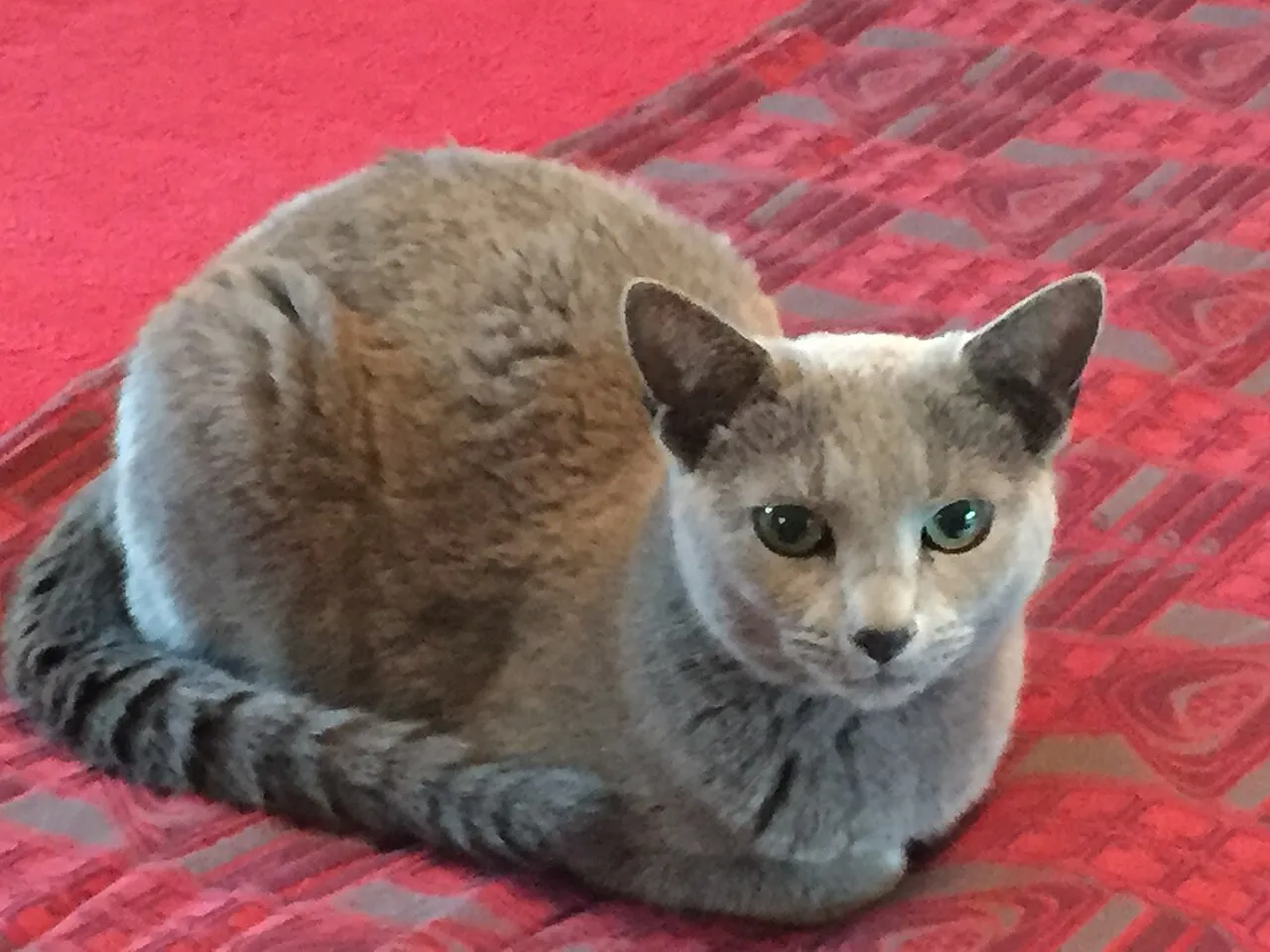
Yvonneperryh · CC BY-SA 4.0
2.1. The Archangel cat
The best-known story says that cats from Arkhangelsk, a port on Russia's White Sea, travelled to Britain aboard sailing ships in the mid-1800s, and early examples were indeed shown as 'Archangel cats'. The dense double coat is often explained as an adaptation to the northern cold, though some historians treat the whole origin story as closer to legend.
Tales of Russian tsars treasuring the breed or Queen Victoria favouring blue cats are also told but hard to verify. What is certain is that short-haired blue cats were being exhibited at British cat shows in the late nineteenth century.
2.2. War and rebuilding
At early British shows all short-haired blue cats competed together, so the stocky British Blue and the slender Russian were judged side by side. Only in the early twentieth century did the Russian Blue begin to be classed separately.
Like many European pedigree cats, the Russian Blue nearly disappeared around the Second World War. British breeders revived it using Siamese and British Blue crosses, while breeders in Sweden and Finland rebuilt their own lines independently. For a time the Siamese influence made the cats longer and finer, and later breeders worked to restore the original type.
2.3. Registries and types
The Russian Blue is recognised by all the major registries, including the GCCF in Britain, CFA and TICA in North America and FIFe in Europe. Each emphasises a slightly different look, and people often speak of British, American and Scandinavian types. Long-haired cats from similar lines are recognised by some registries as a separate breed, the Nebelung.
3. History and popularity in Korea
When pedigree cats began to catch on in Korea in the 2000s, the Russian Blue was among the first breeds to become well known, alongside the Persian, Turkish Angora and Siamese. Its elegant blue coat, green eyes and quiet manner were seen as a good fit for apartment life, and it has enjoyed steady popularity ever since.
From the 2010s, British Shorthairs, Scottish Folds and Munchkins became much more fashionable, but the Russian Blue held its place as a dependable, easy-going pedigree choice. Korean cat communities often describe it as not a clingy cat, but one whose quiet affection grows on you.
One caution: not every blue-grey cat is a Russian Blue. Grey domestic cats, blue British Shorthairs and crossbreeds are sometimes sold under the name, so if you want the breed, check pedigree papers and details of the parents.
4. Appearance and breed standard
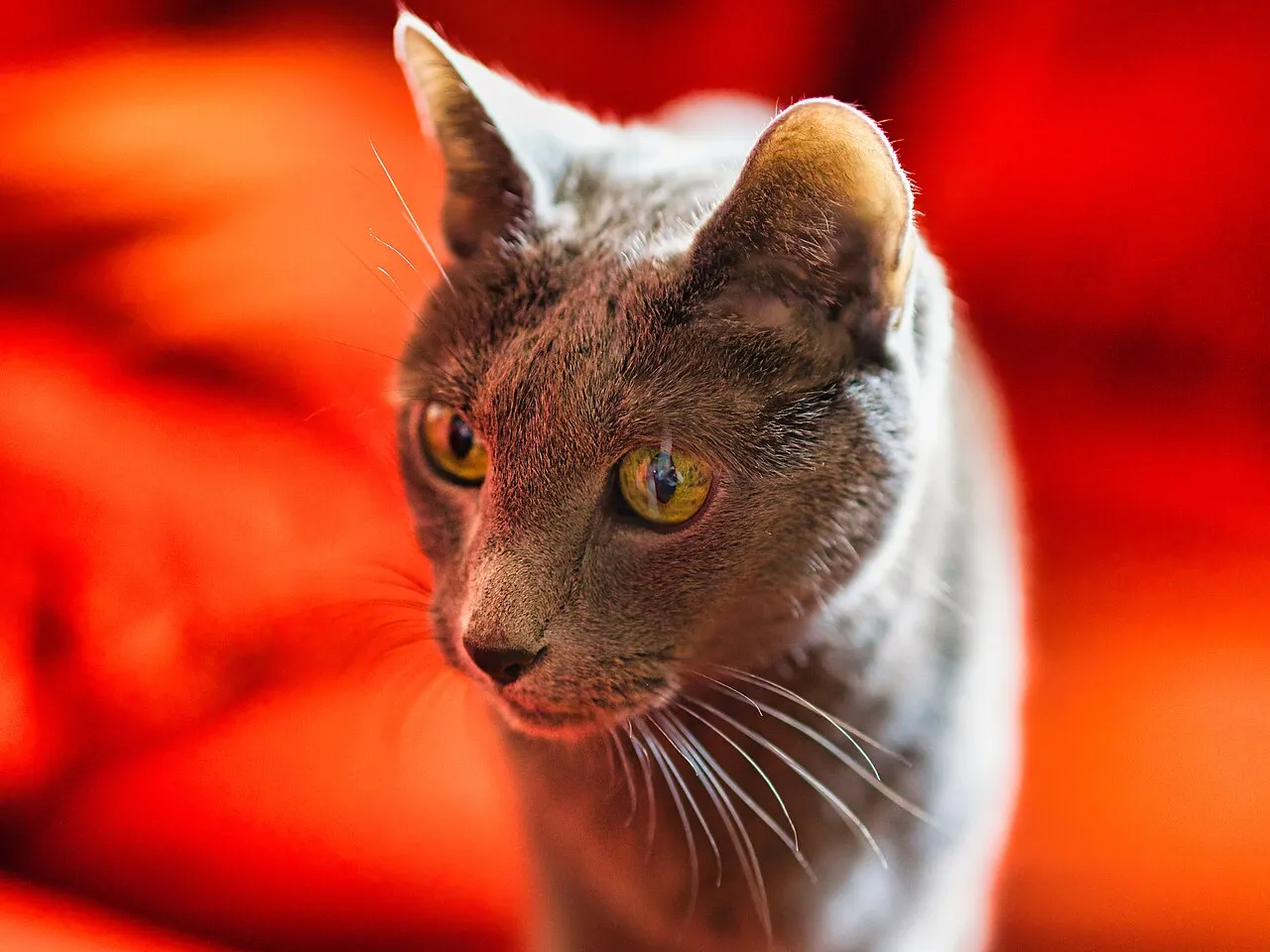
Chepry 💬 (Andrzej Barabasz) 📷 🇵🇱 · CC BY-SA 4.0
The Russian Blue has a 'foreign' body: fine-boned, long and firmly muscled. Its legs are long, its paws small and round, and it moves as if walking on tiptoe. The head is a short, modified wedge with large, wide-based ears, and the slightly upturned mouth gives the famous 'smile'.
| Feature | Approximate standard |
|---|---|
| Weight | Males about 4–5.5 kg, females about 3–4 kg |
| Body | Long, fine-boned foreign type, muscular |
| Coat | Short, very dense double coat that stands out from the body with a plush feel |
| Colour | Even blue-grey with silver-tipped guard hairs |
| Eyes | Vivid green; kittens have yellowish or mixed eyes |
| Nose and paw pads | Slate grey nose, mauve or lavender-pink pads |
The coat is the breed's crowning glory. Because the undercoat and guard hairs are similar in length, the fur stands slightly away from the body and is so dense that a finger traced through it leaves a mark for a moment. The silver tips make it shimmer in the light. Genetically, the colour is black diluted by the dilution gene. Some registries, notably in Australia, also recognise white and black cats of the same type.
5. Temperament
Russian Blues are calm, sensitive and observant. When strangers arrive many retreat under the bed or to a high shelf to watch, and they take time to warm up. With trusted family, though, they quietly follow you from room to room and settle on your lap or beside you, showing affection in a low-key way.
Their voices are soft and they are not big talkers. They are creatures of routine, though, and will wait pointedly beside you or give a gentle meow when dinner is due. They like predictability, and changes in furniture or household members can be stressful.
They are clever and curious; some learn to open lever handles or play fetch. They enjoy play but are happiest in a calm, predictable home rather than a loud, chaotic one. Introduced slowly, most get along with other cats and calm dogs.
6. Who it suits and who it doesn't
A good match for:
- Calm one- or two-person households with regular routines
- First-time pedigree cat owners wanting a relatively easy-care breed
- Apartment dwellers who want a quiet cat
- People happy to let a cat approach in its own time
A poor match for:
- Busy homes with frequent visitors
- People who move house or change routine often
- Anyone expecting a cat that greets every stranger
- Homes where young children are likely to chase the cat
Russian Blues cope reasonably well with being alone during the day, but they look forward to your company in the evening. Give them a window perch and puzzle toys for the hours you are away.
7. Exercise and play
Agile and athletic, Russian Blues love climbing and leaping. Generous vertical space from cat trees and wall shelves provides exercise and somewhere to retreat when guests arrive.
- Wand-toy hunting sessions of 10–15 minutes twice a day
- Fetch with small balls or toy mice, which many Russian Blues learn
- Puzzle feeders and scent games with hidden kibble
- A hammock or window shelf for bird-watching
Play is also key to weight control. In a food-loving breed, simply sticking to regular play sessions makes a big difference. Some individuals are startled by noisy toys or sudden sounds, so start with quiet ones.
8. Coat care and hygiene
The coat is dense but short and easy to look after. Brushing once or twice a week with a rubber brush or soft comb is enough, more often during the spring and autumn moults. Because the coat is so thick, loose undercoat can stay trapped, so an occasional pass with an undercoat comb helps in moulting season.
- Bathing: rarely needed; the dense coat resists water and takes a long time to dry
- Claws: trim every two to three weeks and provide several scratchers
- Ears and eyes: check weekly and wipe any discharge with soft gauze
- Teeth: brush daily if possible to prevent gum disease
Russian Blues shed less than long-haired breeds but not dramatically less than other shorthairs, and blue-grey hair shows up on both dark clothes and light sofas.
9. Feeding and weight
Russian Blues have a well-earned reputation as foodies. Free feeding from a constantly full bowl quickly leads to obesity, so measure the daily ration and split it into two or three meals. A 4 kg adult typically needs about 200–240 kcal a day, adjusted for neuter status and activity.
- A timed feeder delivers set portions at set times, which suits this routine-loving breed
- Keep treats below 10% of daily calories
- Puzzle feeders slow eating and add play
- Wet food increases water intake and supports bladder health
Because the breed standard is slim, extra weight shows quickly. Check monthly that the ribs are easy to feel and the waist is visible from above.
10. Inherited disease and health
Among pedigree cats the Russian Blue has relatively few well-documented breed-specific diseases. That means less has been found, not that these cats never get ill. The following are worth knowing about.
- Obesity and diabetes: food-loving cats easily become overweight, which raises the risk of diabetes; increased thirst and urination with weight loss call for testing
- Lower urinary tract disease: cystitis and bladder stones (struvite or calcium oxalate) can occur; frequent litter box trips or blood in the urine need prompt vet attention, and a male unable to pass urine is an emergency
- Idiopathic cystitis: common in sensitive cats, with stress a major trigger; a stable environment helps prevent it
- Hypertrophic cardiomyopathy (HCM): a heart disease seen in many breeds and in mixed-breed cats, and the Russian Blue is no exception; ask for a heart check at each annual visit and an echocardiogram if a murmur is found
- Progressive retinal atrophy: there have been reports in some Russian Blues, but how common it is and how it is inherited remain unclear
From around age seven, check-ups with blood and urine tests once or twice a year are sensible. Dental treatment under anaesthesia carries less risk if done before old age.
11. Life stages and lifespan
Russian Blues are known for longevity, with a typical lifespan of roughly 14 to 20 years; some well-cared-for cats are reported to pass 20.
| Stage | Age | Key points |
|---|---|---|
| Kitten | 0–6 months | Socialisation, vaccinations, eyes begin turning green |
| Junior | 6 months–2 years | Neutering, peak activity, eye colour settles |
| Adult | 2–7 years | Weight control, urinary health, steady routine |
| Mature | 7–11 years | Blood and urine tests once or twice a year, heart checks |
| Senior | 12 years and up | Kidney, thyroid and joint care; keep changes to a minimum |
In old age the silver tipping may fade a little and the coat may coarsen, and climbing becomes less frequent. Sensitivity can increase with age, so think carefully before moving house or adding a new pet once your cat is a senior.
12. Costs
These are rough 2026 South Korean figures. For a pedigree cat, the Russian Blue's running costs are fairly ordinary.
| Item | Approximate cost | Notes |
|---|---|---|
| Purchase price | Hundreds of thousands to several million won | Depends heavily on pedigree, parent testing and breeder |
| Initial supplies | 300,000–600,000 won | Cat tree, litter box, hiding bed, timed feeder |
| Vaccines, neutering, registration | 300,000–600,000 won | Varies by sex and clinic |
| Food and litter | 50,000–100,000 won per month | Depends on wet food share |
| Toys and consumables | 10,000–30,000 won per month | Puzzle feeders and the like |
| Insurance | 20,000–40,000 won per month | Varies with age and cover |
| Routine check-ups | 100,000–400,000 won per year | More tests for seniors |
| Bladder stones or urinary blockage | Hundreds of thousands to several million won | Depends on whether surgery is needed |
| Echocardiogram | Several hundred thousand won | If a murmur is found |
Pedigree status does not automatically mean high vet bills, but small investments in preventing obesity and urinary disease can save a great deal later. Costs in other countries follow a similar pattern.
13. Before you get one
- Ask for pedigree papers and which registry (TICA, CFA, FIFe and so on) the lines are recorded with
- Ask to meet the parents and about their temperament and health records
- Don't assume any blue-grey cat is a Russian Blue; grey domestic cats, blue British Shorthairs and crossbreeds are sometimes sold under the name
- Kittens that stay with their mother and littermates until around 12 weeks usually have better social skills
- Avoid pet shops and farms selling many breeds in volume, and check the seller's licence
- Treat 'allergy-free cat' marketing with scepticism; if you have allergies, visit the cat several times before deciding
Pedigree cats do turn up in shelters and rescues. An adult Russian Blue's personality is already clear, which makes adoption a good way to find a cat suited to a quiet home. A newly arrived Russian Blue may hide for days or even weeks, so be patient.
14. Russian Blues in culture
Legends cling to the Russian Blue: that Russian tsars prized it, or that Russians believed it brought good luck. These stories are hard to confirm and are best seen as part of the mystique that grew up around the breed.
The combination of silver-blue fur and green eyes is striking, so Russian Blues and similar-looking cats appear frequently in advertising, fashion shoots and magazine spreads as a symbol of elegance, and many of the grey cats in pet food and litter adverts are of this type.
In Korea, posts and videos about the Russian Blue's 'tsundere' character, aloof with strangers but affectionate with its own person, are popular in cat communities and on social media. The breed has also long ranked among the popular pedigree cats in Japan.
15. Trivia
- The coat is so dense that owners often 'draw' patterns in it with a fingertip, which stay visible for a moment.
- Kittens' eyes start yellow or yellow-green and gradually deepen to vivid green, sometimes taking a year or two.
- Long-haired cats of Russian Blue type were developed in the United States into the Nebelung, a name usually linked to the German word for mist or fog.
- The Russian Blue, Chartreux, Korat and blue British Shorthair are all blue cats, but body shape and eye colour tell them apart; the Korat comes from Thailand.
- The upturned corners of the mouth are often compared to the Mona Lisa's smile.
- Thanks to their quiet voices, neighbours in apartment blocks may never realise a Russian Blue lives next door.
- Many owners say their Russian Blue chooses one favourite person in the household and saves its most affectionate behaviour for them.
Health notes are general information. If something seems wrong, contact a vet who treats this species.
🍽️ Can my dog or cat eat this? →
FAQ
Are Russian Blues hypoallergenic?
You will often hear that they produce less Fel d 1 allergen, but there is little solid evidence. Individual cats vary, so if you have allergies, spend time with the cat several times before committing.
How is it different from any grey shorthair?
A Russian Blue has a dense double coat with silver-tipped guard hairs, vivid green eyes, a fine-boned body and a wedge-shaped head. A grey domestic cat can look similar, so only pedigree papers can confirm the breed.
My kitten's eyes are yellow. Is that normal?
Yes. Kittens often have yellowish or mixed eyes that gradually turn vivid green as they mature, a change that can take a year or two.
Photo credits
Photos are freely licensed images from Wikimedia Commons. Authors and licenses are listed below.
- Russian blue.jpg — Tkeiger at en.wikipedia · CC BY 3.0
- Sergei, Tail Stripes.jpg — Yvonneperryh · CC BY-SA 4.0
- Russian Blue AB.jpg — Chepry 💬 (Andrzej Barabasz) 📷 🇵🇱 · CC BY-SA 4.0