TailVille
1. Overview
The Asiatic black bear is a medium-sized forest bear named for its glossy black coat, and it is easy to recognise by the pale crescent or V-shaped blaze across its chest. That mark has earned it the nickname 'moon bear' in English and 'half-moon chest bear' in Korean. Its range is enormous and patchy, stretching from the mountains of Iran and Afghanistan along the Himalayas, through China and mainland Southeast Asia, and on to the Russian Far East, the Korean Peninsula, Japan and Taiwan.
It is a superb climber and a true omnivore that lives mostly on acorns, nuts, fruit and insects, with meat only an occasional extra. Bears in cold regions spend the winter in dens, while those in the tropics may stay active year-round.
Globally the species is listed as Vulnerable on the IUCN Red List because of forest loss, poaching for body parts and conflict with farmers. In South Korea it has become a conservation symbol: after it nearly vanished from the south of the peninsula, a reintroduction programme in Jirisan National Park has brought a small wild population back.
2. Name and classification
Abu0804 · CC BY-SA 3.0
The scientific name Ursus thibetanus was coined in 1823 by the French naturalist Georges Cuvier, and thibetanus simply means 'of Tibet'. For a time the species was placed in its own genus, Selenarctos, a Greek coinage meaning 'moon bear' that points straight at the chest marking. Today most authorities keep it in Ursus alongside the brown bear and the American black bear.
In Korean it is called bandal-gaseum-gom, literally 'half-moon chest bear', usually shortened to bandal-gom. Older Korean texts simply call it gom or use the Chinese character ung (熊). Japanese speakers call it tsukinowaguma, the 'moon-ring bear', and in English it goes by Asiatic black bear, Asian black bear or moon bear.
2.1. Subspecies
Authorities disagree on the exact number, but six or seven subspecies are commonly recognised, separated by coat length, body size and geography.
| Subspecies | Main range | Notes |
|---|---|---|
| U. t. thibetanus | Eastern Himalayas and Tibet fringes | Nominate form |
| U. t. ussuricus | Russian Far East, northeast China, Korea | Largest, with the thickest coat |
| U. t. japonicus | Honshu and Shikoku, Japan | Smaller; thought extinct on Kyushu |
| U. t. formosanus | Taiwan | National symbol of the island |
| U. t. laniger | Western Himalayas, Kashmir | Long, soft fur |
| U. t. mupinensis | South-central China, Indochina | Widespread |
| U. t. gedrosianus | Southeast Iran, Pakistani Baluchistan | Small, isolated dryland population |
Korean bears are assigned to ussuricus, which is why the Jirisan programme sourced bears from the Russian Far East and North Korea.
3. Evolution
Bears split from other dog-like carnivores roughly 20 million years ago. Within the genus Ursus, the Asiatic black bear's closest relative in most genetic studies is the American black bear. The two shared an ancestor in Asia a few million years ago, and the American line later crossed the Bering land bridge, which explains why the pair look and behave so alike. Some analyses instead group it more tightly with the sun bear and sloth bear, so the family tree of Asian bears is not fully settled.
Fossils show the species once ranged far more widely. Bones of the Asiatic black bear or a very close form turn up in Pleistocene cave deposits across Europe, sometimes treated as a separate subspecies. As ice ages came and went, the European populations disappeared and only the Asian ones remained.
Palaeolithic cave sites in Korea also contain bear bones, suggesting that Asiatic black bears and brown bears once lived side by side on the peninsula, the brown bear favouring open country and the northern mountains while the climbing black bear held the broadleaf forests.
4. Range and habitat
Abu0804 · CC BY-SA 3.0
The range runs from southeastern Iran in the west to Japan and Taiwan in the east, but it is a broken patchwork that follows mountain chains and remaining forest rather than a continuous belt. The bear has vanished from most densely settled lowlands and survives mainly in the hills.
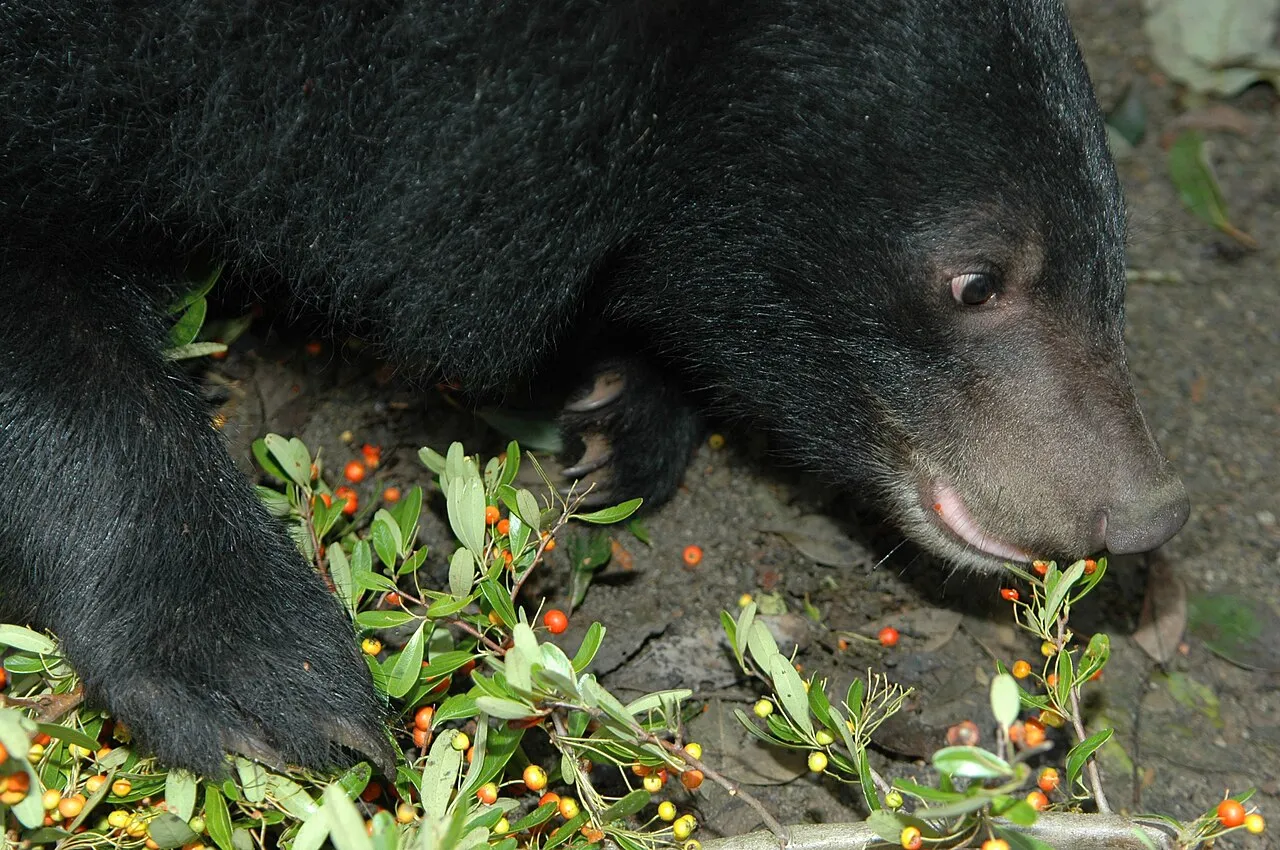
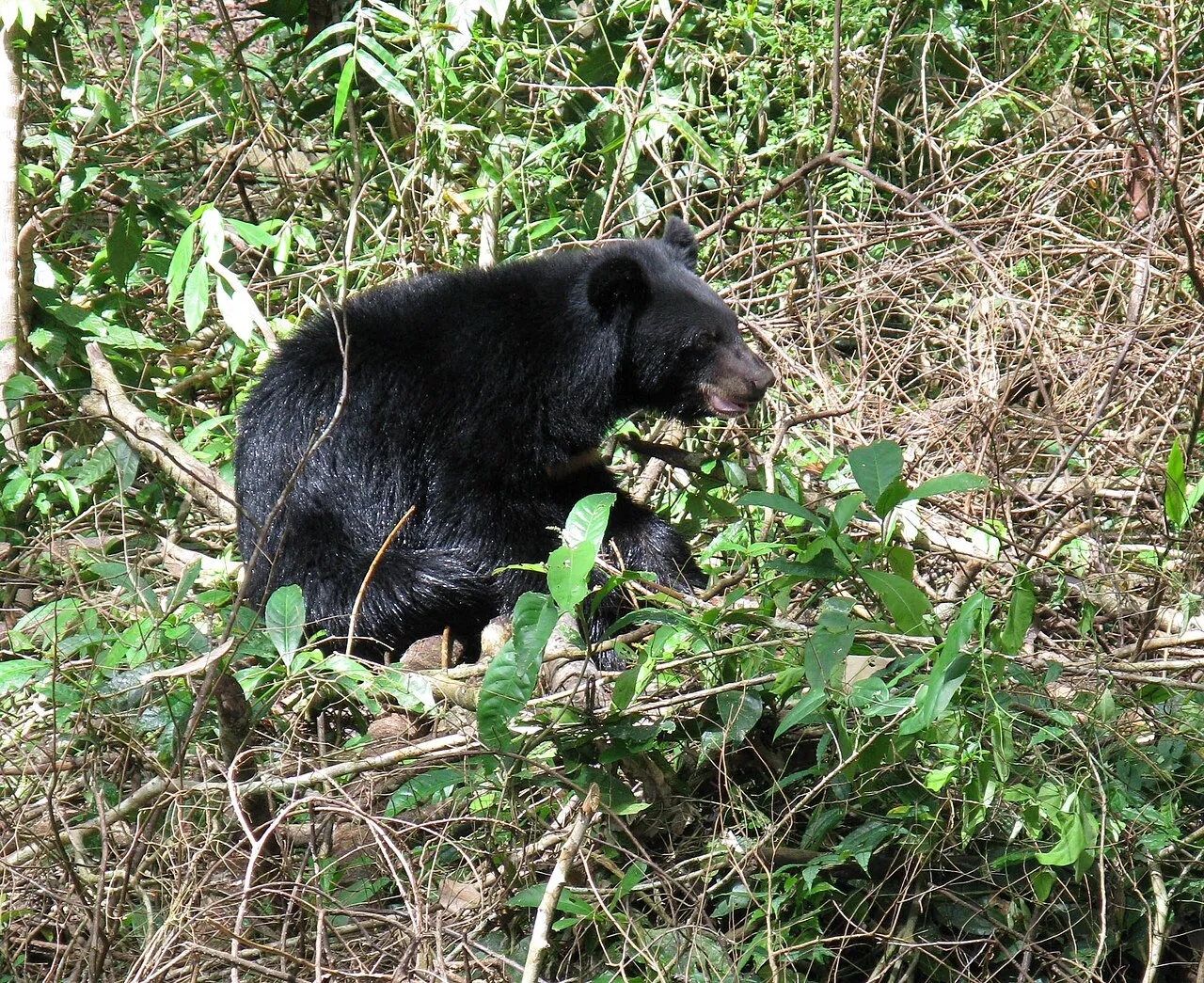
Its favourite habitat is broadleaf and mixed forest rich in acorns, chestnuts and walnuts. In the Himalayas it may climb above 3,000 metres in summer and descend to lower valleys in winter. In Southeast Asia it also lives in tropical evergreen forest, where it overlaps with the smaller sun bear.
In Korea the species once roamed every major mountain range. During the twentieth century it dwindled in the south to a handful of animals in places like Jirisan and Seoraksan. Larger populations persist in North Korea, northeast China and the Russian Far East. Since the Jirisan reintroduction, released bears and their offspring have begun wandering to neighbouring ranges such as Deogyusan, Gayasan and Sudosan.
5. Body
This is a mid-sized bear: smaller than a brown bear, larger than a sun bear. Males are clearly bigger than females, and weight swings hugely through the year. After an autumn feast of acorns a bear can be a third heavier than it was in spring.
| Measure | Male | Female |
|---|---|---|
| Head-body length | about 130–190 cm | about 110–150 cm |
| Shoulder height | about 70–100 cm | about 60–80 cm |
| Weight | about 60–200 kg | about 40–125 kg |
| Tail | about 7–12 cm | about 7–10 cm |
The coat is usually glossy black, occasionally brownish. The chest blaze is typically a V or crescent, but every bear's is slightly different, so researchers use it to tell individuals apart. Long hair around the neck and shoulders forms a ruff that makes the head look bigger than it is.
The ears are large and rounded for a bear. Short, strongly curved front claws grip bark well. Like all bears it walks flat-footed and can stand on its hind legs with ease. Its sense of smell is extraordinary, while eyesight is roughly comparable to ours or slightly poorer.
6. Behaviour and ecology
Abu0804 · CC BY-SA 3.0
Asiatic black bears are essentially solitary. Apart from mothers with cubs and pairs during the mating season, they rarely travel together, though several may feed near one another where food is abundant.
Daily rhythm depends on place and season. In quiet forests they are often active by day, but near people they shift towards night and dawn. Home ranges vary with food supply from a few square kilometres to well over a hundred, and males roam far more widely than females.
6.1. Climbing and tree nests
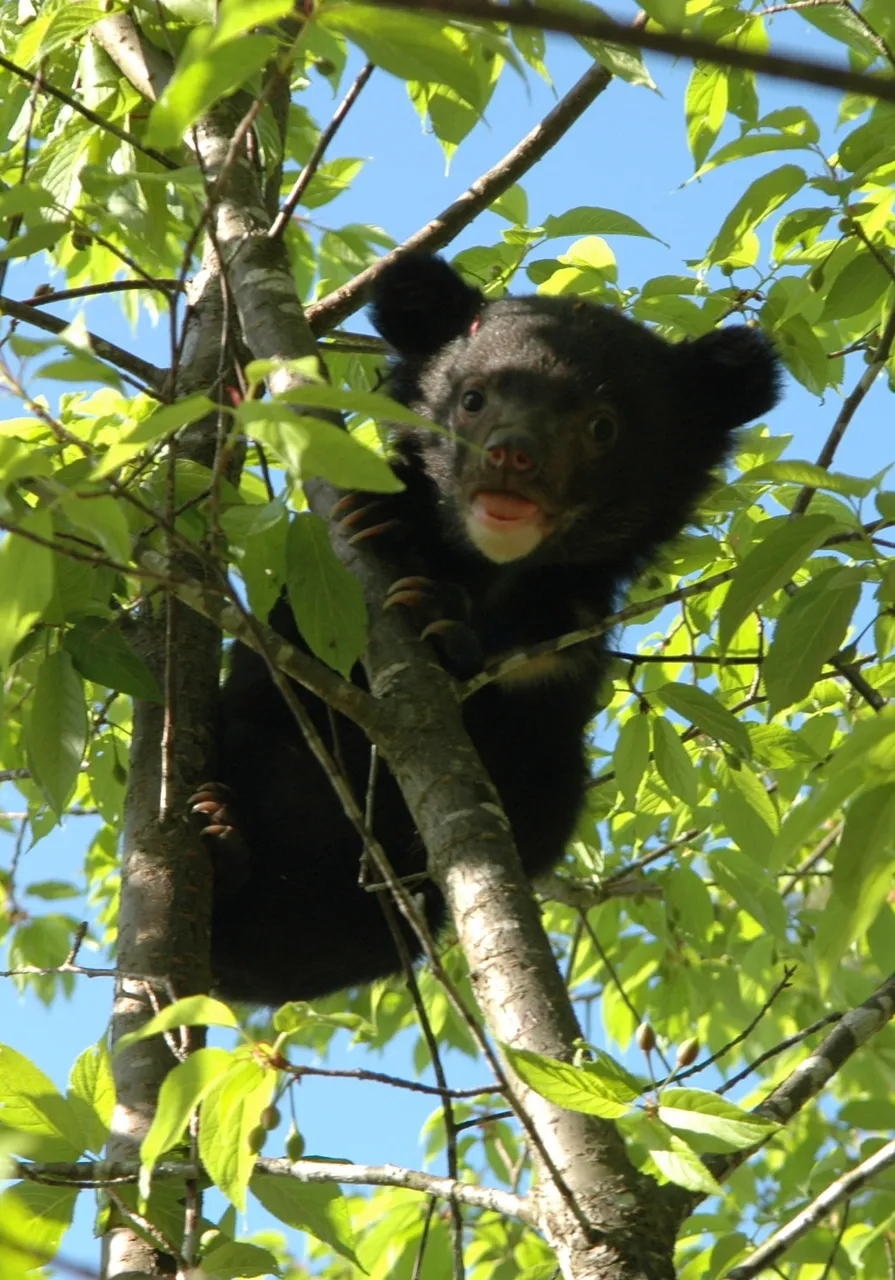
It is one of the best climbers in the bear family. In autumn it hauls itself into oaks and chestnut trees, pulls branches in to strip the nuts, and tucks the broken branches beneath itself. The resulting platform looks like a giant bird's nest, and these 'bear nests' are a classic sign that field researchers use to confirm bears in an area. Trees are also a refuge when a bear feels threatened.
6.2. Winter dormancy
Where winters are cold, as in Korea, Russia and Japan, bears usually den from around December until March or April. Dens may be caves, rock crevices or hollow trees; in Jirisan many have been found in tree cavities or under boulders. During dormancy bears do not eat, drink, urinate or defecate, and their heart and breathing rates drop sharply, but body temperature falls only modestly, so they can wake if disturbed. Bears in warm southern regions may skip denning or keep it very short.
7. Diet and feeding
Although technically omnivorous, the Asiatic black bear eats mostly plants, and its menu changes sharply with the seasons.
| Season | Main foods |
|---|---|
| Spring | Shoots, grasses, young leaves, leftover acorns |
| Summer | Ants, bee larvae and other insects; berries and cherries |
| Autumn | Acorns, chestnuts, pine nuts, wild kiwi and grapes |
| Pre-denning | Intense feeding to build fat reserves |
The autumn acorn crop is critical. In poor mast years bears range further and are more likely to raid orchards and villages. They also tear open ant nests to lick up ants and pupae, and break into wild bee colonies for honey and larvae.
Meat comes mostly from carrion and small animals. Some bears in some regions kill livestock, but it is a minor part of the overall diet. Crops such as maize and fruit, and especially beehives, are common sources of conflict with farmers.
8. Reproduction and life cycle
Roy Bateman · CC BY-SA 4.0
Mating takes place mostly in June and July. Like other northern bears, the Asiatic black bear uses delayed implantation: the fertilised embryo floats free in the uterus for months and only implants in autumn if the mother has put on enough fat. In lean years implantation may fail altogether, so fewer cubs are born after a bad acorn crop.
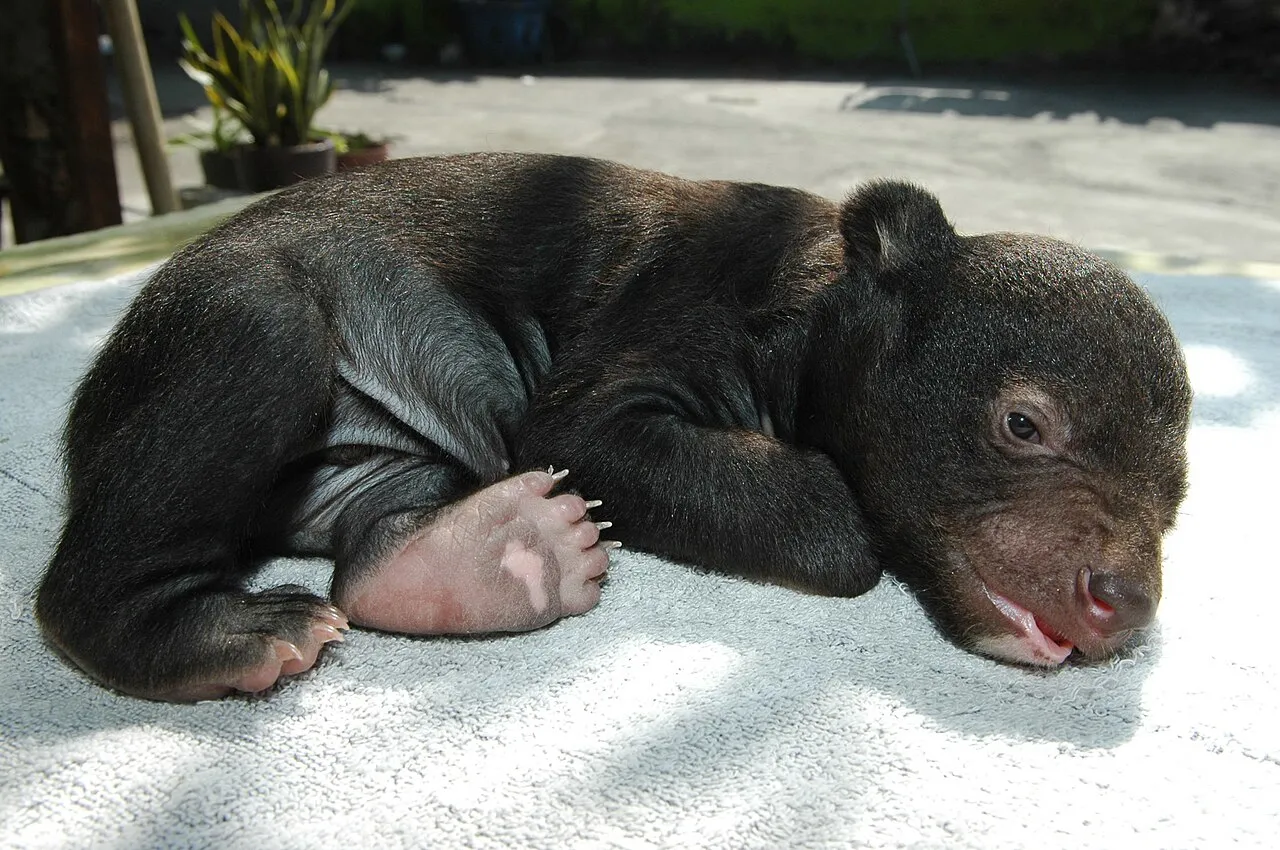
Cubs are born in the den around January or February, while the mother is still dormant. Litters range from one to three, most often two. Newborns weigh only a few hundred grams and are blind and nearly naked. The mother nurses them through the rest of winter and leads them out in spring.
| Stage | Timing | What happens |
|---|---|---|
| Birth | Jan–Feb | Born in the den, about 300–500 g |
| Emergence | Mar–May | Follow mother, learn to climb |
| Cubhood | 1–2 years | Share a second winter den, learn to forage |
| Independence | about 1.5–2 years | Leave mother |
| Maturity | about 3–5 years | Females usually breed every 2–3 years |
Wild bears are thought to live around 20–25 years at most, and captive bears have passed 30, but accidents, poaching and food shortages mean many wild bears die much younger.
9. Intelligence, communication, special abilities
Bears have large brains for their body size and long memories. Asiatic black bears remember which slopes produce the best nut crops and adjust their routes through the seasons. Once a bear learns that rubbish or crops are an easy meal, it tends to return again and again, a direct result of that learning ability.
Communication mixes sound, scent and posture. A stressed bear huffs, clacks its teeth or slaps the ground with a forepaw. Cubs call their mother with high-pitched cries. Rubbing against trees and leaving claw marks is thought to advertise a bear's presence to others through smell and visual signs.
Its standout abilities are its nose and its climbing. Researchers are also intrigued by how bears spend months immobile in their dens without serious loss of muscle or bone, a puzzle with possible lessons for human medicine.
10. Predators and survival
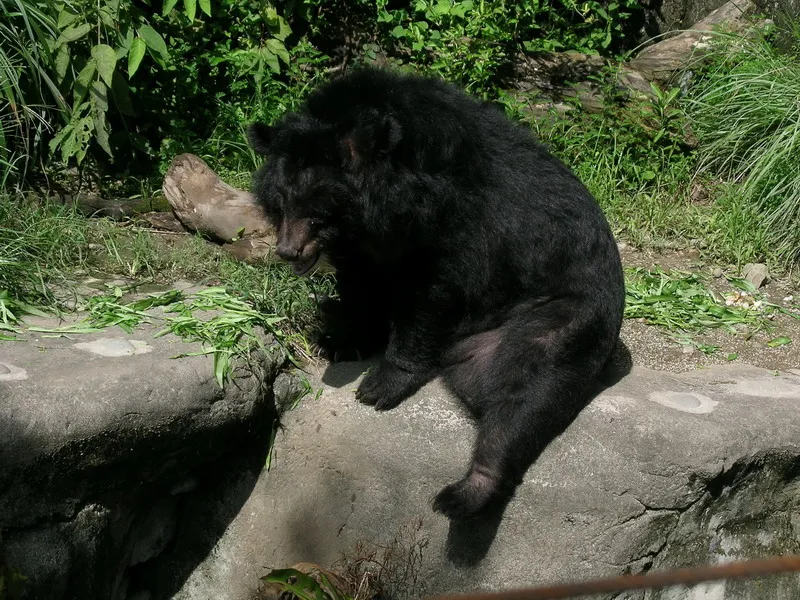
user:smartneddy · CC BY-SA 3.0
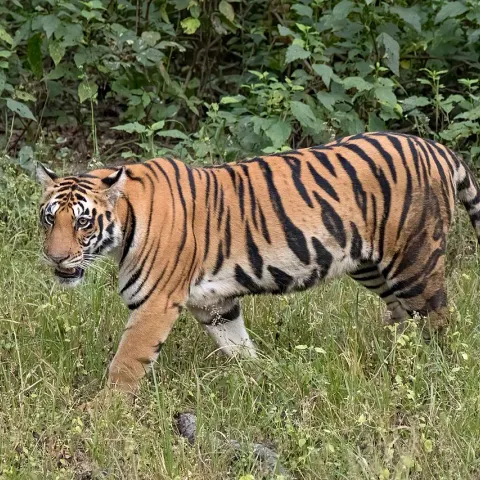
Few animals tackle a full-grown Asiatic black bear. In the Russian Far East and northeast China, Amur tigers are known to hunt them, and large brown bears sometimes attack them. In South and Southeast Asia, tigers and leopards may take young bears. Cubs are vulnerable to wolves and to adult male bears, so mothers stay alert.
The usual response to danger is to retreat or climb. A surprised bear, or a mother with cubs, can however react aggressively. In practice the biggest threat is people: snares, road traffic and fragmented forests have been leading causes of death among the reintroduced Jirisan bears.
11. Relationship with humans
Bears have been both worshipped and hunted across Asia for millennia. They were taken for meat and fur, but the dried gall bladder, used in traditional medicine, became the most valuable part and the single biggest driver of poaching. Bear paws were also prized as a luxury dish and are still smuggled.
11.1. Bear farming in Korea
In the early 1980s the South Korean government encouraged farmers to import and raise bears as a source of income, mainly for bile. Imports were soon halted under international criticism and Korea's accession to CITES, but the bears already brought in, and their offspring, spent their lives in small cages.
Campaigners and authorities later sterilised the farmed bears, sharply reducing new births, and the law was amended so that keeping bears for bile is banned from 2026. Work on sanctuaries for the remaining animals is ongoing, with debate over capacity and funding. It is worth stressing that the farmed bears are a separate story from the wild reintroduction programme.
11.2. The Jirisan reintroduction
By the 1980s the bear was on the brink of extinction in South Korea. In 2000 camera traps in Jirisan confirmed that a few wild bears survived, but far too few to sustain a population. After a trial release in 2001, a full reintroduction programme began in 2004.
The founders were bears of the same ussuricus subspecies brought from the Russian Far East and North Korea, plus bears bred in Korea. After pre-release training they were fitted with tracking collars and set free in Jirisan, where national park researchers followed their movements, dens and breeding. Early on, bears that had been fed by people wandered into villages, and snares killed several, so progress was rocky.
Over time more cubs were born in the wild, and the initial target of about 50 bears was announced as reached in the late 2010s. Recent estimates put the population at roughly 80–90 animals in and around Jirisan, though figures vary with survey method. Some bears have dispersed well beyond the park, reaching Sudosan in Gimcheon and Deogyusan, which is seen as a natural sign of a growing population seeking new territory.
Challenges remain. More bears means more encounters with beekeepers and hikers, highways cut off movement corridors, and a small founder group raises concerns about inbreeding. Wildlife crossings, compensation for damage, visitor education and adding new founders are all under discussion. Hikers in Jirisan are asked to stay on trails, carry out all food and back away calmly if they meet a bear.
12. Conservation
The IUCN lists the Asiatic black bear as Vulnerable. A precise global count is impossible, but the total is thought to be in the tens of thousands and declining in most of the range. Some areas, such as parts of Japan, still hold healthy numbers, while the dryland populations of Iran and Pakistan and several Southeast Asian populations are in serious trouble.
The main threats are:
- Logging, farmland and roads that shrink and split forests
- Poaching for gall bladders, paws and other parts
- Capture of cubs for the pet trade and bile farms
- Retaliatory killing after crop or livestock damage
The species is on CITES Appendix I, which bans commercial international trade. In South Korea it is a Class I endangered species under the Wildlife Protection and Management Act and a designated Natural Monument, so harming or capturing one without a permit carries heavy penalties.
13. In zoos
Asiatic black bears are a familiar sight in Asian zoos. But a wild bear walks kilometres a day, climbs and forages constantly, and in a small concrete enclosure it easily develops stereotypic pacing. Zoo bear welfare has been criticised for decades.
Better facilities now provide large yards with trees, soil and pools, and use enrichment such as hidden food or treats frozen in ice to keep bears busy. Sanctuaries that take in bears rescued from bile farms are also growing. Many argue zoos should move away from simple display towards education, rescue and conservation research.
Cubs are sometimes sold as pets abroad, but an adult bear is immensely strong and dangerous, and keeping one is illegal in most countries. The trade in cubs drains wild populations and should never be supported.
14. In culture
Korea's founding myth tells of a bear that endured a hundred days of mugwort and garlic in a cave and became a woman, later mother of the legendary founder Dangun. The myth never names a species, but since the moon bear was the bear most Koreans knew, the two are often linked. Bear reverence is shared by many northern Asian peoples, including Siberian groups and the Ainu of Japan.
In modern times the bear became a mascot: Bandabi, the mascot of the 2018 PyeongChang Winter Paralympics, was modelled on an Asiatic black bear. It also appears constantly in Jirisan National Park publicity. In Taiwan the Formosan black bear is a beloved island emblem, and Japanese regional mascots and folk tales feature the moon-ring bear too.
In everyday Korean, calling someone 'bear-like' can mean slow or dim, though real bears are clever and nimble climbers. The same image is also used kindly, for someone sturdy and dependable.
15. Trivia
- The chest blaze works like a fingerprint, so researchers can identify individual bears from photographs.
- A 'bear nest' high in an oak is a sure sign that a bear fed there.
- Reintroduced Jirisan bears carry ID codes as well as tracking collars for research.
- Mothers that give birth in the den nurse their cubs for months without eating anything themselves.
- If you meet a bear on a trail, don't turn and run; face it and back away slowly.
- In parts of the Himalayas, moon bear tracks and sightings have been suggested as one source of yeti legends.
Wild animals are not pets. Catching, trading or keeping them is illegal in most places. If you find an injured wild animal, call your local wildlife rescue centre.
FAQ
How many moon bears live in Jirisan now?
Since the reintroduction programme began in earnest in 2004, wild-born cubs have steadily increased, and recent estimates put the population in and around Jirisan at roughly 80–90 bears, though figures vary by survey method.
What should I do if I meet a bear on a hike?
Don't turn and run. Face the bear and back away slowly, without shouting or approaching for photos. Staying on trails and leaving no food behind reduces the chance of encounters in the first place.
Are farmed bile bears the same as the Jirisan bears?
No. Farmed bears descend from animals imported in the 1980s for bile, while the Jirisan bears are a reintroduced wild population founded from the same ussuricus subspecies. Keeping bears for bile is banned in South Korea from 2026.
Photo credits
Photos are freely licensed images from Wikimedia Commons. Authors and licenses are listed below.
- Ursus thibetanus 3 (Wroclaw zoo).JPG — Guérin Nicolas (messages) · CC BY-SA 3.0
- 12-cub on tree.jpg — Abu0804 · CC BY-SA 3.0
- 19-Formosan Black Bear.JPG — Abu0804 · CC BY-SA 3.0
- 44 days Feb 12.jpg — Abu0804 · CC BY-SA 3.0
- Asian black bear in CTNP.jpg — Roy Bateman · CC BY-SA 4.0
- Formosan Black Bear01.jpg — user:smartneddy · CC BY-SA 3.0