TailVille
1. Overview
A boneless, endlessly flexible body, eight sucker-lined arms, skin that changes colour and texture in an instant, three hearts and blue blood: the octopus is often described as the most alien animal on Earth. It is also strikingly intelligent. Octopuses solve mazes, unscrew jar lids and recognise individual people, and they are widely regarded as the smartest invertebrates.
Octopuses are cephalopods, molluscs related to squid, cuttlefish and the nautilus, and more distantly to clams and snails. Their ancestors abandoned the protective shell and became fast, clever predators. Close to 300 species of octopus live in the world's oceans, from rock pools to the deep sea thousands of metres down.
This article uses the common octopus, Octopus vulgaris, the most thoroughly studied species, as its main subject while covering octopuses in general. In Korea, the word muneo usually refers to the much larger North Pacific giant octopus (Enteroctopus dofleini) caught off the east coast, while the smaller octopus caught along the south coast and Jeju is called chammuneo, the 'true octopus', traditionally identified as the common octopus. The article explains both and the rich octopus culture of Korea.
Most octopuses live only one or two years, and even the giants rarely exceed three to five. They breed once; the female guards her eggs until they hatch and then dies. How such sophisticated intelligence evolved in an animal with such a short life is one of biology's intriguing puzzles.
Octopuses are an important catch and food in Korea, the Mediterranean, Japan, Latin America and beyond. As awareness of their intelligence and capacity for pain has grown, so has debate about how humans should treat them.
2. Name and classification
2.1. Scientific name and etymology
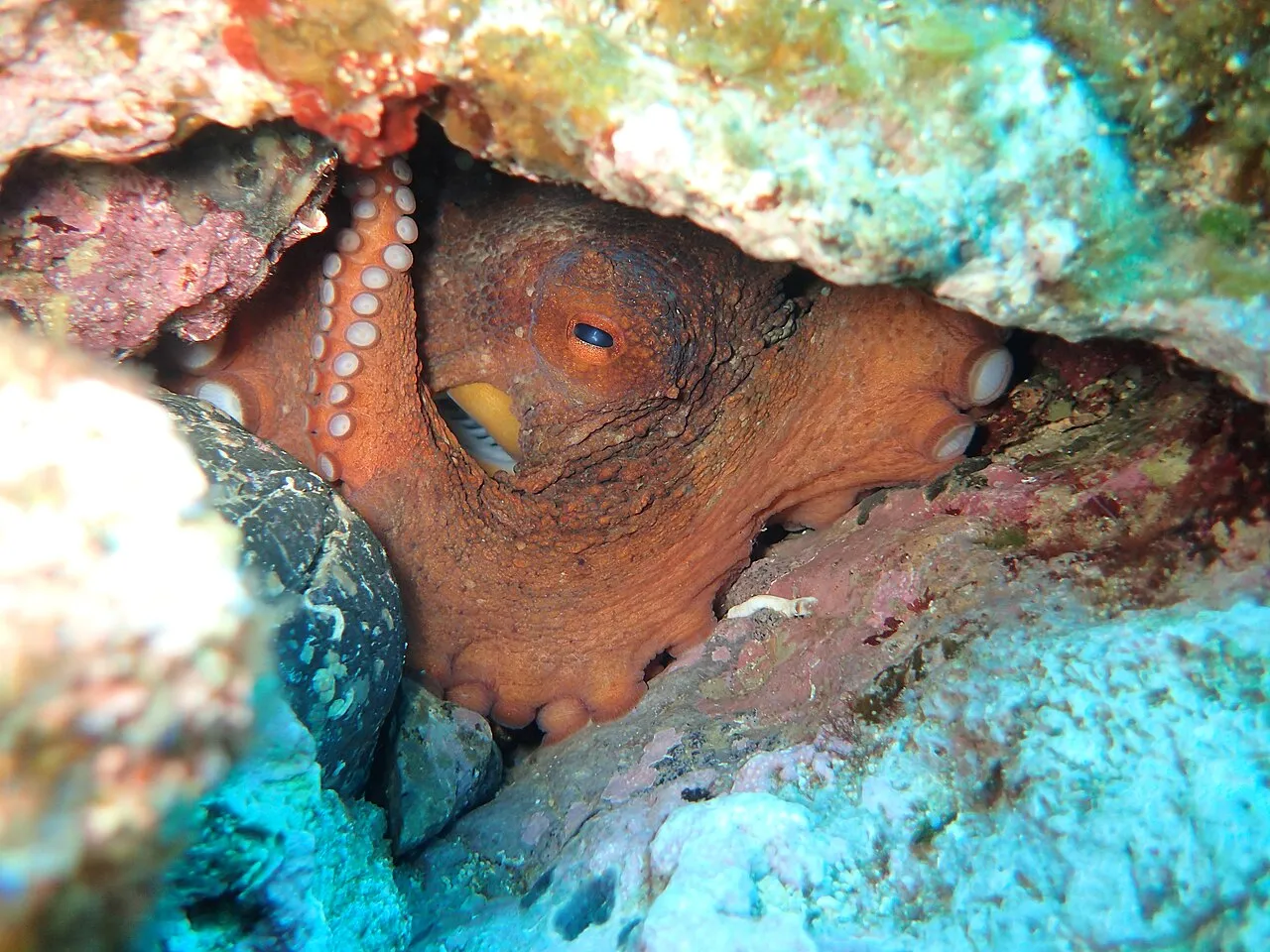
The common octopus is Octopus vulgaris, described by the French naturalist Georges Cuvier in 1797. Octopus combines the Greek okto, 'eight', and pous, 'foot', while vulgaris is Latin for 'common'. The most widely used English plural is octopuses; octopi, based on a mistaken Latin pattern, is also common, and the Greek-style octopodes is rare.
The Korean word muneo is written with characters meaning 'letters fish' or 'scholar fish'. Popular explanations link it to the octopus's ink, which recalls the ink used for writing, or to its rounded head resembling a scholar's. Thanks to the name, the octopus was long associated with learning and the scholarly class in Korea.
2.2. Classification and relatives
Octopuses make up the order Octopoda within the class Cephalopoda. The order has two main branches: the familiar finless or 'incirrate' octopuses, and the deep-sea finned or 'cirrate' octopuses, such as the dumbo octopuses with ear-like fins on their heads.
Octopus species relevant to Korea include:
| Korean name | Scientific name | Notes |
|---|---|---|
| Daemuneo (East Sea octopus) | Enteroctopus dofleini | North Pacific giant; the default 'muneo' in Korea |
| Chammuneo | Octopus sinensis (traditionally O. vulgaris) | South coast and Jeju; around 60 cm total length |
| Nakji | Octopus minor (sometimes Callistoctopus minor) | Long-armed octopus that burrows in mudflats |
| Jukkumi | Amphioctopus fangsiao | Small octopus prized in spring when full of eggs |
| Others | Several species | Small octopuses of the south coast and Jeju |
A caveat is needed. The East Asian 'common octopus' was long treated as the same species as the Mediterranean and Atlantic Octopus vulgaris. Genetic studies since the 2010s, however, indicate that the East Asian population is distinct, and many researchers now call it Octopus sinensis. Octopus vulgaris is increasingly seen as a species complex containing several closely related species. The biology described in this article comes mostly from research on Mediterranean and Atlantic O. vulgaris, and East Asian octopuses are broadly similar.
The North Pacific giant octopus is one of the largest octopuses in the world, living in cold waters from Korea's east coast and northern Japan through the Russian Far East and Alaska to Canada and the west coast of the United States.
3. Evolution
Cephalopod ancestors appeared around 500 million years ago as molluscs with cone-shaped shells. By filling chambers in the shell with gas, they became buoyant and left the sea floor to hunt in open water. Ammonites, which dominated Palaeozoic and Mesozoic seas, and the surviving nautilus are the best-known shelled cephalopods.
The coleoids, the group that includes octopuses, squid and cuttlefish, internalised or almost entirely lost the shell. They gave up armour in exchange for speed, flexibility, sophisticated camouflage and sharp senses and intelligence. Many researchers think losing the shell was a key driver of cephalopod intelligence: without armour, they had to outwit predators and prey.
Octopuses and squid are estimated to have diverged roughly 270 million years ago, although estimates vary considerably. Being soft-bodied, octopuses rarely fossilise. Still, Cretaceous rocks in Lebanon about 95 million years old have yielded octopus fossils preserving arms and even traces of ink, showing that octopuses much like modern ones were already around. A fossil from Illinois about 300 million years old was once claimed as the earliest octopus relative, though re-examination suggested it may be a different kind of cephalopod.
In 2015 the genome of the California two-spot octopus (Octopus bimaculoides) was published, revealing large expansions of gene families involved in nervous system development. Around 2017, studies showed that coleoid cephalopods extensively edit their RNA, altering the proteins made from their genes, especially in the nervous system. This editing may help them adjust to temperature and fine-tune neural function.
Remarkably, the octopus eye is strikingly similar to the human eye in structure and function, yet the two evolved completely independently, a textbook case of convergent evolution.
4. Range and habitat
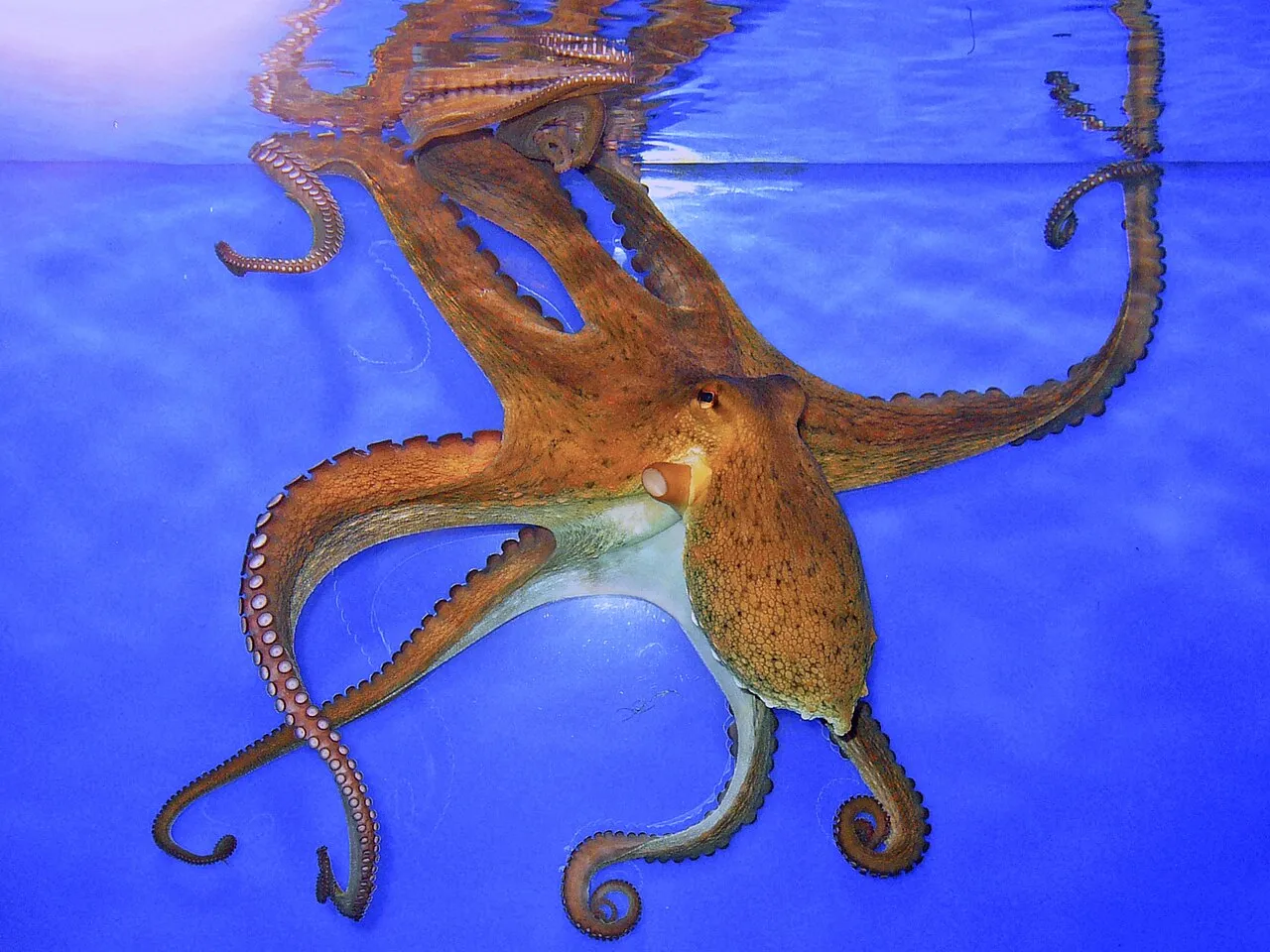
In the broad sense, the common octopus (the O. vulgaris complex) lives in temperate and tropical coastal waters of the Mediterranean, the eastern Atlantic from southern Britain to West Africa, and parts of the western Atlantic. The East Asian form (O. sinensis) lives off southern Korea and Jeju, Japan, China and Taiwan.
Common octopuses mostly live in coastal water shallower than about 100 metres, among rocks, reefs, seagrass and mixed sand and gravel. They make dens in crevices and holes, empty shells or discarded bottles and cans. Den entrances are often surrounded by middens of empty shells, crab carapaces and pebbles, which give away an octopus's home. An octopus may pull stones and shells across the entrance to close itself in.
The North Pacific giant octopus prefers much colder water, roughly 5 to 12 degrees Celsius, from the intertidal zone down to several hundred metres. In Korea the main fishing grounds are along the east coast of Gangwon and North Gyeongsang provinces.
Across the whole group, octopus habitats are astonishingly varied:
- Tropical reefs: mimic octopuses, blue-ringed octopuses and many other small species
- Temperate rocky coasts: common and giant octopuses
- Mudflats: burrowers such as the long-armed octopus
- Open-ocean mid-waters: transparent species such as the glass octopus
- The deep sea: dumbo octopuses, with records approaching 7,000 metres
- Polar seas: several species in the Southern Ocean
Almost all octopuses need full-strength seawater and avoid fresh or brackish water.
5. Body
An octopus body has three main parts: the mantle (the rounded sac usually mistaken for the head), the head and the arms. The mantle actually holds the internal organs; the true head, bearing the eyes and brain, sits between the mantle and the arms. 'Cephalopod' itself means 'head-footed'.
| Feature | Common octopus (O. vulgaris) | North Pacific giant octopus (E. dofleini) |
|---|---|---|
| Mantle length | About 15 to 25 cm | About 30 to 60 cm |
| Total size | Usually 60 cm to 1 m long; up to about 1.3 m | Arm span usually around 3 m; over 4 m reported |
| Weight | Usually 1 to 3 kg; up to around 10 kg | Usually 10 to 15 kg; over 50 kg recorded, with claims of 70 kg or more |
| Lifespan | About 1 to 2 years | About 3 to 5 years |
| Suckers | Two rows per arm, about 200 to 240 per arm | Two rows, around 280 per arm |
Maximum sizes for the giant octopus are hard to verify. Animals of several tens of kilograms are well documented, but older claims of more than 100 kilograms are generally unconfirmed.
5.1. Arms and suckers
Each of the eight arms is a boneless mass of muscle. Longitudinal, transverse and oblique muscle fibres are intricately interwoven, letting the arm extend, shorten, bend, twist and stiffen in almost any combination. This arrangement, called a muscular hydrostat, works on the same principle as an elephant's trunk or a human tongue.
The suckers are far more than suction cups. Each can move independently, and each is packed with sensory cells that let the octopus taste, smell and feel by touch. Research published around 2020 identified special receptors in octopus suckers that detect chemicals such as bitter compounds, allowing an octopus to probe crevices and 'taste' hidden prey it cannot see.
In mature males, the tip of one arm, the third right arm in many species, is modified into a hectocotylus, used to pass sperm packets to the female. Male common octopuses also have a few noticeably enlarged suckers. Lost arms can regrow.
5.2. Three hearts and blue blood
Octopuses have three hearts. Two branchial hearts pump blood through the gills to pick up oxygen, and a single systemic heart sends oxygenated blood around the body. Intriguingly, the systemic heart tends to pause when an octopus swims, which may be one reason octopuses prefer crawling to swimming.
Octopus blood is blue. Human blood is red because of iron-based haemoglobin, but octopuses carry oxygen with haemocyanin, a copper-based protein that turns blue when oxygenated. Haemocyanin is thought to have advantages for carrying oxygen in cold, low-oxygen water.
5.3. Beak, ink and skin
The only hard part of an octopus is its beak, located in the mouth at the centre of the arms. Shaped like a parrot's beak and made of chitin, it cracks crab shells and tears food. Behind it, a ribbon-like toothed tongue called the radula rasps flesh. With no other hard parts, an octopus can squeeze through any gap only slightly larger than its beak; even a large giant octopus can pass through a hole a few centimetres wide.
When threatened, an octopus squirts dark ink from its ink sac. The ink works as a smokescreen, and some studies suggest it also contains compounds that dull a predator's sense of smell.
Octopus skin contains countless chromatophores, elastic sacs of pigment, layered over reflective iridophores and leucophores. Because chromatophores are controlled directly by muscles and nerves, an octopus can change colour and pattern in under a second. By raising papillae, it can transform smooth skin into a bumpy surface resembling rock or seaweed in an instant.
5.4. Eyes and senses
Octopus eyes are large and sophisticated, with a lens and retina much like ours. Unlike the human eye, however, the optic nerve connects behind the retina, so octopuses have no blind spot. They can detect polarised light, but most species have only one type of visual pigment and are thought to be colour-blind. How a colour-blind animal achieves such precise colour-matching camouflage is a long-standing puzzle; proposed explanations include light-sensitive proteins in the skin and the possibility that their unusually shaped pupils extract some colour information.
6. Behaviour and ecology
Albert Kok at Dutch Wikipedia (Original text: Albert Kok) · Public domain
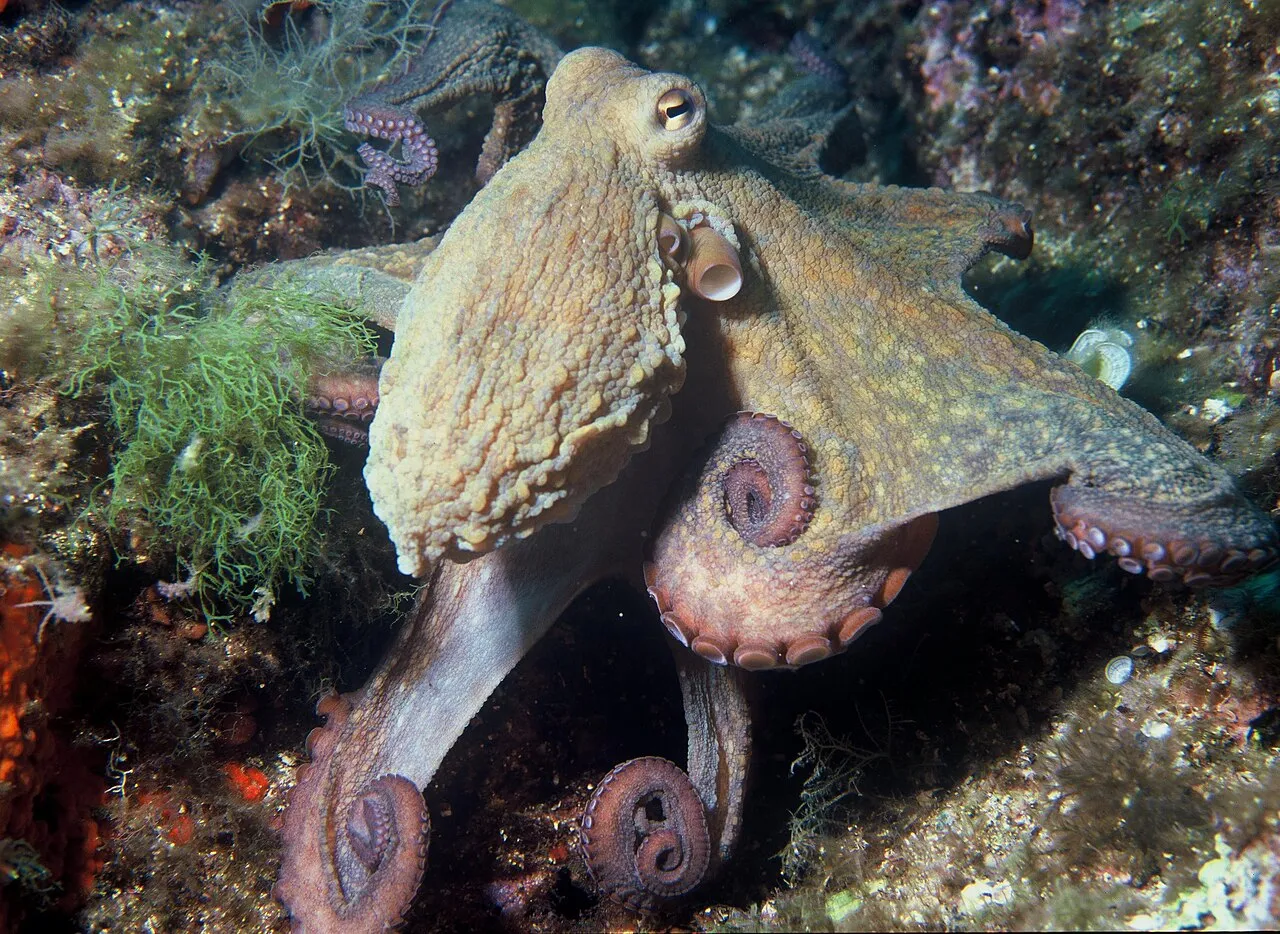
Common octopuses are mostly solitary. Each keeps its own den and forages around it. Activity patterns vary by species and place; common octopuses are often most active at dusk, night and dawn and rest in their dens by day, though where predators are few they also forage in daylight.
Octopuses prefer to crawl, walking on their arms across the bottom. When they need speed, they fill the mantle cavity with water and blast it out through the funnel, shooting backwards by jet propulsion. Jetting is fast but energetically costly, and because the systemic heart tends to stop during swimming, they cannot keep it up for long. Some species have been filmed 'walking' on two arms while wrapping the others around themselves to look like drifting algae or a rolling coconut.
Octopuses were long considered strictly solitary, but recent observations have surprised researchers. Off eastern Australia, sites have been found where many octopuses live in dens close together, nicknamed Octopolis and Octlantis. There, octopuses signal to each other with colour changes and have even been filmed apparently throwing shells and silt at neighbours.
In the Red Sea and elsewhere, octopuses hunt alongside fish: as an octopus probes crevices, groupers and wrasses wait to catch fleeing prey. A study published around 2024 found that the octopus often acts as the decision-maker in these partnerships and even punches fish that are not pulling their weight.
Octopuses show sleep-like rest. During quiet sleep they turn pale, but this is punctuated by brief bouts of 'active sleep' in which skin colours and patterns flicker rapidly and the eyes and arms twitch. Researchers have compared this to human REM sleep and cautiously speculate that octopuses might experience something like dreaming.
7. Diet and feeding
Octopuses are carnivorous hunters. Common octopuses favour crabs, shrimp and other crustaceans, and also eat clams, snails, abalone, small fish and other cephalopods. Giant Pacific octopuses eat crabs and clams too, but have also been recorded taking fish, other octopuses and even small sharks and seabirds.
Their hunting methods are varied:
- Ambush: lying camouflaged against rock and pouncing on crabs or fish that come close.
- Probing: reaching into crevices and burrows and tasting with the suckers to find hidden prey.
- Web-over: spreading the web of skin between the arms like an umbrella over a rock or clump of weed and grabbing whatever is trapped beneath.
- Pursuit: crawling or making short swims after prey.
Captured prey is cracked with the beak or pulled apart with the arms. For tightly closed shells, an octopus may force the valves open or drill a small hole using the radula and salivary secretions. Octopus saliva contains toxins that paralyse prey and enzymes that begin digesting the flesh. Nearly all octopuses are venomous to some degree, but only a few, such as blue-ringed octopuses, are dangerous to humans.
Octopuses often carry food back to the den to eat, so the middens outside a den form a record of past meals that researchers use to study diet. Common octopuses eat a few percent of their body weight a day and grow extremely fast, converting food into body mass with remarkable efficiency.
8. Reproduction and life cycle
Romano Gianluca · CC BY-SA 4.0
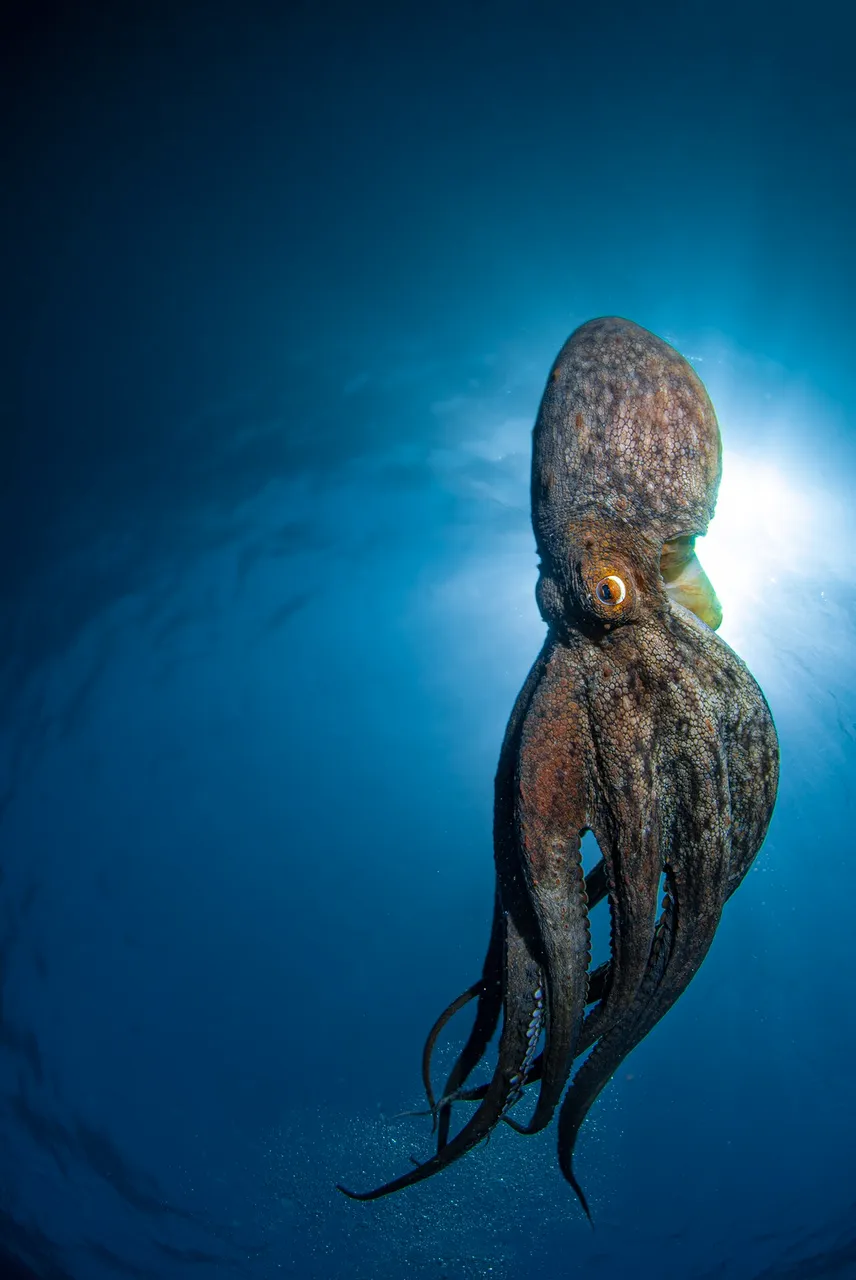
Octopus lives are short and dramatic. Most species breed only once and die afterwards.
During mating, the male uses his hectocotylus to place sperm packets, spermatophores, inside the female's mantle. Because females sometimes eat males, males of some species mate at arm's length or from on top of the female. The female stores the sperm and fertilises her eggs when she lays them.
A female common octopus hangs strings of tiny, rice-grain-sized eggs from the ceiling of her den like bunches of grapes. She may lay around 100,000 to 500,000 eggs. A female giant Pacific octopus lays fewer, larger eggs, roughly 20,000 to 100,000.
What follows is extraordinary devotion. The female stays in her den, stroking the eggs with her arms to keep them clean, jetting water over them for oxygen and driving off predators. She eats little or nothing during this time. By the time the eggs hatch, she is emaciated and soon dies. Males also decline and die within weeks or months of mating.
| Stage | Common octopus | Giant Pacific octopus |
|---|---|---|
| Brooding | About 25 to 65 days, up to around 4 months in cold water | About 5 to 7 months, longer in cold water |
| Eggs laid | About 100,000 to 500,000 | About 20,000 to 100,000 |
| Hatchlings | 2 to 3 mm, drifting plankton | About 6 to 10 mm, also drift for a time |
| Settlement on the bottom | About 1 to 2 months after hatching | Several months after hatching |
| Maturity | About 1 year | About 2 to 4 years |
| Lifespan | About 1 to 2 years | About 3 to 5 years |
Some deep-sea octopuses brood far longer. Off California, at about 1,400 metres, a female was observed guarding her eggs in the same spot for nearly four and a half years, the longest brooding period known for any animal.
The death after breeding has a biological basis. The optic gland, located between the eyes, regulates reproduction and ageing. Experiments in the 1970s found that removing the optic glands of brooding females caused them to abandon their eggs, resume feeding and live longer. Studies in the 2020s showed that after mating the optic gland dramatically changes production of substances linked to cholesterol metabolism, which may be part of the pathway to death. In other words, an octopus's death is less a matter of exhaustion than of a built-in programme.
9. Intelligence, communication and special abilities
Octopuses have the largest nervous systems of any invertebrate. A common octopus has around 500 million neurons, comparable to some mammals such as dogs and cats. Remarkably, about two-thirds of these neurons are not in the brain but distributed through the eight arms. Each arm's neural network can act with considerable independence, touching, tasting and making decisions without detailed instructions from the brain, which is why octopuses are sometimes described as having nine brains. Severed octopus arms have even been seen continuing to move and grasp food for a time.
9.1. Learning and problem-solving
Laboratory studies have revealed impressive abilities:
- Maze learning: octopuses learn and remember routes through mazes to reach food.
- Opening jars: they learn to unscrew lids to reach food inside, and have been filmed opening a jar from the inside while trapped in it.
- Observational learning: a 1990s Italian study reported that octopuses which watched another octopus choose a ball of a particular colour then made the same choice, though replication attempts have produced mixed results.
- Recognising individuals: octopuses can tell people apart. In one aquarium experiment, octopuses distinguished a keeper who fed them from one who poked them with a bristly stick, and squirted water only at the unpleasant one.
- Play: octopuses have been seen repeatedly pushing a floating bottle into a water current and catching it as it returned, behaviour that looks like play rather than foraging.
- Escapes: stories abound of captive octopuses slipping out of tanks to raid neighbouring tanks, or escaping to the sea through drainpipes.
9.2. Tool use
Footage filmed in Indonesia in 2009 astonished viewers: veined or coconut octopuses (Amphioctopus marginatus) carried discarded coconut shell halves under their bodies, stilt-walking across the sea floor, then assembled the halves into a shelter when threatened. Carrying an object for later use is widely cited as one of the clearest examples of tool use by an invertebrate. Common octopuses also actively use objects, gathering stones and shells to barricade their dens.
9.3. Camouflage and mimicry
Octopus camouflage is among the best in the animal kingdom. By changing colour, pattern, skin texture and posture all at once, an octopus can vanish against rock, coral, seaweed or sand. When threatened, it can do the opposite: darken, spread its arms to look larger or flash dark rings around its eyes to startle an attacker.
The mimic octopus (Thaumoctopus mimicus) of Indonesia and nearby waters goes further, impersonating other animals. It can flatten itself and swim like a flatfish, spread its banded arms to resemble a venomous lionfish, or hide in a burrow with just two arms showing to look like a sea snake, switching disguises to suit the situation.
Colour change also serves as communication. Studies suggest aggressive octopuses darken and stand tall, while those backing down turn pale. Octopuses also produce 'passing cloud' displays, dark bands rippling across the body, which may startle prey into moving and revealing itself.
9.4. Why so smart?
Octopus intelligence is a scientific puzzle. Complex cognition is usually linked to long lives, social groups and learning from parents, yet octopuses live a year or two, live alone and never meet their parents. Many researchers think octopus intelligence evolved instead as a response to a demanding lifestyle: protecting a shell-less body and finding a wide variety of prey in complex habitats. Controlling a body with almost unlimited degrees of freedom may also have required a large nervous system. Because octopuses reached high intelligence along a path entirely separate from vertebrates, they are an invaluable comparison for anyone asking what intelligence really is.
10. Predators and survival
Soft and nutritious, octopuses are prized prey for many ocean predators: moray and conger eels, groupers, sharks and rays, seals and sea lions, dolphins, otters and seabirds. In the North Pacific, sea otters, sea lions and seals eat giant octopuses, and sperm whales and some sharks are also known to take octopuses. Octopuses eat each other, too.
Their defences come in layers:
- Hiding: retreating into a den and blocking the entrance with stones.
- Camouflage: matching the colour and texture of the surroundings.
- Startle displays: sudden colour changes or spreading out to look bigger.
- Ink: a smokescreen, or a blob of ink roughly the size of the octopus left behind as a decoy.
- Jet escape: blasting away with a burst of water.
- Arm autotomy: some species can shed a seized arm and escape; the arm later regrows.
- Venom: blue-ringed octopuses carry tetrodotoxin, a potent nerve toxin that makes them dangerous to most predators.
Even so, most octopuses die young. Of hundreds of thousands of eggs, only a tiny fraction survive to settle on the bottom and breed, with most lost during the drifting larval stage.
11. Relationship with humans
11.1. Food and fisheries
Octopus is a cherished food in many cultures. Around the Mediterranean, in Spain, Portugal, Italy and Greece, boiled or grilled octopus with olive oil is a classic, from Galician pulpo to Greek grilled octopus. Japan is known for takoyaki, octopus-filled batter balls, as well as vinegared octopus and sushi. The coasts of Morocco and Mauritania in West Africa are among the world's major common octopus fishing grounds, and Mexico and Peru also land large catches.
A traditional fishing method exploits the octopus's love of dens: pots or jars are strung along a line on the sea floor, octopuses move in, and the pots are hauled up. Versions of this method are found in the Mediterranean, Japan and Korea. Octopuses are also caught with traps, hooks and trawls.
Global octopus catches run to hundreds of thousands of tonnes a year, and prices have risen steadily with demand.
11.2. Octopus in Korea
In Korea the octopus holds a special place. Its name, containing the character for letters and learning, made it a symbol of scholarship, a 'gentleman's fish' with its own ink. In parts of North Gyeongsang Province, especially around Andong, octopus is an essential dish on ancestral memorial tables and at feasts. Boiled octopus was also carved into elaborate shapes of flowers and phoenixes for weddings and 60th-birthday banquets, a craft known as muneo orim.
The east coast of Gangwon and North Gyeongsang provinces is the main source of giant octopus. Large octopuses are boiled whole and thinly sliced, and they also go into ramen, stir-fries and porridge. Add the south coast's common octopus, the mudflat long-armed octopus nakji and the spring delicacy jukkumi, and Korea enjoys a wide range of octopus species. Sannakji, freshly cut live long-armed octopus, is famous but carries a real choking risk, since the suckers can stick in the throat.
Korean expressions borrow the octopus too: a conglomerate expanding recklessly into many industries is said to grow 'octopus-leg style', and a power strip loaded with plugs is an 'octopus-leg outlet', both inspired by the image of arms reaching in all directions.
11.3. Dangerous octopuses
Most octopuses pose little danger to people; a bite hurts and may swell. Blue-ringed octopuses of Australia and the western Pacific are the exception. Only 10 to 20 centimetres long, they carry tetrodotoxin, the same toxin found in pufferfish, and a bite can cause paralysis and respiratory failure. There is no antidote, so first aid such as rescue breathing is vital. Blue-ringed octopuses have recently been reported off Korea's south coast and Jeju, so it is wise never to pick up small octopuses with bare hands.
11.4. Pain and animal welfare
As evidence has mounted that octopuses can feel pain, debate about how we treat them has intensified. Octopuses guard injured body parts, avoid places where they were hurt and show reduced pain behaviour when given anaesthetic. The European Union included cephalopods in its 2010 directive on animals used in scientific research, and in the United Kingdom, following a government-commissioned review in 2021, octopuses and other cephalopods were recognised as sentient beings under the Animal Welfare (Sentience) Act 2022.
This has prompted criticism of boiling octopuses alive and of eating them alive. Plans for large-scale octopus farming, notably in Spain, sparked international controversy over whether it is ethical to confine an intelligent, solitary animal in crowded tanks, and some US states have passed laws banning octopus farming.
12. Conservation
The common octopus (Octopus vulgaris) is listed as Least Concern on the IUCN Red List, reflecting its wide range and high reproductive output. Many other octopus species, including the giant Pacific octopus, have not been assessed or lack sufficient data. Short-lived and fast-growing, octopus populations can swing widely from year to year with environmental conditions.
Locally, though, there are warning signs. Off West Africa, overfishing severely depleted octopus stocks, and closed seasons and catch limits were introduced to help them recover. In Korea, giant octopus catches along the east coast fluctuate considerably, and the need for better stock management is regularly raised. Korean rules prohibit landing octopuses below a minimum weight, and some regions have spawning-season closures; details change with regulations, so current rules should be checked.
Main threats include:
- Overfishing and catching undersized animals
- Habitat damage from bottom trawling
- Coastal development and pollution
- Range shifts with ocean warming, which may also benefit some species
- Ocean acidification
Intriguingly, some studies suggest that cephalopod populations worldwide have actually increased over recent decades, possibly because overfishing has removed competing and predatory fish and because warmer water favours fast-growing cephalopods. What this shift means for ocean ecosystems as a whole is still being studied.
In Korea, octopuses are managed as a fishery resource rather than protected as threatened species.
13. In aquariums
Octopuses are popular exhibits in aquariums worldwide, and giant Pacific octopuses in particular draw crowds with their size and strangeness. Captive octopuses are also important to science; much of what we know about octopus learning, sleep and individual personality comes from observing them in aquariums and laboratories.
Keeping octopuses presents particular challenges:
- Escape-proofing: octopuses can slip through tiny gaps, so lids and plumbing must be thoroughly secured.
- Preventing boredom: intelligent octopuses suffer in barren tanks, so aquariums run enrichment programmes, offering food inside jars and puzzle toys.
- Water conditions: giant octopuses need cold water, and all octopuses are sensitive to water quality.
- Short lives: exhibits need regular replacement as animals age and die.
There are ethical questions too: whether such curious, intelligent animals should live in tanks at all, and whether it is acceptable to keep taking wild animals for display. Some aquariums return octopuses to the sea after a period on exhibit.
Keeping an octopus at home is hard to recommend. Escapes and water quality are difficult to manage, providing enough stimulation is challenging, and the animal will die within a short time. Venomous species such as blue-ringed octopuses are genuinely dangerous.
14. In culture
Octopuses have captivated human imagination for millennia. Minoan pottery from ancient Crete features octopuses with arms swirling across the surface. The Kraken of Norse legend, a monster that wraps around ships and drags them under, is thought to have been inspired by giant squid and octopuses. Victor Hugo's novel Toilers of the Sea includes a famous struggle between the hero and a giant octopus, and Jules Verne's Twenty Thousand Leagues Under the Seas features a battle with giant cephalopods.
In Japan, octopuses appear in Edo-period woodblock prints, including works by Hokusai, and are commonly portrayed as playful, friendly characters; a cheerful octopus wearing a headband is a fixture on takoyaki shop signs.
In modern popular culture, the octopus is the template for the alien. The Martians of H. G. Wells's The War of the Worlds were described as octopus-like, countless science-fiction aliens sport tentacles, and H. P. Lovecraft's Cthulhu has an octopus-like head. The aliens of the 2016 film Arrival, with their seven limbs, also evoke cephalopods.
Animated octopuses include Hank, the camouflaging escape artist of Finding Dory, and Squidward of SpongeBob SquarePants, who despite his name is an octopus (drawn with six limbs). The 2020 documentary My Octopus Teacher, following a man's year-long relationship with a wild octopus in a South African kelp forest, won the Academy Award for Best Documentary Feature and changed how many people see octopuses.
During the 2010 FIFA World Cup, an octopus at a German aquarium became a global sensation for 'predicting' match results. In Korea, octopuses star in east coast festivals and appear in children's media as wise teacher figures.
15. Trivia
- Biologists call an octopus's limbs arms; the term tentacles is reserved for the two long feeding appendages of squid and cuttlefish, though everyday speech blurs the distinction.
- Octopus suckers do not readily stick to the octopus's own skin; research suggests a chemical in the skin inhibits the sucker's grabbing reflex.
- An octopus brain is doughnut-shaped and wraps around the oesophagus, so swallowing something too large could damage it. Octopuses tear food into small pieces.
- Octopuses show arm preferences, favouring certain arms for certain tasks, a bit like left- and right-handedness in people.
- Because chromatophores are muscle-controlled, electrically stimulating the skin of a dead octopus can make its colours flicker.
- Aquarists often describe individual giant Pacific octopuses as having distinct personalities, and scientific studies have documented consistent individual differences in behaviour.
- The short octopus lifespan is a common lament among researchers, who sometimes joke about what octopuses might achieve if they lived for decades.
- On Korea's east coast, winter to spring is considered peak season for giant octopus, when animals of tens of kilograms sometimes appear at Gangwon fish auctions.
- Studies show octopus skin can sense light, so octopuses respond to light even when their eyes are covered.
Wild animals are not pets. Catching, trading or keeping them is illegal in most places. If you find an injured wild animal, call your local wildlife rescue centre.
FAQ
What is the difference between Korean muneo and chammuneo?
In Korea, muneo usually means the large North Pacific giant octopus (Enteroctopus dofleini) of the east coast. Chammuneo is the smaller south coast octopus, traditionally called Octopus vulgaris, though the East Asian form is now often treated as O. sinensis.
Are octopuses really that smart?
Yes. They have around 500 million neurons and have been shown to learn mazes, open jars, recognise individual people and use tools, reaching high intelligence along a path entirely separate from vertebrates.
Are octopuses dangerous?
Most are not, but blue-ringed octopuses carry tetrodotoxin and their bite can be fatal. They have been found off southern Korea and Jeju, so never handle small octopuses with bare hands.
Photo credits
Photos are freely licensed images from Wikimedia Commons. Authors and licenses are listed below.
- Octopus2.jpg — albert kok · CC BY-SA 3.0
- Common octopus.jpg — Martijn Klijnstra · CC BY-SA 4.0
- Octopus vulgaris 02.JPG — H. Zell · CC BY-SA 3.0
- Octopus vulgaris 2.jpg — Albert Kok at Dutch Wikipedia (Original text: Albert Kok) · Public domain
- Polpo nella Riserva naturale statale Torre Guaceto - DSC 0788M.jpg — Romano Gianluca · CC BY-SA 4.0