TailVille
1. Overview
A horse wrapped head to hoof in black and white stripes: the plains zebra (Equus quagga) is the animal most people picture when they hear the word zebra. Of the three living zebra species, the plains zebra, Grévy's zebra and the mountain zebra, it is by far the most numerous and widespread, so most zebras in zoos and documentaries are of this species. It is also known as the common zebra or Burchell's zebra.
Plains zebras belong to the genus Equus, alongside horses and donkeys. In East Africa's Serengeti and Maasai Mara they are stars of the Great Migration, trekking hundreds of kilometres each year with wildebeest, and they are a familiar sight on the grasslands and savannas of southern Africa too. Each family consists of one stallion with several mares and their foals, and many families gather into herds that can number in the thousands.
Why zebras have stripes has puzzled biologists since Darwin's day. Ideas have included confusing predators, regulating temperature and helping individuals recognise each other; in recent years, deterring blood-sucking flies has emerged as the best-supported explanation. Hundreds of thousands of plains zebras remain, but because numbers are falling, the IUCN classified the species as Near Threatened in 2016.
2. Name and classification
Bernard DUPONT from FRANCE · CC BY-SA 2.0
The origin of the word zebra is uncertain. A common explanation is that it comes from a Portuguese or Spanish word for a wild ass, itself possibly derived from a Latin term for a wild horse, applied by Portuguese explorers to the striped horses they met in Africa.
The species name quagga was originally the name of the quagga, a now-extinct zebra of South Africa, and is said to come from a Khoikhoi word imitating its call. The quagga and plains zebra were once considered separate species, but the quagga turned out to be a southern subspecies of the plains zebra. Under the rules of zoological naming, the older name, quagga, became the scientific name of the whole species. So the name of an extinct animal now represents all living plains zebras.
The Korean name eollungmal is a native word meaning 'spotted horse'; the prefix savanna distinguishes this species from other zebras.
2.1. Three zebras and their subspecies
'Zebra' is not a single natural group but a common name for three species within Equus. They look alike at a glance but differ in stripes and lifestyle.
| Species | Range | Features | IUCN |
|---|---|---|---|
| Plains zebra | Eastern and southern Africa | Broad stripes extending onto belly; shadow stripes common | NT |
| Grévy's zebra | Northern Kenya, Ethiopia | Largest; narrow, dense stripes; big rounded ears | EN |
| Mountain zebra | Mountains of Namibia and South Africa | Dewlap on throat; grid-iron pattern on rump | VU |
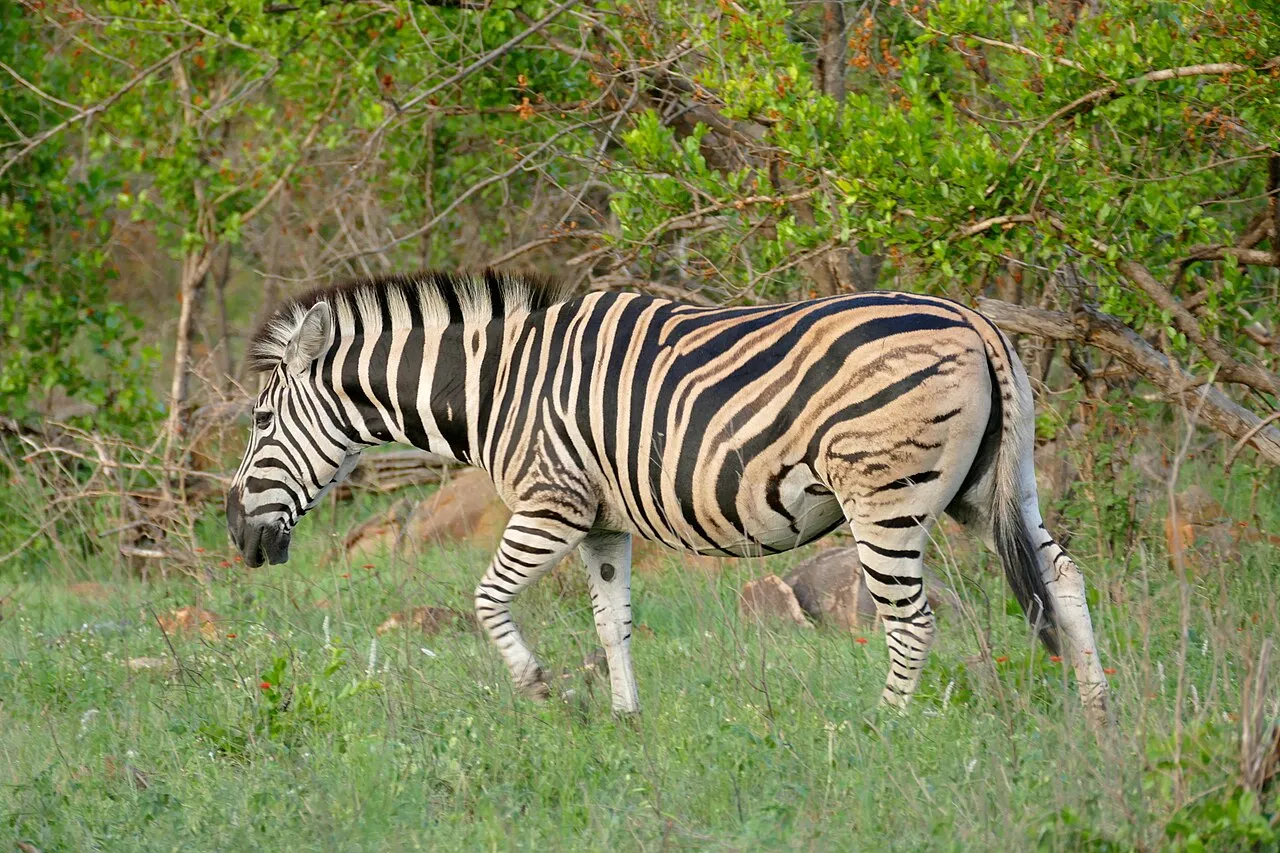
Within the plains zebra, stripe patterns change across the range. Northern animals have bold stripes reaching down to the hooves, while southern ones have paler stripes, brownish 'shadow stripes' between the black ones and faint or absent leg stripes. The extreme was the quagga, whose hindquarters were almost unstriped. Commonly cited subspecies include:
| Subspecies | Range |
|---|---|
| Grant's zebra | East Africa, including Tanzania and Kenya |
| Crawshay's zebra | Zambia, Malawi area |
| Selous' zebra | Southern Tanzania, northern Mozambique |
| Chapman's zebra | Zimbabwe, Botswana, northern Namibia |
| Burchell's zebra | Northern South Africa and nearby |
| Quagga | Karoo, South Africa (extinct late 19th century) |
Experts disagree on how many subspecies to recognise, and recent genetic work suggests differences are modest and change gradually from north to south.
3. Evolution
Horse evolution is one of the best-documented stories in the fossil record and a textbook favourite. The earliest horse relatives, living around 55 million years ago in North America and Europe, were fox-sized forest browsers with several toes. Over tens of millions of years, as climates dried and grasslands spread, horse ancestors grew larger, their legs lengthened, their toes reduced to a single hoof, and they developed high-crowned teeth for grinding tough grass.
The genus Equus arose in North America around 4 to 4.5 million years ago, then crossed the Bering land bridge into Asia, Europe and Africa, where some lineages evolved into zebras. Genetic studies show zebras are more closely related to asses than to horses. Estimates of when the three zebra species split range from a few hundred thousand to one or two million years ago. Ironically, wild horses disappeared from North America, the genus's birthplace, around 10,000 years ago, only to be reintroduced by Europeans.
When and how many times stripes evolved is still debated. All three zebras are striped, but their patterns develop slightly differently, so it is unclear whether their common ancestor was striped or stripes arose separately. Some donkeys and horses show faint leg stripes, hinting that the genetic toolkit for stripes is old within the horse family.
4. Range and habitat
Charles J. Sharp · CC BY-SA 4.0
Plains zebras range widely across eastern and southern Africa, from South Sudan and southern Ethiopia through Kenya and Tanzania, south to northern and eastern South Africa, and west to Angola and northern Namibia. Tanzania, Kenya, Botswana, Zimbabwe, Zambia and South Africa hold large populations.
As their name suggests, they favour grassland and lightly wooded savanna, from short to tall grass, and also use open woodland edges and scrub. Because they need to drink daily, they rarely stray far from water, typically staying within roughly 10–15 km of a water source. They have been recorded above 4,000 metres on high plateaus.
Their range remains comparatively broad, but they have disappeared from countries such as Lesotho and Burundi, and the quagga of southern South Africa was wiped out entirely by the late 19th century. Farm expansion and fences are cutting migration routes, trapping herds that once roamed hundreds of kilometres. In Botswana, the removal of veterinary fences reopened an old route, and zebras were tracked making a round trip of about 500 km between Namibia and Botswana, among the longest recorded land migrations in Africa.
5. Body
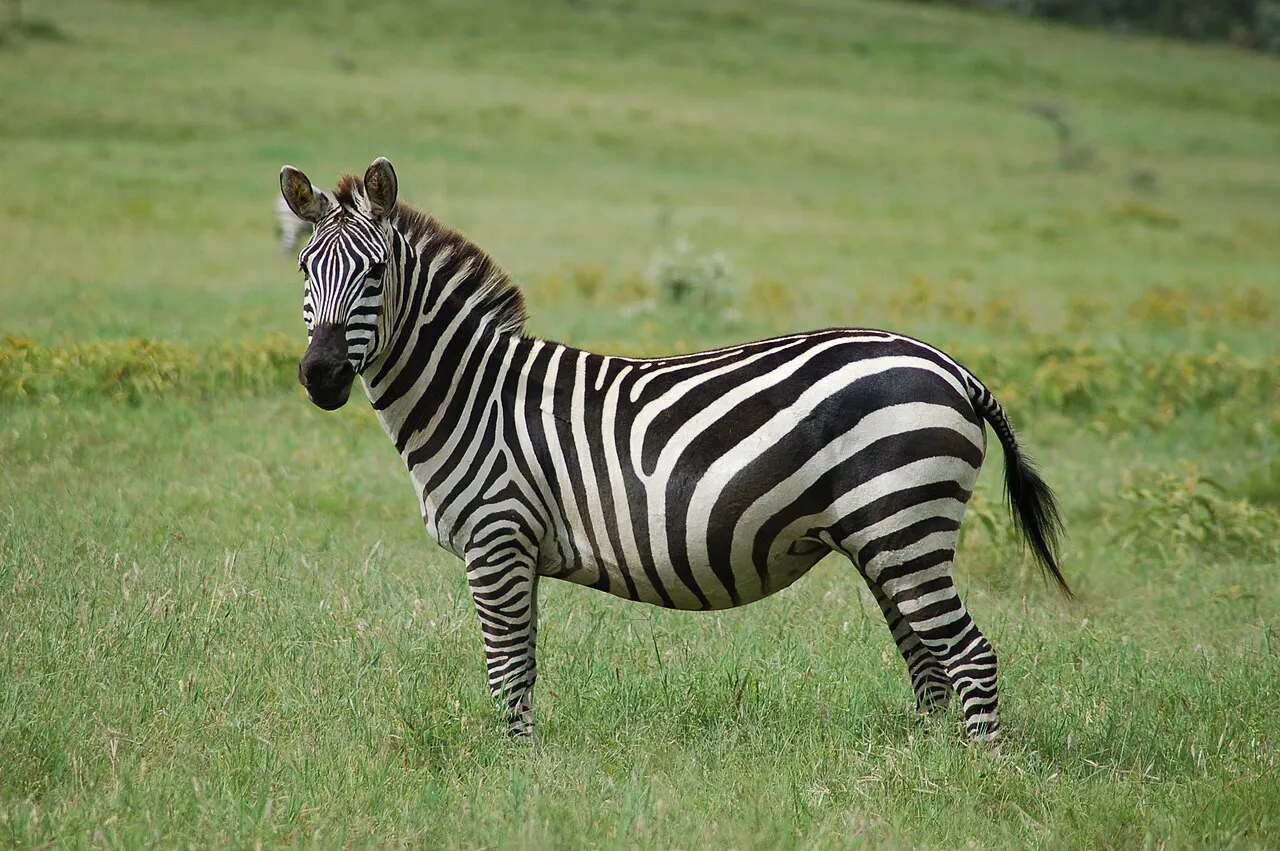
Plains zebras are stocky and relatively short-legged, rather like ponies. A short, upright mane runs along the neck, striped like the rest of the body, and the tail ends in a tuft of long hair. The ears are medium-sized and pointed. Males are about 10% larger than females.
| Measure | Value |
|---|---|
| Shoulder height | about 1.1–1.45 m |
| Body length | about 2–2.5 m |
| Tail | about 45–56 cm |
| Weight | about 175–385 kg (males heavier) |
| Top speed | about 55–65 km/h |
Zebra hooves are hard and wear-resistant. Upper and lower incisors crop grass neatly, and high, broad molars grind tough stems. Unlike cattle, zebras do not chew the cud; instead, microbes in the caecum, part of the large intestine, ferment plant fibre. This hindgut digestion is less efficient but lets food pass quickly, so zebras can eat large amounts of coarse, low-quality grass.
5.1. The mystery of stripes
Each zebra's stripe pattern is unique, working like a fingerprint. Researchers identify individuals from photos, and mothers and foals recognise each other by stripes, scent and voice. Shave a zebra and the skin underneath is mostly dark; stripes form where hair follicles alternately produce and withhold melanin.
Several hypotheses have been proposed for the stripes:
- Predator confusion: a running herd's stripes blur together, making it hard for a lion to single out one animal. Critics note that lions probably cannot resolve stripes well at a distance and seem to hunt zebras without much trouble.
- Temperature control: black and white stripes heat differently, perhaps creating small air currents that cool the body. Zebras in hotter regions do tend to be more boldly striped, but experiments give mixed results.
- Social signalling: stripes help zebras recognise and bond with each other.
- Fly defence: blood-sucking horseflies and tsetse flies struggle to land on striped surfaces.
Fly defence currently has the strongest support. In an experiment on a British farm, horses wearing zebra-striped coats were approached by horseflies, which then failed to land far more often, apparently unable to slow down properly and either bumping into or overshooting the coat. African biting flies carry diseases, and zebras' short coats make them easy targets, so this defence could matter a great deal. Stripes may well serve more than one function, however.
6. Behaviour and ecology
Joachim Huber 2007-2025 (R.I.P.) · CC BY-SA 2.0
The basic unit of plains zebra society is the harem: one stallion with about one to six mares and their foals, a family that may stay together for years or even for life. Mares have their own hierarchy; on the move the top-ranking mare leads while the stallion brings up the rear and guards the group. Stallions without families form bachelor groups, building strength until they can challenge a harem stallion or lure away young mares to start a family of their own.
Many harems and bachelor groups merge into herds of hundreds or thousands, yet each family stays together within the crowd. This multi-level society has been compared to those of elephants and some primates. Plains zebras do not defend territories, instead roaming widely in search of grass and water as the seasons change.
In the Serengeti–Mara ecosystem, roughly 200,000–300,000 zebras travel alongside more than a million wildebeest and hundreds of thousands of gazelles in a great clockwise loop each year. They give birth on the short-grass plains of southern Tanzania in the rains, then move north into Kenya's Maasai Mara as the dry season sets in. Crossings of the Mara River, with crocodiles and powerful currents, are perilous and among the most famous scenes in wildlife film.
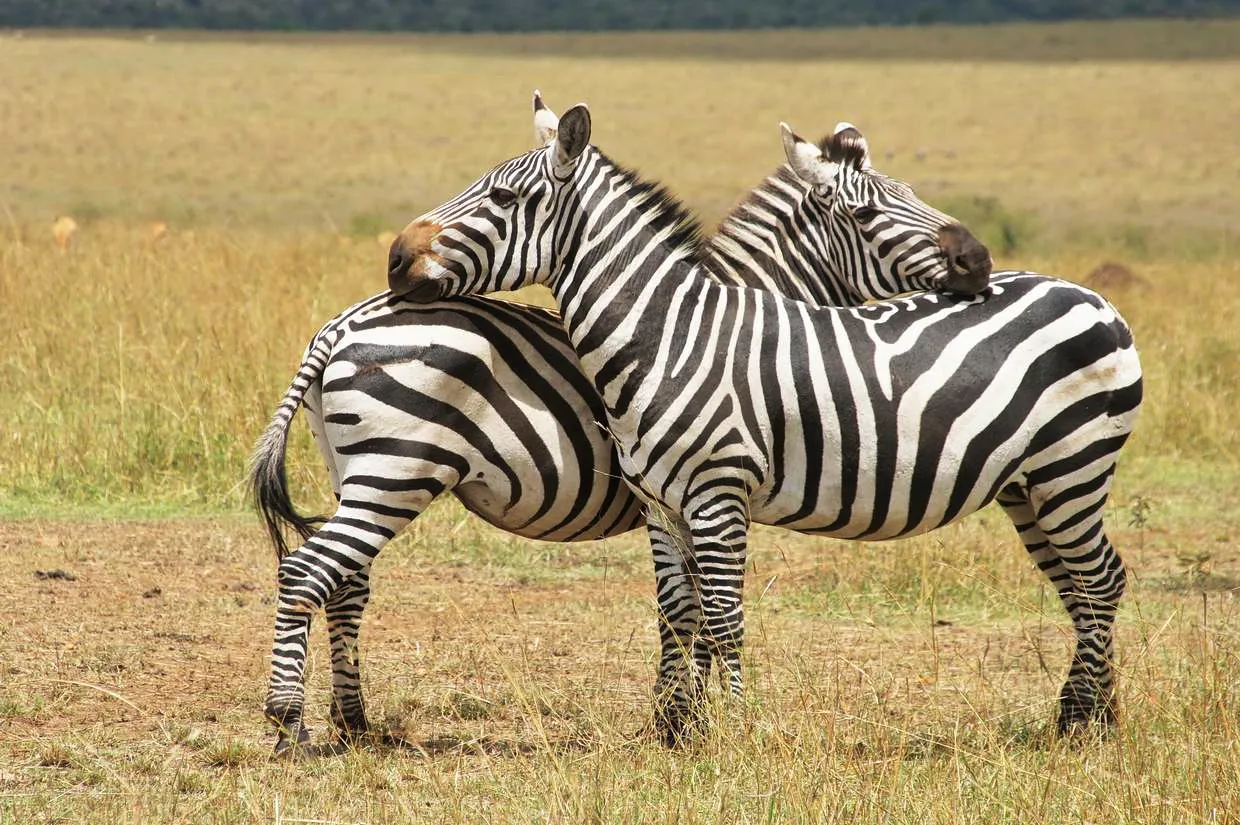
Zebras strengthen bonds through mutual grooming, nibbling each other's coats. Pairs often stand head-to-tail so each can swish flies from the other's face. They usually sleep standing up, and some lie down briefly while others keep watch.
7. Diet and feeding
Plains zebras are grazers: more than 90% of their diet is grass, supplemented occasionally by leaves, shoots, twigs, bark and roots. They spend more than half of each day, often 60–80% of their time, feeding.
Zebras are especially good at eating the tough upper parts of tall, coarse grasses. Their fast but less efficient digestion lets them process large volumes of low-quality stems that other grazers find hard to use. This benefits other species too: zebras crop the tall tops, exposing the tender leaves below for wildebeest, which in turn expose short new growth favoured by Thomson's gazelles. This sequence of grazers using different layers is known as a grazing succession.
Zebras need to drink at least once a day, so they visit water holes often. In the dry season they travel long distances for water and may dig into dry riverbeds with their hooves. They also lick salty soil to obtain minerals.
8. Reproduction and life cycle
Duvignau Alain · CC0
Plains zebras can give birth year-round, but in many areas births peak in the grass-rich rainy season. When a young mare comes into her first oestrus at about one to two years old, she adopts a distinctive posture that attracts stallions, and males from other families often fight to abduct her. This dispersal of young females to new families helps avoid inbreeding.
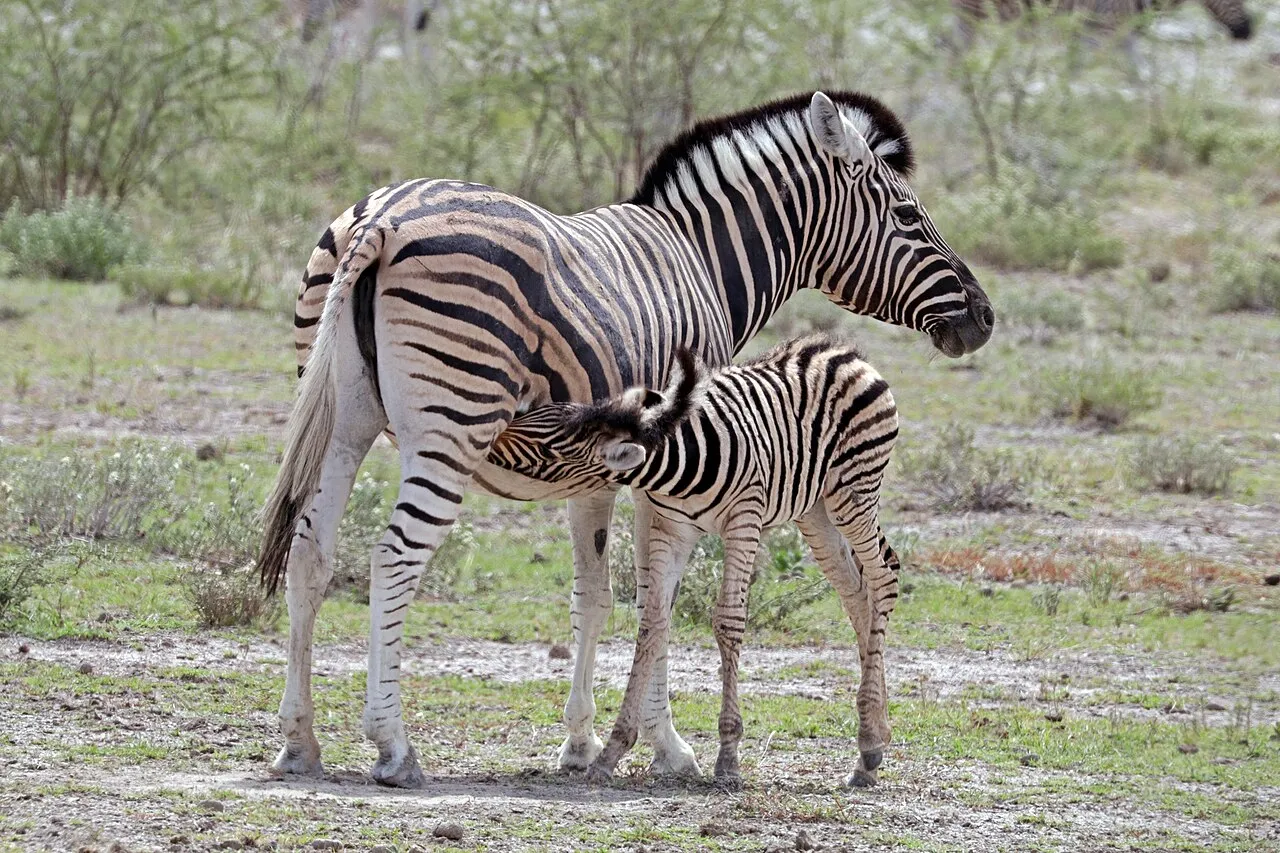
Gestation lasts about 12–13 months (roughly 360–390 days). A single foal weighing about 30–35 kg is born, stands within 15 minutes, walks and suckles within an hour and can run with its mother a few hours later. For the first few days the mother keeps other zebras away so the foal imprints firmly on her stripes, scent and voice. A foal's stripes are brownish at first and darken as it grows.
| Stage | Age | What happens |
|---|---|---|
| Newborn | 0–1 week | Mother keeps others away while the foal imprints |
| Suckling | 1 week–7 months | Starts grazing after a few weeks |
| Weaning | about 7–11 months | Grass only; stays with the family |
| Independence | 1–3 years | Females move to other families, males to bachelor groups |
| First breeding | Females 2–3 yrs, males after 4–5 | Males must win a family to breed |
Foals are heavily preyed upon by lions, hyenas, wild dogs and cheetahs, and first-year mortality is high. Wild zebras typically live 20–25 years, and captive ones sometimes pass 30.
9. Intelligence, communication and special abilities
Zebras make a far wider range of sounds than horses. Their signature call is a barking, braying 'kwa-ha', sometimes described as a cross between a donkey's bray and a dog's bark, used to contact family members and find scattered companions. A short, sharp snort warns of danger, and a soft blowing sound signals contentment.
Facial expressions and body language matter too. Ears pricked forward show curiosity or alertness; ears pinned back signal aggression. Young zebras show submission to adults by opening their mouths, exposing their teeth and making chewing motions. Zebras greet each other by sniffing faces, and their tails also express mood.
Zebras have keen eyesight and hearing and see fairly well at night. Living in groups means many eyes and ears are on watch, so predators are spotted much sooner than by a lone animal. They also have good memories, recalling water sources and migration routes used long before and recognising family members for years.
10. Predators and survival
The plains zebra's chief predator is the lion; in many areas zebras rank alongside wildebeest and buffalo as the lion's most important prey. Spotted hyenas hunt zebras in packs, while African wild dogs, leopards and cheetahs mostly target foals and young animals. At river crossings, Nile crocodiles are a serious threat.
Zebras are far from easy prey. A powerful kick from the hind legs can break a lion's jaw or teeth, sometimes leading it to starve, and zebras bite hard too. A family stallion places himself between predators and his group, and zebras from different families have been seen ringing foals to protect them. When fleeing, zebras zigzag to make pursuit harder.
Herd life is a strong defence: among thousands of animals, each individual's risk drops and more eyes keep watch. Zebras often travel with wildebeest, and it is sometimes suggested that the two complement each other, zebras with good eyesight and wildebeest with sharp hearing and smell. Zebra alarm calls alert other grazers as well.
Disease and drought also take a toll. In Namibia's Etosha National Park, anthrax has been studied as a significant cause of zebra deaths.
11. Relationship with humans
African peoples have hunted zebras for meat and hides for millennia, and zebras appear in San rock art in southern Africa. With European colonisation, hunting escalated dramatically, both for hides and meat and to clear grazing land for livestock.
The most tragic result was the extinction of the quagga. This distinctive zebra of South Africa's Karoo and grasslands was boldly striped only on the head and neck, fading to plain brown behind. Settlers saw quaggas as competitors for livestock grazing and shot them in huge numbers, using the hides for grain sacks and leather goods. The last wild quaggas probably vanished in the 1870s, and the last known individual died at Amsterdam Zoo in 1883, apparently without anyone realising it was the last of its kind.
In 1984 researchers extracted DNA from a museum quagga specimen, one of the first times DNA was recovered from an extinct animal. The work showed the quagga was a subspecies of the plains zebra, inspiring South Africa's Quagga Project, launched in 1987, which selectively breeds plains zebras with reduced striping to recreate the quagga's appearance. Animals with almost unstriped hindquarters, called Rau quaggas, have been produced, though critics point out that resembling a quagga is not the same as bringing one back.
There were attempts to domesticate zebras. In the late 19th century the British banker and zoologist Walter Rothschild famously drove a carriage pulled by zebras through London. In colonial Africa, where horses succumbed to tsetse-borne disease, people experimented with zebras as working animals, but their nervous, aggressive temperament defeated the effort. Zebras can hybridise with horses and donkeys, producing 'zebroids' such as the zonkey, which are usually sterile.
In March 2023 a zebra broke out of its enclosure at a Seoul zoo and wandered city streets for several hours before being recaptured, prompting public discussion in Korea about captive conditions and animal stress.
12. Conservation
In its 2016 assessment the IUCN moved the plains zebra from Least Concern to Near Threatened. It estimated a total of around 500,000 animals, a decline of roughly 25% from about 660,000 in the early 2000s. The trend varies greatly: some protected populations are stable or growing while others have fallen sharply. The number of mature individuals is lower, and recent surveys are lacking in many areas, so figures differ between sources.
The main threats are:
- Hunting and poaching for meat and hides, especially outside protected areas and in unstable regions.
- Habitat loss as farmland and settlements expand.
- Blocked migration routes caused by fences, roads and farms.
- Competition with livestock for grass and water.
- Drought and climate change.
The plains zebra is still common overall, but the fate of the quagga shows how quickly even a familiar animal can vanish. Managing protected and transfrontier conservation areas, keeping migration corridors open and ensuring local communities benefit from wildlife tourism are all key. In South Africa and Namibia, zebras are also managed on private reserves and game ranches.
The plains zebra is not listed on CITES, whereas Grévy's zebra is on Appendix I and the mountain zebra on Appendix II.
13. In zoos
Plains zebras are common in zoos and breed readily. They are often shown in mixed 'African savanna' exhibits alongside giraffes, ostriches and antelopes, which gives visitors a more natural picture and provides the animals with stimulation.
Zebras are herd animals, though, and one or two kept alone easily become stressed. In the wild they live within families and large herds, so they should be kept in groups. Zebras that lose a mate or family member may show anxious behaviour or try to escape. They are also nervous and easily startled by sudden noises or movements, sometimes injuring themselves on fences, so ample space, places to retreat and a proper group size are essential.
In the wild, zebra hooves wear down naturally; in captivity they can overgrow and need trimming. Because zebras cannot be handled like horses, hoof care and veterinary checks often require sedation.
14. Zebras in culture
Zebra stripes are a powerful design in their own right. In Britain, striped pedestrian crossings are called zebra crossings, and black-and-white 'zebra print' is a staple of fashion and interior design. Barcodes are sometimes compared to zebra stripes too.
In animation, Marty, the chatty zebra of DreamWorks' Madagascar who dreams of the wild, is a favourite, and zebras appear in The Lion King and Zootopia. The film Racing Stripes tells the story of a zebra who wants to be a racehorse.
Medical students learn the maxim 'when you hear hoofbeats, think horses, not zebras', meaning common symptoms usually have common causes. As a result, English speakers sometimes call patients with rare diseases 'zebras', and rare-disease organisations have adopted the zebra as a symbol. Referees in black-and-white striped shirts are nicknamed zebras in some sports, and Italian football club Juventus is known as the Zebras for its striped kit.
The zebra is the national animal of Botswana, whose coat of arms shows two zebras supporting a shield, and the animal's harmony of black and white is often read as a symbol of racial unity.
15. Trivia
- A group of zebras is sometimes called a 'dazzle', after the bewildering effect of so many stripes.
- Rarely, zebras are born with spots instead of stripes or are almost entirely dark. In 2019 a black foal with white spots was photographed in Kenya's Maasai Mara, the result of a genetic condition affecting pigment distribution.
- Pale 'blonde' zebras with partial loss of pigment have also been seen occasionally.
- First World War 'dazzle camouflage' painted bold, clashing patterns on warships to make their size, speed and heading hard to judge. Whether zebras directly inspired it is uncertain, but the comparison is often made.
- Stripes on the rump change direction and become horizontal, and the pattern there differs between zebra species, helping identification.
- Zebras often appear to yawn, which may relate more to tension or social signalling than to tiredness.
- A zebra's stripes continue right onto the mane, which stands upright rather than falling over the neck like a horse's.
Wild animals are not pets. Catching, trading or keeping them is illegal in most places. If you find an injured wild animal, call your local wildlife rescue centre.
FAQ
Is a zebra white with black stripes, or black with white stripes?
The skin underneath is mostly dark, and the white stripes are areas where hair pigment is switched off. So biologically it is closer to black with white stripes.
Why were zebras never domesticated?
Having evolved among lions and hyenas, zebras are nervous, quick to bite and kick, and hard to calm. A few were trained to pull carts in the 19th century, but they never became workable like horses.
Is the plains zebra endangered?
In its 2016 assessment the IUCN moved it to Near Threatened. Hundreds of thousands remain, but numbers are estimated to have fallen by roughly a quarter since the early 2000s. Grévy's zebra is Endangered and the mountain zebra Vulnerable.
Photo credits
Photos are freely licensed images from Wikimedia Commons. Authors and licenses are listed below.
- Equus quagga burchellii - Etosha, 2014.jpg — Yathin S Krishnappa · CC BY-SA 3.0
- Burchell's Zebra (Equus quagga burchellii) (15844593253).jpg — Bernard DUPONT from FRANCE · CC BY-SA 2.0
- Burchell's zebra (Equus quagga burchellii) suckling.jpg — Charles J. Sharp · CC BY-SA 4.0
- Equus quagga.jpg — Joachim Huber 2007-2025 (R.I.P.) · CC BY-SA 2.0
- Equus quagga (185908025).jpg — Duvignau Alain · CC0