TailVille
1. Overview
The common raccoon dog is a member of the dog family native to East Asia. Its black facial mask invites constant confusion with the North American raccoon, but the two are unrelated: the raccoon belongs to the family Procyonidae, while the raccoon dog is a canid, a cousin of wolves and foxes. With short legs, a rotund body and shaggy fur, it looks unlike any other dog.
In Korea it is one of the most familiar wild mammals, living around wooded hills, rice paddies, streams and even city parks, and it is one of the most frequent victims of night-time road traffic. Unusually for a canid, it slows down dramatically in winter and spends cold spells resting in a den.
It is common across its native range and listed as Least Concern by the IUCN. In the twentieth century, however, the Soviet Union released thousands into its European territories for fur, and the species has since spread across much of Europe as an invasive animal.
2. Name and classification
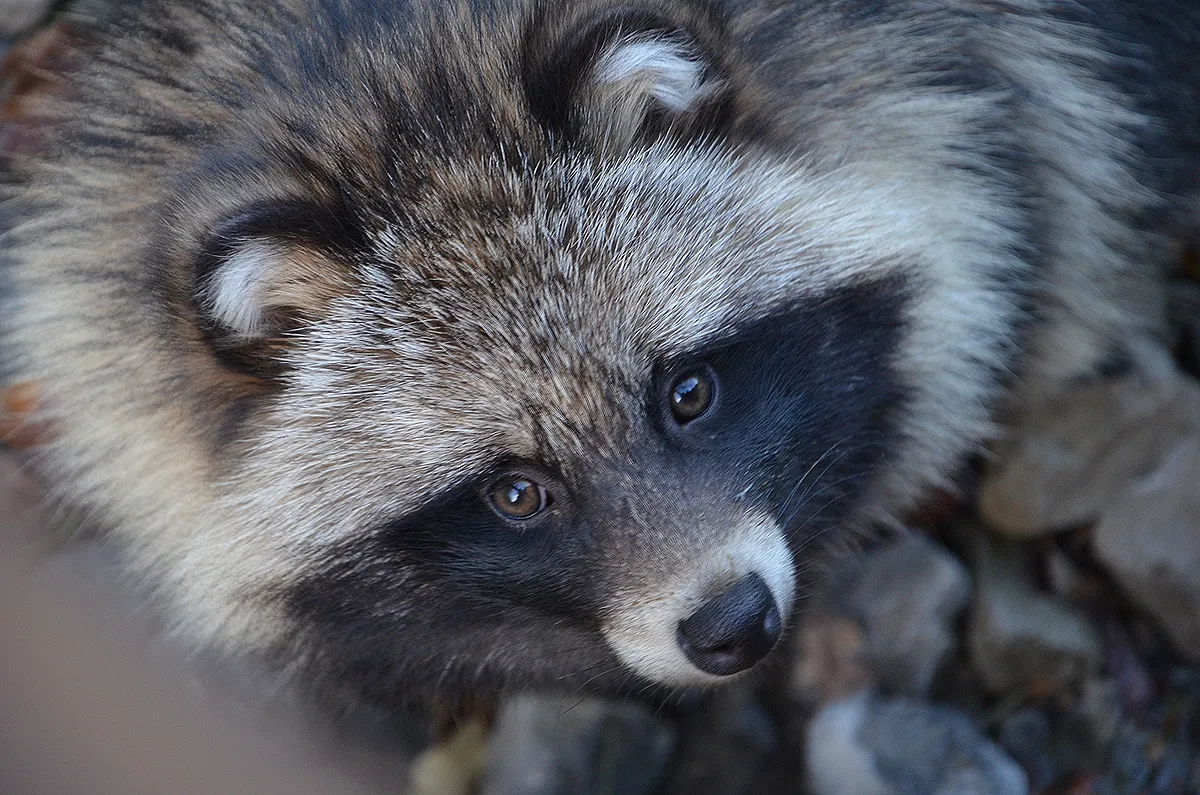
The scientific name is Nyctereutes procyonoides. Nyctereutes is Greek for 'night hunter', and procyonoides means 'like Procyon', the raccoon genus. For a long time the raccoon dog was regarded as the only living member of its genus.
Japanese raccoon dogs, however, differ from mainland animals in chromosome number, skull shape and behaviour, and many researchers now recognise them as a separate species, Nyctereutes viverrinus. Mainland raccoon dogs are split into several subspecies, and the Korean population has been described as N. p. koreensis.
The origin of the Korean name neoguri is unclear. In Japan it is the tanuki, a name loaded with folklore. Confusingly, Koreans often call the North American raccoon neoguri too; strictly it should be miguk-neoguri, 'American raccoon dog', to keep the two apart.
3. Evolution
The raccoon dog belongs to an ancient branch of the dog family. Genetic studies place it relatively close to the foxes, but its lineage split off millions of years ago and has followed its own path ever since. Its short legs, small teeth and rounded body are sometimes seen as retaining features of early canids.
Fossils of the genus Nyctereutes are found across Eurasia. Millions of years ago Europe and Asia held more varieties of raccoon dog than today, and fossils have even turned up in Africa. Most died out as the climate changed, leaving only the East Asian species.
Japanese raccoon dogs probably acquired their distinctive traits after the islands were cut off from the mainland at the end of the last ice age, isolating them for thousands of years. Korean raccoon dogs belong to the mainland group.
4. Range and habitat
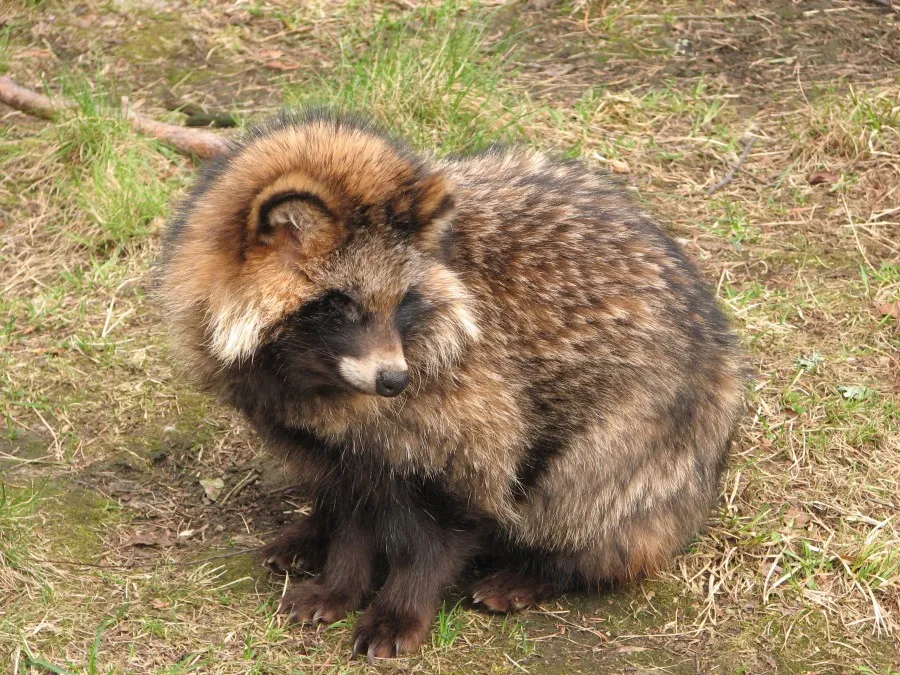
Jukka A. Lång · CC BY 3.0
The native range covers East Asia: the Russian Far East, eastern China, the Korean Peninsula, Japan and northern Vietnam. Between the 1920s and 1950s, Soviet authorities released thousands of raccoon dogs in European Russia and neighbouring regions to boost fur production. They adapted rapidly and spread to Finland, the Baltic states, Poland, Germany, Denmark and beyond, and they now reach as far west as the borders of France and Switzerland.
Raccoon dogs prefer forest edges near water, reed beds, wetlands and mixed farmland, favouring lowlands and foothills over high mountains. In Korea they are common nationwide and follow streams right into cities, turning up in parks and apartment complexes.
5. Body
With its long body and short legs, the raccoon dog seems to hug the ground. Its long, dense coat makes it look much plumper in winter than it really is.
| Measure | Approximate value |
|---|---|
| Head-body length | 50–70 cm |
| Tail | 15–25 cm |
| Shoulder height | about 20–30 cm |
| Weight, spring–summer | 3–6 kg |
| Weight, late autumn | 6–10 kg |
The fur is grizzled grey-brown or yellowish, with darker shoulders, back and legs. A dark mask spans the eyes and cheeks, framed by paler fur. The tail is short and bushy and lacks the rings of a raccoon's tail, which is the easiest way to tell them apart.
In autumn raccoon dogs pile on fat for the winter and may weigh nearly half as much again as in spring. Their winter coat is long and thick; after the summer moult they look slim and leggy, so the same animal can appear completely different from season to season.
The teeth are small, with relatively well-developed grinding molars suited to an omnivorous diet. Males and females look almost identical.
6. Behaviour and ecology
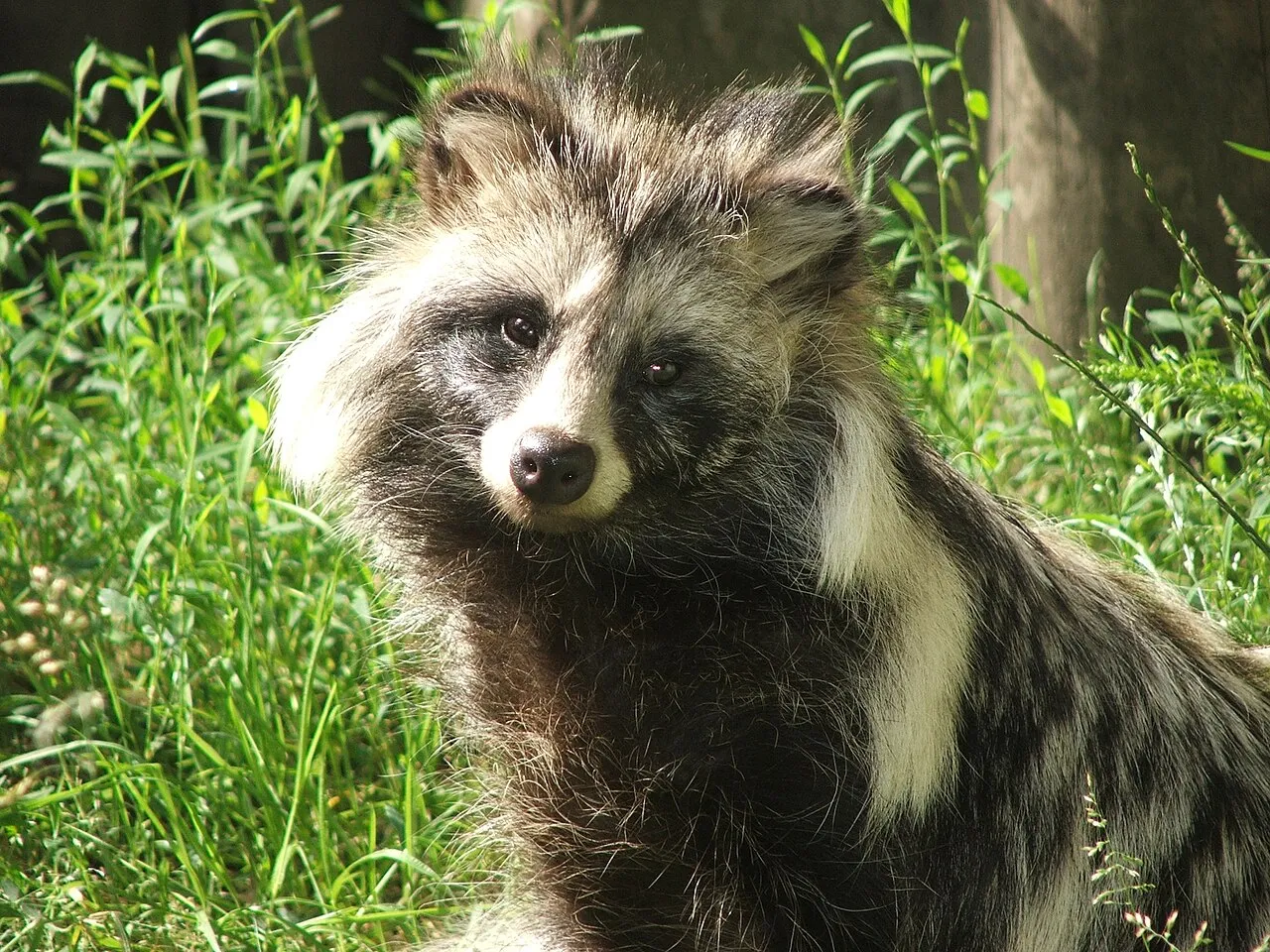
Pkuczynski · CC BY-SA 3.0
Raccoon dogs are mainly nocturnal. They spend the day in burrows, rock crevices, thickets or even drainage pipes and emerge at dusk to forage. They can dig their own dens but often borrow those of badgers or foxes.
Unusually for canids, pairs tend to stay together for long periods, foraging side by side and raising cubs jointly. They are not fiercely territorial, and home ranges often overlap with those of neighbours.
6.1. Shared latrines
One of the raccoon dog's quirks is the communal latrine, where several individuals defecate at the same spot until a sizeable pile builds up. By sniffing these sites, raccoon dogs appear to exchange information about who lives nearby and their breeding condition. For researchers, latrines are a convenient way to confirm presence and study diet.
6.2. Winter rest
The raccoon dog is known as practically the only canid that substantially shuts down for winter. In cold regions it may stay in its den for days or weeks at a time during the coldest months, lowering its metabolism and body temperature slightly to save energy. This is not deep hibernation, and on milder days it comes out to forage. In places with relatively mild winters, such as much of Korea, raccoon dogs are often seen active in winter.
7. Diet and feeding
Even by canid standards the raccoon dog is a thoroughgoing omnivore, eating whatever the season and place provide.
- Animal food: voles, frogs, snakes, fish, crayfish, crabs, insects, earthworms, eggs and nestlings, carrion
- Plant food: persimmons, wild kiwi, grapes, acorns, grain, maize, vegetables
- Near people: food waste, cat food left for strays, crops
Rather than chasing prey at speed like a fox or wolf, it ambles along the ground and the water's edge, nosing out food and picking it up. It often wades into shallow water after frogs and fish.
In late autumn it gorges on fruit to fatten up for winter; a raccoon dog eating fallen persimmons beneath a tree is a classic scene in the Korean countryside. In Europe, there is concern about its impact on ground-nesting birds and amphibians.
8. Reproduction and life cycle
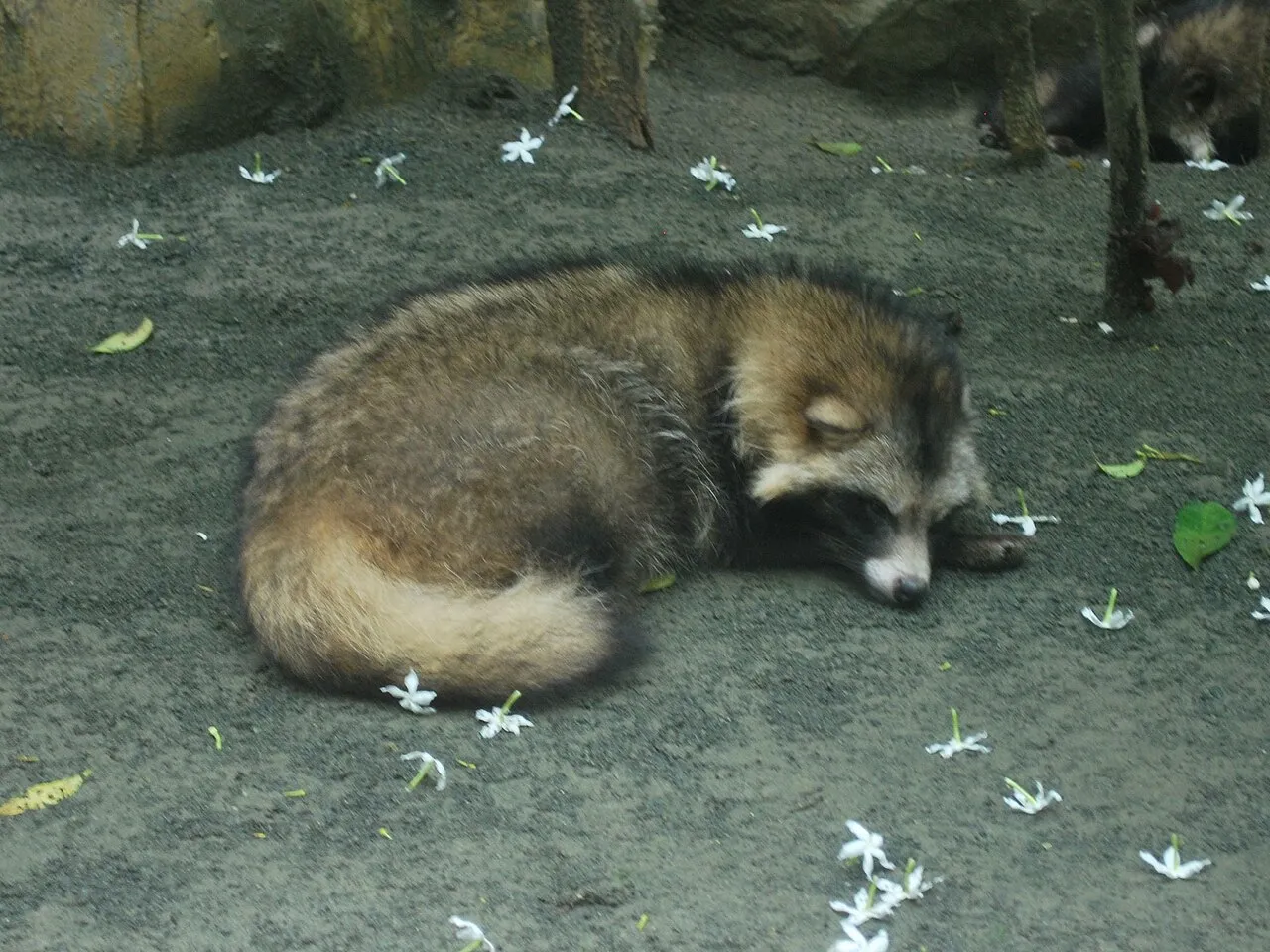
Jpogi · CC BY-SA 3.0
Mating takes place in late winter, around February and March, and gestation lasts about 60 days. Cubs are born in a den from April to June, typically five to eight per litter, which is large for a canid; more than ten is possible when food is abundant.
| Stage | Age | What happens |
|---|---|---|
| Newborn | 0–10 days | Blind, about 60–110 g, dark fluffy fur |
| Den life | 10 days–1 month | Eyes open, nursing |
| Weaning | 1–2 months | Start eating food brought by parents, venture outside |
| Growing | 2–4 months | Follow parents, learn to forage |
| Independence | 4–5 months | Disperse in autumn |
| Maturity | about 9–11 months | Can breed the following spring |
Fathers are devoted. The male guards the den while the female forages and carries food to the cubs, a partnership that makes large litters possible.
The flip side of big litters is a short wild life, typically three or four years, with traffic and disease the main causes of death. Captive raccoon dogs can live more than ten years.
9. Intelligence, communication, special abilities
Raccoon dogs neither howl like wolves nor bark loudly like dogs. They make low growls, high whines and a sharp hiss-like call when threatened. Much of their communication seems to happen through latrines and body odour.
They are known to play dead. When suddenly attacked, a raccoon dog may go limp and motionless, then get up and run once the attacker loses interest. Some suggest this behaviour helped inspire Japanese tales of the shape-shifting, trickster tanuki.
They are also among the few canids able to climb, though not as nimbly as the gray fox, and will scramble into low trees for fruit. They are unafraid of water and swim well.
10. Predators and survival
Small and relatively slow, raccoon dogs have many predators. In the native range these include wolves, lynx, foxes, golden eagles, eagle owls and feral dogs, and cubs can fall to large snakes and raptors. In Korea, where large carnivores have largely disappeared, feral dogs and eagle owls are the main remaining predators.
As natural enemies have dwindled, human-related threats have grown. In Korea the raccoon dog and the water deer are the wild mammals most often killed on roads. Sarcoptic mange is also widespread among Korean raccoon dogs, and animals with patchy hair and cracked skin are often found; such individuals struggle to survive the winter.
11. Relationship with humans
Raccoon dogs have long been used for fur. Their long, thick pelts trim collars and hats, and they are still farmed in large numbers in some countries. Cramped cages and brutal slaughter methods on these farms draw fierce criticism from animal welfare groups, and some products have been found mislabelled as other kinds of fur.
The species also matters for public health. In northern Gyeonggi and Gangwon provinces of South Korea, raccoon dogs were identified as the main wildlife carrier of rabies, and bait vaccines have been distributed there for years, sharply reducing cases in people and livestock. During the SARS outbreak, related viruses were detected in raccoon dogs sold in wildlife markets, highlighting the risks of the wildlife trade.
In towns and farmland, raccoon dogs sometimes cause friction by raiding crops, rubbish and pet food. Feeding them makes them bolder around people and raises the risk of incidents and disease, so it is best avoided.
11.1. An invader in Europe
Released for fur, raccoon dogs found few predators and plenty of food in Europe and spread rapidly; in Finland they became one of the commonest mid-sized carnivores. They eat the eggs and chicks of ground-nesting birds and wetland frogs and newts, and may spread rabies and parasites.
The European Union therefore lists the raccoon dog as an invasive alien species of Union concern. Sweden has used an ingenious control method in which sterilised, collared 'Judas' animals lead managers to others, slowing the invasion. It is a textbook case of a common native animal at home becoming a serious problem elsewhere.
12. Conservation
The IUCN lists the raccoon dog as Least Concern. Between its native range and its introduced European range it occupies a vast area in large numbers, so the species as a whole faces little extinction risk, though no reliable global count exists.
It is common in South Korea and not listed as endangered there. It is still a wild animal, however, and capturing or keeping one without permission may be restricted under the Wildlife Protection and Management Act. Local populations are affected by roadkill, diseases such as mange and habitat fragmentation. Wildlife crossings, roadside fencing and warning signs help reduce roadkill for raccoon dogs and many other species.
13. In zoos
Raccoon dogs are kept in some East Asian and European zoos. They are relatively mild-tempered and omnivorous, so husbandry is not especially difficult, but as shy, nocturnal animals they need dens or hiding places for the day. Hidden food that makes them dig and sniff provides useful enrichment.
Wildlife rescue centres play a big role too. Many injured raccoon dogs arrive after road accidents or with mange, and those that recover are released near where they were found.
Some people want them as pets because they look cute, but they are wild animals that smell strongly, keep night hours and can carry rabies and parasites. If you find an injured raccoon dog, contact a local wildlife rescue centre rather than picking it up yourself.
14. In culture
In Japan the tanuki is, alongside the fox, the great shape-shifting trickster of folklore. It is cast as a prankster who fools people, yet pot-bellied ceramic tanuki in straw hats stand outside shops and restaurants as charms for good business. Studio Ghibli's 'Pom Poko' told the story of tanuki losing their forest to suburban development, and Tom Nook of the 'Animal Crossing' games is a tanuki too.
In Korean, calling someone 'raccoon-dog-like' means they are wily and good at playing innocent. An old proverb about pricing the raccoon dog's pelt while only looking at its burrow warns against counting on something you don't yet have. A Korean instant noodle brand launched in the early 1980s under the name neoguri turned the animal into a household mascot.
In Europe its invasive status means it carries less cultural symbolism, but in countries such as Finland it is a familiar animal in nature documentaries.
15. Trivia
- If a video of a Korean 'neoguri' shows a ringed tail, you are actually looking at a North American raccoon.
- Pairs often travel together, so if you see one raccoon dog at night, its mate is probably nearby.
- Among canids, only the gray fox and the raccoon dog are really known for climbing trees.
- Raccoon dogs have become so common in Finland that people may meet them more often than many native carnivores.
- Side by side, a plump late-autumn raccoon dog and a lean early-summer one hardly look like the same species.
Wild animals are not pets. Catching, trading or keeping them is illegal in most places. If you find an injured wild animal, call your local wildlife rescue centre.
FAQ
How is a raccoon dog different from a raccoon?
The raccoon dog is an East Asian canid; the raccoon is a North American procyonid. Raccoons have ringed tails and use their forepaws like hands, while raccoon dogs have short, unringed tails.
Do raccoon dogs carry rabies?
They can. In northern Gyeonggi and Gangwon, raccoon dogs were identified as the main wildlife carrier and bait vaccines have been distributed. It is safest never to touch or feed them.
Why are raccoon dogs a problem in Europe?
Raccoon dogs released for fur by the Soviet Union spread across Europe and became an invasive species that preys on ground-nesting birds and amphibians and can spread disease.
Photo credits
Photos are freely licensed images from Wikimedia Commons. Authors and licenses are listed below.
- Єнотовидний собака (Nyctereutes procyonoides).jpg — Ryzhkov Sergey · CC BY-SA 4.0
- Der Marderhund, Tanuki oder Enok (Nyctereutes procyonoides), bitte nicht zu verwechseln mit einem Waschbär, hier im Wisentgehege in Springe (Kleiner Deister).jpg — Foto: Bernd Schwabe in Hannover · CC BY-SA 3.0
- Nyctereutes procyonoides 16072008.jpg — Jukka A. Lång · CC BY 3.0
- Nyctereutes procyonoides 4 (Piotr Kuczynski).jpg — Pkuczynski · CC BY-SA 3.0
- Racoon dog2.jpg — Jpogi · CC BY-SA 3.0