TailVille
1. Overview
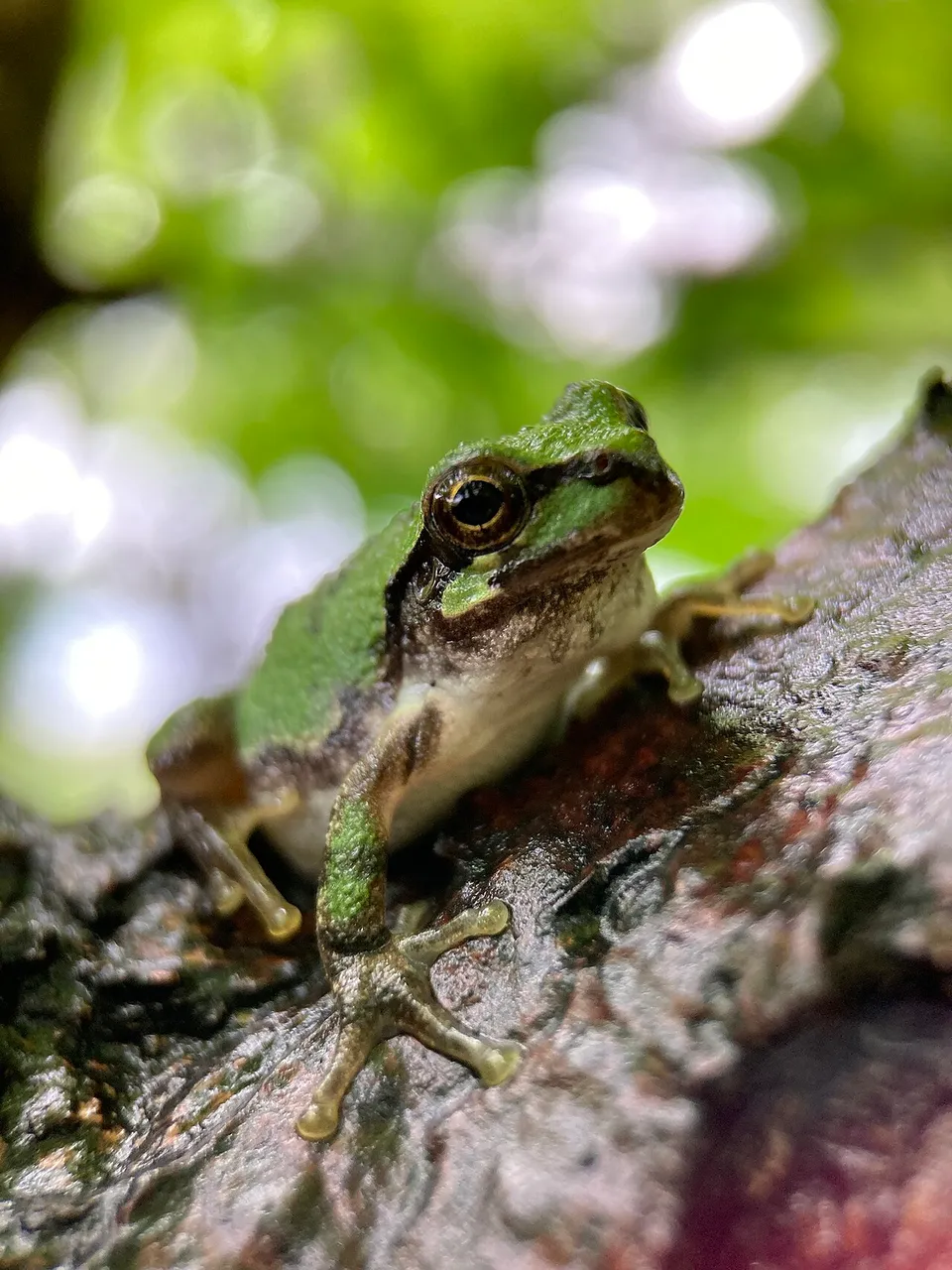
Walk along the raised paths between Korean rice paddies on a late-spring night, just after the seedlings go in, and you will hear a deafening chorus of rapid, rasping calls. Many of the singers are Japanese tree frogs, known in Korea simply as cheong-gaeguri, the 'green frog'. Only about 3–4 cm long, it is one of the most familiar amphibians in Korea and across Northeast Asia.
Sticky pads on its toes let it climb grass stems, shrubs and even window glass. It can shift its colour from leaf green to grey or brown, and its habit of calling loudly before rain made it a traditional weather prophet.
For Koreans, though, the tree frog is above all the hero of a folk tale: the contrary little frog who always did the opposite of what his mother said, and who now cries whenever it rains. The phrase 'like a green frog' describes someone who stubbornly does the opposite of what they are told. This article looks at the real animal behind the story and at its place in culture.
2. Name and classification
Norio Nomura · CC BY-SA 4.0
Cheong-gaeguri combines cheong, a Korean word covering both green and blue, with gaeguri, 'frog'. In English it is the Japanese tree frog, and in Japanese it is amagaeru, the 'rain frog'.
Its scientific name is Dryophytes japonicus. For decades it was Hyla japonica, but genetic revisions of the tree frog family Hylidae in the 2010s moved several East Asian and North American species into the genus Dryophytes, from Greek words for 'tree' (or oak) and 'plant'. Albert Günther described the species in 1859 from Japanese specimens.
Korea also has a close relative, the Suweon tree frog (Dryophytes suweonensis), described from Suwon in 1980 and endemic to the Korean Peninsula. The two look nearly identical and are most reliably told apart by their calls. Genetic studies have also found substantial differences between Japanese and mainland Asian populations of the Japanese tree frog, so its taxonomy may be refined further.
3. Evolution
The tree frog family Hylidae contains nearly a thousand species and is most diverse in Central and South America and Australia. Surprisingly, the tree frogs of Eurasia belong to just a few lineages that arrived from the Americas.
Molecular studies show that Dryophytes, the genus of Korea's tree frog, is closely related to many North American tree frogs. Its ancestors are thought to have crossed from North America into East Asia during the Miocene via Beringia, the land bridge that periodically joined Alaska and Siberia. European tree frogs such as Hyla arborea belong to a separate lineage with a different history. In other words, a Korean tree frog is more closely related to many American tree frogs than to the European tree frog.
Once in East Asia, repeated ice-age cycles and sea-level changes alternately connected and isolated the Korean Peninsula, the Japanese archipelago and mainland China, driving regional lineages apart. The split between the Japanese and Suweon tree frogs probably arose this way. Because small frogs fossilise poorly, most of this history comes from comparing DNA.
4. Range and habitat
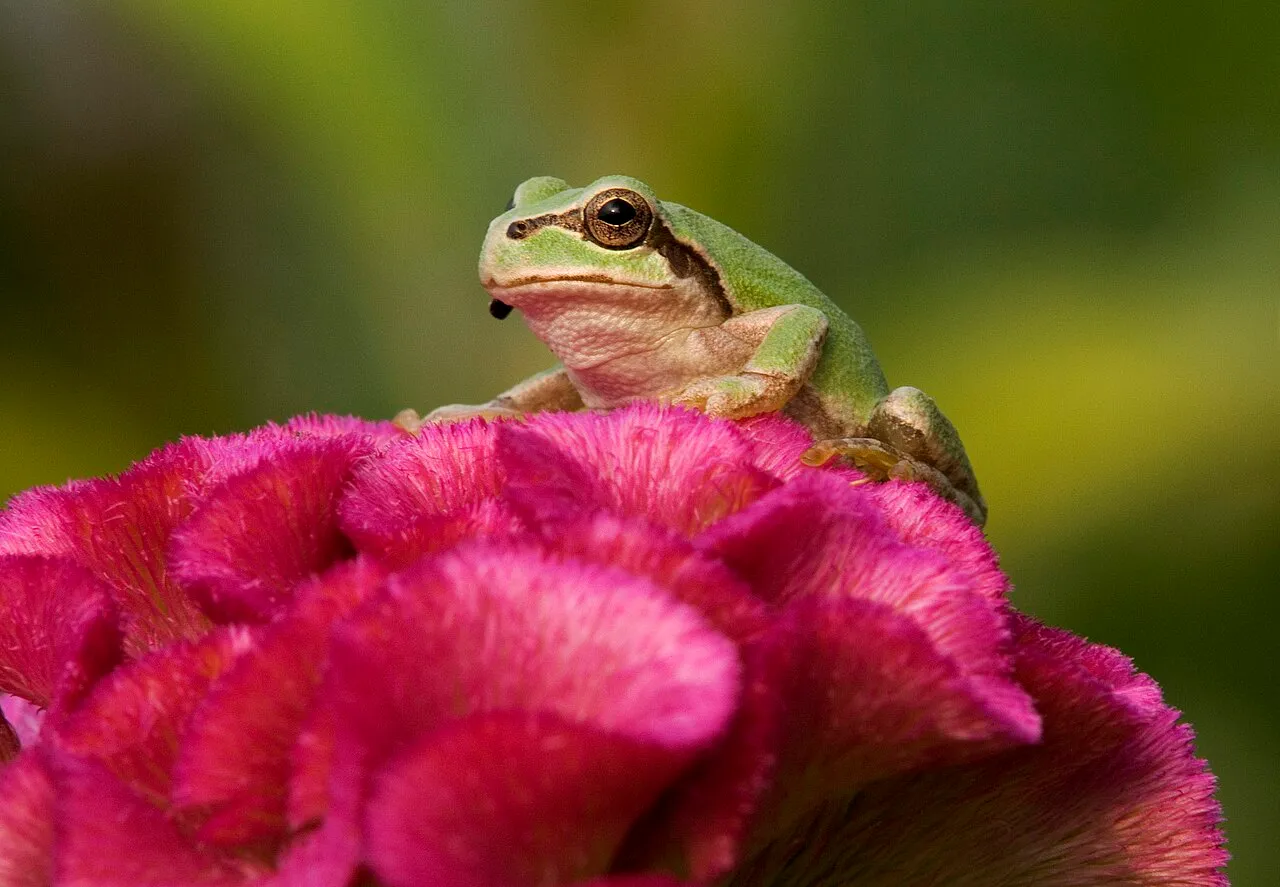
池田正樹 (talk) masaki ikeda · CC BY-SA 3.0
The Japanese tree frog lives throughout the Korean Peninsula and nearby islands including Jeju, across Japan from Hokkaido to Kyushu, in northeastern and parts of eastern China, in the Russian Far East including Primorye and Sakhalin, and in parts of eastern Mongolia. Few small frogs have such a wide range, making it a signature amphibian of Northeast Asia.
In Korea the easiest place to find it is a rice paddy. Flooded paddies act as huge, shallow, temporary ponds — ideal for laying eggs and raising tadpoles. Tree frogs also live around reservoirs and ponds, marshes, riverside grass, shrubby hillsides, rural gardens and city parks, from the coast to mountains above 1,000 metres.
Outside the breeding season they often move away from water into grass, shrubs and trees, which is why people find them clinging to leaves along walking trails, on window frames or even on car mirrors in summer. In late autumn they burrow into soil, under leaf litter, into rock crevices or among tree roots to hibernate.
Common as it is, it is not immune to habitat change. Loss of paddies, conversion of ditches to concrete channels, heavy pesticide use and complete winter drainage of fields can all reduce local populations.
5. Body
The Japanese tree frog is small and plump with a rounded snout.
| Feature | Range | Notes |
|---|---|---|
| Length | About 2.5–4.5 cm | Females slightly larger |
| Weight | About 2–6 g | Varies with season and condition |
| Newly metamorphosed froglet | About 1–1.5 cm | May still have a tail stub |
The back is smooth and usually bright leaf green, but can shift to grey, brown or mottled patterns. A dark brown stripe runs from the nostril through the eye and past the eardrum, one of the features used to tell it from the Suweon tree frog. The belly is white or cream.
Its most remarkable features are the round pads on its fingers and toes. Their surface is a mosaic of tiny hexagonal cells separated by channels filled with mucus. This creates a thin fluid film that grips by capillary adhesion and friction — which is how the frog can cling to wet glass. Tree frog toe pads have inspired research into reusable adhesives and tyre treads.
Breeding males have a large vocal sac under the chin that inflates like a balloon nearly as big as the body. Their throat skin is yellowish or dusky, distinguishing them from females, and they develop nuptial pads on their front thumbs.
6. Behaviour and ecology
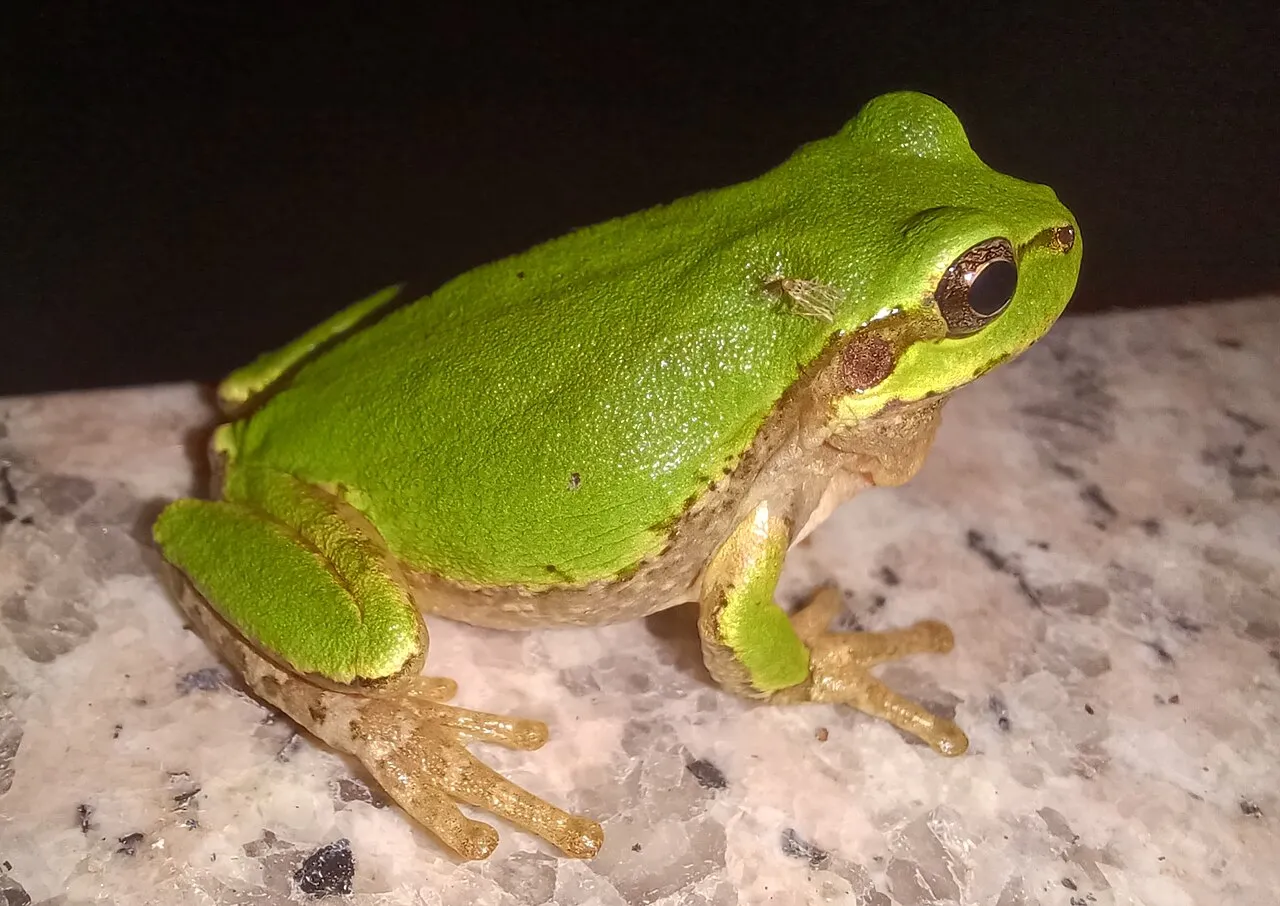
Warehadokuro · CC BY-SA 4.0
Japanese tree frogs are most active from dusk into the night, but on rainy or overcast days they call and move about in daylight too. On sunny days they rest flattened on leaves with their legs tucked under them, a posture that minimises the skin area exposed to drying air. They are surprisingly resistant to desiccation and can sit on leaves even in summer sun.
In the breeding season males stake out spots on paddy banks, in waterside grass and on floating plants and call en masse. Neighbouring males tend to alternate their calls, so the chorus has a strangely rhythmic quality. Japanese researchers who studied this timing used it to inspire algorithms for reducing signal collisions in wireless networks.
After breeding, frogs disperse from the paddies into surrounding woods and fields, spending summer and autumn hunting insects in shrubs and trees. Around October–November, as temperatures fall, they go into hibernation. Studies of populations in colder northern regions suggest the species can tolerate partial freezing by raising levels of protective substances such as glucose in its body, though how this applies to Korean populations needs more research.
7. Diet and feeding
Adult tree frogs are carnivores that eat almost any small animal they can fit in their mouths: flies, mosquitoes, midges, small moths, aphids, leafhoppers, young grasshoppers, small beetles and spiders. In paddies and fields they eat crop pests such as planthoppers and armyworm caterpillars, making them valuable natural pest controllers for farmers.
They hunt by sitting still and waiting. When prey moves, the frog aims carefully, then lunges and flips out its sticky tongue, which is attached at the front of the mouth. Tree frogs respond strongly to movement and often ignore motionless insects.
When swallowing, a frog closes its eyes and retracts its eyeballs into its head, which helps push food down the throat. Tree frogs gathering around streetlights and lit windows on summer nights are there for the insects drawn to the light.
Tadpoles eat something quite different: algae, the microbial film on water plants and organic debris, scraped up with their tiny keratinous mouthparts.
8. Reproduction and life cycle
In Korea the breeding season runs roughly from late April to July, peaking in May and June when paddies are flooded and planted. Males gather first and start the chorus; gravid females approach the males whose calls appeal to them. Studies suggest females prefer males that call louder, longer and more often.
Once paired, the male clasps the female behind her front legs in amplexus. Over the night she lays eggs in many small clusters, from a few to a few dozen eggs each, attached to grass or rice seedlings, while the male fertilises them. A female's total output per season is usually given as several hundred to around a thousand eggs, though sources differ. Each egg is only 1–2 mm across, brown on top and paler below.
| Stage | Duration | Notes |
|---|---|---|
| Egg | About 2–5 days | Hatches faster in warm water |
| Tadpole | About 4–8 weeks | Up to around 4 cm; eyes set at the edges of the head |
| Metamorphosis | June–August | Front legs emerge, tail is absorbed |
| Froglet | First year | 1–1.5 cm; disperses into vegetation |
| Adult | After 1–2 years | Begins breeding |
Tree frog tadpoles have tall, broad tail fins and eyes positioned at the very edges of the head, so they look bug-eyed from above. In summer you can easily see froglets, some still with half a tail, climbing out onto rice leaves.
Wild lifespan is estimated at about two to five years. Most eggs and tadpoles are eaten by fish, dragonfly nymphs, diving beetles and birds, so very few reach adulthood.
9. Communication and special abilities
A male's call is a rapid series of sharp, rasping notes. Amplified by the inflated vocal sac, it is astonishingly loud for such a small animal. Besides advertisement calls to attract females, males give spacing calls toward rivals, and a frog that is grabbed may let out a short distress squeak.
The saying that a calling tree frog means rain has a grain of truth. Tree frogs tend to call more when humidity rises and air pressure drops, conditions that often precede rain. For animals that breathe and absorb water through their skin, damp weather is good weather. Outside the breeding season you can hear lone frogs calling from shrubs before or after showers, so-called 'rain calls'. Of course, a frog is no substitute for the meteorological service.
Colour change is another skill. Tree frog skin has layers of cells containing yellow pigment, light-reflecting crystals and dark pigment. Changes in their arrangement and in how far the dark pigment spreads produce green, grey, brown or mottled tones. Background colour and brightness, temperature and humidity all play a role, and a change usually takes tens of minutes rather than seconds.
Finally, there is climbing. Tree frogs can scale vertical glass and hang upside down beneath leaves, and engineers study their toe pads when designing anti-slip materials and medical adhesives.
10. Predators and survival
Small as it is, the tree frog is food for many animals: snakes such as the tiger keelback and red-backed rat snake, herons and egrets, shrikes and magpies, raccoon dogs and weasels, and even large spiders and praying mantises. Eggs and tadpoles are eaten by small fish, loaches, dragonfly nymphs, diving beetles and giant water bugs.
Camouflage is its main defence. Green on green leaves and grey-brown on bark or stone, it can be very hard to spot. When threatened, it either freezes flat or leaps away into dense vegetation.
The skin produces mildly toxic secretions. They are not dangerous to people, but rubbing your eyes after handling a tree frog can cause stinging, redness and briefly blurred vision. The secretions deter some predators and help protect the skin from bacteria and fungi.
Human changes to the landscape are a growing pressure even for a common species: pesticides and herbicides, winter drainage of paddies, concrete channels that frogs cannot climb out of, and road traffic. Chytrid fungus is present in Korea; native Korean amphibians appear relatively resistant, but ongoing monitoring is important.
11. Relationship with humans
Japanese tree frogs have lived alongside East Asian rice farmers for thousands of years. A paddy is a human-made wetland, and the tree frog is one of the animals best at exploiting it. The nightly frog chorus during the planting season marked the rural calendar, and frogs eating crop pests helped the harvest.
People used tree frog calls to guess the weather. An unusually noisy evening was taken as a sign of coming rain — time to bring in the laundry or adjust the next day's work. In Japan, its very name, 'rain frog', reflects the same belief.
Today the tree frog is one of the first wild animals many Korean children meet. Primary school science lessons on the frog life cycle often involve watching tree frog tadpoles, and they are a staple of nature education programmes. If you catch one to look at, keep it briefly and release it where you found it; warm hands, soap and lotion residues can harm a frog's thin skin.
In eco-friendly rice farming, the number of tree frogs and other amphibians is increasingly used as an indicator of ecosystem health: a paddy full of frogs is usually one with fewer pesticides and richer biodiversity.
12. Conservation
The Japanese tree frog is listed as Least Concern on the IUCN Red List thanks to its vast range, large populations and adaptability to farmland and gardens. In Korea it has no special legal protection and is one of the commonest frogs.
But common does not mean permanently safe. In Korea, paddy-dwelling amphibians, including tree frogs, are affected by:
- Shrinking rice paddy area and urban development
- Field consolidation and concrete irrigation channels replacing earth banks
- Pesticide and herbicide use
- Winter drainage altering hibernation conditions
- Roads fragmenting habitat and killing migrating frogs
Far more threatened is its close relative, the Suweon tree frog. Endemic to Korea and restricted to lowland paddies in parts of Gyeonggi and Chungcheong provinces, it has lost much of its habitat to development and changing farming practices. It is designated a Class I endangered species under Korea's Wildlife Protection and Management Act and assessed as Endangered by the IUCN. The two species sometimes share paddies, and studies have reported hybridisation in some areas.
The best way to protect both is to protect the paddy ecosystem itself. Some areas are trialling reduced pesticide use, keeping some water in fields over winter, and maintaining earth banks and wildlife-friendly channels.
13. In captivity and observation ethics
Tree frogs can be seen in Korean nature centres, natural history museum displays and native-species exhibits in some zoos, kept in small enclosures with water, plants, hiding places and live insect food.
Because they are common, people are sometimes tempted to catch one and keep it at home. We don't recommend it. Wild tree frogs eat only live insects, and their needs for humidity, temperature and winter dormancy are hard to meet, so they often die prematurely in homes. Releasing a frog somewhere other than where it was caught can spread disease and disrupt local genetic make-up. And because the protected Suweon tree frog looks almost identical, a well-meaning collector could break the law without realising it.
The best way to meet a tree frog is in the wild. Listening to the chorus on a paddy bank on a May night, watching a male inflate his vocal sac in torchlight, taking a photo and leaving him be is a memorable experience. If you want to raise tadpoles to watch metamorphosis, do it briefly under the guidance of a school or nature centre and return the froglets to where the tadpoles came from.
14. In culture
The Korean folk tale goes roughly like this. Long ago, a mother frog and her son lived by a pond. Whatever his mother told him to do, the little green frog did the opposite: told to go to the hills, he went to the water; told to go to the water, he went to the hills. When the mother grew old and ill, she wanted to be buried on a sunny hillside, but knowing her son's habits she asked to be buried by the stream instead. After she died, the son was overcome with remorse and decided that this one time he would do exactly as she had asked. He buried her beside the stream. Ever since, whenever it rains and the water rises, he worries that her grave will wash away, and he cries and cries.
The tale teaches filial piety and also works as an origin story explaining why tree frogs call when it rains. Similar tales exist in China and Japan with variations in the details.
From it comes the Korean expression 'like a green frog' for someone who deliberately does the opposite of what they are told, often applied to teenagers. Other frog proverbs are common too, such as 'a frog in a well' for a narrow-minded person and 'a frog forgets it was once a tadpole' for someone who forgets humble beginnings — though these refer to frogs in general.
Tree frogs appear in children's songs, picture books, animation and educational characters, and their round eyes and green bodies decorate countless children's products, raincoats and rain boots. In Japan, too, tree frogs symbolise the rainy season and early summer, and frog calls have long been a seasonal image in classical poetry.
15. Trivia
- Occasionally a completely sky-blue tree frog turns up and makes the news. A mutation reducing yellow pigment leaves only the blue structural colour, so the 'green frog' becomes a literally blue one — fitting, since cheong can mean both.
- For their size, tree frogs are incredibly loud; in quiet countryside a chorus can be heard hundreds of metres away.
- Tree frogs sometimes turn up on high-rise apartment balconies, probably carried up in plant pots or by climbing the walls.
- Antimicrobial peptides have been identified in tree frog skin secretions and studied as potential leads for new antibiotics.
- The Suweon tree frog's call is slower and more metallic than the common tree frog's, and researchers distinguish the species by analysing recordings.
- Tree frogs tend to emerge from hibernation later than some other Korean frogs, so they are seldom seen until well into spring.
- A tree frog can rest motionless on the same leaf for a whole day, then travel tens of metres in a single night of foraging.
Wild animals are not pets. Catching, trading or keeping them is illegal in most places. If you find an injured wild animal, call your local wildlife rescue centre.
FAQ
Does a calling tree frog really mean rain?
There is some truth to it: they tend to call more when humidity rises. But they are nowhere near as reliable as a weather forecast.
Is it safe to touch one?
Its skin secretions can sting eyes or cuts. It's best not to handle them — human hands are hard on frogs too — and wash your hands if you do.
How is it different from the Suweon tree frog?
The Suweon tree frog is a close relative endemic to Korea that looks almost identical but has a different call. Unlike the common tree frog, it is a Class I endangered species in Korea.
Photo credits
Photos are freely licensed images from Wikimedia Commons. Authors and licenses are listed below.
- Tree frog2.jpg — 池田正樹 (talk)masaki ikeda · Public domain
- Hyla japonica 190964693.jpg — Norio Nomura · CC BY-SA 4.0
- Hyla japonica sep01.jpg — 池田正樹 (talk) masaki ikeda · CC BY-SA 3.0
- Japanese tree frog (Hyla japonica), green.jpg — Warehadokuro · CC BY-SA 4.0