TailVille
1. Overview
Mantis shrimp look a bit like shrimp or lobsters but belong to an entirely separate group of marine crustaceans. Around 450 to 500 species are known, burrowing into seabeds from tropical coral reefs to the mudflats of Korea's west coast. Their English name comes from the folded front limbs that resemble those of a praying mantis.
Two superpowers made them famous. The first is the punch: some species swing club-like limbs fast enough to shatter snail shells and crab carapaces, one of the fastest movements in the animal world. The second is vision: humans have three types of colour receptors, but mantis shrimp have twelve or more photoreceptor types and can see polarised light.
This article centres on the brilliantly coloured peacock mantis shrimp (Odontodactylus scyllarus), while also introducing the Japanese mantis shrimp (Oratosquilla oratoria), a springtime delicacy in Korea.
Small as they are, mantis shrimp are aggressive and clever hunters, and their abilities have inspired research in materials science, optics and robotics.
2. Name and classification
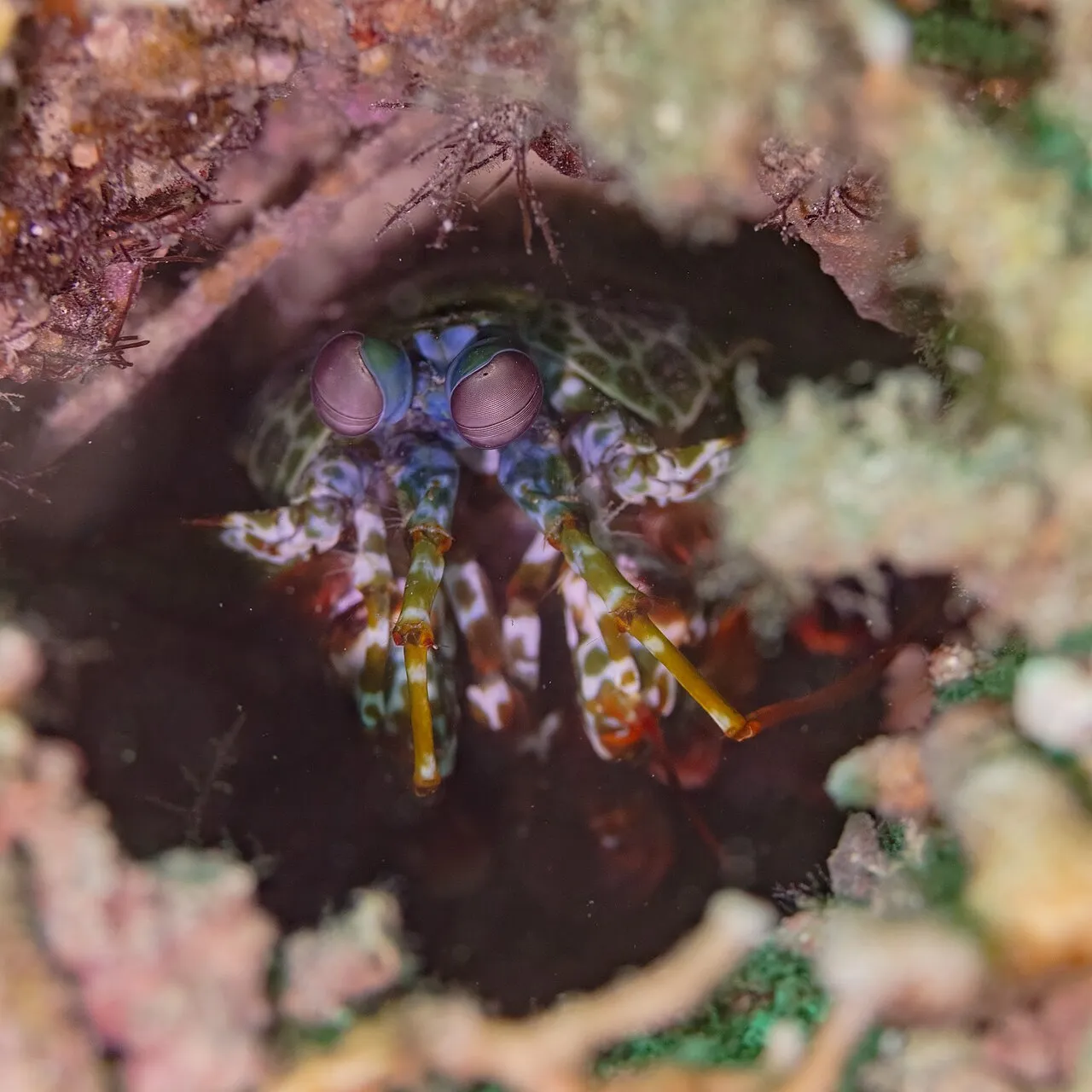
Diego Delso · CC BY-SA 4.0
Mantis shrimp belong to the phylum Arthropoda, class Malacostraca, subclass Hoplocarida and order Stomatopoda. Shrimp, crabs and lobsters share the same class, but stomatopods split from them roughly 400 million years ago, making them very distant relatives despite the name.
Stomatopoda combines the Greek for mouth and foot, referring to limbs clustered near the mouth. The Korean name, gaetgajae, means mudflat crayfish. Some regions call it ssok, but that name properly belongs to a different burrowing crustacean, which causes confusion. In Japan it is called shako and is a well-known sushi topping.
Mantis shrimp are divided by how they use their raptorial limbs:
| Type | Limb shape | Main prey | Example |
|---|---|---|---|
| Smashers | Rounded club | Hard-shelled snails, clams, crabs | Peacock mantis shrimp |
| Spearers | Spiny, barbed spear | Soft, fast prey such as fish and shrimp | Japanese mantis shrimp, zebra mantis shrimp |
The peacock mantis shrimp shimmers in green, red, blue and orange, hence its name. It lives on coral reefs of the Indian Ocean and western Pacific and is usually 3 to 18 centimetres long.
3. Evolution
The hoplocarids appear to have branched off from other malacostracans around the Devonian. Ancestral forms turn up in Carboniferous rocks roughly 340 million years old, though these animals lacked the powerful raptorial limbs of modern species.
Forms resembling today's mantis shrimp, with limbs that fold like a jackknife, arose in the Mesozoic, and fossils from the Jurassic and Cretaceous look strikingly modern. Many researchers think spearing limbs came first, with some lineages later evolving club-shaped smashing limbs to crack hard-shelled prey.
Their extraordinary eyes are also an evolutionary specialisation. Compared with other crustaceans, they carry an unusual variety of photoreceptors, interpreted as an adaptation for rapidly recognising prey, rivals and mates in bright shallow seas. Species living deeper tend to have fewer receptor types.
4. Range and habitat
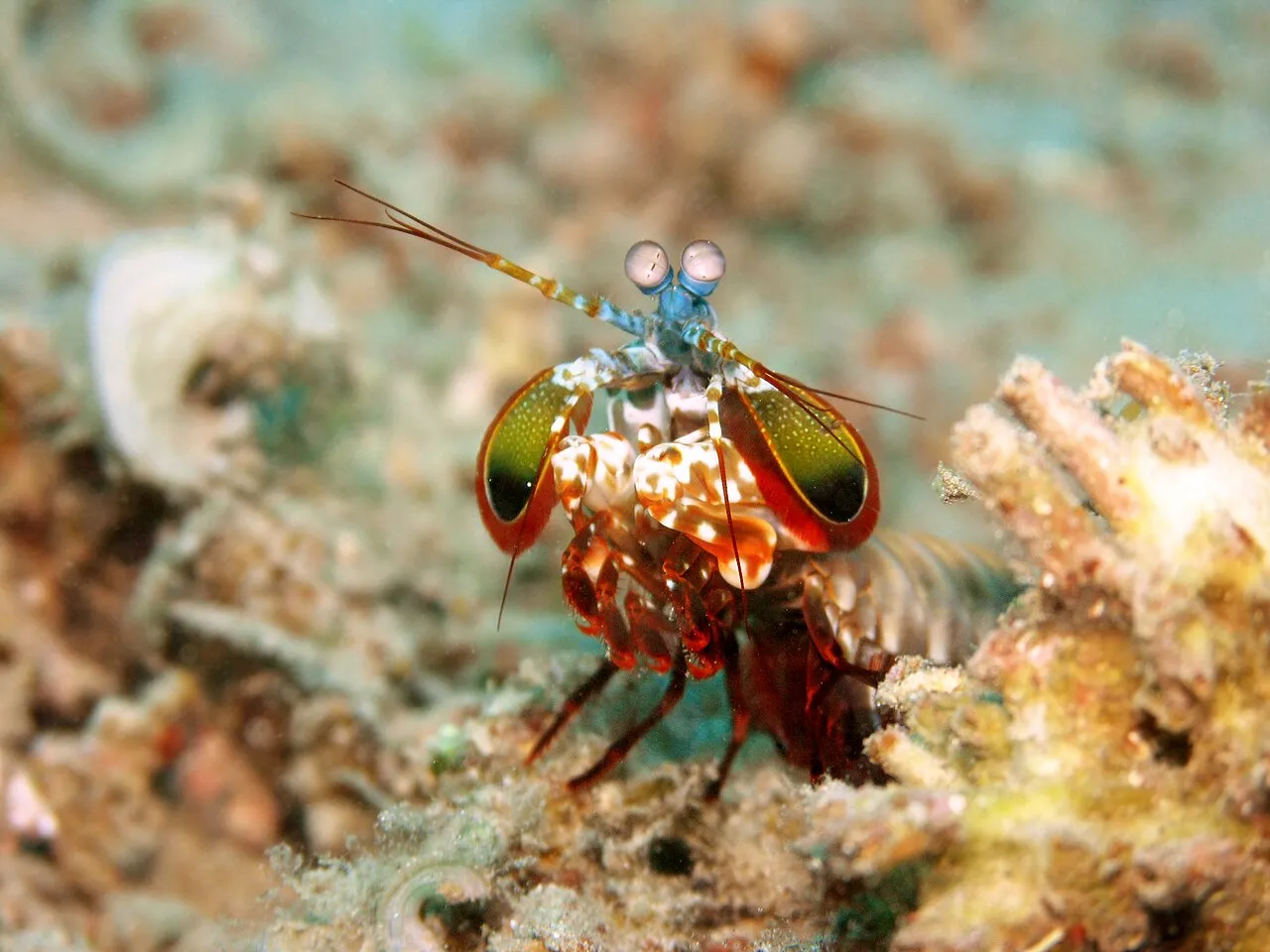
Mantis shrimp are most diverse in tropical and subtropical seas, though several species live in temperate waters. Most inhabit shallow water within a few tens of metres, but some are found hundreds of metres down.
The peacock mantis shrimp ranges from East Africa across the Indian Ocean and Southeast Asia to northern Australia and the islands of the western Pacific. It lives in U-shaped burrows or crevices in rubble and sand near coral reefs, sometimes decorating or blocking the entrance with pebbles and coral fragments.
Korea's Oratosquilla oratoria lives on sandy mud bottoms in the Yellow Sea and along the south coast. It digs deep burrows in coastal waters about 10 to 30 metres deep and emerges at night to feed. The same species is common off Japan, China and Taiwan, making it East Asia's best-known edible mantis shrimp. A few other stomatopods have also been recorded in Korean waters.
| Species | Main range | Habitat |
|---|---|---|
| Peacock mantis shrimp | Indian Ocean to western Pacific | Rubble and sand near reefs |
| Japanese mantis shrimp | Korea's west and south coasts, Japan, China | Coastal sand and mud |
| Large spearers such as the zebra mantis shrimp | Indo-Pacific | Deep burrows in sand |
5. Body
A mantis shrimp's body is long and somewhat flattened, with a small carapace over the head, a segmented abdomen and a broad tail fan. The swimming legs beneath the abdomen carry gills and serve for both swimming and breathing.
| Feature | Peacock mantis shrimp | Japanese mantis shrimp |
|---|---|---|
| Length | usually 3 to 18 cm | usually about 10 to 15 cm, large ones near 20 cm |
| Colour | vivid green, red, blue and orange | greyish brown with a lavender tinge |
| Raptorial limbs | Clubs (smasher) | Spiny spears (spearer) |
The signature feature is the second pair of thoracic limbs, the raptorial appendages, held folded like a jackknife and flicked open to strike or impale. The peacock's club is extraordinarily tough: a hard outer layer of hydroxyapatite-like mineral over chitin fibres stacked in a slowly rotating spiral, a Bouligand structure that stops cracks spreading even after thousands of blows. Engineers are studying it to design impact-resistant composites.
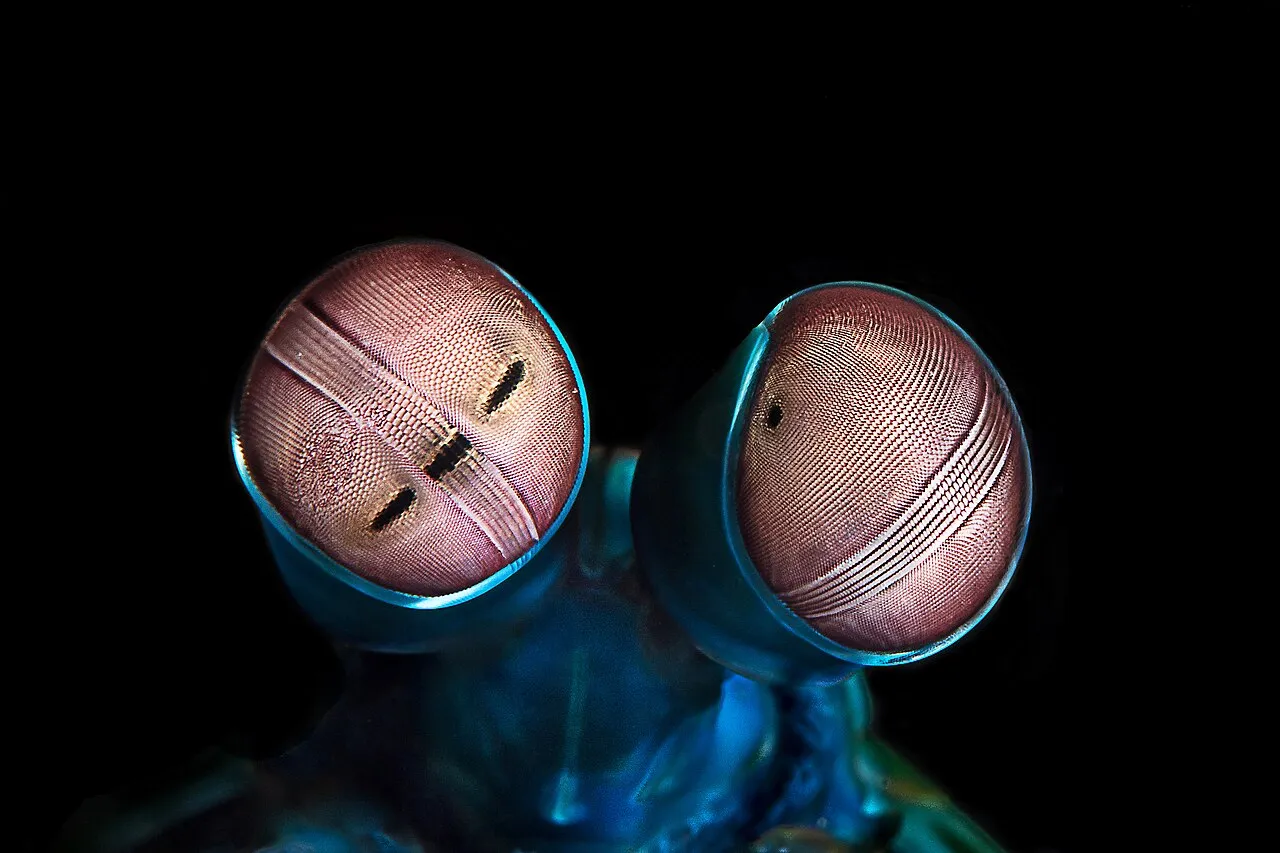
The compound eyes sit on mobile stalks and move independently. A band across the middle of each eye, the midband, divides it so that three regions view the same point at once, which is thought to let a single eye judge distance.
Mantis shrimp grow by moulting. Because even the club surface is replaced, they hide in their burrows for several days after moulting while the new exoskeleton hardens.
6. Behaviour and ecology
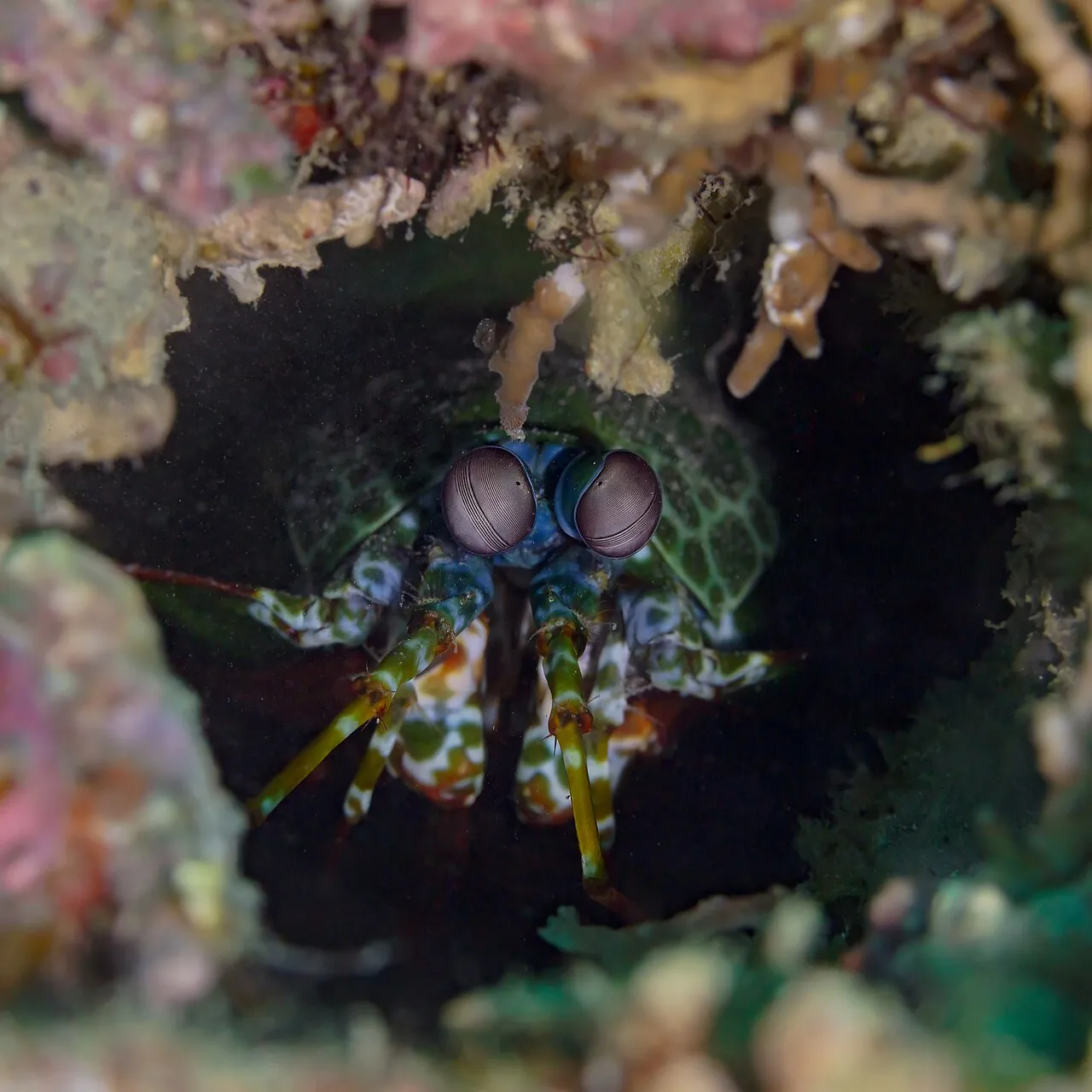
Most mantis shrimp live alone in burrows and defend them fiercely. A burrow is an ambush post, a refuge from predators and a safe place to moult and guard eggs. Good burrows are scarce, so rivals fight over them.
Activity patterns vary. The peacock mantis shrimp is mostly active by day, roaming outside its burrow, while the Japanese mantis shrimp forages mainly at night. Many spearers lie in wait at the burrow entrance with only their eyes showing, sometimes for hours, before snatching a passing fish with lightning speed.
Fights between mantis shrimp are often ritualised. Opponents spread their raptorial limbs to display colours, and when they do strike, they frequently aim at each other's heavily armoured tail fans, which act as shields. After an exchange of blows, the weaker animal usually retreats, settling dominance without fatal injury. Newly moulted individuals, whose shields are soft, tend to avoid fights and instead exaggerate threat displays, a form of bluffing.
7. Diet and feeding
All mantis shrimp are carnivorous predators, and their prey depends on limb type.
Smashers such as the peacock mantis shrimp favour hard-shelled animals: snails, clams, crabs and sea urchins. They hammer repeatedly until the shell breaks, then pull out the flesh, sometimes chipping methodically around a snail's opening.
Spearers such as the Japanese mantis shrimp target soft prey: small fish, shrimp, worms and young squid. Their spiny limbs unfold in an instant to impale or clamp prey. Spearing strikes are slower than smashing blows but more than fast enough to catch a darting fish.
Mantis shrimp often carry food back to their burrows. A litter of broken shells and crab carapaces is a telltale sign that a smasher lives nearby.
8. Reproduction and life cycle
Cédric Peneau · CC BY-SA 4.0
Reproductive habits vary widely. In some species pairs separate after mating; in others, partners share a burrow for a long time. Some tropical spearers, such as Lysiosquillina maculata, are known for long-term pairs that share hunting and egg care.
After mating, the female lays thousands to tens of thousands of tiny eggs in a mass that she cradles in her front limbs or attaches to the burrow wall. She turns and aerates the eggs, and may eat little during this time. In a few species, the eggs are split into two masses, one tended by each parent.
Hatchlings are transparent larvae that look nothing like adults. They drift as plankton for weeks to months, moulting repeatedly, and once they resemble adults they settle to the bottom and start burrowing.
| Stage | Approximate duration | Notes |
|---|---|---|
| Egg | weeks | Guarded in the burrow |
| Larva | weeks to months | Transparent, planktonic |
| Juvenile | months | Settles and digs a burrow |
| Adult | years | Defends a burrow and breeds |
The Japanese mantis shrimp spawns from spring to early summer, when egg-bearing females, full of yellow roe, are especially prized as food. Lifespans vary; the peacock mantis shrimp is said to live several years and some large species reportedly more than a decade, but wild lifespans are poorly known.
9. Special abilities: the punch and the eyes
9.1. A punch like a bullet
In 2004, a team led by biologist Sheila Patek used high-speed video to show that the peacock mantis shrimp's club tip exceeds about 20 metres per second, with accelerations over 10,000 times gravity, roughly 80 kilometres per hour. Muscles alone cannot achieve this, so the animal stores energy in a saddle-shaped spring in its limb, held by a latch, then releases it all at once, much like drawing and loosing a bow.
Even more striking is cavitation. The club moves so fast that pressure behind it drops, forming tiny vapour bubbles that collapse with a flash of light, heat and a shock wave. The prey is effectively hit twice, once by the club and again by the collapsing bubble, and even a near miss can stun small prey.
Aquarium keepers tell stories of large peacock mantis shrimp cracking tank glass, and their strikes can injure fingers; English-speaking fishermen sometimes call them thumb splitters.
9.2. Some of the most complex eyes on Earth
Depending on species, mantis shrimp eyes contain twelve to sixteen types of photoreceptor. About twelve serve colour vision, several of them in the ultraviolet. They also detect linear polarisation, and some can distinguish circularly polarised light, a rarity among animals. Research suggests they reflect polarised light from parts of the body as private signals visible to other mantis shrimp.
Does that mean they see far more colours than we do? Surprisingly, a 2014 experiment found the opposite: asked to discriminate similar colours, mantis shrimp did worse than humans. Researchers proposed that instead of comparing receptor signals to compute colour, they read the pattern of which receptors respond, recognising colours quickly rather than finely. Their eyes seem tuned for speed over subtlety.
Their polarisation vision has inspired cameras for detecting cancerous tissue and new kinds of polarisation image sensors.
9.3. Learning and memory
Mantis shrimp are considered unusually good learners for invertebrates. In experiments they remembered the scent of opponents and avoided rematches with individuals that had beaten them. They also memorise the location of their burrows and find their way back after foraging some distance away, apparently using the sun, polarised light and landmarks.
10. Predators and survival
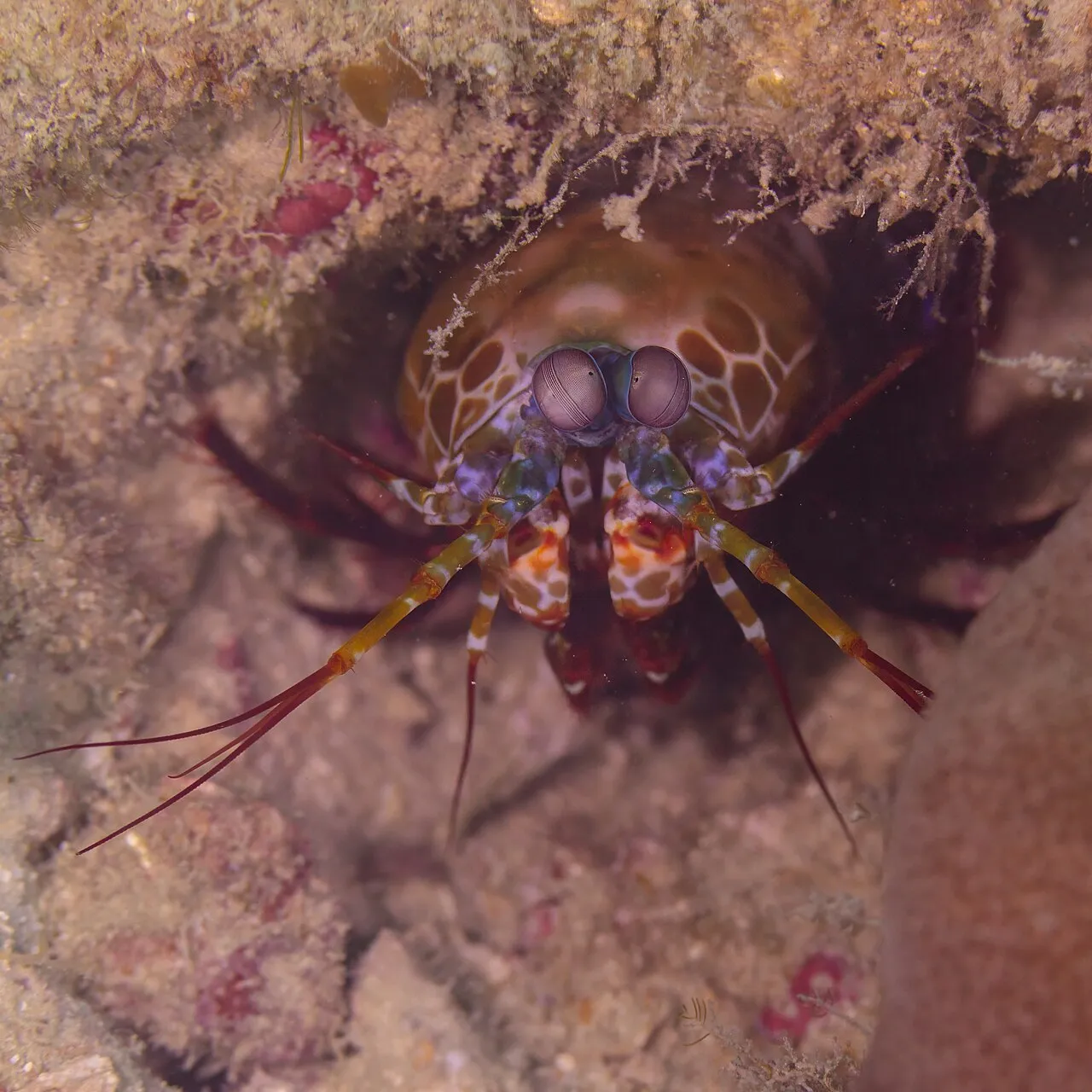
Diego Delso · CC BY-SA 4.0
Despite their weapons, mantis shrimp are small enough to be eaten by groupers, sharks and rays, octopuses, cuttlefish and other large fish. As drifting larvae they face countless plankton predators, and very few survive.
Their key survival strategy is the burrow. They spend most of their time inside or at the entrance and dart in at any sign of danger, sometimes sealing the door with pebbles. Cornered, they fight back with their raptorial limbs and can drive off predators as formidable as octopuses.
The period just after moulting is the most dangerous, since soft bodies and clubs cannot fight or crack prey, so they stay hidden.
11. Relationship with humans
In Korea, mantis shrimp are a springtime delicacy along the west and south coasts. Roe-filled females from April to June are considered best and are sold in coastal markets in Chungcheong, Jeolla and Gyeongsang. They are usually steamed in salted water and snipped open with scissors, but are also eaten raw, grilled, in soups, fried or marinated in soy sauce. Sharp spines on the shell edges and tail require care.
In Japan, boiled shako tops sushi, and in China, Hong Kong and Southeast Asia, mantis shrimp are popular stir-fried with garlic and chilli or deep-fried. In the Mediterranean, the related Squilla mantis is cooked in Italy and elsewhere.
Fishermen find them a nuisance when they damage catches or cut hands. Scientists, by contrast, find them a treasure. Impact-resistant materials inspired by the club are being explored for helmets, body armour, aircraft parts and sports gear, and small robots have been built on the latch-and-spring principle of the punch.
12. Conservation
Most mantis shrimp, including the peacock, have not been evaluated by the IUCN, owing to the large number of species and scarce ecological data. There is no evidence that most species are particularly threatened, but that partly reflects how little we know.
Potential pressures include:
- Coral reef destruction and bleaching, shrinking tropical habitat
- Mudflat reclamation and coastal development affecting Korea's mantis shrimp
- Overfishing and seabed disturbance by trawling
- Ocean acidification, which may affect mineralisation of shells and clubs
- Collection for the aquarium trade, sometimes damaging reefs
Korea's mantis shrimp are harvested steadily as food, with catches varying from year to year. They have no protected status in Korea, though some argue for managing catches during the spawning season.
13. In aquariums
The peacock mantis shrimp is a popular exhibit in public aquariums thanks to its colours and behaviour. It is usually kept alone, since it will eat or attack any fish, shrimp, crab or snail sharing its tank, and it needs plenty of sand and rubble to burrow and rocks to hide among.
Peacock mantis shrimp are also sold in the marine aquarium hobby, but home keeping is discouraged. Large individuals can damage thin glass or acrylic and badly injure hands, and many are wild-caught, adding pressure on reefs. Small mantis shrimp also arrive unintentionally in live rock and become notorious for preying on other tank inhabitants.
Aquarists stress that mantis shrimp can become stressed in bare surroundings and benefit from enrichment such as shell-on food or hidden prey that engages their hunting instincts.
14. Mantis shrimp in culture
Mantis shrimp became famous only fairly recently. In the early 2010s, a web comic by an American cartoonist celebrating their punch and eyes went viral, turning them into internet favourites as the toughest creature in the sea. They have since become staples of documentaries, science videos and memes.
Games and animation feature characters inspired by them, from hard-punching fighters to rainbow-coloured sea monsters, and science talks rarely omit them when listing amazing animal abilities.
In Korea, mantis shrimp belong more to regional food culture than pop culture; banners announcing mantis shrimp season are a familiar sight at west-coast spring festivals and fish markets. In Japan, some towns famous for shako use it as a mascot.
Their colour receptors have inspired artworks and advertising about colours humans cannot see. As noted above, though, claims that mantis shrimp see more colours than we do should be made with care.
15. Trivia
- The punch is too fast for the human eye; only high-speed cameras reveal the movement.
- A peacock's club is rebuilt at each moult, so even a worn club becomes new again.
- Many species are colourful, but colour varies greatly within a species depending on habitat.
- Reef aquarists joke that sudden clicking noises from a tank mean a hidden mantis shrimp is cracking shells.
- Some mantis shrimp produce low rumbling sounds, apparently to advertise territory.
- Cooked mantis shrimp turn red because heat frees the pigment astaxanthin from shell proteins, the same reason shrimp and crabs redden.
- Handle them with care: both the tail-fan spines and the raptorial limbs are sharp.
Wild animals are not pets. Catching, trading or keeping them is illegal in most places. If you find an injured wild animal, call your local wildlife rescue centre.
FAQ
Is a mantis shrimp a shrimp?
No. It shares a class with shrimp but belongs to its own order, Stomatopoda, which split off roughly 400 million years ago.
Can mantis shrimp really break aquarium glass?
Aquarists report large peacock mantis shrimp cracking thin tank glass, and they can injure fingers, so handle them with care.
Do mantis shrimp see more colours than humans?
They have many more receptors, but experiments found them worse than humans at telling similar colours apart; their eyes seem built for speed rather than fine discrimination.
Photo credits
Photos are freely licensed images from Wikimedia Commons. Authors and licenses are listed below.
- Odontodactylus scyllarus Réunion.jpg — Cédric Péneau · CC BY-SA 4.0
- Camarón mantis (Odontodactylus scyllarus), Anilao, Filipinas, 2023-08-24, DD 167.jpg — Diego Delso · CC BY-SA 4.0
- Odontodactylus scyllarus1.jpg — Jens Petersen · CC BY 2.5
- Camarón mantis (Odontodactylus scyllarus), Anilao, Filipinas, 2023-08-24, DD 164.jpg — Diego Delso · CC BY-SA 4.0
- Odontodactylus scyllarus eyes.jpg — Cédric Peneau · CC BY-SA 4.0
- Camarón mantis (Odontodactylus scyllarus), Zanzíbar, Tanzania, 2024-06-01, DD 09.jpg — Diego Delso · CC BY-SA 4.0